Amulet: The Last Council

Amulet, vol. 4
by Kazu Kibuishi
ages: 9+
First sentence: “Who are you playing against?”
Support your local independent bookstore: buy it there!
Others in this series: The Stonekeeper, The Stonekeeper’s Curse, The Cloud Searchers

Emily and her friends and family are on a quest: one to figure out what the stone Emily wears around her neck really means, one to help overthrow the elf king. They’ve found the cloud city, Cielis, where they thought they would find answers. But, instead, there are only more questions. Emily’s friends and family are separated and imprisoned (although the robots, Miskit and Cogsley, find an old, exiled stonekeeper to give us some much-needed backstory) while Emily is taken by the council, and subjected to “testing”: a virtual game in which if you die, you don’t come back.

Things aren’t good in Cielis, and the answers Emily is seeking for aren’t going to be found. Instead, there are just more questions.

I said, after I finished the third book, that I really needed to stop reading this. And yet, when I saw that the fourth one had come out, I went, “OOOOH, AMULET!” and picked it up. And, when I finished this one, I had the same reaction: Kibuishi just isn’t writing/drawing these as fast as I want him to. I want answers! I want to know the rest of the story! I want to know where this is all going! (I couldn’t remember what had happened!) It’s so engrossing, so well-done, amazingly drawn, that I could just get caught up in it, reading until the story is done. Except it’s not there yet.

*sigh* Waiting until the next book comes out.
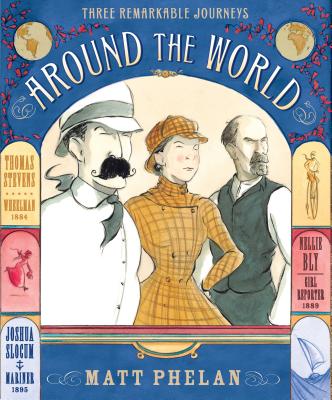
Around the World

by Matt Phelan
ages: 9+
First sentence: “It all began, as many great adventures begin, with a story.”
Support your local independent bookstore: buy it there!

It’s the late 19th century, and the time is ripe for exploration, adventure, new ideas. Over the course of 10 years, three different people, independently of each other, decide to make the voyage in Jules Verne’s Around the World in Eighty Days a reality. Each chooses a different method of transportation, each takes a slightly different route, each has it’s own ups and downs.

Matt Phelan tells these three stories — Thomas Stevens, who traveled around the world on a bike (one of those old-fashioned ones with a big wheel); reporter Nellie Bly, who decided she would beat Verne’s story (and met Verne along the way); and sailore Joshua Slocum, who sailed the world, alone, in a schooner, at age 52 — in graphic novel form, simplifying them for his intended audience, and yet making them highly entertaining. I found myself interested in the stories and lives of these three, which is something that I didn’t expect to be.
 Out of the three stories, I found Thomas Stevens’ to be the most interesting. Around the world on a bike? Fascinating. But beyond the coolness of his traveling method, I thought Phelan’s art lent itself best to Stevens’ story. Nellie Bly’s worked okay, though I think a lot of the excitement and frustration she experienced were lost in the graphic novel form. And I didn’t follow Joshua Slocum’s story well at all. Perhaps that’s because as the stories went on, Phelan got more and more introspective, and it just wasn’t as interesting to me.  Or, perhaps I just suffered from the opposite: because it was a graphic novel, even though the art was grand, I felt like I was missing chunks of the story; I wanted more words, to fully understand what was going on.

But, overall, I’m glad I read it. It’s a good introduction to three little-known people who dared to adventure.

Anya’s Ghost

by Vera Brosgol
ages: 14+
First sentence: “What’s for breakfast?”
Support your local independent bookstore: buy it there!

When you pickup a graphic novel that has a blurb from Neil Gaiman on the front (“A Masterpiece!”) and has been getting a lot of buzz, you invariably have high expectations.

And in many ways this graphic novel lived up to my expectations. Dealing with issues of inclusion, it tells the story of teenage Russian immigrant Anya Borzakovskaya, . Sure, she’s been here since she’s 5, and sure, she doesn’t have much of an accent, but she does have the baggage that many children of immigrants have: parents who can’t speak English well, traditions that are held over from the old country, a funny last name that she’s embarrassed about. She’s struggling at her private school; her mom wants her to be friends with the other Russian kid, Dima, who’s just the world’s biggest nerd. All she wants to do is skip and hang out with her one friend, Siobhan, and smoke.

Then she falls down a hole and meets a ghost. Not just any ghost, but one that wants to stay with Anya, and help her, and experience life. Creepy, no?

Well, yes. It’s a ghost story after all. Which is what disappointed me. I wanted more creepyness. I wanted to be scared out of my skin, and while I got a little bit of my wish near the end, I was disappointed that it wasn’t as scary as, say, Coraline.

That’s not to say it doesn’t work: it does, as one of those good-girl-at-heart-finds-her-way-back-into-the-fold books. Just not as a ghost story.

At least, not for me.

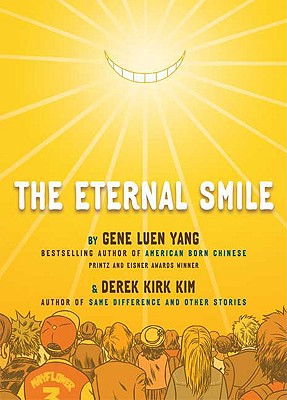
The Eternal Smile: Three Stories

by Gene Luen Yang and Derek Kirk Kim
ages: 13+
Support your local independent bookstore: buy it there!

It seems a little strange to say that something called “The Eternal Smile” made me feel melancholy, but it did.

The book is three short stories, beautifully drawn, all muse upon the themes of belonging and purpose. They weren’t sad, exactly, and you can’t say they didn’t have happy endings, because they did. But they were bittersweet, edged with longing. Enough to make me melancholy.

I’m not quite sure which author wrote which story (or if they both wrote all three), since they drawing style for each one was so drastically different. That said, the art fit the stories perfectly. The first one, at first glance, seems to be a fantasy hero story: the downtrodden guy fights incredible odds (or in this case, revenge upon the king’s death by killing the frog king), only to find out that things aren’t exactly as they seem. The art is dark and brooding; it’s easy to sense that the end won’t be pretty.

The second story features animals: a greedy frog, who all he wants to do is get enough cash so he can put it in a barrel, dive in and never hit bottom; his toady (I think literally); and his two granddaughters. They come up with a scheme, based on this smile that the toady sees, and develop a religion based on it. Of course there’s more to it; it turns out that the story is nothing more than a children’s show. It’s a delightful poke at mega-churches, reality TV, and people who don’t have the backbone to say what they really think in the face of powerful people. And the art is bright and cheery, which perfectly juxtaposes the deeper, darker story.

The last story is the most heartbreaking, I think. It’s about a mousey woman, working in a cubicle for some large corporation. She wants a raise, and (of course) her boss deflects her and then laughs behind her back. Then she answers one of those “dear lovely, can you send $1,000,000 to help my family in Nigeria” emails. From there, they begin corresponding, and she imagines a whole story surrounding this mysterious African prince. Of course, things don’t work out, by any stretch of the imagination. The art is in shades of gray, the characters cartoonish, childish, which drives the somber point home more.

The one thing these stories do have, even with their melancholy, is that they make you think. About how things don’t always go as we planned. And that even so-called losers have dreams and aspirations. And how there is always hope, even in the face of hopelessness.

Which left me smiling, in the end.

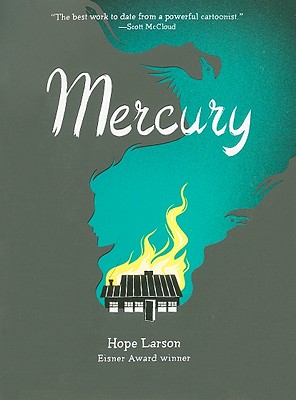
Mercury

by Hope Larson
ages: 12+
First sentence: “Hi, house.” (Though, admittedly, there are eight pages of pictures before that sentence.”)
Support your local independent bookstore: buy it there!

There are two stories going on here, both take place in a small town in Novia Scotia. One involves 16 year old Tara whose old family farm house has just burned down. Her mother is off to Alberta to look for work, and Tara is back in her old town (before they moved to the farmhouse, after her parents’ divorce) living with her aunt, uncle and cousin. She’s trying to adjust to a new life, and it doesn’t help that her mom wants to move to Edmonton.

The other story takes place 150 years ago: Josey is living in the farm house (the same one that burned down; you realize as the story unfolds that Josey and Tara are related), living her life. Her mother isn’t the most compassionate person, and her father isn’t the best farmer, but they’re making do. That is, until Asa Curry comes into their lives. He offers Josey’s father a way to get rich quick: there’s ore under the farmlands, and they can mine for gold. Things seem to be going well; Josey, at least, knows that she really likes Asa. But unfortunately, what is gold is not always good.

It’s an intriguing tale Larson is telling here, one that works well for the medium that it’s in. Sometimes I’m impressed how much can be “said” in a picture, how much one little frame can convey that would take pages and pages of prose to get across. I’m also impressed that something like magical realism, which bothers me in prose, I can accept and go with in a graphic novel. It’s a smattering of magic, something so innocuous that it shouldn’t really matter to the plot. And yet, it does.

It’s a good story as well: there’s heartache and loss and hope. My only question is wondering what Mercury has to do with the story. I missed that somehow.

That said, I’m going to be reading more of Larson’s work.

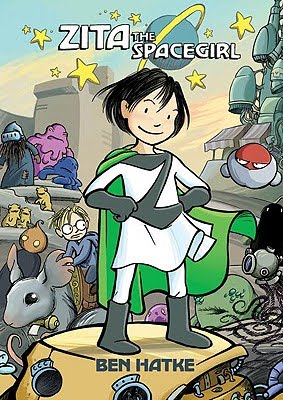
Zita the Spacegirl

by Ben Hatke
ages: 9+ (though I read it aloud to my 5 year old)
First sentence: “Finders keepers!”
Support your local independent bookstore: buy it there!

What kid doesn’t want to go on an adventure? Excitement! Different worlds! Being the hero!

I’m not sure if Zita ever felt that way, but she got thrown into it one day, when she and her friend Joseph discovered a device with a button. Zita must be one of those curious types: she pushed the button… which opened a portal, and both she and Joseph got pulled through.

And thus the adventure begins. Joseph gets captured by an evil-looking tentacled beast, and Zita goes after him to save him. While he’s been tied up by the Scriptorians (on this unnamed planet), being expected to save the world from certain doom — an asteroid is headed their way — Zita experiences the world, meeting all kinds of unusual friends: a giant mouse, a robot named One who has delusions of grandeur; a nervous robot named Robby, who’s been hiding in the wastes; a beast named Strong Strong; and a man with magical tools named Piper. All who help her get to the Scriptorians’ castle to rescue Joseph.

It’s quite the adventure, one with clever drawings and story. It’s funny and sweet and adventurous. We couldn’t get enough of it; my girls and I were completely captivated are already clamoring for the next installment.

You can’t get better than that, I think.

Olympians, the Graphic Novels

by George O’Connor
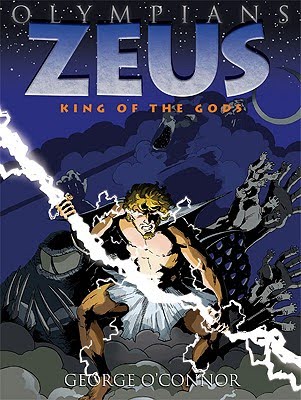
Zeus: King of the Gods
First sentence: “In the time before time, there was nothing, Kaos.”
Support your local independent bookstore: buy it there!

Athena: Grey-Eyed Goddess
First sentence: “My sisters and I are the Moirae, also known as the Fates.”
Support your local independent bookstore: buy it there!

I don’t remember where I saw these two reviewed, but it sounded like an interesting approach to the stories of Greek mythology. So, as part of the Once Upon a Time challenge, I thought I’d give them a try.

To start with, these are beautifully drawn books. O’Connor imagines the gods in a way that’s both human and divine. They are larger than life — especially the Titans — but also very accessible. Zeus tells the story of the Titans, and Kronos (and I still can’t type these names without thinking of Percy Jackson!) as well as how Zeus came to be. The books aren’t interested in thinking about motivation of why they do things. It’s just the Gods, and they do things because they do.

Athena was the more interesting of the two books, however. Perhaps because Athena’s story is more interesting than Zeus’s? The book is framed as the Fates telling stories about Athena, including her origin story, which was fascinating (okay, it’s not one that I knew), as well as one about her fight with Pallas, the Aegis that she wears, and her quarrel with Arachne. No book on Athena would be complete without the Perseus and Medusa story, as well. The stories succinct without being choppy, and while it doesn’t give Athena a well-rounded personality, it does explain many of her different personality traits.

Perhaps the most interesting thing about the books are the fact sheets at the back. They tell, playing card style, facts about the gods (which day of the week, which planet, Greek and Roman names, etc.). Fascinating stuff. O’Connor also provides a reading list, places to go to find out more information about the gods as well as Greek and Roman culture.

Well worth the time.

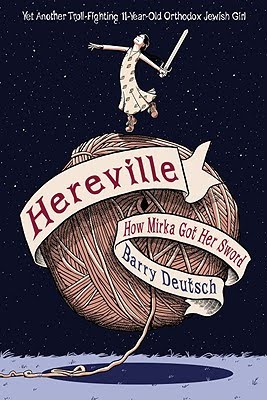
Hereville: How Mirka Got Her Sword

by Barry Deutsch
ages: 11+
First sentence: “Mirka liked her stepmother, Fruma, well enough.”
Support your local independent bookstore: buy it there!

This book, hands down, has the best tagline: “Yet another troll-fighting 11-year-old Orthodox Jewish girl.” How can you resist that?

Hereville is a town, the where is not really important, that is pretty much secluded from the outside world. Mirka lives there with her father, stepmother, and brothers and sisters (both blood and step). Life is pretty ordinary: she goes to school, her stepmother tries to teach her how to knit, her sisters worry about getting married, her brother deals with the neighborhood bullies. But, Mirka is a bit different than the others: she sneaks in non-Jewish books (how she gets them, I don’t know) which are banned, pouring over the ones about swordfighting and killing dragons, especially. Her dream? To get a sword and fight dragons.

This is not exactly feasible for an 11 year old Orthodox Jewish girl. That is, until Mirka finds a witch in the forest and has a run-in with the witch’s pig. In a brilliant bit of art and storytelling, Mirka goes through the trial, beating the pig. In the end, she’s rewarded by the witch with the location of a troll who has a sword. Even though, when she asks Fruma about how to defeat trolls, Mirka’s forbidden from seeking the troll, she goes, she confronts everything, and — no secret since it’s in the title — gets her sword. But there’s a cost; there always is.

You wouldn’t think it could be done, but the book deftly combines fantasy with a peek into the world of Orthodox Judaism. The book is littered with Yiddish words, and the section on Shabbos was poetic. It’s a good start to a series — hopefully it is a series, since I’m quite curious to know what Mirka’s going to do with her sword now she’s got it — with a unique premise. And you can’t get much better than that.

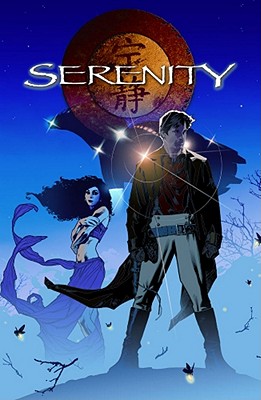
Serenity: The Graphic Novel

by Joss Whedon, Brett Matthews, Will Conrad
ages: adult
vol 1: Those Left Behind
First sentence: “And so I say to you on this fine day, citizens of Constance, that your lives are not defined by that with which you enter this world, but rather with what you leave behind on it.”
Support your local independent bookstore, buy it there!

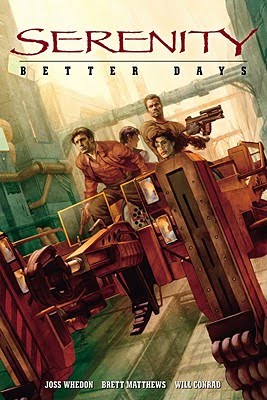
vol 2: Better Times
First sentence: “I don’t like speeches.”
Support your local independent bookstore: buy it there!

I saw these over at The Written World, and since I was feeling a bit on a Nathan Fillion kick, I picked them up. (Yes, I do like the show because of him. Or maybe I like him because of the show?) I am shameless sometimes. (Yes, I have also caved into curiosity and am reading Heat Wave.)

The graphic novels pick up the world in the time period after the series ended but before the movie Serenity. (That will only make sense to fans.) They’re basically episodes in graphic novel form, something which I simultaneously found entertaining and irritating. Entertaining, because it’s always nice to visit with old “friends”, characters one loves. Irritating because I wasn’ really sure what was going on the whole time; it was a bit confusing in its storytelling. Oh, sure, I think I caught the general arc, but I’m just not a skilled enough graphics novel reader to really capture the whole essence of it all. And, in spite of the drawings looking amazingly like the actors, I missed the actors. You didn’t get Jayne’s sardonic inflection, Mal’s snarky smile. Little things — like intonation and inflection — that make acting a storyline out so much better.

That said, I adored the introduction in the first one by Nathan Fillion. (The second’s introduction was written by Adam Baldwin, and was highly entertaining as well.) Anyway, Nathan wrote about his love of comic books as a kid and how Mal was his favorite role, thanking Joss Whedon for making him, and all of them really, a superhero. That, at least, was very cool stuff.

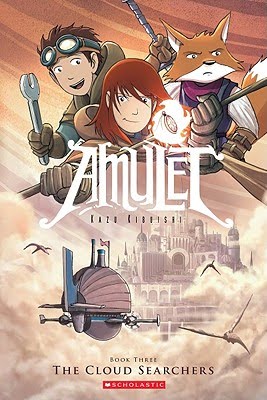
The Cloud Searchers

Amulet, vol. 3
by Kazu Kibuishi
ages: 10+
First sentence: “Luger.”
Support your local independent bookstore: buy it there!

Picking up where we left off, our fearless crew, including Emily, her brother, mother, and assorted robots and guards are off to find the lost city of Cielis, in order to find the Guardian Council to help them overthrow the Elf king. Along the way, they pick up two elf renegades: one just happens to be the elf prince. Emily (and the rest) don’t really trust them, but they also don’t have a choice. And when darker forces come calling, it’s probably a good thing to have all the help you can get.

This book is still just as lovely and as exciting as the first two, but I’m starting to forget the train of the story from one book to the next. Which really isn’t Kibushi’s fault; I’m terrible at remembering things. But, that said, I’m wondering if it wouldn’t be wise to put off reading the rest of this (albeit great) series until the whole story is completed. Because, especially with this one, each book isn’t telling it’s own individual story, being rather a piece in the whole puzzle. And while the puzzle itself is intriguing, it’s not going forward fast enough for my brain to retain the pieces.

Which means I’ll have to get back to the series later.