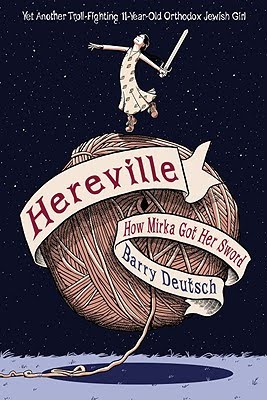
Hereville: How Mirka Got Her Sword

by Barry Deutsch
ages: 11+
First sentence: “Mirka liked her stepmother, Fruma, well enough.”
Support your local independent bookstore: buy it there!

This book, hands down, has the best tagline: “Yet another troll-fighting 11-year-old Orthodox Jewish girl.” How can you resist that?

Hereville is a town, the where is not really important, that is pretty much secluded from the outside world. Mirka lives there with her father, stepmother, and brothers and sisters (both blood and step). Life is pretty ordinary: she goes to school, her stepmother tries to teach her how to knit, her sisters worry about getting married, her brother deals with the neighborhood bullies. But, Mirka is a bit different than the others: she sneaks in non-Jewish books (how she gets them, I don’t know) which are banned, pouring over the ones about swordfighting and killing dragons, especially. Her dream? To get a sword and fight dragons.

This is not exactly feasible for an 11 year old Orthodox Jewish girl. That is, until Mirka finds a witch in the forest and has a run-in with the witch’s pig. In a brilliant bit of art and storytelling, Mirka goes through the trial, beating the pig. In the end, she’s rewarded by the witch with the location of a troll who has a sword. Even though, when she asks Fruma about how to defeat trolls, Mirka’s forbidden from seeking the troll, she goes, she confronts everything, and — no secret since it’s in the title — gets her sword. But there’s a cost; there always is.

You wouldn’t think it could be done, but the book deftly combines fantasy with a peek into the world of Orthodox Judaism. The book is littered with Yiddish words, and the section on Shabbos was poetic. It’s a good start to a series — hopefully it is a series, since I’m quite curious to know what Mirka’s going to do with her sword now she’s got it — with a unique premise. And you can’t get much better than that.

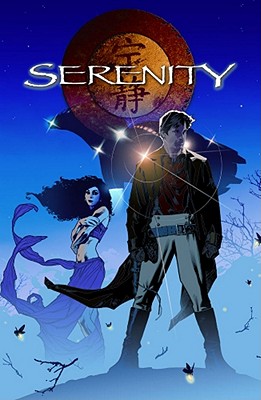
Serenity: The Graphic Novel

by Joss Whedon, Brett Matthews, Will Conrad
ages: adult
vol 1: Those Left Behind
First sentence: “And so I say to you on this fine day, citizens of Constance, that your lives are not defined by that with which you enter this world, but rather with what you leave behind on it.”
Support your local independent bookstore, buy it there!

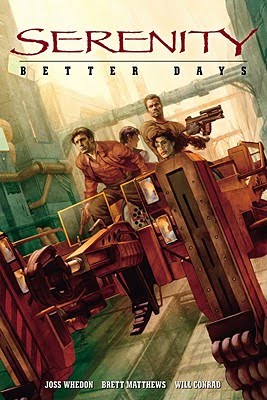
vol 2: Better Times
First sentence: “I don’t like speeches.”
Support your local independent bookstore: buy it there!

I saw these over at The Written World, and since I was feeling a bit on a Nathan Fillion kick, I picked them up. (Yes, I do like the show because of him. Or maybe I like him because of the show?) I am shameless sometimes. (Yes, I have also caved into curiosity and am reading Heat Wave.)

The graphic novels pick up the world in the time period after the series ended but before the movie Serenity. (That will only make sense to fans.) They’re basically episodes in graphic novel form, something which I simultaneously found entertaining and irritating. Entertaining, because it’s always nice to visit with old “friends”, characters one loves. Irritating because I wasn’ really sure what was going on the whole time; it was a bit confusing in its storytelling. Oh, sure, I think I caught the general arc, but I’m just not a skilled enough graphics novel reader to really capture the whole essence of it all. And, in spite of the drawings looking amazingly like the actors, I missed the actors. You didn’t get Jayne’s sardonic inflection, Mal’s snarky smile. Little things — like intonation and inflection — that make acting a storyline out so much better.

That said, I adored the introduction in the first one by Nathan Fillion. (The second’s introduction was written by Adam Baldwin, and was highly entertaining as well.) Anyway, Nathan wrote about his love of comic books as a kid and how Mal was his favorite role, thanking Joss Whedon for making him, and all of them really, a superhero. That, at least, was very cool stuff.

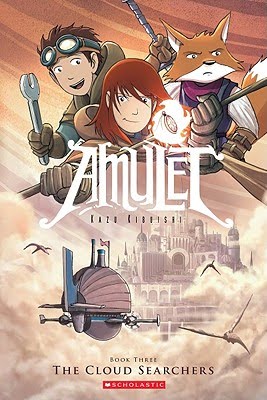
The Cloud Searchers

Amulet, vol. 3
by Kazu Kibuishi
ages: 10+
First sentence: “Luger.”
Support your local independent bookstore: buy it there!

Picking up where we left off, our fearless crew, including Emily, her brother, mother, and assorted robots and guards are off to find the lost city of Cielis, in order to find the Guardian Council to help them overthrow the Elf king. Along the way, they pick up two elf renegades: one just happens to be the elf prince. Emily (and the rest) don’t really trust them, but they also don’t have a choice. And when darker forces come calling, it’s probably a good thing to have all the help you can get.

This book is still just as lovely and as exciting as the first two, but I’m starting to forget the train of the story from one book to the next. Which really isn’t Kibushi’s fault; I’m terrible at remembering things. But, that said, I’m wondering if it wouldn’t be wise to put off reading the rest of this (albeit great) series until the whole story is completed. Because, especially with this one, each book isn’t telling it’s own individual story, being rather a piece in the whole puzzle. And while the puzzle itself is intriguing, it’s not going forward fast enough for my brain to retain the pieces.

Which means I’ll have to get back to the series later.

Jellaby

by Kean Soo
ages: 9+
Support your local independent bookstore: buy it there!

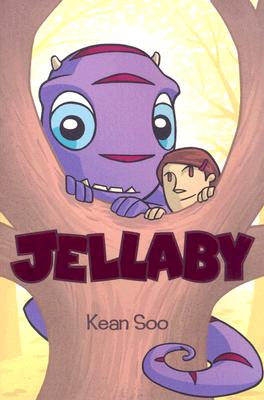
This monster, this book, is very cute. I fell in love with Jellaby (it’s the monster on the cover) as soon as it appeared in the book. It’s charming, it’s cute in a monsterish sort of way, and made me want to wrap it up and put it in my pocket.

It’s just the beginning of a story — I need to find the next part; I want to know what happens! — but it’s a good beginning. Portia is a girl who’s father is missing (did he die? did he disappear?), and she’s not adapting to that well. She’s struggling in school, her mother leaves her alone a lot. And then she finds Jellaby. It’s a friend (she makes another friend in the bullied kid, Jason Tham), someone to keep her company. And then, by random chance, she discovers that Jellaby is a lost soul, too. Together her and Jason concoct a plan to get Jellaby back to his home.

That plan is just put in motion in this book. It’s really mostly background and set up, though it’s done incredibly well. There’s something deep going on in the book, even if I can’t quite figure out what it is. Which means, I’m definitely curious as to where the story is going, and the adventures Portia, Jason and Jellaby will have.

Joey Fly, Private Eye in Big Hairy Drama

by Aaron Reynolds/Illus. by Neil Numberman
ages: 9+
First sentence: “Life in the bug city.”
Support your local independent bookstore: buy it there!
Review copy sent by the author

Joey Fly and his sidekick, Sammy Stingtail are on the case. Again. This time, a big-time (and big) theater owner is asking him to find his main star, the four-winged, long-legged Greta Divawing. Joey and Sammy are up to it of course (they’re up to anything). It’s just a matter of tracking down the bug who did it.

The question is: which bug would that be?

This book is much like the first in the series: smart and fun and interesting. It’s well-written and funny, and has elements that will appeal to both boys and girls (mine were very excited to see it when it came in the mail!). The story has some great twists and turns, plus sliding a bit of educational information in there. There’s a little bit for everyone, but nothing feels shortchanged or slighted. And visually, it’s quite engrossing: it’s worth stopping and poring over the frames to find all the little things Numberman has hidden in there.

In short, it’s a great little series.

As an added bonus, the author/illustrator are offering up these ornaments to print off and cut out. Click to embiggen, and enjoy!

Jane Eyre: The Graphic Novel

by Charlotte Bronte/Adapted by Amy Corzine
ages: 12+
First sentence: “Now that typhus has felled both my sister and her husband, we must look after their child.”
Support your local independent bookstore: buy it there!

I read Jane Eyre a couple of years ago, and found that I really enjoyed it. So, when my in person book group decided to read it for this month’s book, I figured I’d give the graphic novel a try, just to see how it held up.

And while I found that the pictures were a poor substitute for the narration, I really quite enjoyed it.

The drawings were easy enough to follow, and the book was stripped down to it’s basic elements: Jane’s perseverance and the love story with Mr. Rochester. It’s not a bad thing to have the book taken down to those bare elements; in fact it makes them shine by putting them in center stage. The ending, after she finds Mr. Rochester again, was quite poignant.

It’s a good introduction to the classic, however I wonder if by doing it this way, too many people will read the graphic novel and think that they don’t need to go read the book now. And that would be a shame.

Manga Shakespeare: A Midsummer Night’s Dream

by William Shakespeare/drawn by Kate Brown
ages: adult
First sentence: “Now, fair Hippolyta, our nuptial hour draws on apace.”
Support your local independent bookstore: buy it there!

I decided to take a little break from fantasy novels and read this… fantasy play. Actually, C was looking through and pointed out that it’s essentially the worlds first chick flick. Very true. Romance, silliness, and everyone gets the guy in the end.

My opinion hasn’t changed in the three years since I read it last. It’s all a bunch of silliness. Oberon’s a bit of a jerk (in fact, most of the men are). It’s still better seen, rather than read, but reading it in Manga form was fun. The drawings were interesting — a cross between ancient Greece and modern (they were wearing togas AND ties). It was a little disconcerting: it’d have been nice if Brown had decided which to choose. But on the other hand, it worked with the silliness of the play; it was almost if they couldn’t decide what on earth to do with themselves. But, it wasn’t too distracting. I did wish it were in color, though. But that’s just me.

Not as good as seeing the play, but it works. I’m finding I like Manga Shakespeare. It’s a good way to access the plays.

French Milk

by Lucy Knisley
ages: 16+
First sentence: “My last night in Chicago for six weeks, and unseasonably warm for December.”
Support your local independent bookstore: buy it there!

This slim travel memoir/graphic novel is about Lucy’s trip to Paris with her mother the semester before she graduates from college. It’s very much a young adult book; Lucy’s trying to figure out her future, dealing with rejections and insecurities about what path to take, and so it, at times, becomes highly angst-ridden. The book is best the times when Lucy lets her ego go, and she sits back and enjoys what Paris has to offer. The food! The art! The architecture! The history! The people!

The trip is in January, and so the book has a very winter feel. But even with that, it’s a joyful experience. Told through drawings and pictures, Lucy captures Paris in a way I’ve never read before. The only thing it lacked, I think, was a sense of smell. I saw what she saw, I felt what she felt, but I wanted to smell it all as well. It was a touristy book, but she also went off the beaten path, discovering shops and markets and museums that your average tourist wouldn’t have the time. (In other words: I’d love to have the opportunity to be this kind of tourist!)

Mostly, though, what this book made me do is long to be in Europe again. The pace of life, the sensibilities, the food… I’m just a European at heart, I guess. And this book tapped into that for me. And I really enjoyed that.

Amulet

by Kazu Kibuishi
Vol 1: The Stonekeeper
First Sentence: “We were supposed to pick up Navin at eight o’clock. We’re late”
Support your local independent bookstore: buy it there!

Vol 2: The Stonekeeper’s Curse
First sentence: “Let go of me. I don’t want to see him.”
Support your local independent bookstore: buy it there!

First off, I read this one backwards, and got Volume 2 first. While it works okay as a stand-alone, I highly recommend getting Volume 1 first and reading them in order. It makes much more sense that way.

After the car accident that kills their father, Emily, her brother Navin move with their mother out to the woods, into the country house owned by their mother’s Grandfather Silas. It doesn’t seem like anything exciting, until on their first night they are lured into the basement by a strange noise. Which turns out to belong to a strange beast that kidnaps their mother. Emily and Navin follow twists and turns, aided by a strange necklace that Emily found in the house, discovering the strange new world below.

In the second book, the story continues: Emily’s mother has been poisoned, and it turns out that the evil Elf King is out to get Emily. In search of an antidote for her mother, Emily takes on the elves as well as fighting the overpowering influence of the stone. She meets a guide, and learns that there is an underground resistance, which Navin happily joins, to overthrow the king. What her part in all of this, and whether or not she can save her mother, remains to be seen.

Yeah, it’s all a bit Star Wars and Lord of the Rings (C, who also read them even noticed the similarities), but it’s gorgeously drawn, and a rollicking adventure. The world is creative, combining both fantasy elements — like the powers of the stone — with technology — Emily and Navin are accompanied in their endeavors by a collection of robots, ranging from the crotchety to the overly-sensitive. Emily’s personal bodyguard is a pink bunny robot named Miskit, which I found to be highly amusing. It’s well-paced; there’s always something to keep the pages turning. All of which makes me curious for the next installment.

A great addition to middle grade graphic novels.

The Storm in the Barn

by Matt Phelan
ages: 11+
First sentence: “The dust can have it.”
Support your local independent bookstore: buy it there!

I don’t quite know what to say about this one. I picked it up because of SLJ’s Battle of the Kids Books, but I’m not sure what I expected. First off, it’s gorgeously drawn. I do love the mood it evokes: the browns and blues of the Dust Bowl. There are subtle things too, like a raised eyebrow, or a simple tear that make this book just beautiful to look at. Almost like I was looking at timeless photographs.

That and it references Ozma of Oz (well, it is set in Kansas, after all), which is nice. Alluding to the desert that Dorothy has to cross and the hardships she goes through to get back to Oz make a nice parallel to the story of our 11-year-old hero, Jack, as he deals with the trials of the Dust Bowl, and learns to face his fears about what just might be in the neighbor’s barn.

But.

I’m not sure I quite got the story. There’s a mythical element to it, a larger-than-life aspect that just didn’t sit well. There were parts that confused me, and I had to go back and reread (relook?) at them a few times in order to make sense. It’s told mostly through pictures; there’s very little dialogue, and I’m afraid I missed elements that would have made the story more cohesive. For me. But, this was not really a pouring over book; there weren’t little details that made me want to linger over the individual pictures. It wanted to propel itself forward; I always felt a little annoyed when I had to turn back and reread a section.