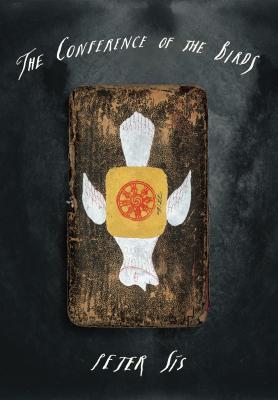
The Conference of the Birds

by Peter Sis
First sentence: “
Support your local independent bookstore: buy it there!
Content: There’s nothing. I found it in the kids poetry section, but it’s more an adult poem; something to ruminate on. So I moved it to the adult poetry section.

So, I blame Books on the Nightstand bingo for this. I started my card back in May, and the one I ended up with has a square for “written for adults but with illustrations”. I had no idea what to do with that. Then, we got a competition of sorts going at work (we all have bingo cards going and the first one to blackout wins… something), and I was doing inventory in my sections (the kids books are basically my fiefdom. Seriously. I have had  many coworkers tell me they just “don’t mess with Melissa’s sections”.) and discovered this book. It’s not a children’s book, so it fits the bill: adult book, with illustrations (but not a graphic novel).

Bascially, it’s an adaptation of a 12th-century Sufi poem, about an epic flight of birds, who fly through thick and thin, through days, through the deepest despair, in order to find their True King, Simorgh. You can pretty much sense the allegory dripping off of this poem (Deeper Meaning for my mother). And I’ll admit: I needed to read this poem this week. It gave me the reminder that I can get through all the valleys of my life, and maybe there will be fulfillment in it all.

But, what I truly loved was Peter Sis’s art. The book itself is gorgeous: thick pages, that are just luxurious to touch (and should be, with such a high price for a slim book). And the paintings were done in muted earth tones, with layers of depth to them (at least to my untrained eye). It’s a book I could imagine going back to when I just wanted to page through something lovely.

It’s not something I ever would have picked up on my own, so I’m grateful for the extra push from the bingo game. Sometimes getting outside of your comfort zone is a good thing.

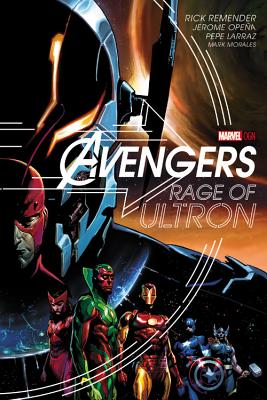
Avengers: Rage of Ultron

by Rick Remender, Jerome Opena, Pepe Larraz, Mark Morales
Support your local independent bookstore: buy it there!
Content: It’s geared toward adults, but I could see a teen who was interested in the Avengers being okay with reading this. It’s in the Graphic Novel section of the bookstore.

I am running a Graphic Novel book group for teens (really, for whomever comes) this summer, and I wanted a Marvel Avengers one to start the group off (because of the movie). I did a lot of asking and digging to figure out if there was a stand-alone that those who aren’t into the universe (read: me) and who have only seen the movies (again: me) could understand. In the end, I settled on this one.

And on many levels I was right: it was a stand-alone (mostly; the ending was a bit ambiguous) and it gave me enough information to understand the story on its own terms, even if I didn’t know how it fit into the larger Marvel universe.

But: these are not your movie Avengers. And that was the biggest hurdle for me.

It’s a similar story to Age of Ultron: a robot was created by Hank Pym, and then when homicidal, deciding that humanity was worthless and needed to be exterminated. One of my favorite panels in this GN was the opening one: a “voice over” (what does one call it when it’s in book form?) of Ultron declaring humanity worthless while Captain America rushes around saving people from Ultron’s destruction. It’s intense and nicely done.

The Avengers beat Ultron, of course, and send him out into space. Then the story fast-forwards to sometime in the future, where Ultron has taken over the moon of Titan, enslaving the people there, and Starfox (Hubby had to explain about the Titans; good thing I have him around) comes back to a new group of Avengers, who are arguing about whether or not Artificial Intelligence counts as “life”. Some, like The Vision, argue that it is; that turning them “off” is tantamount to killing them. But AI like Ultron prove Pym’s point: they can’t be trusted. (I actually really liked the whole discussion of artificial intelligence and found it fascinating.) Ultron follows Starfox back and starts a big fight, one that eventually consumes all of the Avengers.

What I found most interesting were the underlying themes running through the GN: should AI be considered alive and be granted the same rights? To what point should the creator be responsible if the AI goes, well, crazy? I found it interesting that Pym called Ultron his “son” and felt, ultimately, responsible for Ultron’s actions, though I think he took it a bit too far.

The art was fantastic, with strong lines and bold colors. And there were some panels — the one I’ve mentioned at the beginning as well as one near the end of the book — that were simply amazing.

I don’t know if this is going to catapult me into reading other Avengers (or Marvel, aside from Ms. Marvel) GNs, but I really did enjoy reading this one.

Dragons Beware!

by Rafael Rosado and Jorge Aguirre
Support your local independent bookstore: buy it there!
Others in the series: Giants Beware!
Content: There’s nothing that a capable third grader couldn’t handle, and I would have willingly read this aloud to a second- or first-grader. It’s in the Middle Grade Graphic Novel section of the bookstore.

There are a few graphic novels that my girls — especially K — will go to over and over and over again, thoroughly immersing themselves in the story each time. Giants Beware! is one of them, and so when I brought home the sequel every single one of my girls was super excited. (K wins, though. She practically grabbed the book out of my hands and ran off to read it.)

And none of us were disappointed with the story line. After “slaying” the giant, Claudette, Gaston, and Marie have basically gone back to their lives. However, things have changed: Claudette is still trying to prove herself to her father and is living it up as a hero in Mount Petit Pierre. Marie has been locked in a tower by her mother, her princess lessons intensified, with a camp of foppish princes at the base. And Gaston (who my heart went out to) decided to give up his love, cooking, and try to be more like his father and sister, determined to be a warrior and a blacksmith.

Then ?, the wizard, escapes from his prison, and heads toward Mount Petit Pierre, bent on revenge. Claudette and Gaston’s dad takes off for ? to get his sword back from the dragon ?. And, of course, Claudette, Gaston, and Marie follow him.

A quick aside: one of the running themes throughout the book is that it’s really quite impossible to do something on your own. EVERYONE (well, maybe except Gaston and Marie) in this book starts off thinking that they need to protect everyone else and just do things on their own. But, in the end, it’s only together that they succeed. I loved that.

Of course, there are adventures on the way. I don’t think you need to have read Giants Beware (though why haven’t you??) before you read this one, but it is better if you do know the story, if only to get the little illusions dropped throughout the book. I love how it’s paced, with epic battle scenes at the end, and everyone playing a different role. Which is something else I loved: Gaston finally stops trying to be what he thinks he “should” be and embraces his passion. Marie is awesome in her own way: she’s not a warrior, but without her, they wouldn’t have succeeded. And Claudette learns patience and a willingness to work with others. They’re all better off for their adventure.

It was an absolutely delightful read. Hopefully, there will be more!

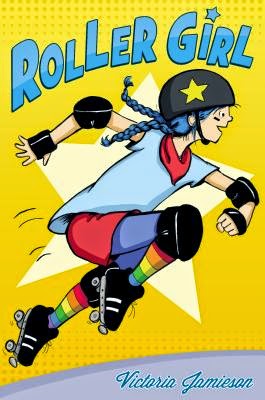
Roller Girl

by Victoria Jamieson
Support your local independent bookstore: buy it there!
Content: It’s in the middle grade graphic novel section.

It’s the summer before sixth grade — middle school (gulp!) — and Astrid has things all Planned Out. She and her BFF, Nicole are going to hang out, go to derby camp, and have tons of fun!

Except. That’s not the way things happen. Nicole is off to dance camp, and is becoming someone Astrid can’t even relate to. And derby camp, well, let’s just say it’s a LOT harder than Astrid ever figured it’d be.

I picked this one up for K a while back, who really enjoyed it. But had some issues with it, especially with the friendship element. Why do things this happen, she wondered. It spawned a discussion about friends and change, and trying new things. So, I needed to see what it all was about.

And I loved it. I loved that Astrid was who she was, and while she changed — she realized that she was being a bit self-centered and not a very good friend — she still remained the same person she always was. I liked that it showed that things can pay off when you work hard at something. And that sometimes, it’s okay when other people take the spotlight. The drawing’s fun and colorful, and I love that Astrid is (at least) half-Puetro Rican.

It’s a sold graphic novel, and one that I know kids will love. (K did!)

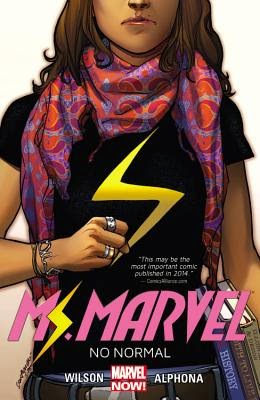
Ms. Marvel, Volume 1: No Normal

by G. Willow Wilson and Adrian Alphona
Support your local independent bookstore: buy it there!
Content: There’s some talk of teen drinking and some violence, but I’d hand it to anyone who loves superheroes and is willing to sit through the Avengers movie. It’s in the adult graphic novel section, but I wonder if it’d get more traction in the teen?

I’m sold. Seriously. I’ve heard the buzz (thanks to Leila and others) and I caved, and THEY WERE RIGHT. It’s worth it: you should read it.

(Do I need to say more?)

Kamala Kahn is a 16-year-old daughter of Pakistani immigrants, and she’s basically chafing against her life. She doesn’t like being Muslim. She doesn’t like having overprotective parents. She doesn’t like not being “pretty” and “blonde”. And so when Captain Marvel appears to Kamala (after a party she snuck out to) and gives Kamala an opportunity to reboot her life, Kamala wishes to be like Captain Marvel. Her wish is granted: she has super-powers. (And is tall and blonde.) Eventually, she figures out that the tall and blonde and “non-politically correct” costume isn’t all it’s cracked up to be. She accepts that she — Ms. Marvel, as she dubs herself — is Pakistani and goes with it, embracing (albeit reluctantly) her new superpowers.

Why did I love it? First: it’s a Pakistani girl superhero! She’s Muslim, and while she chafes against her parents’ rules, she’s faithful, which I appreciated. Which also means she’s a character of color: not all superheroes need to be white. (Or drawn with super-skimpy costumes, so yay for that as well.) But it’s more than that: Kamala is smart and funny, and the writing and art reflect that. I loved Kamala’s ordinary-ness, and her devotion to her friends (and parents), and her struggle to figure out what all this means and to accept who she is.

It’s completely worth the buzz. Fantastic.

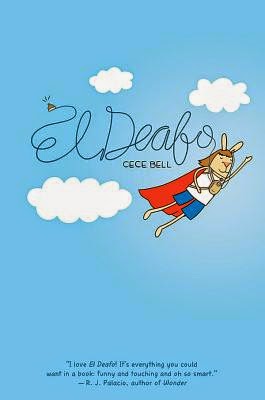
El Deafo

by Cece Bell
Support your local independent bookstore: buy it there!
Content: There’s a little talk of Love (she has a crush) but other than that, it’s quite accessible for the 3-5 grader. It’s in the middle grade graphic novel section at the bookstore.

This one has been on my radar for a long time, and (like too many other things), I can now say I Should Have Read it Sooner!

It’s the mostly-true (except for the part where she’s a bunny) story of Cece Bell, and her experiences as a deaf child in the 70s and early 80s. She lost her hearing due to a bout with meningitis when she was four, and as a result had to wear a hearing aid and use a Phonic Ear during school. It’s not something she really enjoys at first, even though she realizes it gives her a sort of super-power.

But, the story is really only incidentally about being deaf, it’s more about finding a way to belong and a friend. Bell is very practical about the friends she made, not sugar coating anything. But, it’s not a harsh book; on the contrary, it’s a very sweet and often hilarious story. And it’s good that it’s out there to remind readers that it’s because of our differences that life is interesting.

Very highly recommended.

Graphic Novel Round Up, December 2014

In Real Life
by Cory Doctorow and Jen Wang
Support your local independent bookstore: buy it there!
Content: There’s a couple instances mild swearing and because it’s about economics and gaming, it’s in the teen section of the bookstore. That said, A (who is in 5th grade) read it, understood most of it (at least the general idea), and really liked it. It’s in the teen graphic novel section of the bookstore.

I’ve never read anything by Cory Doctorow, but I was intrigued by this when it came into the store, and after reading a review of it for the Cybils blog I knew I needed to pick this one up.

Anda is a gamer. Which makes her a bit of an anomaly in her new school in Flagstaff, Arizona. So when a woman comes to their tech class, inviting them all to join this new online gaming community, Coarsegold, Anda jumps at the chance. Once inside the game, though, she soon finds out things are not all coming up roses. She hooks up with another player, Sarge, who introduces Anda to the world of gold farming. Actually, Anda and Sarge’s job is to kill off those who are gold farming — harvesting virtual gold for real money.

But then Anda befriends one of the gold farmers, a Chinese boy who goes by the English name, Raymond. She discovers that he’s being forced to work for hours on end without a break, for very little money and no health coverage. So, she gets Involved.

I enjoyed much about this foray into the gaming world. I enjoyed Anda as a character, and that Jen Wang drew her realistically. Even her avatar, which was slimmer and “whiter” than Anda was, wasn’t Barbie perfect. I enjoyed the fact that the introduction to the gamer world was a girl, as well. Especially with gamer-gate, acknowledging that girls are gamers, too (and good at it) is a good thing. Doctorow mentions in his introduction that this is not just about gamers, but it’s also about economics and making a difference. And I could see that as well; it’s a primer how electronic transactions take place and a reminder that in this world, no one is truly ever disconnected from anyone else.

Fascinating.

I Remember Beirut
by Zeina Abirached
Support your local independent bookstore: buy it there!
Others in the series (loosely speaking): A Game for Swallows
Content: Much like Hidden, this is about the effects of war on everyday people. It’s pretty matter-of-fact, but it feels like an older graphic novel. It’d be in the teen graphic novel section of the bookstore.

This is basically Abirached’s memories of growing up during the war in Lebanon. Her  house was in the middle of what she called “no man’s land”, which was a zone in between the worst of the fighting and the safer places in Beirut. Her memories are organized roughly chronologically, and range from the mundane — how they showered — to the macabre — her brother loved collecting bits of schrapnel — to the sad — when a neighbor had to move because their house got blown up.

Done in the same stark black and white drawings, it’s a reminder that no war is without casualties, and that sometimes those casualties are the everyday lives of people who aren’t even involved in the fighting. 

Graphic Novel Round-Up, November 2014

I spent a Saturday recently just reading graphic novels to help me out of the slump. I think it might have worked; I feel much more interested in reading a full-length book now. Also, both A and K picked some of these up and found themselves completely engrossed. So, it’s a good batch.

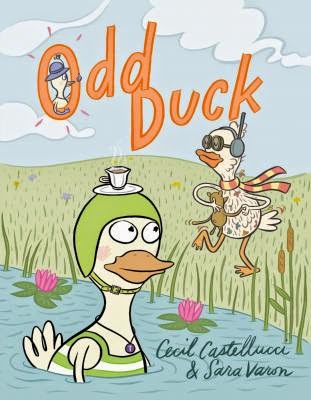
Odd Duck
by Ceci Castellucci and Sara Varon
Support your local independent bookstore: buy it there!
Content: There’s nothing. And the words/ideas are pretty simple. It’s good for reluctant readers as wel as those who just want a good, short story. It’d be in the middle grade graphic novel section of the bookstore.

Theodora is an ordinary duck. She does her ordinary duck exercises in the morning, goes for her ordinary duck walk (because she doesn’t like to fly), and reads ordinary duck books in the afternoon. She lives a nice, quiet life and is very happy.

That is, until Chad moves in next door. Chad is not an ordinary bird. He does not do his exercises in an ordinary way (if at all), He dyes his feathers weird colors. He does art (gasp)! Theodora is not happy. But then, come winter, she and Chad bond (because they don’t fly south). They discover that they have things in common, and that they really enjoy each other’s company. And that maybe being different isn’t so bad.

It’s a charming little graphic novel, full of adorable art and sweet little lessons, but it’s never heavy-handed or didactic. Perfect for younger and reluctant readers.

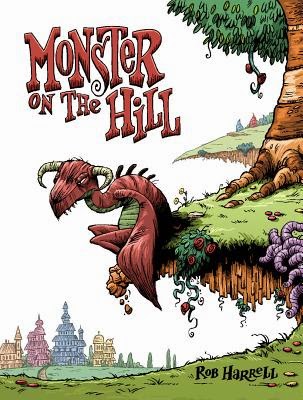
Monster on the Hill
by Rob Harrell
Support your local independent bookstore: buy it there!
Content: Linguistically, it’s more challenging. But it’s probably on par with the Amulet books, which means it’s probably good for 3rd grade and up. Content-wise, there’s some monster violence, but that’s it. It’d be in the middle grade graphic noel section of the bookstore.

In this version of 1860s England, there are monsters that terrorize every town. But never fear: that’s what the townspeople want. (Seriously.) But, in Stoker-on-Avon, they have a problem: their monster, Raymond, doesn’t do anything but moan and complain. It’s bringing the town down. So, the town leaders send the eccentric Dr. Charles Wilkie (and a street urchin, Timothy, hitches along for the ride) to convince Raymond to buck up and do his job.

This leads to a road trip, a lot of bonding, some lessons learned, and a giant battle against an unstoppable foe before everything is set to rights again.

This one had me eating out of the palm of its hand. I loved Raymond — he was delightfully pathetic — and his schoolmate, Noodles (aka Tentaculor) and their relationship. There was so much that had me just laughing out loud. True, there could have been a female character (just one? Please?)  or perhaps some diversity (though it was England in 1860-something), but for the most part, I found this simply charming.

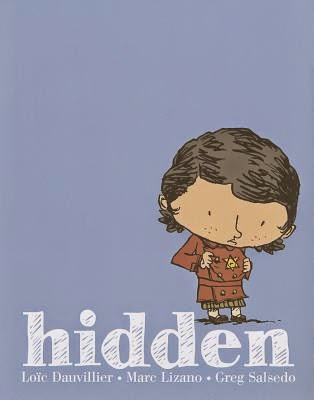
Hidden
by Loïc Dauvillier, Marc Lizano, and Greg Salsedo
Support your local independent bookstore: buy it there!
Content: It’s about the Holocaust, so there will definitely be things to discuss. It glosses over the worst of the horrors; there’s a passing image of a concentration camp survivor, as well as illusions to other horrors. Even so, it’s very kid-appropriate. It’s in the middle grade graphic novel section of the bookstore.

This one is your standard Holocaust fare. Mostly. Framed as a story a grandmother is telling her granddaughter about the time when she was a child, Dauvillier focuses mostly on the Resistance and the people in France who helped those who were Jews get away.

It’s a very tender story of a young girl, Dounia (the grandma) whose parents were taken to the concentration camps in 1942, near the end of the war. Even though Dounia hides during the inital raid, the neighbors (some of whom are part of the reistance), know they’ll be back, looking for her. So, they arrange for her to live with a woman in the country. In the act of escaping, the neighbor’s husband is caught, though he’s only arrested and released. He manages to find his way back to his wife and Dounia. Her main concern, though, is finding her parents again and so they keep looking, especially once France is liberated. Eventually, they do find her mother, and the story ends.

I liked this one well enough, but (possibly because it’s tamed down a bit) it lacks the emotional punch that other Holocaust books have. Still, it’s a good introduction to the topic.

Graphic Novel Roundup – Raina Telgemeir Edition

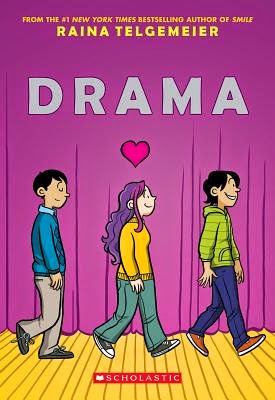
Drama
Support your local independent bookstore: buy it there!
Content: There’s middle school drama, but other than that, it’s pretty tame. It’s in the teen graphic novel section of the bookstore, but only because it feels a bit mature for the middle grade section.

Callie is a theater nerd. She’s not one to be on stage — she can’t sing, and her acting needs some work — but she LOVES being backstage, helping create the sets. And so, for the middle school production (middle school!) of Moon over Mississippi, she’s been assigned to be in charge of the sets. That’s overwhelming enough, but Callie’s personal life has taken a turn for the confusing. She thought she was getting somewhere with her long-time crush, but he went back to his girlfriend (who’s not terribly nice). And then a set of twin brothers show up in her life to just confuse things more.

I really liked Telgemeir’s depiction of middle school (spot on!) and the theater program (again, spot on!). I loved Callie’s spunk and drive and her longing to feel accepted and belong. And even though it was Callie’s story, I thought that all her friends — from the twins to her best friend, Liz — were fully developed. (Though there were some stereotypes, the mean girl girlfriend being one.) My only real complaint was the inclusion that all guys who do theater (at least on-stage) are gay. It’s a stereotype, and although there are gay boys who do theater, not all theater boys (even on-stage) are gay. I know I’m nitpicking, but here in Kansas, that’s the kind of stereotype that really takes hold and so parents discourage boys from participating in the arts because of it. I would have appreciated one character, at least, who wasn’t part of that.

Even so, it was a lot of fun to read.

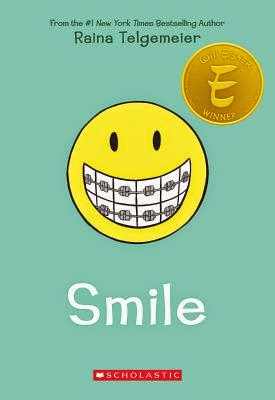
Smile
Support your local independent bookstore: buy it there!
Content: much the same as Drama; it’s got some themes that are a bit old for the younger elementary crowd, but there’s not much “objectionable”. It’s in the Teen Graphic Novel section, mostly because it seems to do better there.

Every once in a while, there’s an author (or in this case an author/artist) who gets the middle grade years so absolutely perfectly. The awkwardness, the challenges with friends, the wanting to be liked and not feeling liked.

Telgemeier is one of those people. It’s loosely based on her early teen years, and tells the story of how she lost her two front teeth in an accident and the dental work it took to make her smile what it is today. But it’s also the story of acceptance (inner and outer) and the things we’ll do and put up with so we don’t feel alone.

One thing I liked (well, I liked lots of things) was that the middle and high school Telgemeier drew was a diverse one. From her friends to the boys she liked, there were all shades of skin. And it wasn’t  this one’s the “black friend” or the “Asian friend”. They were all just friends — well, sort of; some of her friends, as A pointed out when she read it, were not very nice — and it wasn’t like Telgemeier was forcing a diverse world on things. It felt natural.

And, on top of that, she set it in 1989, which was a lot of fun to revisit.

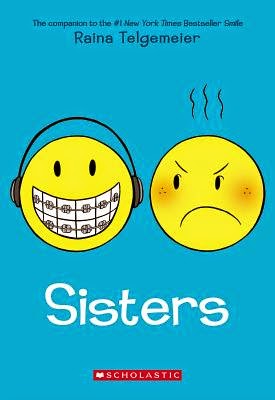
Sisters
Support your local independent bookstore: buy it there!
Content: This one is “tamer” (not that the other two are wild) than the previous two books, and has a more universal appeal, being about sibling rivalry. It’s in the middle grade graphic novel section of the store.

This is another memoir(ish) graphic novel, that takes place during Smile (though you don’t need to read that one to enjoy this one). It’s centered on Raina’s relationship with her younger sister, Amara. It has their backstory, their relationship as siblings as well as a road trip (yay road trip!) to visit cousins in Colorado for a family reunion.

It’s not an easy relationship, the one between Raina and Amara. There’s jealousy, age difference, interest differences, and (of course) just plain sibling rivalry. It’s the usual stuff: hitting, yelling, punching, name-calling. But an event on the road trip (I knew they were useful!), helps the sisters see that maybe it’s okay if they’re different. They can still get along.

I think, out of the three, this one was the least angsty, the least middle-school drama-y, and my personal favorite. Not only because I still remember fighting with my siblings, but because I’ve got all these girls around here who fight and squabble and don’t get along. Maybe, someday, they’ll figure it out. So, this one hit home in a way the other two didn’t.

A word on her art: it’s a bit cartoon-y (that’s the techincal term), but I thought it fit her story-telling style. It’s not terribly detailed, but it served it’s purpose, and the bright colors drew the eye in.

I handed all three of these off to the girls and they enjoyed them as much as I did. I’m glad we finally got around to reading her work!

Graphic Novel Roundup

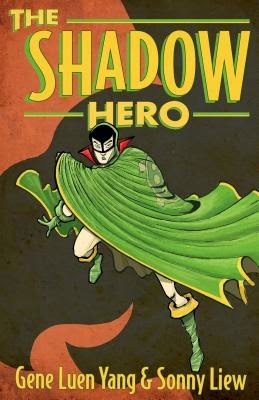
The Shadow Hero
by Gene Luen Yang & Sonny Liew
First sentence: “In 1911, the Ch’ing Dynasty collapsed ending two millenia of imperial rule over China.”
Support your local independent bookstore: buy it there!
Content: There’s some violence (graphic, obviously), but that’s about it. It’s a higher reading level, but I wouldn’t be adverse to giving this to the superhero loving 9- or 10-year-old. It’s in the teen graphic novel section of the bookstore.

In the 1940s, the first Asian-American, Hing, was hired by a small comic press to draw a superhero. The producers/owners wanted The Green Turtle to be white but the way Hing drew The Green Turtle, you really couldn’t tell. It was a short-lived comic, and Hing never gave The Green Turtle’s backstory.

Which is where The Shadow Hero comes in: Yang and Liew imagine The Green Turtle’s origin story.

And what a story. Yes, this is a superhero comic: the kind of nerdy, unambitious boy who gets a super power, but not without great cost. Our hero is Hank Chu, the son of Chinese immigrants. All he really wants to do is run the grocery store in Chinatown with his father. But, Chinatown is run by the mob, people who extract “taxes” from the businesses. Hank’s dad forgets a payment once, and the mob comes down on him, hard, killing him in front of Hank. That spurs Hank (kind of; his mother had been pushing him to become a superhero for a while) into action: he’s going to take down the mob, going after the boss.

Like all of Yang’s work, this is wonderfully drawn, and the story is compelling. I’m not a huge superhero comic person, but I couldn’t put this one down. It’s definitely a story worth reading.

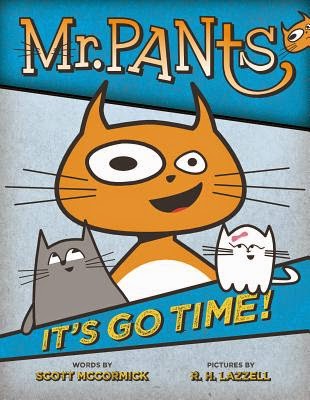
Mr. Pants: It’s Go Time!
by Scott McCormick and R. H. Lazzell
First sentence: “What are you laughing at, Mr. Pants?”
Support your local independent bookstore: buy it there!
Content: It’s a perfect beginning chapter graphic novel. Words are simple and large print, but the humor is abundant and the pages keep turning. It’s in the beginning chapter book (grades 1-2) section of the bookstore.

This is one that our Penguin children’s rep (who has the most delightful Irish accent) RAVED about. She said, “Seriously: you just have to read it. It’s hilarious!” I put it off for a while, until she came again (there’s a sequel coming out), and reminded me: “You HAVE  to read this.” So, I did. And she’s right: you have to read it. It’s hilarious.

It’s the last day of summer, and Mr. Pants — a cat with two cat sisters and a human mom. No, I don’t understand, either — wants to go play laser tag. Except his younger sisters — Foot Foot and Grommy — have other ideas. Foot Foot wants to play with her new toy. Grommy wants to go to the Fairy Princess Dream Factory. Mom has to go shopping. The deal is this: Mr. Pants goes along with all this stuff (he doesn’t want to do, obviously), and they can go play laser tag.

Much like Babymouse, this is a gold mine for hilarity. There’s also some gender-bending going on; Mr. Pants is your typical “boy”, but he’s also accepting of his sisters’ likes. (Which, I think, is typical for a boy with sisters. Ask me, sometime, about the summer I was into Little House on the Prairie. I was Laura, and my brother was Mary.) It’s everything a beginning chapter book needs to be: colorful, funny, interesting, and good.

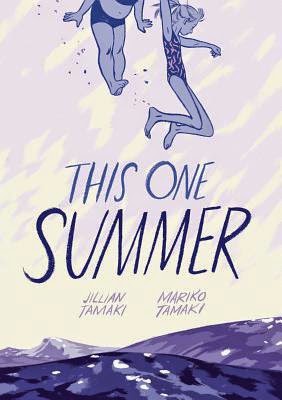
This One Summer
by Jillian Tamaki and Mariko Tamaki
First sentence: “
Support your local independent bookstore: buy it there!
Content: There’s a half-dozen f-bombs as well as mild swearing, and one of the minor characters gets pregnant. It’s in the teen graphic novel section for those reasons.

Every summer since she was five, Rose and her family would go to their cabin by the beach. She has her best friend there, Windy, and enjoyed the days playing, exploring, hanging out. But this summer is different. Rose is 13 (I think; she seemed 13) and she and Windy are talking about growing up (boobs were a big topic). And her mother and father are fighting. Quite a bit. Rose gathers from eavesdropping that much of it surrounds their failed attempt to have another baby. Which just makes Rose feel unwanted.

Add on top of that their observance (mostly from sneaking around) of an unfolding drama in the little town where their cottages are: a boy who works at the convenience store got his girlfriend pregnant and doesn’t want to accept responsibility.

It’s an interesting graphic novel, one that I think I didn’t like as much as I could have, solely because I was not the right age. But the 12-to 14-year old crowd, especially girls, would relate. It’s about changing, and accepting the future, and figuring out friends, and understanding the world. And it’s perfect for its target audience.

Just not for me.