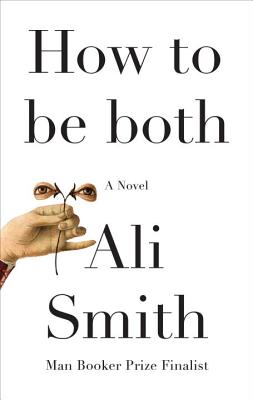
Audiobook: How to Be Both

by Ali Smith
Read by John Banks
Support your local independent bookstore: buy it there!
Content: There’s probably six or so f-bombs spread through the whole book. It’s in the adult fiction section of the bookstore.

I knew very little about this book before picking it up, only that it made for an excellent book group discussion in one of the book groups at the store, and that a couple people on staff really loved it. It was enough for me to use my last audiobooks.com credit to get the audio. The other thing I knew was that this book is two novellas in one, and that half the books printed have one first, and the other half are reversed. You don’t know, previous to picking it up, whose story you will get first.

The two stories are interconnected looks at art and perception. One is contemporary, the story of a mother-daughter relationship. The other is a stream-of-consciousness from the perspective of an Italian Renaissance painter in the 1400s. I really don’t want to say much more than that, except I read it Camera-Eyes, and I thoroughly enjoyed the way the two stories weaved together. It gave me much to think about.

Also, once I got used to the narrator (and the book), I thoroughly enjoyed listening to this one. I enjoyed his style, and that he didn’t try to do falsetto female voices. Everything was pretty matter-of-fact, which took a bit to fall into the groove with, but once I did, was quite lovely.

An excellent read.

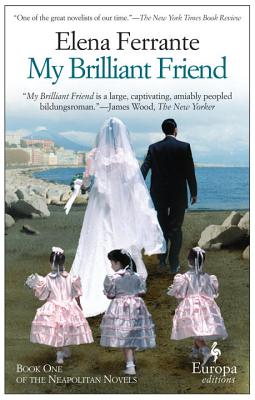
Audiobook: My Brilliant Friend

by Elena Ferrante
Translated by: Ann Goldstein
Read by: Hillary Huber
Support your local independent bookstore: buy it there!
Content: There’s a few mild swear words and some frank talk about not-quite sex. It’s incredibly slow with a lot of narration rather than dialogue, but I’d give it to a high schooler who was interested in historical fiction. It’s in the adult section of the bookstore.

I picked this one up because I’ve heard good things about Ferrante from our translation book club (they only read works in translation), and because I needed a book in translation for my bingo card.  (Which I’m going to end up being three squares short from getting a blackout. I read a lot.) I didn’t know much about it, going in, so I didn’t think I had any expectations. (I did however, expect to really enjoy the narrator, which I did.)

What it turned out to be was a very slow, intricate, detailed portrait of a girl, Elena, in a neighborhood in Naples, Italy, and her (somewhat obsessive) relationship with her best friend, Lila. This first book is a lot of set up: their lives — Lila is the daughter of a shoe repairman; Elena the daughter of a porter, whose mother has a wandering eye and limp and is cruel — and their relationship — mostly competitive, mostly on the side of Elena — to each other. They meet in elementary school, where Lina is the smartest and the best. But because she is poorer than Elena and because her parents won’t be bullied by the teacher (there was a lot of bullying by people in this), Lina drops out of school while Elena continues.

And yet, everything Elena does is because she wants to seem important to Lina. She wants Lina to look at her and feel like she Needs Elena in her life. And yet, for the most part, she doesn’t.

I’m still not sure how I feel about this one. On the one hand, I adored Huber’s narration, the way she embodied the characters (and how effortlessly the Italian names and places came off her tongue). She really is a talented reader, and I love listening to her. But, I’m not sure I figured out what was so great about the novel. I was interested enough to keep reading; the character’s lives were intriguing and, yeah, I guess I did want to hear what Elena and Lina would do next. But, in the end, I don’t know if I cared. I finished the book and kind of went, “Huh.” Maybe it’s because I don’t read a lot of books like this (both translated as well as adult fiction), but it just kind of washed over me.

Not that it was bad. It just wasn’t something I was terribly enthusiastic about.

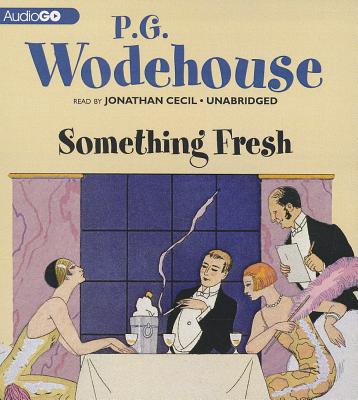
Audio book: Something Fresh

by P. G. Wodehouse
Read by: Jonathan Cecil
Support your local independent bookstore: buy it there! (Though it looks like this one is out of print…)
Content: There’s really nothing. Some smoking. A few words of mild swearing. I’d give it to a high schooler who was interested in Downton Abbey. It’d be in the Adult Fiction section of the bookstore.

Ah, Wodehouse. I had a square on my bingo card that was “Published exactly 100 years ago.” I did some research, and when I discovered that Wodehouse had a book I’d never read out that year, I jumped at the chance.

There’s a lot going on plot-wise in this one, though it mostly surrounds a scarab that is inadvertently stolen from an American millionaire, Mr. Peters. His daughter, Aline, is engaged to the Hon. Freddy Threepwood, the son of the Earl of Elmsworth, who is the one who walked off with the scarab. So, Peters hires Ashe Marson (and Aline hires Joan Valentine) to pose as his valet and get the scarab back. Unfortunately, at the castle, the Earl’s secretary, the Efficient Baxter, is super suspicious and is thwarting all attempts to return the scarab to its rightful owner. There’s several side love stories as well as a bunch of ridiculous relatives as well.

Silly, no? Well, it’s Wodehouse.

There were several audio versions of this, and I picked one at random, not knowing what to expect. I wasn’t terribly impressed; it was hard to tell, sometimes (especially since Wodehouse does rapid-fire dialogue), who was talking. And Cecil’s American accent was HORRIBLE. Awful. Seriously. As was his women’s voices. (Sometimes, he wouldn’t even bother with changing his voice for the women.)

In spite of that, Wodehouse’s writing made me smile (I wonder: how much I’d have laughed if the narrator had been better?), the characters were sufficiently silly, and the plot was sufficiently ridiculous. I thoroughly enjoyed my trip to Blanding’s Castle.

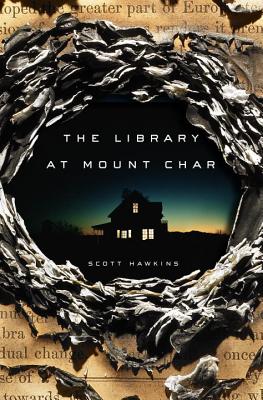
Audiobook: The Library at Mount Char

by Scott Hawkins
Read by Hilary Huber
Support your local independent bookstore: buy it there!
Content: SO so SO violent. So VERY violent. And a LOT of swearing, including a big bucketful of f-bombs. You are forewarned. It’s in the adult fiction section of the bookstore.

When the Random House rep came in to pitch this one, she started by saying “I have no idea how to  describe this book.” And it’s true: it’s about a Library. And librarians, but not the way you think. It’s about the end of the world, but not in the way you think. In fact, any way I try to sum this one up it’s going to end with: but not in the way you think. Throughout this whole book, that was the one constant: it’s nothing like you expect.

When Carolyn was eight, her parents died in a tragic accident, and, along with 11 other children, she was adopted by a man they came to know as Father. Father was a librarian, the caretaker of a most unusual library, and Carolyn and her new siblings became his apprentices, each learning a catalog. It wasn’t an ordinary apprenticeship, either: David, who was in charge of war, learned all the ways of war and death known to man (and some not yet known). He became awful and violent and cruel. Margaret learned the ways of death and the underworld, dying multiple times. (Another one, Jennifer, learned the ways of healing and was tasked with bringing everyone back from the dead.) Carolyn’s catalog was all the languages known to man, both ancient and current, as well as ones not known. To be simplistic, it was an awful existence: Father was heartless and cruel in his punishments, and there was no mercy to be seen anywhere.

But now, Father has gone missing, the siblings have been kicked out of the library, and it’s up to them — well, Carolyn, since she speaks English best — to figure out where Father is.

This is, unfortunately, one of those books that the less you know, the better. Know that Steve — an American man that Carolyn ropes into helping — is the heart of the book. And Erwin — an ex-military Homeland security agent — is crass and awful, but good at heart. Know that the end is worth the rest of the book. And that it definitely gets worse before it gets better. And that “better” is relative.

I was talking to another bookseller about it (one who read an ARC months ago) about how this one is best when read in a group, almost: you need another person to be able to process what happens. So, it’d be a good one for book groups, if you can handle the dark.

A bit about the audio: Hilary Huber was FANTASTIC. Seriously. In many cases, her narration is what kept me reading. Especially since, in many ways, listening to this book is more difficult than reading it: you’re not able to skim the really horrible bits. But her voice, and the way she chose to narrate this book, was amazing. So much so, that I’m going to look for more books read by her.

I didn’t love this one, but I am really glad I listened to it. There’s a lot to think about.

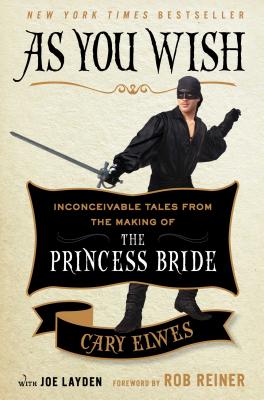
As You Wish

Inconceivable Tales from the Making of The Princess Bride
by Cary Elwes with Joe Layden
read by Cary Elwes (with other actors/directors/etc. reading their contributions)
Support your local independent bookstore: buy it there!
Content: There’s nothing “objectionable”, though the reading level is probably that of high school. It’s in the biography and film sections of the bookstore, but I’d give it to anyone who has a interest in the movie (especially if they are big fans).

I’m late to this party, since this book came out last October. But, I’ve had my eye on it, mostly because I have loved the movie for years (and am constantly surprised how many of my regular daily sayings are actually lines from this movie) and finally got my hands on the audio book.

There’s not much to say about the content: Cary Elwes was asked at the 25th anniversary screening of the movie what he took away from the making of it. He came up with (in his words) a lame answer, and this book was born out of his desire to really detail what the experience meant to him. He got contributions from the actors who are still alive, and a book was born.

It’s not brilliant writing by any stretch of the imagination. But, it is chock-full of fun trivia (yes, I did watch the movie again, spouting out all the wonderful tidbits I’ve learned. My family was patient with me.) and delightful stories.

But, the best thing? (And the reason I’d recommend the audio over the print?) Cary Elwes is a brilliant narrator. Not just his regular voice, but he does a spot-on American accent (several, in fact), and he is just a delightful narrator to spend six hours with.

At the very least, it’ll make you smile. And that, I think, is worth it.

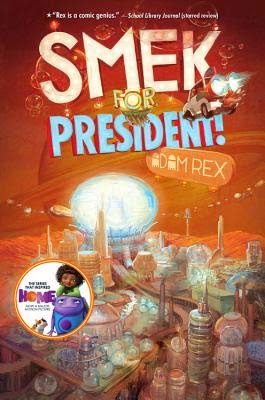
Audiobook: Smek for President

by Adam Rex
Read by Bahni Turpin
Support your local independent bookstore: buy it there!
Content: Nothing. Nada. Some fake swearing (“pardon my language”). The audio version is probably good for kids who have an attention span longer than 20 seconds; the book is in the middle grade (grades 3-5) section of the bookstore.

I loved the audiobook of The True Meaning of Smekday, so when I heard that Bahni Turpin was doing the sequel, I KNEW that was how I needed to experience this book. And I was right. Turpin is perfect for this. Seriously.

The story picks up a year and a half after Gratuity “Tip” Tucci and J. Lo save the world. The Boov have moved to New Boovworld, on one of Saturn’s moons. J. Lo and Tip are hanging on Earth, trying to get used to having Tip’s mom around. And, for J. Lo, trying to to fit in. They need a break, and so J. Lo soups up their car, Slushious, and they head off-world to check out the new Boov homeland. Since they saved the world, they’ll be welcomed as heroes, right?

Well, no.

Things don’t go quite like they planned. J. Lo is named Public Enemy Number One, and thrown into jail. Tip repeatedly avoids being captured, but only just barely. Which sends her on an adventure through New Boovworld. She meets and befriends a delightful flying billboard, whom she names Bill (of course), as well as several other Boov (and one human; Dan Landry’s son), in her attempts to free J. Lo and set everything right. There’s a lot of action, tons of humor, and a bit of time travel in the mix.

But what really made the book was Turpin. I adore her reading style, and it’s perfect for Adam Rex’s humor. I was chortling, guffawing on occasion, and I was thoroughly charmed by all the Boov voices (with their distinctive quirks). I was pleased to see that the Chief was back (if only in Tip’s imagination), as well as other favorite characters from the first book. I loved how Rex imagined New Boovworld. And it was satisfying (as a parent) to see that there were real consequences for Tip’s actions.

In short: I adored it.

Audiobook: Small Victories

by Anne Lamott
Read by the author
Support your local independent bookstore: buy it there!
Content: She likes the word s**t, and drops about five f-bombs.  Which kind of caught me off-guard. It’s in the religion/philosophy section of the bookstore.

I’ve been curious about Anne Lamott for a while now; she’s an incredibly popular author at the store. I was in between audio books recently and discovered this one, and it was delightfully short. I figured audio was a good way to experience her.

This is basically a series of short reflections on life, God, and the intersection of the two. For the record: Lamott is a liberal, which I don’t mind at all, and was very against the invasion of Iraq in 2003. (Several of the essays are from around that time period.) She belongs to a church in northern California. She has a son, and lots and lots of friends, many of whom are suffering from serious illnesses. She has a good sense of humor, and is honest about her struggles with God, people, and just life in general.

In many ways, the words were just what I needed to hear: we’re all human, we’re all trying. God is in connecting with other people and reaching out to love them.

What I didn’t like so much, was Lamott’s reading of her own work. I understand why she needed to read her own words; it would have been odd otherwise. But Lamott read in such a way that it soundedlikeonereallylongsentancewithoutevertakingapauseorevenraisedorloweredhervoicewithsentenceinflection. When I concentrated to hear the words, I loved it. But her reading of them almost turned me off altogether. I’m glad I stuck it through to the end, for the thoughts and ideas. But, I wish Lamott had been a better narrator.

Audiobook: The House of Silk

by Anthony Horowitz
Read by Sir Derek Jacobi
Support your local independent bookstore: buy it there!
Content: While there’s nothing “objectionable”, it does, in the end, feature murder, and the solution is pretty tough to take. Still, I think it’d be a good book for all the teen Sherlock lovers out there. It’s in the mystery section at the bookstore.

I’ve been meaning to read this one for years, I swear. I like Sherlock Holmes, and this one is actually sanctioned by the Conan Doyle estate, and Horowitz has written some fun middle grade books… and and and.

I finally got around to it because Horowitz published Moriarty, and I remembered that I did want to read House of Silk. Thankfully, the library had an audio version, and so I opted for that.

And what a ride. First: I loved Jacobi’s narration, from his slightly gruff Watson to his more elegant Holmes. And the wide variations of English accents were amazing. The only time I felt he was off was when he did an American woman, but I was able to forgive that.

The conceit is that Watson is writing this at the end of his life, with the intent that it would be hidden and released in 100 years, because the scandal was too great for it to be published during his lifetime. Which sets up an ominous tone that permeates the whole book. Holmes and Watson (married now, and his wife was away so he was back at 221B Baker Street) were solicited by a man, Carstairs, who felt he was being threatened by one of the Flat Cap Gang from Boston. That leads Holmes and Watson down a tricky, twisty, dark path and into the deepest darkest secrets of some of the most powerful men in Britain.

I know I’m being vague. But, really: the less you know, the more enjoyable the ride. And the ending had me flabbergasted. I had some of it figured out — in retrospect, nothing comes out of left field, which is nice — but when the final revelation came I was sufficiently amazed at Holmes and disgusted by the depravity. As well I should be.

I don’t know if I would have liked it as much had I read it; I prefer the TV shows to the stories, and listening to it gave it the feel of one of those. Or maybe it’s just because Horowitz knows action and plotting… which lends credence to my middle grade/mystery crossover theory.

Either way, I thoroughly enjoyed this one.

Audiobook: Yes, Please

by Amy Poehler
Read by the author.
Support your local independent bookstore: buy it there!
Content: Amy likes to swear. A lot, but not excessively, and generally not gratuitously. She is also pretty frank about sex and her drug use. I’m not going to say it’s not for teens — whom I know make up some of her fan base — but know that going in. It’s in the humor section at work.

I have made an executive decision: all celebrity bios are better in audiobook form. Period. That is all.

I really wasn’t that interested in reading this one; I’d paged through it a couple times when it came in back in October, and I figured: this was one for the True Fans. (Which I am not. I’m more like a Passing-by Fan.) But even I couldn’t resist the opportunity to listen to Amy Poehler read her book.

And, for the most part, it was a lot of fun. It’s a meandering book, wandering through memories, observations, Deep Thoughts, and Pithy Comments. That worked for me for a while, but wore me down by the end. Thankfully, the last chapter was recorded live, which helped end the book on a high note.

Perhaps it’s because she comes from an improv background, but I felt Poehler (and the audiobook) was at its best when she strayed from the script and just riffed. The two minutes she and Seth Meyer went off (which I’m assuming is not in the book, though I haven’t checked) were brilliant. She operated under the guise that she was recording the whole thing in her own personal home audio booth, and that there was a party going on in the background. She chatted for a bit with Patrick Stewart, Kathleen Turner, and Carol Burnett which just made me happy. And hearing her parents’ Boston accents (actually, I loved it when Poehler’s came out too) was charming.

It was all the little extra things that made this book enjoyable. But in the end, that wasn’t enough for me to truly love it.

Audiobook: The Boys in the Boat

by Daniel James Brown
Read by: Edward Herrmann
Support your local independent bookstore: buy it there!
Content: It’s a book about the 1930s, rowing, and Nazism. It’s appropriate for anyone who’s interested in reading about those things, and can handle a long-ish book. It’s in the History section of the bookstore.

In the 1930s, 8-man rowing was one of the most popular sports (who knew). And the west coast — the University of California and University of Washington — was the hot-spot of the sport. And in the years leading up to the 1936 Olympics in Berlin, the Washtington team became the best of the world.

This is the story of how the Washington boys became the Olympic gold medalists.

I think this is one of those books that I really needed to listen to rather than read. While I think it would have been interesting, listening to it made it riveting. I enjoyed the stories of Joe Ranz — who ended up in the number 7 seat in the Olympic boat — and the other boys, and how they came to be at Washington. I enjoyed the conflict that coach Al Ulbrickson had with the California coach. I didn’t enjoy the rehashing of 1930s Berlin, but I think that’s because I listened to In the Garden of the Beasts and this is basically re-hashing much of that territory. For someone who is unfamiliar with Hitler’s rise, it’s pertinent information.

But what I  really loved was the bits about how the sculls were made, about the effort it took to row a race. And the races themselves? They had me glued to my seat, hooked on every word.

It was a remarkable event, a remarkable story. And I’m so glad I know about it, now.