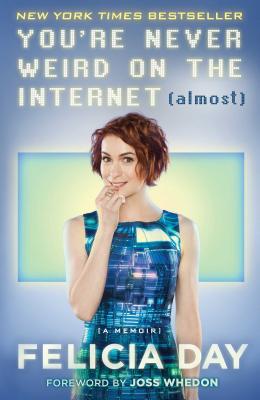
Audiobook: You’re Never Weird on the Internet (Almost)

youreneverweirdby Felicia Day
Read by the author
Support your local independent bookstore: buy it there!
Content: There’s some mild swearing and a couple of f-bombs until you get to the second-to-last chapter, where she talks about Gamer Gate and trolls on the internet,  and then there’s a LOT. It’s in the Biography section of the bookstore.

I am not a huge fan of Felicia Day. Don’t get me wrong: I know who she is, I’ve seen some of what she’s done, and I like her. But fan? Not really. And yet, this book appealed to me from the moment I saw the cover (and heard the title). A memoir of an awkward, anxiety-riddled, gamer girl who happens to be a semi-famous actor? Count me in.

And it, as read by Day, was absolutely charming. (I’m sure it was charming in print form, too, but I’d definitely recommend listening to this one.) Day writes about her interesting childhood (homeschooled for “hippie reasons not God reasons”), starting college at 16 (double majoring in math and violin performance), heading to LA and trying to break into the acting business, playing World of Warcraft, and finally, creating her own web show ages before anyone knew what a web show was.

It’s a fascinating journey, and while she has “coffee mug” nuggets of wisdom along the way (I wish I wrote them down; they were pretty great), the best part, for me, was just listening to Day be honest about anxiety, depression, and figuring out how to be the best and most honest person she can be.

She sounds like a delightful person, one I’d happily invite to that dinner party with famous people I’d love to have. And this is an absolutely delightful book.
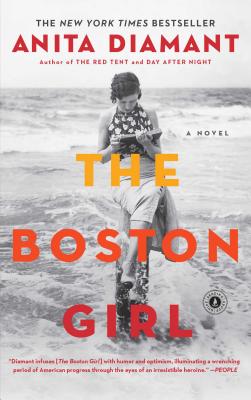
Audiobook: The Boston Girl

bostongirlby Anita Diamant
Read by: Linda Lavin
Support your local independent bookstore: buy it there!
Content: There are some mild swear words and references to drinking and smoking. It’s in the adult fiction section of the bookstore.

Addie Baum is the daughter of Eastern European immigrants, who came to American when the persecution became too bad back home. Addie was born in 1900 in Boston, and grew up in a world wholly different from that her parents, and even her older sisters (the youngest who was 14 years older than Addie), knew. It was a world where Addie went to school instead of getting married young and having babies. A world where she held a job and chose love for herself. A fascinating, modern world, but one that put her at odds with her parents — especially her mother — and the way of life they had always known.

I loved this one from the start. It begins as a series of reflections of an 85-year-old Addie in response to the question asked by her 22-year-old granddaughter: “How did you get to be the woman you are today?” The whole novel felt like a personal history, complete with asides that a grandmother would say in the telling. And while it covered Addie’s whole life, the focus was on her formative years from when she was 15 until she met and married her husband. The opportunities she had (because of the people she met), her struggles with family and religion and men, her jobs and the experiences she had because of them. It was a fascinating slice of life.

And the narrator was perfect. She caught that personal history vibe and ran with it; so very often I could almost see Addie, sitting in her living room, telling this story to an interested granddaughter. No, she didn’t do voices, though she had a good Boston accent overall, but I don’t think it was needed for this. The way Lavin read it was just perfect.

As was this story.

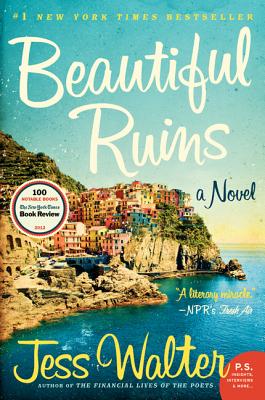
Audiobook: Beautiful Ruins

beautiful ruinsby Jess Walter
Read by: Edoardo Ballerini
Support your local independent bookstore: buy it there!
Content: There is a bit of sex, and a lot of swearing, including a bunch of f-bombs. It’s in the adult section of the bookstore.

It’s April 1962, and Pasquale has just returned home to his small seaside village of Porto Vergogna to run his deceased father’s hotel, Hotel Adequate View. It’s a nothing of a hotel in a nothing of a village, and he pretty much feels like he’s at a dead end. Then the beautiful American actress Dee Moray shows up on Pasquale’s doorstep.

Thinking she has cancer, Dee’s on leave from the Richard Burton/Elizabeth Taylor production from Cleopatra. She takes refuge at Pasquale’s hotel while he tries to figure out who sent her and why she was there.

Flash forward fifty years, when Pasquale shows up in Hollywood at the famous producer Michael Dean’s office, looking for Dee. And in and around those two events there is a story. Between flashbacks and flash forwards and a few side trips, Walter spills out Dee and Pasquale’s story, from his affair with an older woman (that resulted in a child) to her affair with Richard Burton (that resulted in a child) and the consequences of their decisions.

It was a bit more meandering than I like my books to be. There were several sections that if I had read this in print, I would have skipped. And so, listening to it on audio, I kind of got impatient. However, the narrator was brilliant. Didn’t matter the accent, he was there and so, so good. In fact, it’s what kept me listening throughout the book. Eventually, I did bail, during the epilogue-like part because I just lost interest.

There were parts that I did enjoy, threads of the larger story that I did connect with. But mostly, other than the narrator, I wasn’t that thrilled with the book. It’s just wasn’t my sort of story.

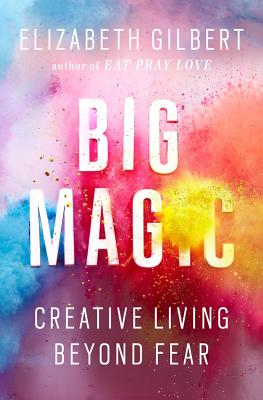
Audio book: Big Magic

Creative Living Beyond Fear
by Elizabeth Gilbert
Read by the author.
Support your local independent bookstore: buy it there!
Content: There are a few f-bombs (around fourish, if I remember right) and other mild swearing. It’s in the Creative Non-Fiction section of the bookstore.

Big Magic is what Elizabeth Gilbert calls the act of creation. Sure, she’s a writer, someone who makes their living off of creativity, and so this book — much like The Art of Asking by Amanda Palmer — is nominally written toward those who want to live an artistic life. But, as Gilbert argues in the book, who wouldn’t want to do that?

It’s not a new message: find time to be creative. Make space in your life to be creative. Be open to creative inspiration and connection You will be a happier person for it. And you can just add Gilbert’s voice to that message. She has no patience for people who say they Can’t (that’s a very limiting word) do that. And she has no patience for people who want to Suffer for their Art. She believes — and I buy into this — that happy people are the most creative, and conversely, creative people are happiest.

(As a side note: I used to be more creative, both cross-stitching as well as decorating the house and other projects. They’ve all fallen by the wayside. I suppose that’s one of the reasons I like doing story time every Saturday: it allows me to have a creative outlet.)

It’s an interesting look at art and is incredibly practical about how it can be a part of your life. And while I enjoyed listening to Gilbert read her work, I think this is one I want to buy, to have on hand to read and to share with the children. For while I don’t think it’s an absolute Recipe for Happiness, it’s a good reminder that I enjoy being creative and that I can, in fact, make time for that sort of thing in my life.

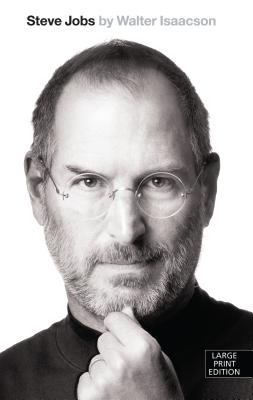
Audiobook: Steve Jobs

by Walter Isaacson
Read by Dylan Baker
Support your local independent bookstore: buy it there!
Content: Steve Jobs had a foul mouth. You are forewarned. Also, it’s a bit on the business-y side. It’s in the biography section at the bookstore.

I don’t know why, really, I picked this up. I’m not a computer person, or even an Apple fan (though I do own an iPhone). I needed something short to listen to while I drove around delivering things one day, and this kind of jumped out at me.

It’s a basic biography of Steve Jobs, the founder and eventual CEO of Apple computers and CEO of Pixar. Isaacson, a reporter, was picked by Jobs before his death in 2011 to write this book, and given access to all sorts of information that Jobs, who was someone who valued complete control, usually didn’t divulge.

I did learn a lot of things about Jobs, computers, the 1970s, business and the intersection between all of them. First and foremost: Jobs wasn’t a nice person. Which got me to wondering: are all people at a high level of business — either CEOs or just high up in the business — generally work-obsessed jerks? If so, what does that say about us as a country, that in order to be “successful” and proclaimed “innovative” and “a genius” we have to treat other people like crap?

The other thing I learned about Jobs was that he was just an Idea Man. He worked, sure, but it was managing and thinking outside the box and demanding things of others, but he never really created anything himself. I don’t know if I had any respect for him to lose, but knowing that he just thought up the ideas rather than actually implementing them changed my perception of him.

Did I like the book? Not really. It was kind of long and a little boring. Part of that may have been the narrator, who wasn’t the most engaging. But part of that was Isaacson’s writing: it was meandering and a bit pandering. Not something (or someone) I would want to read again.

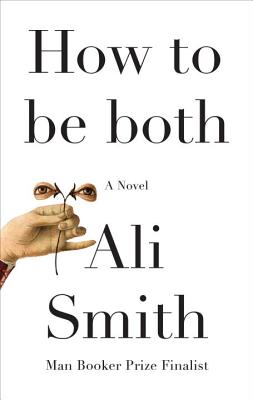
Audiobook: How to Be Both

by Ali Smith
Read by John Banks
Support your local independent bookstore: buy it there!
Content: There’s probably six or so f-bombs spread through the whole book. It’s in the adult fiction section of the bookstore.

I knew very little about this book before picking it up, only that it made for an excellent book group discussion in one of the book groups at the store, and that a couple people on staff really loved it. It was enough for me to use my last audiobooks.com credit to get the audio. The other thing I knew was that this book is two novellas in one, and that half the books printed have one first, and the other half are reversed. You don’t know, previous to picking it up, whose story you will get first.

The two stories are interconnected looks at art and perception. One is contemporary, the story of a mother-daughter relationship. The other is a stream-of-consciousness from the perspective of an Italian Renaissance painter in the 1400s. I really don’t want to say much more than that, except I read it Camera-Eyes, and I thoroughly enjoyed the way the two stories weaved together. It gave me much to think about.

Also, once I got used to the narrator (and the book), I thoroughly enjoyed listening to this one. I enjoyed his style, and that he didn’t try to do falsetto female voices. Everything was pretty matter-of-fact, which took a bit to fall into the groove with, but once I did, was quite lovely.

An excellent read.

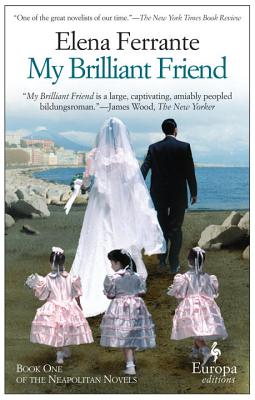
Audiobook: My Brilliant Friend

by Elena Ferrante
Translated by: Ann Goldstein
Read by: Hillary Huber
Support your local independent bookstore: buy it there!
Content: There’s a few mild swear words and some frank talk about not-quite sex. It’s incredibly slow with a lot of narration rather than dialogue, but I’d give it to a high schooler who was interested in historical fiction. It’s in the adult section of the bookstore.

I picked this one up because I’ve heard good things about Ferrante from our translation book club (they only read works in translation), and because I needed a book in translation for my bingo card.  (Which I’m going to end up being three squares short from getting a blackout. I read a lot.) I didn’t know much about it, going in, so I didn’t think I had any expectations. (I did however, expect to really enjoy the narrator, which I did.)

What it turned out to be was a very slow, intricate, detailed portrait of a girl, Elena, in a neighborhood in Naples, Italy, and her (somewhat obsessive) relationship with her best friend, Lila. This first book is a lot of set up: their lives — Lila is the daughter of a shoe repairman; Elena the daughter of a porter, whose mother has a wandering eye and limp and is cruel — and their relationship — mostly competitive, mostly on the side of Elena — to each other. They meet in elementary school, where Lina is the smartest and the best. But because she is poorer than Elena and because her parents won’t be bullied by the teacher (there was a lot of bullying by people in this), Lina drops out of school while Elena continues.

And yet, everything Elena does is because she wants to seem important to Lina. She wants Lina to look at her and feel like she Needs Elena in her life. And yet, for the most part, she doesn’t.

I’m still not sure how I feel about this one. On the one hand, I adored Huber’s narration, the way she embodied the characters (and how effortlessly the Italian names and places came off her tongue). She really is a talented reader, and I love listening to her. But, I’m not sure I figured out what was so great about the novel. I was interested enough to keep reading; the character’s lives were intriguing and, yeah, I guess I did want to hear what Elena and Lina would do next. But, in the end, I don’t know if I cared. I finished the book and kind of went, “Huh.” Maybe it’s because I don’t read a lot of books like this (both translated as well as adult fiction), but it just kind of washed over me.

Not that it was bad. It just wasn’t something I was terribly enthusiastic about.

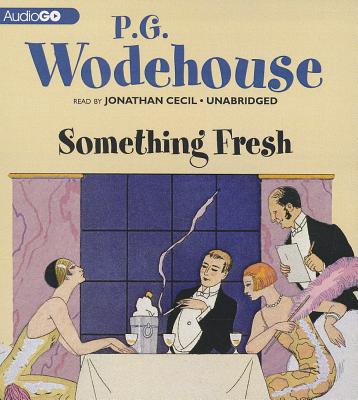
Audio book: Something Fresh

by P. G. Wodehouse
Read by: Jonathan Cecil
Support your local independent bookstore: buy it there! (Though it looks like this one is out of print…)
Content: There’s really nothing. Some smoking. A few words of mild swearing. I’d give it to a high schooler who was interested in Downton Abbey. It’d be in the Adult Fiction section of the bookstore.

Ah, Wodehouse. I had a square on my bingo card that was “Published exactly 100 years ago.” I did some research, and when I discovered that Wodehouse had a book I’d never read out that year, I jumped at the chance.

There’s a lot going on plot-wise in this one, though it mostly surrounds a scarab that is inadvertently stolen from an American millionaire, Mr. Peters. His daughter, Aline, is engaged to the Hon. Freddy Threepwood, the son of the Earl of Elmsworth, who is the one who walked off with the scarab. So, Peters hires Ashe Marson (and Aline hires Joan Valentine) to pose as his valet and get the scarab back. Unfortunately, at the castle, the Earl’s secretary, the Efficient Baxter, is super suspicious and is thwarting all attempts to return the scarab to its rightful owner. There’s several side love stories as well as a bunch of ridiculous relatives as well.

Silly, no? Well, it’s Wodehouse.

There were several audio versions of this, and I picked one at random, not knowing what to expect. I wasn’t terribly impressed; it was hard to tell, sometimes (especially since Wodehouse does rapid-fire dialogue), who was talking. And Cecil’s American accent was HORRIBLE. Awful. Seriously. As was his women’s voices. (Sometimes, he wouldn’t even bother with changing his voice for the women.)

In spite of that, Wodehouse’s writing made me smile (I wonder: how much I’d have laughed if the narrator had been better?), the characters were sufficiently silly, and the plot was sufficiently ridiculous. I thoroughly enjoyed my trip to Blanding’s Castle.

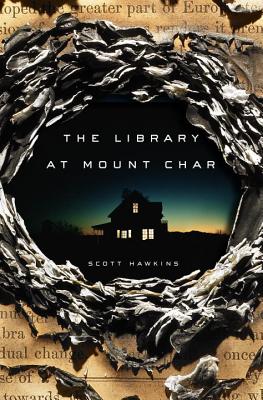
Audiobook: The Library at Mount Char

by Scott Hawkins
Read by Hilary Huber
Support your local independent bookstore: buy it there!
Content: SO so SO violent. So VERY violent. And a LOT of swearing, including a big bucketful of f-bombs. You are forewarned. It’s in the adult fiction section of the bookstore.

When the Random House rep came in to pitch this one, she started by saying “I have no idea how to  describe this book.” And it’s true: it’s about a Library. And librarians, but not the way you think. It’s about the end of the world, but not in the way you think. In fact, any way I try to sum this one up it’s going to end with: but not in the way you think. Throughout this whole book, that was the one constant: it’s nothing like you expect.

When Carolyn was eight, her parents died in a tragic accident, and, along with 11 other children, she was adopted by a man they came to know as Father. Father was a librarian, the caretaker of a most unusual library, and Carolyn and her new siblings became his apprentices, each learning a catalog. It wasn’t an ordinary apprenticeship, either: David, who was in charge of war, learned all the ways of war and death known to man (and some not yet known). He became awful and violent and cruel. Margaret learned the ways of death and the underworld, dying multiple times. (Another one, Jennifer, learned the ways of healing and was tasked with bringing everyone back from the dead.) Carolyn’s catalog was all the languages known to man, both ancient and current, as well as ones not known. To be simplistic, it was an awful existence: Father was heartless and cruel in his punishments, and there was no mercy to be seen anywhere.

But now, Father has gone missing, the siblings have been kicked out of the library, and it’s up to them — well, Carolyn, since she speaks English best — to figure out where Father is.

This is, unfortunately, one of those books that the less you know, the better. Know that Steve — an American man that Carolyn ropes into helping — is the heart of the book. And Erwin — an ex-military Homeland security agent — is crass and awful, but good at heart. Know that the end is worth the rest of the book. And that it definitely gets worse before it gets better. And that “better” is relative.

I was talking to another bookseller about it (one who read an ARC months ago) about how this one is best when read in a group, almost: you need another person to be able to process what happens. So, it’d be a good one for book groups, if you can handle the dark.

A bit about the audio: Hilary Huber was FANTASTIC. Seriously. In many cases, her narration is what kept me reading. Especially since, in many ways, listening to this book is more difficult than reading it: you’re not able to skim the really horrible bits. But her voice, and the way she chose to narrate this book, was amazing. So much so, that I’m going to look for more books read by her.

I didn’t love this one, but I am really glad I listened to it. There’s a lot to think about.

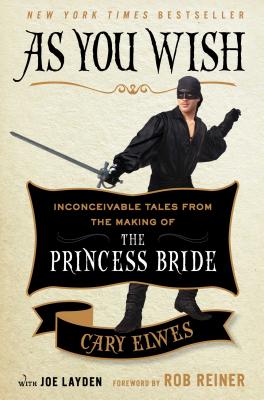
As You Wish

Inconceivable Tales from the Making of The Princess Bride
by Cary Elwes with Joe Layden
read by Cary Elwes (with other actors/directors/etc. reading their contributions)
Support your local independent bookstore: buy it there!
Content: There’s nothing “objectionable”, though the reading level is probably that of high school. It’s in the biography and film sections of the bookstore, but I’d give it to anyone who has a interest in the movie (especially if they are big fans).

I’m late to this party, since this book came out last October. But, I’ve had my eye on it, mostly because I have loved the movie for years (and am constantly surprised how many of my regular daily sayings are actually lines from this movie) and finally got my hands on the audio book.

There’s not much to say about the content: Cary Elwes was asked at the 25th anniversary screening of the movie what he took away from the making of it. He came up with (in his words) a lame answer, and this book was born out of his desire to really detail what the experience meant to him. He got contributions from the actors who are still alive, and a book was born.

It’s not brilliant writing by any stretch of the imagination. But, it is chock-full of fun trivia (yes, I did watch the movie again, spouting out all the wonderful tidbits I’ve learned. My family was patient with me.) and delightful stories.

But, the best thing? (And the reason I’d recommend the audio over the print?) Cary Elwes is a brilliant narrator. Not just his regular voice, but he does a spot-on American accent (several, in fact), and he is just a delightful narrator to spend six hours with.

At the very least, it’ll make you smile. And that, I think, is worth it.