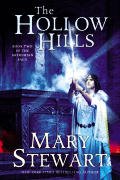
The Hollow Hills

When I started this one, Hubby commented that it was his favorite of the trilogy, mostly because Merlin goes traveling across Europe. While I liked Crystal Cave because I liked the Merlin that Stewart created, I liked this one primarily because this is my favorite part of the Arthurian legend. That, and Merlin goes a-traveling, which is always fun, too.

The Hollow Hills picks up right after the fateful night of Arthur’s conception, with Merlin limping back to his home in the cave in Wales. He’s servant-less for a while (which was mildly amusing; Merlin is just incapable of taking care of himself), but eventually gains a reluctant servant in Ralf, when he’s banished from the King’s (and by now Queen’s) presence, mostly for his role in that fateful night. Eventually, the Queen (and King) call Merlin to them and ask him for his help in taking care of Arthur and making sure Arthur is safe. Merlin, of course, makes the arrangements, and then, possibly to add mystery to the tale and most definitely to misdirect his (and Arthur’s) enemies, he takes off for the mainland of Europe, traveling to all the big cities. It’s not a large part of the novel, but it is an enjoyable one.

Once he deems it safe — well, actually because King Uther is dying and Merlin is who he is — Merlin heads back to Britain. He takes up residence in the Wild Forest, near where Arthur is being fostered, and takes over the mentoring of Arthur. I love this part; basically the last third of the book when Arthur himself enters the story. It’s the stuff legends are made of (well, duh): a strong-willed, energetic boy, learning all he can from an older, wiser man and then that boy somehow making himself worthy to become what he truly is… a King.

I did have some quibbles with this one, most notably with Morgause. I think I like Marion Zimmer Bradley’s treatment of the women better (as well I should, since Mists of Avalon is a pretty feminist-slanted work). While I recognize that Stewart was trying to be as faithful to history, giving men all the “power” and shunting the women off to the side (Merlin’s mother, Ninane wasn’t terribly well portrayed, though she wasn’t as weak as Ygraine), it still grated on me how Morgause, from pretty much the get-go was portrayed as a power-hungry, evil woman. Perhaps she was. (Perhaps she didn’t even exist.) But, I prefer Bradley’s interpretation of the women.

Aside from that (and that’s really only the last chapters), it’s a thoroughly enjoyable book. I still like Merlin as a character, and I think Stewart’s aging him nicely. I like that his character feels different in this book than he did in the last one: more mature, weightier, as he comes into the power and reason for existing that he’s been waiting for his whole life. He’s still portrayed as an imperfect human, but she draws more heavily on the prophecy and Sight aspects of Merlin’s character. Because of this, he’s beginning to take on the role that he’s known for best: that of Arthur’s right-hand, as well as prophet and enchanter. Even with all this, though, Merlin’s still a sympathetic character, as well as an understandable one.

Only one more book to go.

The Crystal Cave

I first read the Mary Stewart Merlin trilogy (of which this is the first book) during my Arthurian phases back when I was in college (actually, it was right after Hubby and I got married; he came to the marriage with these, of which I had never heard of, but would have discovered eventually, I suppose). I remember being captivated, enthralled, entranced, charmed and totally engrossed by them. I haven’t picked them up in 15 years (now you know how long we’ve been married…) and I was wondering whether or not they stood the test of time.

I’m glad to say, they have. Or at least, this one has (since I haven’t read the other two, yet). Stewart takes the legend — from Geoffrey of Monmouth’s History of the Kings of Britain — which, from what her Author’s Note stays, is terrible history, but a really good story. But, she goes above and beyond the standard Arthur fare, to give us Merlin’s story. And that is precisely what I loved about it. The book begins when Merlin is six years old, bastard son of a Welsh princess (Niniane in this book). He doesn’t know whom his father is; his mother isn’t telling anyone. He lives an uncomfortable, if quiet, existence in his grandfather’s house. He discovers, when he’s about 11, a cave and a master, Galapas, and his gift for the Sight — for prophecy, for visions, for Seeing. From there, when his servant accidentally kills the king — and the future king is no friend of Merlin’s — escapes to Brittany and into the hands of Ambrosius and Uther, to learn, to grow, and to help Ambrosius become King of Britain. And then the standard Arthur legend picks up (with a lovely side trip with Merlin raising Stonehenge; I remembered liking that part from the first time, and I still do): Uther desires Ygraine, Merlin helps him, and thus Arthur is conceived.

The thing I really liked (both times) is the humanization of Merlin. He’s too often made mystical, super-human; a wizard, a Druid, a Mage. Here, he’s just a guy with a gift for a god to use as he will and someone with a lot of smarts. He’s a normal person, with wants and desires and hopes and fears (though he doesn’t fear death, because he’s seen his own death), and while he’s not really ambitious, he’s at least willing to support others’ ambitious. He cares for people — his servants, his friends — and he’s genuinely concerned about them, even when it seems he’s not.

The other thing is how very modern Merlin feels himself to be. It’s 500 AD, and yet Merlin’s way ahead of his time. (Which isn’t hard, considering how barbaric it was!) A lot of what is attributed to “magic”, Stewart explains with logic, chance, and good engineering. It’s quite refreshing.

Now, on to read the other two.

Serving Crazy with Curry

I had originally picked this up to finish off my Expanding Horizons Challenge list because the review by CdnReader made me curious, but then Sarah gave me Interpreter of Maladies and I read that one instead. Still, it was sitting on my dresser, not due yet, and so I picked it up. I thought it was interesting, but like CdnReader, I wasn’t overly impressed by it.

Devi — a late-20s Indian woman — decides to commit suicide. Her life is terrible, especially in comparison to her father’s and her older sister’s, and there’s nothing left to live for. But, her mother saves her, and as a result, Devi moves in with her parents, stops talking and begins cooking. It also causes a chain reaction, causing everyone in her family to reevaluate whether or not their life is worth living.

I liked that there was a lot about decisions and comparisons. Everything everyone does in this book has some sort of consequence, whether it was a recent decision, or something more in the past. I liked that; I liked that people had to deal with the consequences of their own lives. I thought the observations that Amulya Malladi made about sisters and family and comparisons and parenting were good ones. I even liked Devi as a character, though the rest of her family took a bit of getting used to. The prose felt a bit clinical at times, but that’s possibly due to the switching of the narratives; you get portions of the story from different points of view, and it didn’t really work as well as I hoped it would.

But, I think one of my biggest disappointments was the lack of food. Yeah, it was there, hanging out in the background with Devi’s experimental fusion Indian cooking, but it wasn’t as delicious or as sensory as I hoped it would be. I wanted to get a feel for the Indian food, and I felt that I was missing something because I didn’t know what half the dishes were. I wanted this book to make me desire to eat Indian food, but it fell flat. I was even disappointed by “mouthwatering recipes”. They were mostly just lists of ingredients and ways to throw them together, not the how of it all. Which I found disappointing.

So, in the end, it’s a decent novel — kind of soap-operaish, but with interesting people — but nothing to jump and shout about.

American Gods

Forgive the bad Asian food metaphor. I thought of it early on while reading American Gods, and I liked it so much that I had to use it.

See, Stardust is fried rice. It’s nondescript. Everyone likes it. Sure, it may have elements that you don’t like, say watercress, or things that you wonder why it’s in there — broccoli or celery — but pretty much, everyone likes fried rice. It’s good. It’s simple. It’s tasty.

But, American Gods is kim chee. (Hubby took issue with this; he likes Korean food. I have to admit that I do too.) It’s loud. It’s obnoxious. It’s spicy. It’s not easily accessible. It takes some real getting used to. Not many people eat kim chee for the first time and say “Wow! This fermented spicy cabbage is THE BEST THING OUT THERE!” (I know I didn’t. I thought, when Hubby and I were dating and he took me to a Korean restaurant that he was eating one of the grossest things I’ve ever seen.)

American Gods is one weird book. As I thought about it, I’m not sure if it’s awful weird or brilliant weird. While I was reading, it was kind of awful weird. It’s incredibly vulgar and basically without a plot until the last 1/4 of the book. I felt like I was a car stuck in the mud, wheels spinning. Shadow, as a main character, is interesting, but actionless. He’s just a drifter, someone who moves from story to story within the book. I skipped whole sections, wondering about the point of that particular weird encounter or story. (Especially the interludes. They were really weird, and pretty pointless.)

But, after finishing it (at the end I thought, “REALLY! That’s it? That’s the whole point?!”), and thinking about it, and talking to Hubby about it, I began to realize the brilliance of the whole thing. You’re supposed to feel like a car spinning in the mud. The main character’s supposed to be a ruse, a distraction. That’s because (sorry, can’t avoid the spoilers) it’s all one big con. Not just for the characters, but for reader as well. Sure, if you’re a close reader (which I’m not), you would have picked up on the clues (brilliant foreshadowing), and figured it out way before I did. But, even so, when it’s all said and done, I think it’s a brilliant concept.

See? It’s Korean food. It takes some getting used to, but once you do, it just might be some of the best stuff you’ve eaten. (It just might not be for everyone.)

Mansfield Park

This was the other Jane Austen (along with Northanger Abbey) that merited a one sentence review: “It’s not a bad book; I just like her other stuff a whole lot better. ” Actually, I’m going to change that, borrowing a line from Becky’s review of Camilla: It’s not Jane Austen’s best work, being both delightfully pleasant (I did smile a few times) and yet sluggishly dull. But it’s not my favorite Austen, and it never will be.

Why do I not like thee? Let me count the ways:

1) Fanny. She’s annoying. She’s a doormat, a pushover. Sure, she’s an upright, moral person, but what good is that if she can’t even do anything without Edmund there. Yeah, there’s the whole status thing and Mrs. Norris is sufficiently vile, but even so, I’d like her to just be slightly more assertive, or at least more something. She reminded me of Anne in Persuasion, but Anne’s so much more sympathetic. Perhaps it’s because she’s older. But Anne knows her own mind, and even though her family (and others) think little of her, she’s not a doormat. Fanny is, and that drove me nuts. That, and she spent the entire book pining for Edmund. (Mr. Crawford wasn’t that bad until the end. Okay, so their sensibilities were not similar, but he really was trying and she just sat there pining for Edmund. What if he had never come round?) She’s not a sympathetic heroine at all. Which brings me to point 2.

2) The love story was terrible. This book was a long diatribe on what Austen believed to make up a good character. She abhorred excess in all its forms — either too rich or too drunk or too poor or too flirty — and Fanny was supposed to be the model of quiet, sensible decorum. (She didn’t like the spoiling of the Bertram sisters, but she also didn’t like the excess of ill manners at her parents house.) The love story was an afterthought, only coming on in the last 50 pages. Even Northanger Abbey had a better love story. When you read Austen, you want to read good character development and societal parody but you also want a good love story. At least I do. And I was highly unsatisfied with this one. (It’s not the “kissing cousins” thing. I can deal with that. It’s the “Edmund’s in love with Miss Crawford for the entire book and it’s just because she wasn’t horrified enough — or at all, really — at the actions of Henry and Maria and so Edmund realized that he could not marry someone who couldn’t be horrified at running away with someone else’s wife and that means Fanny has to be perfect” thing. Bleh.)

3) All the other characters. Enough said. Mrs. Norris was vile, evil, and I wanted to smack her. No wonder Maria went wrong. Sir Thomas and Lady Betram were lazy and Mrs. Norris was just a snob. She’s worse than Lady Catherine deBerg, too, because Mrs. Norris really has no reason to be a snob. She’s someone Lady Catherine would look down on. That makes it worse. Lady Bertram was as much a pushover as Fanny (maybe that’s why they got along?). Sir Thomas was a flip-flopper, sometimes being nice to Fanny, sometimes being a real jerk. Edmund was a twit. Sorry. See above. Tom was a drunk (at least he reformed). The Bertram sisters were shallow flirts and Maria got what she deserved. No pity. Mary Crawford was also a shallow, money grubbing flirt who could have been okay, but Austen decided that no, the only “decent” person in the book is going to be the pushover Fanny. And then there’s Henry. I actually liked him until he ran off with Maria. He wasn’t too bad; a bit of a flirt, but he was actually fun and interesting (and he read and acted well).

Mansfield Park isn’t an Austen book I’m going to come back to any time soon. I’d say that’s too bad, but I’m perfectly happy with the Austen books I do like.

Djinn in the Nightengale’s Eye

A couple years ago, when I read Possession (also by A. S. Byatt), my friend Julie recommended this collection of fairy stories, saying that I would LOVE it. She’s almost right: I liked it, but it fell short of LOVE. (Sorry, Julie.)

I really liked the first three stories: “The Glass Coffin”, which was a Snow White-esque story with a tailor instead of a prince waking up the imprisoned princess; “Gode’s Story,” a somewhat complex story about a man who wanted a woman, cursed her to wait for him, dumped her when she became haunted, married another and then became haunted when the first woman killed herself; and, my favorite,”The Story of the Eldest Princess,” where she goes off on a quest, but because she’s read so many stories, ends up opting out of the whole quest thing and instead hooks up with an old healer woman.

The other two stories — “Dragon’s Breath” and the title one — were okay, but not nearly as enjoyable. My complaints with Djinn, especially, are similar to the ones I had about Possession: too much extra stuff, but not enough plot. When it finally got around to the plot, I really enjoyed it: what would you do if you had access to a personal djinn? (And, what is it that a woman most desires? They never answer that one.)

It really was a collection of stories about stories. Sometimes, it worked — like in “The Eldest Princess”; sometimes, not so much, like in “Dragon’s Breath”. But when it worked, it worked really well, and I was captivated by the writing — Byatt is a really descriptive writer; I just wish she’d be a tighter writer. Perhaps that’s why the shorter stories appealed to me more: the writing was tighter, the stories more linear and less circular. They worked better for me.

Maybe sometimes I do “get” short stories. Funny.

Interpreter of Maladies

I was supposed to read Mistress for my last Expanding Horizons Challenge book. But I’ve had it on hold at the library for two months, and I just don’t think it’s coming (mostly because it’s currently listed as in the display case). So, I cast about looking for a last book to fill the Indian requirement, and my friend Sarah lent me this book.

For those of you (like me) not in the know: it’s a series of short stories written by Jhumpa Lahiri, an Indian-American. The stories feature people in various situations — dealing with death, with affairs, with tourists, with life — and places. Some are in America, some in India, some in England. One of the things that bothered me is that I kept trying to come up with some overarching theme, some reason why these stories were supposed to be together in a book. That was foolish of me (I don’t read enough short story collections): each story was meant to stand on it’s own, a little snapshot into the lives of the characters.

On the one hand, I loved this book. The prose is very eloquent (I can see why it won the Pulitzer Prize; it seems to be that sort of book), the images very picturesque. And yet, I felt on some level like it was calculated. It bothered me the same sort of way poetry bothers me — it’s beautiful, but I feel like I’m missing something. It’s like seeing a snapshot of an event versus experiencing the whole event. And, when I read at least, I often prefer the whole event to a little slice. I felt like I wanted more, needed more, and just when it was getting interesting, the story ended. That’s not to say I didn’t like the stories. “Mrs. Sen’s” was a very touching look at being an immigrant and adjusting to a new life in a new country. “This Blessed House” was amusing — a newly married couple kept finding Christian iconography (for lack of a better word) around their newly bought house — and an interesting look at the compromises people have to make when they get married. And, my favorite, ” The Third and Final Continent” was a nice portrait of a man’s immigrant journey and the people he encountered before and after arriving in the U.S. to settle. It’s also a glimpse into what the second immigrant generation loses.

Even though I wasn’t ultimately satisfied by it, it was a good read, something that I’m not sorry to spend my time on. Maybe one of these days, I’ll even “get” it.

The Other Boleyn Girl

I tried, a few years back (almost exactly), to read this one by Philippa Gregory, to no avail; I had read a couple other fiction books on Anne Boleyn and the Tudors (albeit YA fiction), and I was Tudored out. I went on and enjoyed two others by her, but this one was always lurking in the background; I figured I’d get around to it someday. The release of the movie prompted me to pick it up again. But, 230 pages into it, I realized something: I really don’t like these characters. In fact, I loathe them. I don’t mind naked ambition so much, but combine naked ambition with wantonly using people and loose morals, and you’ve got a bunch of people I’d rather not be reading about.

So, I bailed. Sometime after Mary Boleyn was pushed aside as King Henry VIII’s lover and Anne was squirming her way in, I decided that I’ve had enough of the Boleyn and Howard family. I mean, really: it’s one thing to be an object of the king’s desire, and to have him literally lust after you in front of his wife, the Queen. It’s entirely another to be practically pushed on him by your family (father and uncle specifically) and told to go have sex with Henry because it’s good for the family, while your poor husband (which your family arranged for you to marry in the first place) is shunted to the sidelines. Ugh. And so, since I know how the book ends anyway (everyone knows how the book ends; that’ s not the point), why bother spending time with such disagreeable people?

It’s not Philippa Gregory; as I said, I enjoyed both The Queen’s Fool and The Virgin’s Lover (though I remember liking the former better). Rather, it’s the Tudors, Howards and Boleyns. They were just despicable people (well, in historical fiction, anyway, they’re made out to be despicable people). And I think I’d rather not read about them. (Though I do have to admit, I’m intrigued enough by the time period that I’m rather curious about HBO’s The Tudors. I don’t know if I’ll ever get around to getting the DVDs, though… maybe after I forget how annoying and amoral these people were…)

This does mean, however, that I’m not going to count this one for the Once Upon a Time Challenge. I think I’ll substitute American Gods by Neil Gaiman, instead. I’ve been meaning to read another Gaiman. It’s got to be better than the Tudors, anyway.

The Winter Queen

I almost got a Russian minor in college. I know, I know… I’m not exactly a connoisseur of all things Russian around here, but I did have an interest in the country during my college days. (That and I had a morbid fear of Calculus. I know, I know… Russian isn’t easier than calculus. But try telling a stubborn 18-year-old that.) Anyway… I was trudging along taking classes, and mostly enjoying them until it came to the last two classes for a minor. One was conversation, and it was taught by a grumpy Russian woman, who told me that if I took her class she’d fail me. I spoke horribly. The other was the Russian literature class. I realized I just couldn’t stomach Russian literature.

Well, either I was horribly wrong (and I’ll admit that I could have been — Anna Karenina wasn’t nearly as horrible as I thought it would be… except for the last 100 pages. They were worthless) or Russian literature has changed a whole lot in the last 20 years.

Because I loved this book.

I’m not a big mystery reader, but I do love it when I find a good one. One that keeps me guessing, that makes me bite my nails, that keeps me up until late hours trying to finish it. Throw in a bit of humor, keep it relatively clean, add a winning/cute/sympathetic, detective, add a real intense ending, and you’ve got me hooked.

There you have it: Boris Akunin’s The Winter Queen in a nutshell. Really. Why bother with a plot summary, when all you really need to know is that Erast Fandorian, while no Sherlock Holmes, is an up-and-coming detective who just happens to get involved in something way over his head. And that he manages to solve the mystery anyway. And don’t forget the ending that had me going, “AAAAHHH! Where’s the next book!”

There’s really nothing more to say.

The Saffron Kitchen

This is one of those really good book-group books; there’s so much fodder for discussion. Talk about Sara and her relationship to her parents, especially her mother. Compare Sara’s and Maryam’s childhoods… was Maryam a good mother? Talk about Maryam’s relationship with her father. How did it affect her future and why do/don’t you think it affected her?

And the one that’s been haunting me for a couple of days: Was Maryam’s decision right?

I won’t bore you with the personal details on my end (I’d rather not, anyway), but I will say that this book threw my past up in my face (in a way; I didn’t live in Iran, obviously, and my father was — and is — actually a very kind, loving man. ) and made me assess my present. Can a person be happy in the life and love she chose even when she has had to give up something very dear to her?

I’d like to think, yes, she can.

But, one of the premises of the book — sorry for the spoilers, I don’t know how to review this without divulging it, because it’s just too personal — is that Maryam, at least, can’t. She lives with the ghosts, is haunted by her past, and ends up wrecking her life in order to face that past. I felt so bad for her husband, Edward. The only thing he ever did to deserve being left is love her. And that’s just not fair. That’s not fair of me, though, because this book isn’t about fairness.

I did like that it addressed issues of homeland and exile — is part of the reason why Maryam can’t overcome her past because she was forced to leave her country for another? (Ah, another book group question.) I liked and admired Sara; she was stuck in the middle of all this, and helplessly confused about her mother’s actions, especially since they so closely deal with Sara, herself. I liked Sara’s marriage to Julian — it was grounded, honest, and open, everything a good marriage should be. (And, I should add, very unlike her parents’. )

I’m not sorry I read this, but I do have to say it’s not one I, personally, will be reading again. The language is beautiful, the story haunting and moving. It’s just too close for comfort.