Sea Glass

by Maria V. Snyder
ages: adult
First sentence: “Worry and dread clawed at my stomach.”
Support your local independent bookstore, buy it there!

The problem with second books in a trilogy is precisely that: they are second books. They neither create nor resolve conflicts that are playing out over the course of the books. Their place is to advance the story, to create subplots, and to, well, make people want to read the conclusion. Which means, often, that they are either meandering or depressing.

In this case, it’s meandering that wins out. We pick up the story immediately after Storm Glass ends, with Opal facing the consequences of her new-found powers. Opal, as a character, is all over the map in this one: she’s moody, she’s mistrusting, she’s insecure, she’s trying to strike out on her own. She develops her romance with one of the leads, but yet can’t deny she has feelings for another. She wanders around in the dark abyss of second-book-in-a-series-dom, leaving us readers to wonder why on earth we’re reading this book (so we’ll be ready for the conclusion!).

Synder’s not on the top of her game in this book; while the world is still fascinating, it’s not quite enough to offset the wandering plot. Snyder has the characters go all over the place — so much time is spent traveling! — and introduces plots and subplots and characters that don’t go anywhere, or even do much to add to the initial story. It’ll all probably make sense when the third book comes out, but until then, readers are left hanging and wondering what this all means.

And until then, we can blame it all on it being the second book in a trilogy.

Sugar

by Bernice L. McFadden
ages: adult
First sentence: “Jude was dead.”
Support your local independent bookstore: buy it there!

I don’t quite know what to say about this.

On the one hand, it’s a really well written story about acceptance and redemption (of sorts), of prejudice in a small Southern town, of friendship.

On the other hand, it’s about sex. All kinds of sex. Violent sex. Prostitute sex. Married sex. Lustful sex. How women react to sex. How men need sex. How sex drives so much of what we do.

Sure, the book’s about a prostitute, and it starts with a violent murder/rape. But, I’ve read other books about prostitutes that were less about the sex and more about the person than this book was. It was a bit heavy on the sex for me. Perhaps McFadden meant for it to be this way; perhaps the story couldn’t have been told any other way, but I often felt that the sex was weighing down the story, not allowing the real story — the relationship between our two main characters, Pearl and Sugar, and their respective needs to heal — to come through.

And so, being distracted by all the sex, I wasn’t really able to appreciate what McFadden was attempting to say. Attempting, because I’m not sure she even succeeded without all the sex. The story was well-written — there was some beautiful descriptive language, and sometimes even the vulgarity was used effectively — but meandering. At first, I liked the flashbacks and back story, but by the end, when I as a reader knew more than the characters in the book, it felt wearisome. I wanted more of a redemptive story, and I was given the hopes of one. Then, at the last minute, it was taken away from me; Pearl was sent back into mourning, Sugar went back to her old lifestyle, and Pearl’s husband, Joe, was thrown into the metaphorical fire. Not a happy or even hopeful ending.

However, I’m sure you can chalk this one up to it being just me, for whatever reason.

Howards End

by E. M. Forester
ages: adult
First sentence: “One may as well begin with Helen’s letters to her sister.”
Support your local independent bookstore: buy it there!

Quick memory: I first read this book when Hubby and I moved from Utah to Washington, DC. In one of those weird quirks of time and space (especially since I usually get very carsick if I’m not constantly looking out the window), I was able to read this while we were driving the moving truck across the country. I remember two things about my impressions the book: I liked it and I thought it wasn’t anything like the movie.

I can’t speak for the movie part anymore (though I’m going to re-watch it soon), but I still quite liked the book. If you haven’t read it, it’s the story of two sisters — Margaret and Helen Schlegel. They’re half German, middle class women in their mid- to late- twenties (old maids in Austen’s books, anyway), liberal in their thought. It’s only when they cross paths with two families — one old-school wealthy (the Wilcoxes) and one definitely lower class (the Basts) — that their ordered lives, as well as their philosophy, get thrown into a tailspin.

The thing that struck me most this time around (perhaps it struck me last time, too) was that this not only a book about the class divide in early-20th-century England, but it was also a book about the connections that are made between people. Margaret meets Mrs. Wilcox, which impresses Mrs. Wilcox enough that she wills Howards End to Margaret. This in turn sets the rest of the family off (because it’s just not “done”), which in turn leads the family to interact with the Schlegel sisters, which leads to Margaret’s falling in love with and marrying Mr. Wilcox. In turn, Leonard Bast accidentally meets the Schlegel sisters, and that in turn, eventually changes the course of his life. It’s fascinating seeing all the intricate connections that Forester weaves through the book.

And it works, I think, because Forester is such an astute writer. He doesn’t dribble on like Dickens (sorry), and he’s not as brilliantly pointed as Austen. But, he is observant about people’s characters and, perhaps most of all, their motivations. He is able to get inside a character, so much so that you understand them, even if you don’t like them all that much. And that is what really drives this story, making all the various elements in it work well together. Which is good, because I’m not sure, in the end, that this is a truly memorable story with a memorable plot and memorable characters.

That’s not to say it’s not a good book; it is. It’s just not one that I think I’ll talk about and think about for quite a while.

The Catcher in the Rye

by J. D. Salinger
ages: 16+
First sentence: “If you really want to hear about it, the first thing you’ll probably want to know is where I was born, and what my lousy childhood was like, and how my parents were occupied and all before they had me, and all that David Copperfield kind of crap, but I don’t feel like going into it, if you want to know the truth.”
Support your local independent bookstore: buy it there!

I’ve gotten the impression that you can’t be on the fence about this book, that you either love it or hate it.

Well… I’m mostly ambivalent.

I didn’t hate the book. Sure Holden was annoying — so gratingly annoying — but I mostly felt pity for him. He was so pretentious and judgemental, and yet I could see that underneath all of that he was confused, lost and hopelessly depressed. The poor kid needs a good shrink and some meds. But barring that, he was mostly just a punk teenager trying to be more grown up than he actually was. Nothing to hate, nothing to despise, much to pity.

The book itself was all right. I’m not a huge fan of stream-of-consciousness books; I like things to clip along without spending much time in a character’s head. But, this book wouldn’t have worked any other way. Or, if it was told in another fashion, I don’t think it would have had the same impact. The reader could be more dispassionate about Holden and his troubles (for all my ambivalence, I wasn’t dispassionate; I did have emotional reactions to it all), and more dismissive. This way, with Holden being the narrator — though I have to admit that I wondered whether or not he was reliable; he did admit to being a liar, after all. Did any of this *actually* happen, or was it all in his head? — the reader was forced to confront Holden and his missteps, insecurities and judgements, and react to them, for good or ill. It’s a challenging book in that it throws life — a depressed, miserable life — in the readers’ faces, without flinching, without embarrassment, and makes the reader deal with it. Which is something that I can respect.

One other thing: I think I understand better what John Green was getting at in Looking for Alaska. If only for that, I am glad I read this one.

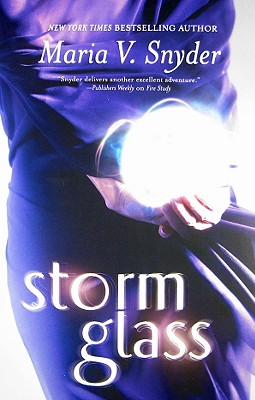
Storm Glass

by Maria V. Snyder
ages: 14+
First sentence; “The hot air pressed against my face as I entered the glass factory.”
Support your local bookstore: buy it there!

Four years after Opal helped Yelena capture the Warpers in Fire Study, she’s still dealing with the aftermath. She’s a student at the Keep, learning to be a magician, except she’s more of a one-trick wonder. Sure, that one trick — blowing magic into her glass sculptures in order to test for a person’s magic ability, and enabling magicians to communicate with each other — is pretty useful. But she keeps her distance from the others students, assuming they don’t want much to do with her.

Things change for her when she is called out to fix the problem with the Stormdancers on the coast: their glass orbs are breaking and killing some of the dancers. Opal, with all of her trust and confidence issues, is able to handle the problem, but that also opens up a Pandora’s box of problems, some of which are positive, but many just pick at the wounds Opal’s been trying to heal.

It’s not as good a book as the Study Series, but it’s not a bad book either. Opal has the potential, with all her (understandable) hesitation to be completely annoying, but Snyder pulls off the delicate balance between insecure and grating. The fact that Opal’s dealt with a lot, physically and psychologically, helps with that balance. As does her love interests. The romance isn’t as swooning as Valek and Yelena’s (can I mention that I missed Valek? I. missed. Valek. Kade’s a decent romantic hero, and while I didn’t trust Ulrick as far as I could throw him, I could understand the appeal. But neither is Valek. Swoon.), but it has potential. The thing that carries this book, however, is the world that Snyder has created. It’s a complex and intriguing place and Snyder builds upon the foundation she laid in the Study books. I would probably go as far as to say that if you haven’t read the Study series, this one might not make much sense. Snyder does go into some back history, but newbies might get lost.

That said, it was a fun book, fluffy and light: perfect for a cold winter’s day.

The Undaunted

by Gerald N. Lund
ages: adult
First sentence: “David Dickinson’s eyes were wide open.”
Review copy sent to me by someone at By Common Consent because I volunteered for this torture.

Five ways to ruin a historical novel:

5. Write in dialect: “It be joost fur me, Dah?” If I have to read it aloud to understand it, it’s not worth my time.

4. Too much historical detail, not enough plot. “These full-sized coal carts were four feet wide and eight feet long and could hold the contents of six of the small coal tubs. That was about four tons of coal each. The carts had wheels and axles formed from a single piece of steel. This meant the two wheels did not turn independently, nor did they have an independent braking system. This was where the spraggers come in. If a car got rolling too fast down a grade, it would jump the tracks and smash into the wall.” I really don’t care that much about mining practices in England in the mid-19th century anyway. I swear about 500 pages of this book could have been axed. (Granted, I only made it through the first 50, but I’m just sayin’.)

3. Too much narrative exposition, not enough action. “David still hesitated. He liked Albert Beames, or Bertie, as most of the trappers called him. He was a bit odd looking, with freckles hidden beneath the layers of coal dust, and teeth that were prominent enough that some of the older boys called him Beaver Beames. Bertie was a year older than David and about a stone heaver* [yep, that was footnoted] He was totally devoid of ambition and was baffled by David’s continual talk of becoming a hurrier.” Three words for you: Show. Don’t tell.

2. Having a Message. Okay: I get it. They were Brave and Noble and Faithful. It’d be nice if they were interesting characters, too.

And the number one way to kill a historical novel:

1. Footnotes and endnotes. Puh-lease. It’s fiction, not a textbook. If I really cared what Yorkshire Pudding or Turkish Delight was I’d Google it.

I knew there was a reason I never read LDS fiction.

Mr. Darcy Broke My Heart

by Beth Pattillo
ages: adult
First sentence: “The taxi pulled up outside Christ Church, and I climbed out of the backseat, but the scorching July heat stole my breath and the threatened to press me back inside the cab.”
Support your local independent bookstore: buy it there!
Review copy sent to me by a publicist.

Claire is one of those long-suffering heroines that readers tend to either really identify with or supremely hate. Since her parents’ deaths when she was 18, she has done everything in her power to help her younger sister, Missy. Claire sacrificed her education, getting a GED and foregoing college. She sacrificed a good job: most recently she was an office manager for a pediatricians’ office, and has been recently laid of. She’s been unlucky in men, settling for Neil, a sports enthusiast who, while nice enough, may not even know that Claire’s off to Oxford, in her sister’s place, for a week-long seminar on Pride and Prejudice.

It’s only once Claire’s across the pond that all she’s sacrificed comes plainly into view. She meets James — suave, polished, gorgeous, rich — and immediately falls for him. In addition, she meets Harriet, of the Formidables (a society devoted to keeping Austen’s secrets), who lets Claire on a big secret: she has the original copy of First Impressions, the novel P&P is based on. As Claire reads on — noting the substantial changes from the final novel — she finds similarities to her own life (funny how that happens), and ends up doing some major soul searching. It’s a happily-ever-after, but not the one that you were expecting.

I should be jumping and cheering: the average Joe gets the girl! (Sorry. Spoilers there.) Claire goes with the normal, the everyday, and finds happiness. Yet… Claire is so insipid that I could hardly stand her enough to get through the novel. She eventually finds a backbone, but not before she goes through pages and pages of waffling. Sure, she’s still grieving over the loss of her parents — or rather, she’s suppressed the grieving process in favor of responsibility — but we’re never really given much of a chance to connect with her on that level. But what really bugged me was the significant changes to the P&P story. Sure, it’s nice to imagine that a copy of First Impressions could be out there, and sure it’s plausible that the story would be radially different from the final P&P, but it just didn’t work for me. At all. Period. I skipped those pages, cringing at the attempt to capture the magic that is Jane Austen.

As the characters in the novel eventually figure out: some things are better left untouched.

The Street of a Thousand Blossoms

by Gail Tsukiyama
ages: adult
First sentence: “A white light seeped through the shoji windows and into the room, along with the morning chill.”
Support your local independent bookstore: buy it there!

The thing that kept coming to mind as I was reading this sweeping novel, was that this book is much like a picture album. The pictures go together because they’re of the same family, and because they tell a story of the passing years. But, each individual picture has a story. Sometimes those stories are interesting, sometimes they’re a little boring. Much like this book.

Tsukiyama tells the story of two brothers — Hiroshi and Kenji — over the course of nearly 30 years. When we first meet them, it’s 1939, and they are orphans living with their grandparents (their parents died in a freak boating accident). The book follows them as they grow up: through the horrors of the war years; Hiroshi’s rise as a sumotori and Kenji’s discovery and mastery of the art of theater mask making; as both brothers find (and lose) love. It’s more than a slice of life, it’s history.

But, even though it’s quite lyrical and beautifully written and incorporates Japanese incredibly seamlessly, I found myself going back and forth on this one. Some of the snapshots were fascinating. Some of the people I cared immensely about. But, sometimes I found myself unable to get into the language, or drifting off because the plot, such as it was, wasn’t grabbing me.

That said, one of the things that Tsukiyama does beautifully is give us a slice of Japan. More than the people, it was the way Tsukiyama described the land, the culture, and the people, as well as the push and pull between tradition and modernity. For that alone, the book is worth reading.

The Heretic’s Daughter

by Kathleen Kent
ages: adult
First sentence: “The distance by wagon from Billerica to neighboring Andover is but nine miles.”
Support your local independent bookstore, buy it there!

This is a fascinating, harrowing tale about a time in American history that I know very little about: the Salem witch trials.

Our main character, Sarah Carrier, is growing up in Billerica (and later Andover), Massachusetts. She’s often at odds with her hard, logical, unsentimental mother, Martha. Then, the summer of 1691, Martha is arrested on suspicion of being a witch, and asks Sarah to do the unspeakable: to cry out against her own mother in order to save her life. That’s the basic plot in a nutshell, but the book is so much more than that. Rambling and long, it’s a look at how Puritan communities and families functioned and interacted. It’s an attempt to understand why the Salem witch trials happened — whether it was just misunderstanding, fear, or jealousy; though in that case, I’m not sure it succeeded. I was left with almost more questions, especially after the descriptions of Martha’s trial. It’s almost incomprehensible to the modern mind how exactly everyone could let these abuses of human rights could go on. It was a different time and place, and that feeling is something Kent captured quite well.

The ending, for me, was a bit off, though. After Martha’s trial (and eventual execution), the book goes on telling us the fate of Sarah. Sure, it’s called the heretic’s daughter, but I’m not sure I really cared that much about Sarah’s fate. Perhaps it was because I was more emotionally invested in the story of her mother, and their relationship. Or maybe it was because Kent leaps over years and years in the final 7 pages. At any rate, the final revelation, the final secret her mother was keeping came as a “Huh, what?!” moment, which lessened the impact of the rest of the book.

Which, to be sure, was fascinating.

The Wine-Dark Sea

by Leonardo Sciascia
ages: adult
First sentence: ‘Your Majesty,’ said the Minister of State Santangelo, tapping Ferdinand lightly on the shoulder with one finger, ‘this is Grotte.'”
Support your local independent bookstore: buy it there!

I’m not a fan of short stories. I don’t know why that is, really. Perhaps it’s because I feel disjointed from one story to the next — I do better when the stories are interconnected. Or perhaps, it’s just that there’s not enough meat there for me.

So, keeping that in mind, I really didn’t care all that much for this collection of stories. Sure, they were a slice of Sicily — from the mafia to the ups and downs of everyday life — but most of them fell quite flat. I did like the title story, however. It was a tale of a man who bonds with a family and their nanny on the way to Sicily. It’s sweet, it’s funny, and enjoyable to read. Some of the other ones — Guifa and End-Game, are ones that I think of off the top of my head — are cleverly written, but a bit strange. The rest ranged from “meh” to “I think I’m going to skip this one.”

Perhaps it’s the translation? Nah… it’s probably just me. And my short-story issues.