Audio book: The Bookshop of Yesterdays

by Amy Meyerson
Read by Ann Marie Gideon
Support your local bookstore: buy it there!
Or listen at Libro.fm
Content: There is some mention of sex, and swearing, including f-bombs. It’s in the fiction section of the bookstore.

Miranda Brooks is happy with her life. She has a good job teaching history to 8th graders in Philadelphia. She has a good boyfriend she just moved in with. She doesn’t want to shake things up.

Then she gets a package in the mail — a copy of the Tempest, her estranged uncle’s favorite play — and a note that said uncle has just passed away. Suddenly, she’s off on a plane to LA, the land of her youth, to follow the clues her uncle laid out, to find out the mystery of her past, and how her once-beloved uncle was pushed out of her life.

In addition, Miranda is left sole ownership of the bookstore, Prospero Books, that she has fond memories of when she was a little girl. Through the quest her uncle set, and through the regulars at the bookshop, Miranda slowly finds meaning in what she assumed was a pretty good life.

Oh I enjoyed this one! The narrator was perfect, the story sufficiently bookish, with a side of mystery and romance. It hit all my happy buttons. Not sure it’s high literature, but it was definitely fun.

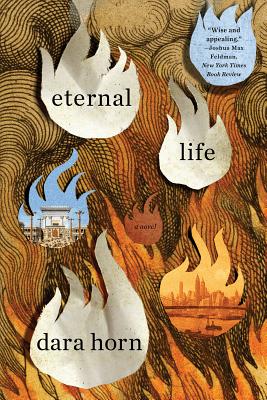
Eternal Life

by Dara Horn
First sentence: “Either everything matters, or everything is an outrageous waste of time.”
Support your local independent bookstore: buy it there!
Content: There is some swearing, including multiple f-bombs. It’s in the adult fiction section of the booktstore.

Rachel has lived for centuries. Way way back, in Roman-occupied territory, she made a deal with God: save her son (the child of her and her love) and she will give over her death. Which means: she’s lived a long, long time. She’s been married many times, and reinvented herself many times. She’s had dozens and dozens of children. And yet, she’s never looked older than eighteen.

And so, in this most recent iteration of her life, her granddaughter is a scientist who is trying to solve the “problem” of death, and her lover (who also fore-swore death) has shown back up, manipulating her children’s lives, and Rachel has realized (not for the first time) that what makes life bearable is knowing that it ends.

The book was… okay. As far as musings about eternal life and what it means goes, it’s not bad. And I did finish it, so it wasn’t horrible. It just wasn’t great. It was interesting, but not compelling, and the ending was just there. Maybe I expected something more exciting (it’s about what it means to not die, after all), but really, it wasn’t all that.

Audio book: Where the Crawdad’s Sing

by Delia Owens
Read by Cassandra Campbell
Support your local independent bookstore: buy it there!
Or listen at Libro.fm
Content: There is some talk about sex, as well as off-screen sex; domestic abuse, and an attempted rape scene. There is also some mild language. It’s in the adult fiction section of the bookstore.

My co-workers have been raving about this for months, and I just hadn’t gotten around to reading it. A long drive home from Texas seemed just the time to give it ago.

It’s nominally the story of Kya, a girl who grew up in the marshes of North Carolina. Her father was an abusive drunk, and her mother and siblings all abandoned her to her father when she was seven. She basically raised herself, especially after her father left three years later. With some help from the African American community, she basically figured things out on her own. She did have one friend, Tate, who taught her to read and encouraged her in her scientific studies — she was basically self-educated, but also highly observant — of the marshlands. And then Tate left to go to college and didn’t come back.

It’s also a bit of a murder mystery. The bright young star in town, Chase Andrews, is found dead by the fire tower. And all signs point to Kya as the murderer. The question was: did she do it, or was she framed?

It’s a gorgeously written book, full of details about the natural world, and the narrator was marvelous. I was spellbound most of the way through the book. But I think I was more invested in the murder mystery part of that, because it was left without a tidy resolution. (Ah, adult fiction being so true to life.) I liked the characters, but it really was Owens’ storytelling that drew me in (and the narrator’s reading!) and kept me hooked in this book.

A really excellent read.

The Girls at 17 Swann Street

by Yara Zgheib
First sentence: “I call it the Van Gogh bedroom.”
Support your local independent bookstore: buy it there!
Review copy provided by the publisher.
Content: There is frank discussion of eating disorders and some mild swearing. If the girls were younger, it’d be a Teen book, but because they’re in their 20s, it lands in Adult Fiction. It’d be appropriate for teenagers, though.

Anna has moved to St. Louis from Paris because her husband, Matthias, got a job here. She was a ballerina, but injured herself and has been off dancing for a while. And when she moved to the states, she couldn’t find a dancing job. One thing led to another, and it soon turned out that the only thing that Anna really could control was her eating. And control it she did, right down to 88 pounds.

Which is why she ended up at 17 Swann Street, a treatment house for those with eating disorders, primarily anorexia and bulimia.

The book follows Anna through six weeks of treatment, while we find out how she ended up at 17 Swann Street through flashbacks. We get to know some of the other patients, but only through Anna’s eyes, as well as Anna’s personal struggles with body image and food.

I liked this book, but I didn’t love it. Partially was visual: there was just too many italics. I know it’s a little thing, but I got tired of reading in italics and felt that they were unnecessary. But, beyond that, I felt that this was kind of clinical, and I was kept at an arm’s distance from really feeling like I was involved in it. Maybe it was me (I have my issues with food, but not a full-blown eating disorder), but I just didn’t connect with Anna or her story. I felt it was all a bit too… pat, for lack of another word.

It’s not a bad book — I finished it, after all — but it’s not the best I’ve read either.

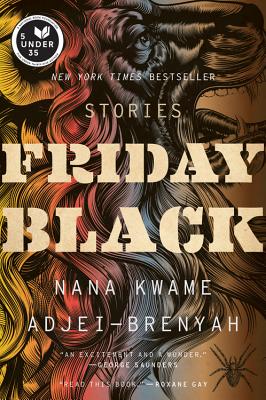
Friday Black

by Nana Kwame Adjei-Brenyah
First sentence: “Fela, the headless girl, walked toward Emmanuel.”
Support your local independent bookstore: buy it there!
Content: It’s violent and there is some strong language, including a lot of f-bombs. It’s in the adult fiction section of the bookstore. 

I picked this one up after hearing the author on the New York Times Book Review Podcast. I’m not usually a short story sort of person — and this one took me a while to get through — but it sounded fascinating enough that I felt compelled to pick it up. 

It’s a set of mostly unconnected short stories (though there are three about working in retail that take place in the same store) about what it’s like to be black in America. It’s nominally speculative fiction: the shoppers in the title story are forms of zombies, made that way by consumer greed, literally killing each other on the way to get the Product They Need. Or, in the final story, “Through the Flash”, Adjei-Brenyah imagines a future where technology and climate change has stuck us all in this terrible time loop, doomed forever to repeat the same day and the effects that would have on people, for good and ill. 

But my favorite story — “favorite” meaning “the one that suck with me the most” is “Zimmer Land”, an “amusement” park where white people get to pay for the opportunity to extract “justice”: stop a terrorist, solve a bomb threat, or stop a “thug” from invading their streets. If, by the end, you haven’t realized that it’s a pretty damning telling of the way white people deal with crises, whether real or perceived, then I think you read it wrong. 

I didn’t get all the stories — part of my problem with short stories, usually — but that could be because I’m a white person, and I just don’t understand black life or experience. Even so, I found this to be incredibly powerful. He’s definitely a voice in fiction I’ll be watching out for more from. 

Spinning Silver

by Naomi Novik
First sentence: “The real story isn’t half as pretty as the one you’ve heard.”
Support your local independent bookstore: buy it there!
Content: There is some domestic violence and other violence as well as some more mature themes. It’s in the Science Fiction/Fantasy section of the bookstore. 

If you’ve read Novik’s Uprooted, then you know what you’re in for with this book. (If you haven’t read Uprooted, why not?) 

This takes place in much of the same place that Uprooted does: a vaguely Eastern-European/Russian country. We follow the story of Miryem, the daughter of an inept Jewish money lender, who decides to take on the family business for herself. She becomes successful enough that it captures the attention of the Staryk, a viscous race of faerie who, during the winter, stole from the humans, goods, yes, but often money. She is tasked with turning silver into gold — which she does — and as a “reward” is kidnapped and taken to the Staryk kingdom. 

So, yes: shades of Rumplestiltskin, but the inferences go deeper. There is playing with names and the importance of them (everyone who reads a lot of fantasy knows that one’s true name is to be kept close because there is magical power in them). But, there’s also a demon and quite a few very very smart women who are willing and able to play the system to get what’s not only best for them, but also for the country. 

My only real complaint is the shifting narrative — but that’s just because I’m in the middle of the Cybils, and it seems like there’s a lot of shifting narrative books out there and I’m a bit over it. I love the way Novik plays with fairy tales, meshing them with religion and folklore to create something wholly her own. 

Excellent. 

The Collector’s Apprentice

by B. A. Shapiro
First sentence: “This isn’t how it was supposed to be, Edwin.”
Support your local independent bookstore: buy it there!
Review copy provided by the publisher.
Content: There are a couple of f-bombs, and a couple of tasteful sex scenes. It’s in the fiction section of the bookstore.

It’s 1922 and Pauliene Mertens is in Paris, abandoned by her ex-fiance (he took the money and ran, ruining her family’s fortune and name) and disowned by her family. So she changes her name to Vivienne Gregsby and reinvents herself, as a secretary to an American, Edwin Bradley, who is in Paris looking to collect art and start a museum. Knowledgeable about Impressionism and post-Impressionism, Bradley soon discovers that Vivienne is indispensable, and brings her to America to help him set up his (private) museum. From there, it’s a lot of drawing-room drama: alleged and actual affairs, money issues, ex-fiance popping up with another scheme, Matisse and Gertrude Stein, and the whole undercurrent of whether or not anyone will figure out who Vivienne really is.

It’s a little bit of a mystery — who killed Edwin? It’s a little bit 1920s art history. It’s a little bit romance (Vivienne takes up with Matisse, not to mention her relationship with George that starts the whole book off). It’s a little bit of a lot of things, which maybe is what kept me from loving it. I enjoyed the art history part the best; the way Shapiro writes Matisse is fabulous; he (and Gertrude Stein) was my favorite character. Vivienne was kind of a bland character to spend most of the book with, and it made the ending kind of surprising. (In fact, the only thing I wanted out of the book was George to get his comeuppance. Seriously.)

It’s (really) loosely based on history, and I found myself wondering what was true (answer: not much, really) and what wasn’t. And while I enjoyed it well enough, it wasn’t my favorite novel this year by a long shot.

An Absolutely Remarkable Thing

by Hank Green
First sentence: “Look, I am aware that you’re here for an epic tale of intrigue and mystery and adventure and near death and actual death, but in order to get to that (unless you want to skip to chapter 13–I’m not your boss) you’re going to have to deal with the fact that I, April May, in addition to being one of the most important things that has ever happened to the human race, am also a woman in her twenties who has made some mistakes.”
Support your local independent bookstore: buy it there!
Review copy provided by the publisher.
Content: There’s a lot of swearing, including multiple f-bombs. It will be in the Science Fiction/Fantasy section of the bookstore, but a high school student who was interested could definitely read this one.

April May is just living her life — and not really her best one, at all — when she stumbles upon a… thing… in Manhattan at three a.m. She has enough presence of mind to grab her filmmaker friend and upload a video about the phenomenon that will come to be known as The Carls, which shoots April into the world of the famous. She  is at the forefront of everything Carl-related: TV stations want interviews, her YouTube and Twitter followers skyrocket. And, yet, no one knows what the Carls really want.

Soon, April is experiencing the darker side of fame: There are factions out there that want to defend the world from The Carls, and see April as a traitor for being a “spokesperson” for them. And it doesn’t help that April keeps burning the bridges between her and everyone in her life that cares about her.

There are two ways you can read this book:

1) as a straight-up science fiction story. And, to be honest, it kind of lacks on this level. It’s not really a great plot; you only find out what The Carls are up to at the end of the book, and it turns out to be rather anti-climatic. April is a questionable human being, more concerned about her own fame than the lives or feelings of the people around her (though I do wonder if I’d feel the same way if Green wrote April as a man). There’s a bit of action, but not much; it’s mostly talk about coding and uploading videos and dealing with people.

2) as an exploration of what fame can do to a “regular” person. This is where I thought the book actually worked. If you know anything about Green (one half of the Vlogbrothers, etc.), it seems that he is coming to terms with the way fame works, especially in the era of social media, and how that affects people. I found that part of the book to be fascinating; how the masses glom on to someone — anyone really — who says things we like (or don’t) and by the sheer force of numbers make that person famous. And how that fame — and the money advertisers and corporations and “news” stations are willing to throw at them — ultimately changes a person. It was an interesting exploration into April’s psyche and the ups and downs of fame.

An interesting read, in the end.

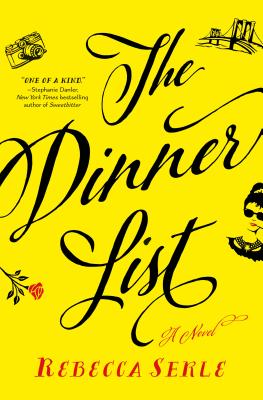
The Dinner List

by Rebecca Serle
First sentence: “‘We’ve been waiting for an hour.’ That’s what Audrey says.”
Support your local independent bookstore: buy it there!
Review copy provided by the publisher.
Release date: September 11, 2018
Content: There is some (tasteful) sex, and a few swear words. (I don’t remember any f-bombs, but I may be wrong). It will be in the adult fiction section of the bookstore.

We all have seen those questions: Who would you want to have dinner with, if you could have it with anyone, dead or alive?

Sabrina wrote a list, and tonight, it came true. She’s having dinner with her five people: her (dead) alcoholic father who left when she was little, her favorite professor from college, her best friend, her ex-fiance, and Audrey Hepburn. They sit down for dinner, to talk, reconnect, and (perhaps) heal. Interspersed with the dinner conversation are chapters with the story of Sabrina and Tobias’s (he’s her ex) relationship.

It’s more than a cute romance book (though it is that, since there is an element of Fate to Sabrina and Tobias’s relationship), looking at forgiveness and what it takes to keep a relationship together. The personalities of the five dinner guests meshed really well, and I liked how they each played off each other. It was a sweet story (and I didn’t mind the twist too much) and an enjoyable read.

The Lost for Words Bookshop

by Stephanie Butland
First sentence: “A book is a match in the smoking second between strike and flame.”
Support your local independent bookstore: buy it there!
Review copy provided by the publisher.
Content: There is some off-screen sex, some difficult themes, and a lot of swearing, including multiple f-bombs. It’s in the adult fiction section of the bookstore.

Loveday (pronounced love-DEE) Cardew works in a used bookshop, and would rather not deal with anyone she doesn’t have to. Archie, the owner, is okay — he’s been informally looking out for her since she walked into his office at 15 and tried to steal a book and he offered her a job instead — but everyone else? Loveday is fine on her own, thank you very much.

But then two things happen: Nathan, a magician and a poet, accidentally walks into Loveday’s life, and books from her past start appearing at the bookshop. These two things combined force Loveday to rethink her relationship to her past, as well as to others around her. And maybe — just maybe — it’s time for a change.

It’s rare for me to find an adult book I like, even rarer to find one that I find completely charming. But this one hit all my buttons: it’s basically about book-lovers, and it’s a smart love story with a depth to it. I adored Loveday and her gruffness; as her backstory unfolds, you understand why she is the way she is, and you feel for her. And I loved Archie; he was definitely a personality that takes up the room. It was populated with all sorts of characters I wanted to get to know and loved spending time with. I also liked the format; Butland titled sections “Poetry” and “History” and “Memoir” among others, and I thought it was clever and fitting in a book set in a bookshop.

In short: this one was incredibly sweet and I adored it.