Audiobook: The Book of Delights

by Ross Gay
Read by the author
Support your local independent bookstore: buy it there!
Or listen at Libro.fm
Content: It’s irreverent and sweary, including multiple f-bombs.

I was having a week where I was angry at everything. Did not matter what it was, I was just in a constant state of pissed-off-ness. I was scrolling through my audio books, and I landed on this one. “Hm,” I thought to myself, “maybe I need this one.”

I vaguely knew about Gay going in because he visited the store, and a lot of the staff really loved him. (A lot of the customers, too.) But I wasn’t ready for this book back in April, when it came out. I did, however, need it now.

The basic premise is that Gay, a black poet, spent a year — from his 42nd birthday to his 43rd — writing small essays on the things that delight him. Sometimes they wander into memories, sometimes into ruminations on race or the nature of Joy. Sometimes it was just him expressing delight in a simple touch, or the sharing of a flower, or conversation.

Whatever it was, it was all particularly delightful, especially as read by Gay. His reading, for me, was everything. He made me think, he made me laugh, and he made me look for the delights in my own life. (If you want a sample of him reading, check out his poem To the Fig Tree on the Corner of 9th and Christian.)

This book is, simply, a delight.

The Bookwanderers

by Anna James
First sentence: “
Support your local independent bookstore: buy it there!
Content: It’s not long and it doesn’t have a lot of hard words, though it does seem to lean in to bookish kids, even if one of the characters has a hard time reading because he’s dyslexic. It’s in the middle grade (grades 3-5) section of the bookstore.

Tilly has grown up in her grandparents’ bookstore, Pages & Co. (a quick real-life interjection here: they have a bakery and a store, but no evidence of customers? How are they paying the bills? I know, I know, it’s a kids’ book…) surrounded by books. She is an avid reader, partially because you can’t grow up in a bookstore and not be and partially because it’s a connection to her mother, who disappeared when Tilly was little.

And now that she’s 11, something unusual has started happening: characters are coming out of books. And she’s been pulled into them, not just metaphorically, but literally. It turns out that her grandparents and mother are part of this group called Bookwanderers, people who can literally travel between the pages of a book. And now, Tilly and her friend Oskar find they can travel in books too, which means, maybe that’s where Tilly’s mother went? And maybe they can find her.

On the one hand, this is super charming. I was charmed by the presentation, by the idea of taking something metaphorical (getting lost in a book) and making it literal. I liked Tilly and her willingness to take chances, even though she had a good support system with her parents. I liked that it wrapped the story up, but also left a thread open for more books in the series.

But. I’m not sure how much kids are going to like it. (Which makes me sad.) Because of copyright issues, James can only use the classics, which makes sense, but I’m sure that kids would much rather read about falling into books they love, and not Alice in Wonderland, Anne of Green Gables, and A Little Princess. It makes sense why she used the classics, but it is a drawback, and one I’m not sure many readers could get past. Which means it’s more for adults who love reading and have a fond memory of reading as a kid, and that’s kind of sad.

Even so, I was happy I read it!

The Starless Sea

by Erin Morgenstern
First sentence: “There is a pirate in the basement.”
Support your local independent bookstore: buy it there!
Release date: November 5, 2019
Review copy provided by the publisher.
Content: There is some violence and some swearing, including a few f-bombs. It will be in the Fiction section (though I think it fits better in science fiction/fantasy), but I bet it’ll have some YA crossover.

I haven’t read The Night Circus since it first came out, though I own it and I was thinking I need to reread it, but I imagine my reaction to The Starless Sea was pretty much the same: Morgenstern may not have a driving plot to her books, but she can write! Oh, she can write. Such lovely sentences, such lovely pages. Such gorgeous, haunting, twisting, lovely words. (And I don’t usually read for words.) There were pages I wanted to highlight and copy and, yes, get tattooed on my body (and I’ve never felt that way about words before, not even Maggie Stiefvater’s words). And, truth be told, the way this book unfolded kept me interested until the end.

The plot is simple: Zachary, a fortune-teller’s son, found a magic door when he was 11, but didn’t go through it. Fourteen years later, he’s at grad school in Vermont and finds — entirely on accident — a book called Sweet Sorrows, that has a tale about a fortune-teller’s son who finds a magic door but doesn’t go through. That piques Zachary’s interest, and he begins a journey — one that starts in Manhattan and ends by the shores of the Starless Sea and involves a reformed hit-man and a painter who may or may not be immortal — to find out what, exactly, was behind that door he didn’t go through all those years ago.

But, really: this book is a book for all of us who love and recognize the power of stories. Who recognize that truths can be found in fiction, that there is a need to tell stories and believe stories and embrace stories. It’s a remarkable book, and one that will stay with me for a long, long time.

Guts

by Raina Telgemeier
Support your local independent bookstore: buy it there!
Content: There is a lot of talk about bodily functions — throw up, diarrhea, puberty, among others. It’s in the middle grade graphic novel section of the bookstore.

My first reaction to finishing this book? My gosh, Raina had a childhood. All of these books (Smile and Sisters as well) are loosely based on her childhood. And if that’s the case (and I don’t know why it wouldn’t be), then wow, Raina’s childhood was something.

This one deals with her issues with stomach aches and throwing up and anxiety and the reactions of her classmates and family surrounding it. In fourth grade, Raina developed a fear of throwing up, which made her want to throw up, and so she developed a phobia around food and being sick because of that. There’s anxiety wrapped up in there as well: when she was nervous, it manifested physically. And there’s a subplot with a girl in her class who made fun of Raina because of her issues. It all turns out happily in the end.

Telgemeier is a fantastic artist; there are a few spreads where I think she nails what anxiety feels like in images. And one where she depicted the passing of time in a single image that is just amazing. And I appreciate that she’s telling these sorts of stories. There has to be kids out there who experience the same feelings — or just the ones with anxieties! — who need this book to feel seen and understood.

It may not be my favorite graphic novel this year, but it’s another solid entry from Telgemeier.

Audio book: Red at the Bone

by Jacqueline Woodson
Read by: Jacqueline Woodson, Bahni Turpin, Shayna Small, Peter Francis James, and Quincy Tyler Burnstine.
Support your local independent bookstore: buy it there!
Or listen at Libro.fm
Content: There is some on-screen sex as well as swearing, including multiple f-bombs. It’s in the adult fiction section of the bookstore.

I’m at a loss to talk about this one plot-wise. It jumps back and forth through time, starting in 2001, at Melody’s “coming of age ceremony”, where she’s wearing the dress her mother, Iris, wasn’t able to wear, because she was pregnant with Melody and didn’t get a ceremony. It gives us glimpses into the inner lives of Iris and Melody, but also Iris’s parents, and Aubrey, Melody’s father. It’s an introspective novel; nothing really happens, but Woodson’s tight writing and way of observing human nature still allows us to get to know these characters and understand their motivations.

I thoroughly enjoyed the audio book, partially because Woodson’s writing is a joy to listen to, and partially because the different narrators helped keep the story straight. (I was talking to a co-worker who said she was having trouble with this one because she didn’t know which chapter was from which point of view — Woodson, unlike other writers, doesn’t do any favors by telling us at the outset who is narrating, instead making us do the work of figuring it out.) It was short, and to the point, and I liked listening to this one family’s story through the years.

Recommended, particularly in audio.

Stargazing

by Jen Wang
Support your local independent bookstore: buy it there!
Content: There are some awkward moments, and a bit of violence by one of the characters. It’s in the middle grade graphic novel section at the bookstore.

Christine is an Asian-American girl, who lives a very stereotypical Asian-American life: she plays the violin, her parents expect her to get good grades, she takes Chinese class on Wednesday nights, and so on. And then she meets Moon, the daughter of a single mom who comes to live in the small house behind Christine’s. Moon is unlike everyone Christine knows: impulsive, loud, creative, outgoing, and most of all, seemingly unstoppable.

They become best friends, but when Moon seems to move on from Christine, she gets jealous, and then Moon ends up in the hospital. Is there any way Christine can salvage their relationship?

I adore Jen Wang’s books, and this is no exception. She’s tackling immigrant issues, but they’re not at the forefront. Christine and Moon’s friendship is, and the conflict between their families. It could be because Moon’s family is a single mom or Buddhist, or because Christine’s parents are strict. I liked that they were both part of the Asian community, but the story is universal. There are some absolutely perfect art spreads — I liked it, especially, when the girls went to the planetarium on a field trip — and I think Wang tackled the issue of friendship, especially new friendship, perfectly.

Oh, and bonus points for including K-Pop as part of this! A really good graphic novel.

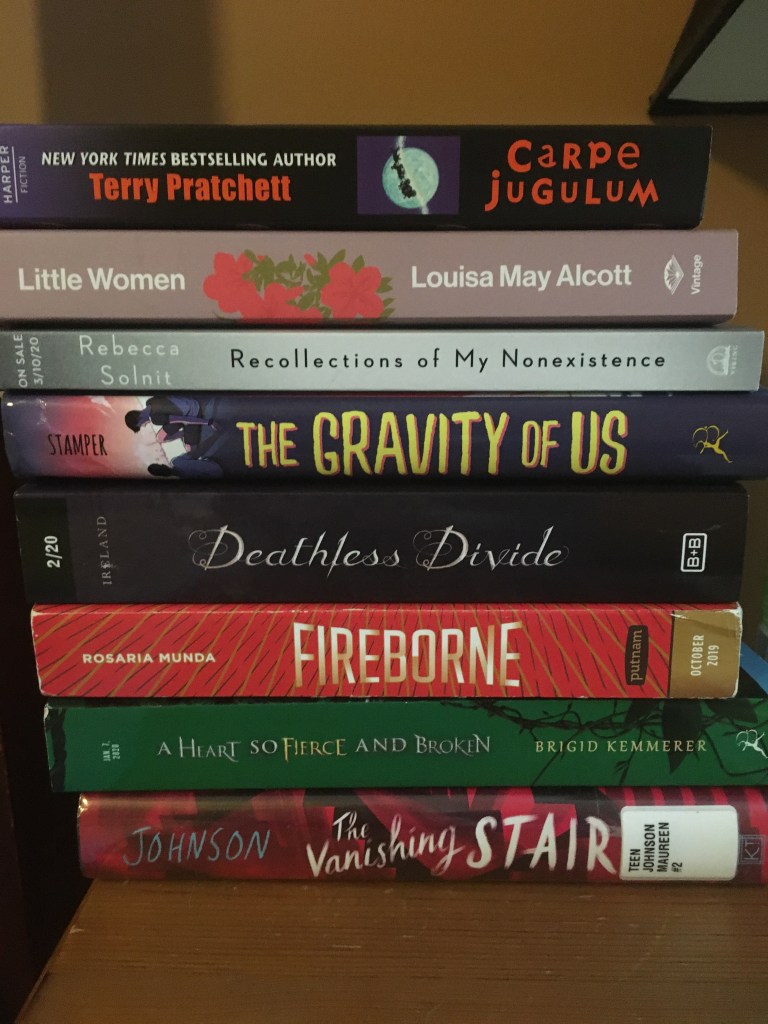
State of the TBR Pile: October 2019

It’s not a big pile this month, partially because fall is kind of busy(ish), though not as busy in the past, and partially because I think I’m falling into a bit of a slump. It’s not that I’m not reading or enjoying what I’m reading, it’s just that I’m not sure what I feel like reading. It’s weird.

Oh, and I’ve noticed that I’m down one Terry Pratchett every month. Which means I should have them done by the end of the year… 😀

Lords and Ladies by Terry Pratchett
Maskerade by Terry Pratchett
Look Both Ways by Jason Reynolds
10 Blind Dates by Ashley Elston
Lab Girl by Hope Jahren
The Raven Boys by Maggie Stiefvater
The Dream Thieves by Maggie Stiefvater

What are you looking forward to reading this month?

Running with Sherman

by Christopher McDougall
First sentence: “I knew something was wrong the second the pickup truck pulled into our driveway.”
Support your local independent bookstore: buy it there!
Review copy provided by the publisher.
Release date: October 15, 2019
Content: There’s some mild swearing. It will be in the sports section of the bookstore.

When our Random House rep came and pitched this book, he said (something to the effect of) he didn’t think that a book about burro racing would be a good read, but that this was fantastic. Since we all love him, we took him at his word, and I picked it up. And you know what? He’s right. This IS a fantastic read.

Chris McDougall and his wife ended up in Amish country by choice. They liked the idea of a simpler life, and so chose to get out of Philadelphia and live next door to people who shun most of modern technology. And so, when one of his neighbors (a Mennonite, not an Amish) begged Chris to take a neglected donkey off of a hoarder, Chris didn’t blink an eye. They christened the donkey Sherman, and had to figure out what to do with him. Another one of his friends mentioned that donkeys need a job, and Chris got a harebrained idea: he had heard of (and attempted to run, once) burro racing in Colorado and maybe, just maybe, that would be a goal for Sherman.

So, Chris and his wife Mika and some friends set about attempting to train Sherman for the World Championship Burro race. And the trip is SO worth the ride. Chris takes us through the ups and downs of healing a donkey — and a few people, as well — and prepping and how everything got figured out. And along the way, I was reminded that 1) connection with animals is important for humans (it’s a good thing we have a dog!); 2) connection with community — friends and wider than that, if possible — is important; 3) exercise and being out in nature is important; and 4) fear the thing, do the thing.

And the ending? The chapter in which Sherman got to run the burro race? I legit cried. It’s such a heartwarming and special and wonderful book!

Invisible Women

by Caroline Criado Perez
First sentence: “Most of recorded human history is one big data gap.”
Support your local independent bookstore: buy it there!
Content: There is some harsh facts about women’s health and some mild swearing. It’s in the sociology section of the bookstore.

An old high school friend of mine invited me to read this book as part of a book club she started on Facebook. She said she needed a sounding board to go off on as she read this book, and after finishing it, I can see why. Perez’s thesis is that women have not been included in studies — medical, transportation, housing, government, you name it — because the “typical human” is a 30-something, average height, white male. And since women — and I think this includes trans women, though Perez doesn’t talk about that — have different needs, patterns, biological responses, that means the lack of data is literally killing women. It’s an extreme position, but I think she has the data to back it up.

I found the book to be enlightening — while this is a first world problem, it’s more of a dire issue in places like Bangledesh and India, where assistance from first world organizations (often run by men) don’t think about the how the needs of women in those places differ from the needs of women in the first world, not to mention how the are vastly different from men. It makes me want to respond to this problem somehow, but I’m not entirely sure. Give to organizations that give assistance that are run by women? (That was an awkward sentence…) Vote for women, definitely. But: how do you change thousands of years of men being the “norm”? It’s disheartening. I suppose the least I can do is some of the small things: make sure I’m not defaulting male in my speech, in my thinking (I’ve already had to stop myself a few times) to be more inclusive. Because inclusivity is good. And making sure that women are represented is important.

The Power

by Naomi Alderman
First sentence: “Dear Naomi, I’ve finished the bloody book.”
Support your local independent bookstore: buy it there!
Content: There is a lot of swearing, including multiple f-bombs, some sex, and a few graphic rape scenes. It’s also incredibly violent. It’s in the science fiction/fantasy section of the bookstore.

The basic premise of this book is that one day, suddenly, all women in the world get a power — the ability to channel electricity — that gives them the ability to “fight back” against men of the world. It starts with teenagers, but eventually spreads to most women. The narrative follows four people: a mayor of a New England town, a girl in the foster system, a daughter of a British mob boss, and a young Nigerian man. The change affects all their lives: the mayor becomes governor and then senator, creating for-profit training camps for girls to learn to better control and use their power; the girl kills her foster father (who was raping her) and runs away and eventually starts a new religion, becoming Mother Eve; the daughter of a mob boss ends up taking over the whole operation; and the young man becomes a news reporter, going where the stories — of rebellion, of resistance, of control — are.

It was, for me, a tough book to swallow, and it wasn’t until the end when I realized what Alderman was doing. It’s best to remember that science fiction is more about the present than the future; and Alderman is shining a light on violence against women by turning the tables. The women in this book, once they get the power, become very… well… masculine. They embrace and abuse power, they torture and rape and kill men solely because they are weak. They create laws that restrict men’s movements, and in the end, blow the whole system up.

It’s also a critique of the nature of power, I think. I feel like Alderman is saying that power over another person corrupts anyone, male or female. That there is no “better nature” that will, inherently, make a woman better at leading. That power is, at it’s heart, an violent act of controlling another person.

It’s not an enjoyable read, but it is an interesting one, and has given me much to think about.