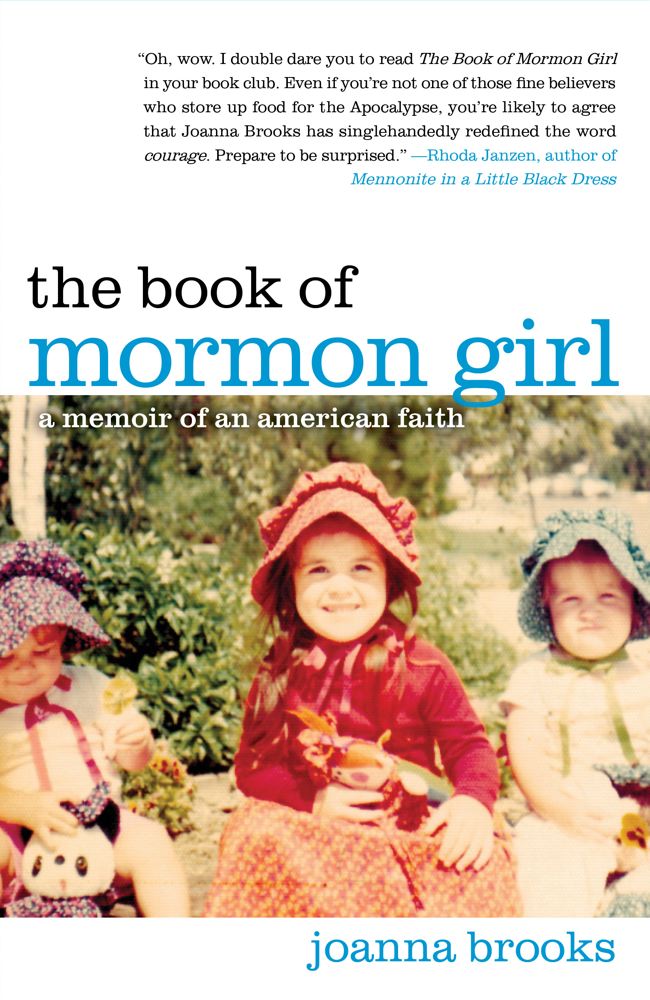
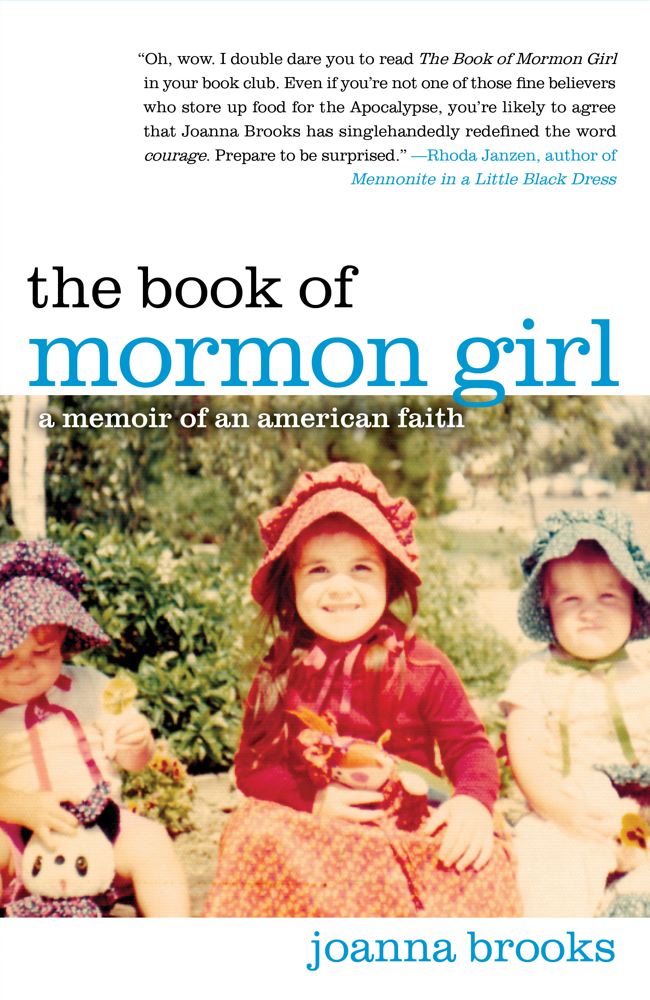
The Book of Mormon Girl

by Joanna Brooks
age: adult
First sentence: “On Monday nights, my father and mother gathered their four children around the kitchen table in our tract house on the edge of the orange groves and taught us how the universe worked.”
Support your local independent bookstore: buy it there!
Disclaimer: while I didn’t know Joanna at BYU, I knew of her. And my husband actually knows her. In fact, as the story goes, he asked her out once and she said no.

I am not Joanna Brooks. And yet, growing up Mormon in the late 1970s and 1980s, there were many elements of Joanna Brooks’ story that I recognized.

This story — which was buzzed about a bit back before the election when Mormons were having our “moment” — is basically that of Joanna’s childhood, growing up in Orange County, California. Her path to BYU, and then her path away from — what shall we call it? — orthodoxy, full activity, your typical Mormon life.

It’s nothing I didn’t know, or haven’t heard. The Monday night family meetings (ours were on Sunday afternoons, actually), the year’s worth food storage in the basement (which fully ruined me for store-bought canned peaches and pears. Not at ALL good.), the end-of-the world paranoia (that was mostly high school, when I was actually noticing it). All of it was instantly familiar to me.

And you can tell that Joanna has a fondness for her childhood, the way she was raised, and even the way the church was — to some extent — in our childhood. But, then we hit BYU.

(It surprised me that she is only a year older than I am. I thought she was older than that.)

I don’t know what BYU is like now, but she reminded me of all the reasons I disliked the place in the early 1990s. I wasn’t in the middle of everything — from the firings and excommunications to the protests — but I caught enough of it through my program — journalism rather than English — that I realized that the Church (the organization, not necessarily the doctrine) could be a not-very-friendly place for people who didn’t toe the line.

And it was this point where Joanna’s and my paths diverged, and where I found the book to dissolve into melodramatics. Yes, she was discriminated against, but I’m going to assert that it’s because she lived in the wrong places. I have often told my daughters — especially when they come home feeling excluded and belittled at church — that not everywhere is like here. That there are places — like my ward growing up in Ann Arbor — where people don’t always expect everyone to tow the conservative Republican line  like they do in, oh, Orange County, California. Or Wichita, Kansas, for that matter.

Maybe it was too personal for me, maybe it was too much like my own story, and maybe that’s why I finished it feeling unsettled. That said, I am glad that Joanna’s story (and mine, to a certain extent) is out there for people to read. Maybe it will make a difference, too.

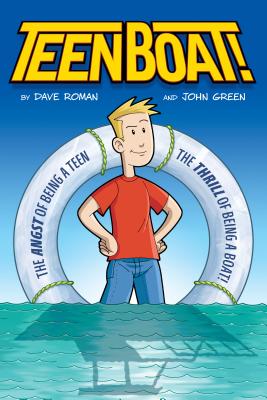
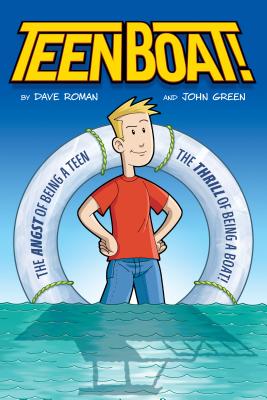
Teen Boat

by Dave Roman and John Green
ages: 12+
First  sentence: “Every night it’s the same dream.”
Support your local independent bookstore: buy it there!

There are superhero stories, where a person has Great Powers and has to Save the World or Something Else Important. And everything, for the most part, is Good and Evil and Right and Wrong. 

And then there’s Teen Boat.

His superpower? Turning into a small yacht.

His life? Is pretty much the life of your ordinary, average high school boy: he’s crushing on the cute girl, his best friend thinks he’s clueless, he get detention, he has to get a job. Nothing Superheroish here.

It also doesn’t help that he turns into a boat at the most inopportune times. (Internal inconsistency alert: can he turn into a boat at will? Well, sometimes. And sometimes he can’t. But he also can turn into a boat against his will when water touches his internal nautical activation button, which happens when he gets water in his ear. It doesn’t really make sense.) What his life is, really is a balancing act between his abilities and his desires. With random pirates.

The best word for this book? Silly. Ridiculous. In the best possible way. Teen Boat (or TB for short) (that’s really his name) is a fun character, very much the awkward teen boy, put in absolutely insane situations. (I was serious about the pirates.) I do have to admit that it wore on me after a while; by the end I was rolling my eyes more than laughing. But even with that, it was still a fun — well, silly — read.

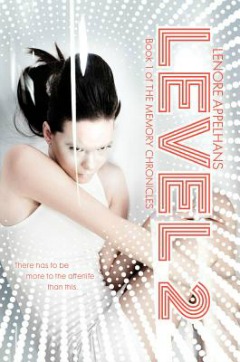
Level 2

by Lenore Applehans
ages: 12+
First sentence: “I’ll sleep when I’m dead.”
Support your local independent bookstore: buy it there!
Review copy provided by my place of employment.
Additional disclaimer: while I wouldn’t claim to “know” Lenore, I have met her on several occasions when she stops in town, and enjoy her company.

Felicia is dead. (That’s not a spoiler.)

She’s been lounging around in her hive in Level 2, revisiting her memories — only the pleasant ones, please; specifically of Neil, her boyfriend at the time of her death — talking to her friends Beckah and Virginia, trying to stave off the ever-increasing boredom. Then, one day, something Exciting happens: the system malfunctions, and Beckah disappears.

Oh, and Julian — an old, not-so-beloved flame of Felicia’s — reappears. And it seems that Level 2 isn’t the happy, peaceful, resting place Felicia thought it was. In fact, it’s a place where a group called the Morati — angels who weren’t quite, well, angelic — are siphoning humans’ energy in order to invade heaven. And they need Felicia’s power.

What the what?

At first take, this is an interesting glance into the afterlife. I liked the use of Felicia’s memories to give us backstory, without having to set up everything first. (Yes, we do eventually learn how she died.) It serves to help us get to know Felicia, to understand her interior motivations.

But, unfortunately, it also allows us to keep our distance.  Which is the first of my problems with this one. I go back and forth between whether I’m a character-driven reader or a plot-driven reader, and I think I’m both. If the plot is slow, I will forgive it if there are fascinating characters. And I’ll forgive wooden or stereotpyical characters if the plot keeps my interest. The problem with Level 2 is that I didn’t have either.

I think we’re supposed to like Felicia, with all her guilt and complexities (not to mention her fixation on Neil). But I just… didn’t. I thought she was whiny privileged, and not at all the Heroine she was made out to be. (Maybe that was on purpose? And there will be More in the next book?) I did like Julian (whom I don’t think we were supposed to), but I felt let-down by his character arc. I wanted more from him. And Neil? Well, lets just say he was arm candy.

The second of my problems is that I felt the plot was uneven: perhaps it was because the memories broke up the flow of the plot, but I felt it came in fits and starts. It was too slow at the beginning, took too long to get rolling, and then ended up going too fast at the end. In fact, I finished the book with a “WHAT? HUH?” expression: I had no clue, really, what just happened. Perhaps that was my fault: I’m not exactly the most careful of readers all the time, so I probably missed something. Either way, the Twist and the Big Reveal did not work for me.

Now, to be fair, I may be being a bit hyper critical. It’s not every day that someone I “know” gets a book published, and advance buzz for this was quite good. I’m always more critical of books with a lot of advance buzz, so I tend to avoid them.  This book reminded me a lot of the Matched series, so I know there will be readers for it. And I’m not sorry I spent the time immersed in this world.

I just wish I had liked it more.

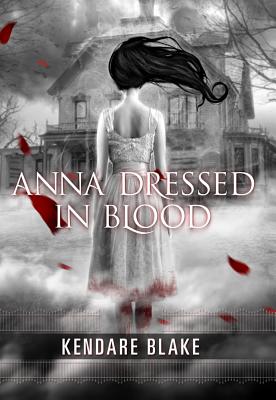
Anna Dressed in Blood

by Kendare Blake
ages: 14+
First sentence: “The grease-slicked hair is a dead giveaway — no pun intended.”
Support your local independent bookstore: buy it there!
For the YAckers book group.

Cas is a ghost killer.

How can that be, you ask, since they’re already dead?

Well… some ghosts don’t want to stay dead. And some ghosts start acting out against humans, harming them. And it’s those ghosts that Cas, with his family heritage — his father was a ghost killer before him — and his athame — the knife that does the killing, tackles.

That doesn’t mean everything is coming up roses. In fact, quite the contrary. Cas’s father was brutally  murdered by a ghost outside of Baton Rouge, Louisiana, and Cas has been spending the last several years working to get good enough to go back and face whatever it is. And so, when he gets word of an especially violent ghost in Thunder Bay, Ontario, he knows he has to go get it. Her.

Anna Dressed in Blood.

A bit of an aside here: I don’t do horror. Period. Never have, never will. And yet: I found myself attracted to this book. From the ink the color of dried blood, to the violence that Anna does (and she does some violence), to the intense (for me!) climax at the end (they got the ghost with a hundred pages left to go, and I was wondering what Drake was going to do with them; worry not: they’re incredible), I couldn’t put this one down.

Another quick aside: the over quote from Cassandra Clare is “Spellbinding and romantic.” Um. NOT. This is not a romantic book. This is a violent, bloody, intense book. Sure, there’s a bit of love-falling-into, but honestly: don’t let the girl in the dress on the cover throw you off. It’s an episode (or three) of Supernatural. It’s a ghost Buffy (the comparison is aptly made in the book, actually). It’s a ramped-up, less funny Ghostbusters. It’s awesome. Perhaps it’s spellbinding. But it’s not romantic. Unless, of course, you find grappling with a deadly ghost romantic. Then, yeah. It’s romantic.

Either way, it’s worth the read.

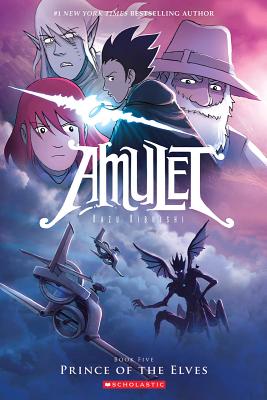
Prince of the Elves

Amulet, vol. 5
by Kazu Kibuishi
ages: 10+
First sentence: “You’ve never heard about the Great Erlking?”
Support your local independent bookstore:buy it there!
Others in the series:The Stonekeeper, The Stonekeeper’s Curse, The Cloud Searchers, The Last Council

To catch you up (this is as much for me as it is for you):

Emily and Navin’s father died in a car crash, and their mother has been kidnapped. They follow her into this strange world, and discover that their grandfather was a stonekeeper, a role that has passed on to Emily. In this world, the Elf King is a tyrannical ruler, someone who needs to be overthrown. Except he, too, is a stonekeeper, something which gives him unlimited power. It’s up to Emily, Navin, and the friends they collect to work together to overthrow the king.

Up until now, the books have been about Emily learning about her powers, and the kids making and collecting friends as part of the resistance. But (finally!), in this one, I felt like the plot was actually moving forward again. We’ve got an actual physical bad guy, rather than a distant one (kind of like the difference between Sauron and Saruman). We’ve got a battle. We’ve got a gorgeous two-page spread of a monster attacking a ship. (Seriously: it’s amazing.) We’ve got a backstory explaining how the Elf prince became exiled and how the bad guy became the bad guy. We’ve got (some) ANSWERS.

And, as always, my thoughts on the book are the same: gorgeously drawn, brilliantly plotted, and the next one can’t come out soon enough. (I think I need to break down and buy these!)

10 Questions for Mike Jung

When I decided to resurrect my 10 Question For series, I was in the middle of the 2012 Cybils round one, and, more specifically, I had just finished Geeks, Girls, and Secret Identities. I was so enamored with the book and with Mike Jung, I knew he had to be next. Thankfully (I never tire of being surprised that authors are willing to “talk” to me!), he said he’d love to do an interview.

MF: So, Geeks, Girls, and Secret Identities (or GGSI, as we ended up calling it on my Cybils panel), is your first book. Congrats! Can you tell us a bit about the process of how it came to be published?MJ: Thanks! I started writing GGSI in 2006, and after a close call with an agent I started seriously querying other agents in 2009. I ended up signing with the Erin Murphy Literary Agency’s Ammi-Joan Paquette in 2010, but before that happened I somehow managed to blunder my way into a friendship with Arthur Levine – we first connected with each other on Facebook, and in mid-2010 (right after I signed with Joan) I got to meet Arthur at the SCBWI Summer Conference. We really hit it off, and fortunately the manuscript that would become GEEKS, GIRLS, AND SECRET IDENTITIES was ready to go. Arthur read it after the conference, acquired it, and ka-blam, dream come true for yours truly.

MF: Where did you get the idea to write a middle grade book about superheroes?
MJ: I knew from the start that I wanted to write middle grade, although it did take some time to keep my writerly voice from zigzagging between MG and YA – I kept inserting a very YA-centric note of cynicism into the manuscript, and I had to exert quite a bit of discipline to get a handle on that. My middle-grade years were powerfully formative for me, and they were the time when books truly embedded themselves in the foundation of my worldview. I read to escape loneliness, lose myself in new worlds, and contemplate the startling fact that people could actually conjure these amazing stories out of thin air. Regarding superheroes, well, I think the next question answers that.

Mike with another author (and Cybils guru) Sarah Stevenson

MF: Fess up: are you a superhero geek? (It seems, from the book, that you may be. Either that, or you did your research well, because you got the fanboy/girl thing down.)MJ: I am a MASSIVE superhero geek, and though it’s been a long time since I’ve read comics with any great frequency, I’ll always be an old-school Marvel and DC devotee. Yes, BOTH Marvel and DC – I’m very bipartisan that way. I owe a great debt of thanks to my older brother, whose comic book collection was vast and lost a whole lot of collectible value because of my tendency to read everything in it, no matter how carefully bagged and boxed up it might have been.

When it comes to Spider-Man girlfriends, I’ll always be “thumbs up!” on Gwen Stacy and “meh” on Mary Jane Watson. John Byrne’s work on the X-Men was superb, but he started going slowly but surely downhill when Alpha Flight got their own series. There is only one true Silver Surfer, and it was created by Jack Kirby: hallelujah, all hail King Kirby, now and forever. The Sub-Mariner would kick Aquaman’s butt in a fight. I spent six months trying to draw a perfect rendition of Danny Rand’s hand smoldering with the power of Iron Fist. I retain my fondness for the Metal Men. I think Plastic Man’s full potential was squandered. Among DC’s female heroes I’ve always preferred Black Canary to Wonder Woman. I could do this all day…

MF: Being married to a superhero geek, I completely understand! I find humor so subjective. Was it difficult writing a funny book? How did you get the humor to work?
MJ: I totally agree that humor is really, really subjective, and in a way, that took some of the humor-related difficulty out of the equation, because I wasn’t really trying to tailor my writing to anyone’s sense of humor but my own. I’m told that humor is one of my strengths, and I did throw a whole bunch of stuff into GGSI just because I think it’s funny. That’s really all there is to it. I know what I like, I know what I think is funny, and I’ve spent enough time developing my writing skills to know how to make that happen on the page. Sometimes I wish I had a stronger grasp on the defined mechanics of humor, such as they are – the comedy rule of three, and so on – but my understanding of what’s funny about my writing is based solely on having done a whole lot of writing practice and having read a whole lot of books.

I’m also very aware and accepting of the subjective nature of humor. It’s really not possible to write something that’s universally funny – no matter what your sense of humor is like, you’ll always be able to find someone who doesn’t share it. It’s actually a very liberating thought, because it utterly releases us from the need to try and please anyone but ourselves.

MF: I know this is unfair, but do you have a favorite scene or character in GGSI?
MJ: I don’t want to be too spoilery about it, but my favorite part of the book is probably the very end of chapter 26. I never wanted to write a book that was just slaphappy and humorous, or fast-paced and action-packed – my goal from the start was to create a story with a strong, authentic emotional core. I wanted my characters to have emotional experiences with genuine impact, whether it be through the dynamics of peer interactions, the love of parents for their children, or the uncertainty of a friendship that may be lost. The end of chapter 26 is where I was most successful in making that happen, and I think I was able to do it through dialogue, action, and description. I’m quite proud of that section of the book.

MF: I agree: it wasn’t just a superhero book, and it wasn’t just a comedy; it has a good emotional core. Truthfully: I loved Polly, and the role – atypical for a lot of girl characters – she played in the book. Why did you decide to write her that way?MJ: The snide part of me wants to say “Why wouldn’t I?” It’s not the first time I’ve been asked this question, it’s a question that I see asked of a lot of writers, and it’s worth noting that I’ve yet to be asked why I chose to write Vincent the way I did. [Touche: Shannon Hale makes a similar point here. *hangs head in shame*]

Questions like this imply that the unthinking, non-deliberate, default choice would be to create a girl character that isn’t strong, proactive, and dynamic. That certainly has been a default choice in the past, and maybe for some writers it’s still a default choice, but I like to think that we’ve matured enough as a society that it’s no longer perceived as an automatic choice for EVERY writer.

I’m not a Pollyanna about this: I know that as a global community we have far too much room for growth in that respect. But I have spent my share of time thinking about issues of gender bias and societally imposed roles, and as the father of a young girl I believe I bear both an obligation and a responsibility to continue thinking about those things. It’s not hard to do, because my adult life has been filled with strong, intelligent, articulate females, not the least of which are my wife and daughter. Polly is a strong character with an absolutely pivotal role in the book. She’s neither weak nor submissive, and has no trouble speaking her mind and taking action as she sees fit. She may be atypical in terms of girl characters in literature, but she’s not at all atypical in terms of reality. The world is packed to the rafters with strong women and girls.

And, because I couldn’t resist, I sent this tweet out:

MF: You’ve also written a chapter in Dear Teen Me. What were the differences between writing for a middle grade and a teen audience?MJ: The main difference was that I didn’t really think very hard about how to write in a voice that matched the age and experience of my characters, because my DTM letter isn’t fiction. I think writing a YA novel would be entirely different, because I’d need to inhabit the minds of my characters in order to make the novel truly come alive. My DTM letter was written entirely from my own perspective, however, and the things I wrote about (coping with suicidal thoughts, mostly) were things I experienced as a teenager, so I knew the subject matter would be relevant for teens coping with the same difficulties.

MF: How did you come up with the ukulele song? (Which is also hilarious.)
MJ: Before writing my book my main creative outlet was music – I played the local coffeehouse circuit, performing original songs on guitar and ukulele. I stopped doing that when my daughter was born, but I picked up the uke again last year at the Erin Murphy Literary Agency’s annual retreat. My dear friend Carrie Gordon Watson (who’s also a musician) and I joked around about forming a band to play at the retreat, and somehow we ended up actually doing so. It turned into an incredibly fun and meaningful experience, and got me back into making music. Later that summer I had a conversation with my editor about how hard it is for authors to just come right out and ask people to buy their books, and I had another semi-joking conversation on Facebook about writing a theme song for my book launch party. I let my brain marinate in those two conversations for a couple of months, and then the song pretty much wrote itself.
 
MF: That’s cool! (Can I say that I hope you write one for your next book?) What’s the best book you’ve read most recently? And why did you love it?

MJ: I actually read it in manuscript before it was under contract, but I bought a shiny new copy of Ellen Oh’s PROPHECY, the first book in a YA fantasy trilogy set in ancient Korea. If you like strong female protagonists, rip-roaring action, vividly imagined settings, and extremely creative mayhem, you’ll love PROPHECY – it’s one of the best things out there right now. My favorite book of 2012 just might have been Kate Milford’s THE BROKEN LANDS – when I finished the last page my first feeling was sadness that I’d never be able to read it for the first time again. I also loved Anne Nesbet’s THE CABINET OF EARTHS, Martha Brockenbrough’s DEVINE INTERVENTION, J. Anderson Coat’s THE WICKED AND THE JUST,  Raina Telgemaier’s DRAMA, Courtney Summers’s THIS IS NOT A TEST…uh, yeah. It’s hard to pick just one.

Thanks so much for your time, Mike!

You can check out Mike’s doings on his blog, and on his Twitter feed.

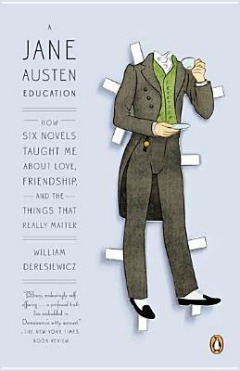
A Jane Austen Education

How six novels taught me about love, friendship, and the things that really matter
by William Deresiewicz
ages: adult
First sentence: “I was twenty-six, and about as dumb, in all human things, as any twenty-six-year-old has a right to be, when I met the woman who would change my life.”
Support your local independent bookstore: buy it there!

When I saw this one a while back, I knew, as a professed lover of all things Jane, that I had to eventually read it. Thankfully, my delightful gift exchange partner, Holly, made that eventually sooner rather than later.

I didn’t quite know what to expect from a book like this, or who even it’s intended for. Other Janeites? The random public? Guys who should be reading Jane Austen? (Which they should.)

And the answer is: yes, all of the above.

Deresiewicz weaves his personal story of a 26-year-old, single, angsty Jewish male with analyses of all six of Austen’s books, giving each book a theme that helps him through a time period in his life. He doesn’t go chronologically with her works, but rather in the order that he read them, and with what fit with what period. It’s a book about Austen, yes, but it’s also a book about Deresiewicz’s growth as a person, and the role that Austen played in that.

Having read all the novels many times (though not recently; one of the things I realized while reading this is that it’s been a while since I’ve visited with Austen, and “a while” is too long), he didn’t really say much that I didn’t know. I’m not sure I’m going to look at her novels in a new light now, or anything like that. Perhaps, if I were less than an avid fan, I would have (I also want to give this to the guy at work who disdains all “chick fiction”, calling it “fluffy” and beneath his notice). At the very least, Deresiewicz succeeded in reminding me why I adore Austen.

A couple of quotes, because these stood out:

From the Northanger Abbey chapter (“Learning to Learn”): “Real men weren’t afraid to admit that they still had things to learn — not even from a woman.”

From Mansfield Park (“Being Good”): “To listen to a person’s stories, [Edmund] understood, is to learn their feelings and experiences and values and habits of mind, and to learn them all at once and all together. Austen was not a novelist for nothing: she knew that our stories are what make us human, and that listening to someone else’s stores — entering into their feelings, validating their experiences — is the highest way of acknowledging their humanity, the sweetest form of usefulness.”

For me, this was a delightful romp through familiar land: watching someone come to a realization that Austen and her small, domestic dramas and comedies really do hold valuable lessons for the rest of us, even 200 years later.

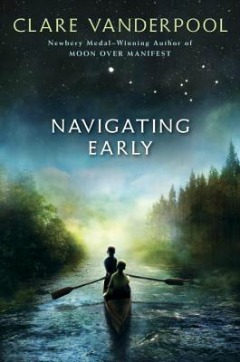
Navigating Early

by Clare Vanderpool
ages: 10+
First sentence: “If I’d know what there was to know about Early Auden, that strangest of boys, I might have been scared off, or at least kept my distance like all the others.”
Support your local independent bookstore: buy it there!
Review copy provided by my place of employment.
Additional disclaimer: I’ve chatted with the author on numerous occasions when she’s stopped into Watermark.

It’s 1945, and Jack Baker’s father has come back to Kansas from serving in World War II. Except, he came home to a son he doesn’t recognize and a wife who recently died. So, he packs up the house and tows Jack up to Maine to attend a boarding school near the Naval station where he’s based.

None of this sits well with Jack.  He’s a Kansas boy, through and through: loving the wide-open spaces, the sky, the heat, the wheat fields. And so Maine, especially Maine in the fall, throws him for a loop. Not to mention that he’s lost his anchor — his mother — and he’s adrift in the sea of boys and New England customs (like rowing), that are completely foreign to him.

Until he meets Early Auden, a boy who only listens to Billie Holiday when it rains; who lives in the school basement and only comes to class when he feels like it; and — most amazingly — has all the digits of pi memorized, seeing colors, patterns, and stories in the numbers. It’s all overwhelming for Jack; he really has no idea how to deal with everything. Until fall break, when Early leads Jack on an adventure, both literal and metaphorical, to find something that neither boy thought they were looking for.

It’s an evocative novel, one which explores loss and belonging, of being uprooted and searching for a place to fit.  To be honest, everything I said about Moon Over Manifest works here as well: even though the novel isn’t set in Kansas, Jack’s love for his home state comes through loud and clear. (And after 6 1/2 years here, I’m beginning to see what it is to love about being here.) But, Vanderpool also creates a sense of the Maine wilderness, of the early- to mid-fall glory of the woods, of tramping around in the rain. I enjoyed the juxtaposition of the two climates.

In fact, the thing I enjoyed most about the novel was the way Vanderpool juxtaposed elements: Kansas and Maine; the death of a mother with the death of a brother; Early and Jack’s story with that of Pi’s (pi the number becomes Pi the character in Early’s mind; the numbers tell his story.); the various characters Early and Jack meet on their journey. It kept me interested throughout, wondering how everything would weave together in the end.

Actually, the end was probably my least favorite part: while it came to a conclusion, I felt something was, not quite fitting together. It doesn’t have a happily-ever-after bow — something I appreciated — but it didn’t quite sit well with me either.

But that’s a small quibble in an otherwise excellent book.

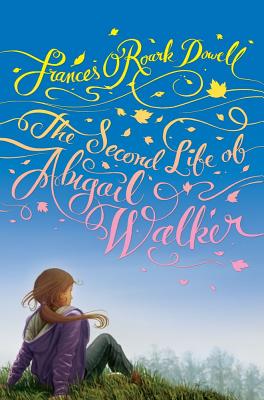
The Second Life of Abigail Walker

by Frances O’Roark Dowell
ages: 9+
First sentence: “The fox had been stepping into stories since the beginning of time.”
Support your local independent bookstore: buy it there!

Sixth grade has not been the best for Abigail Walker. Her best friend recently moved away, and she’s been caught up in a group of mean-ish girls because her mother wants Abby to be friends with them. In addition, her parents (especially her dad) are always on her case about eating, since she’s a bit more overweight than they’d like her to be. Between these two things, all Abby wants to do is hide in her closet and eat candy bars.

I’m going to interject here:  I want to give this one to parents. Just so they can see the effect their comments have on their children. The parents in this one earn a great big huge OY, PEOPLE. I want to smack them.

Anyway. Abby starts frequenting the field across the street from her house, and discovers a fox, which bites her (not hard). She also meets a boy, Anders, and his father who is recovering from PTSD from his tour in Iraq. Between Helping Anders with his dad and the fox, Abby begins branching out, discovering a strength in her to make new friends and to begin to stand up to her parents.

Aside from the whole parent-issue thingy, this was just an okay book. Abby is dealing with lots of issues, and I was glad to see her being to make things right. For a while, I was thinking O’Roark Dowell would wrap everything up in a nice bow, and I was quite glad she didn’t. (I should trust her more; she rarely steers me wrong.) The only real misstep in this one was the fox; I was never quite sure why the fox really needed to be there. It seemed like it belonged in a different book, one that was wholly an animal fantasy, rather than a middle grade issue-oriented book.

But aside from the fox, it was a sweet story about a girl who’s trying to figure out who she really is in the face of everyone’s expectations.

The State of the TBR Pile 12: Jan 2013

I know you’re dying to know: what does a Cybils’ panelist read after the Cybils are done? Well… this:

A Jane Austen Education, by William Deresiewicz (Christmas present #1)
Navigating Early, by Clare Vanderpool (Because she’s local, and her book launch party at work is soon.)
The Dragon’s Tooth, by N. D. Wilson  (Holdover from the Cybils; I really want to read the first.)
Tokyo Heist, by Diana Renn (Because Leila said it was good.)
Almost Home, by Joan Bauer (Because it’s on the MG Cybils shortlsit.)
Son, by Lois Lowry (Because I NEED to read this.)
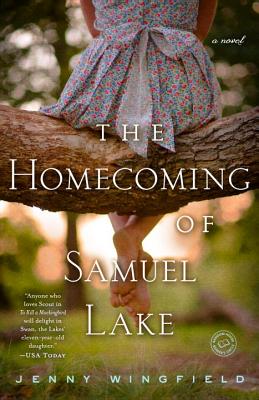
The Homecoming of Samuel Lake, by Jenny Wingfield (Bookgroup book)
The Diviners, by Libba Bray (Christmas present #2)
Anna Drenched in Blood, by Kendare Blake (YAckers book)
Big Boned, by Meg Cabot (Because I’m curious about the Heather Wells series.)
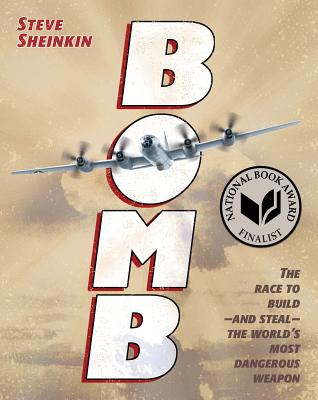
Bomb, by Steve Sheinkin (Because I should. And it’s getting Newbery buzz. It’s that time of year.)

Not shown:
Level 2, by Lenore Appelhans (Same reason as Clare’s book, actually. It’s not shown because C is currently reading it.)

What’s on your pile?