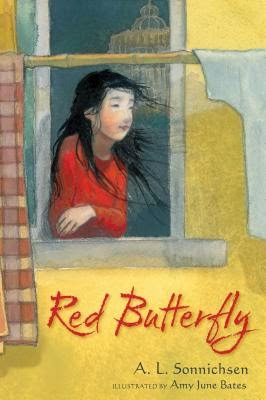
Red Butterfly

by A. L. Sonnichsen
First sentence: “Mama used to have a piano
with an on/off switch
and a dial to make drums beat.”
Support your local independent bookstore: buy it there!
Review copy snagged from the ARC shelves at my place of employment.
Content: It’s pretty long, which will turn some readers off, though it’s in verse, which makes it easier to read (but also might turn readers off). The Chinese words, while spelled phonetically, might also be a deterrent. It’s in the middle grade (grades  3-5) section of the bookstore.

Kara was abandoned at birth, and in China, that generally means certain death. Especially since she is a girl and born with a deformed hand. But a kind, elderly American woman living in Tianjin took Kara in. Now, eleven years later, Kara is wondering why Mama never leaves the house, why she has never gone to school, and why they can’t leave to go join Daddy in Montana.

It takes a while for things to spill out: Mama is always telling Kara to be content with what she has, and not long for something more, but things do eventually come to light. In China, one needs papers to be a legal resident. Kara, because she was abandoned and rescued, has none. And so, they’ve been in hiding all these years.

On the one hand, I enjoyed this peek into China, especially the lives of those children who are neglected and abandoned to the orphanages because of the one-child laws. It’s told in verse, which suits Kara’s contemplative nature and her desire to figure out who she is and where she belongs.  I liked the people Kara met and her interactions in the orphanages.

However, while I got to know Kara and her story, it felt, well… too American. An American pulled her off the streets when she was a baby. She befriended a New Zealander worker in the orphanage (not American, but English-speaking/Western). She ended up in Florida with a second adoptive family. There were Chinese characters, but they were almost afterthoughts in Kara’s life. And while I understood why, I was sad not to get to know China or the Chinese.

It wasn’t bad, overall, but it wasn’t my favorite either.

Fish in a Tree

by Lynda Mullaly Hunt
First sentence: “It’s always there.”
Support your local independent bookstore: buy it there!
Content: The chapters are short, and while there are some bigger words, there’s nothing that a 3rd grader couldn’t handle. It’s in the middle grade (grades 3-5) section of the bookstore.

Ally doesn’t like school. Part of that is the result of her moving so much — her dad’s in the military, currently deployed in Iraq/Afghanistan (it didn’t say; I’m assuming this) — of it is because Ally can’t read. It’s a fact she’s hidden by becoming a troublemaker and through her art, but whenever she tries to read, the words swim, her head hurts, and she just. can’t. do. it.

Enter in Mr. Daniels, the permanent sub for her regular sixth-grade teacher who’s off on maternity leave. He picks up on Ally’s defense mechanisms, and realizes that there’s more going on than meets the eye. He espouses the believe that not everyone’s smart in the same way (yay for that!), and draws on Ally’s strength, giving her the confidence to make friends — Albert, the science geek, and Keisha, a baker extraordinaire — and to stand up to the classroom bully, Shay.

There are some nitpicky things that bothered me throughout that kept me from loving this as much as I wanted to. First, why did the teacher have to be male? I’m torn on this one: on the one hand, it’s showing a man doing things that are “normally” reserved for women. He’s concerned about his students, he’s caring, and he reaches out. Not to mention that he’s a man in a female-heavy profession. However, it seems to me in books like this — where a teacher saves a struggling student — the teacher is always male. It’s the men who get to think outside the box, who find ways to connect with the struggling students, who make changes within the system. And that bothered me.

Additionally, there’s a point when Albert comes out of his shell to fight back against his bullies, in order to protect Ally and Keisha from them. Perhaps that was in character for Albert, but it bothered me deeply. Why did he need to protect them? I initially thought it was because they were his friends — maybe he’d do the same for boys who were his friends — but then he says something about “never hitting a girl”and I cringed.

On the other hand, I was glad that Hunt included a broad spectrum of personalities and classes: there are people who are hyper, middle of the road kids, rich kids, kids on free lunches. The usual suspects — drugs, bad parents, etc –aren’t anywhere to be seen. The focus, really, is on celebrating our differences, and recognizing that intelligence isn’t tied to doing well on tests. And that’s worth celebrating.

So, while it’s an uneven book, I’m glad it’s out there.

The Calligrapher’s Daughter

by Eugenia Kim
First sentence: “I learned I had no name on the same day I learned fear.”
Support your local independent bookstore: buy it there!
Content: It’s pretty long and involved, and some off-screen sex (both married and extra-marital). It’d be in the adult section of the bookstore.

Najin Han was born in 1910, soon after the Japanese invasion (I suppose) of Korea.The daughter of a talented calligrapher, she was supposed to be raised in the traditional manner: to be a servant to men, without the education or opportunities men have.

But, because her mother was Christian, and because Najin was curious, she ended up having more opportunities than she “should” have. She went to school, learned both English and Japanese.She spent time in the exiled court (thanks to some terrific maneuvering from her mother and a well-placed aunt). She got trained to be a teacher and a midwife. So when her husband — an arranged marriage, of course — goes to America for theological training and she gets stuck in Korea, she has Options.

Based on her parent’s lives, Kim writes a fascinating story about life in early-20th century Korea. There was much I didn’t know, from the way the Japanese took over the Korean culture, trying to suppress it to the fact that Christianity was in Korea fairly early on.

I enjoyed reading this one, though there were times that I skimmed — I didn’t care when Kim switched into other points of view; Najin’s story was the one I was most interested in — but for the most part I found this to be a fascinating portrait of a country and time we don’t hear much about.

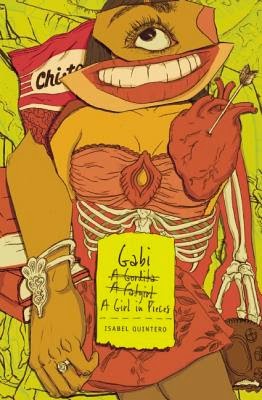
Gabi a Girl in Pieces

by Isabel Quintero
First sentence: “My mother named me Gabriela after my grandmother who — coincidentally — did not want to meet me when I was born because my mother was not married and was therefore living in sin.”
Support your local library: buy it there!
Content: There’s a lot here: talk of drug use, sex (off screen, not graphic), and swearing (including multiple f-bombs). It’d be in the Teen section (grades 9+) of the bookstore.

I didn’t know what to expect when I picked this up. I’d heard good things about it, and it won the Morris Award this year. Even so, I wasn’t prepared for the onslaught of emotions I’d feel while reading it.

It’s Gabi Hernandez’s senior year, and life has gotten more complicated than usual. One of her best friends is pregnant; the other just came out, and has been kicked out of his parents’ house. She’s still struggling with math in school, but she has hopes that she can get into college, the first in her family, since her parents immigrated from Mexico. She wants a boyfriend, but is afraid since she’s a self-proclaimed “fat girl” that she’ll never find love. Then there’s her meth-addicted father, and her punk younger brother. Not to mention a mom who is constantly placing pressure on her to be a “good” girl.

Writing all that down, it both sounds like a lot and not quite enough to hold a book together. One of the things that makes this book shine is the voice. Told in diary form, we get Gabi’s innermost thoughts, her insecurities and feelings, her poems and heartfelt letters to her father (which she never sends). Even though her life is complicated and hard, you can’t help but connect with Gabi on the most elemental level: she’s just a girl trying to live the best she can.

But, it’s also a feminist book, showing us the double standard we have for girls and boys. Which leads me to: oh my gosh, her mom. I wanted to smack her. She was SO hard on Gabi, from nagging her constantly about her weight to lectures about sex (while she tells Gabi’s brother “be sure to use a condom”). I know she was trying and doing the best she could under the circumstances, but I wanted to shake her. Call this another one of those reverse-parenting books, but there is no way I want to have the sort of relationship with my daughter that Gabi had with her mom.

It was Gabi’s awakening to the double standard, and her actively trying to do something about it — which came near the end of the book –which endeared me to the book. There was so much crap going on (if there’s an issue out there that deals with teenagers, it was in the book) going on in Gabi’s life that I found it difficult, initially, to relate. But by the end, I was cheering for Gabi, for her attitude toward her life, and for Quintero’s unflinching portrayal of her.

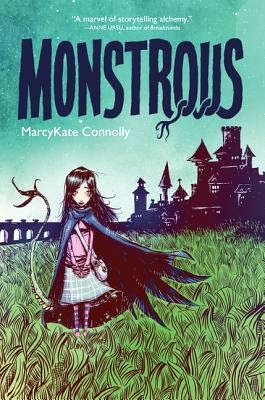
Monstrous

by MarcyKate Connolly
First sentence: “I will never forget my first breath.”
Support your local independent bookstore: buy it there!
Content: It’s long and slow and while the romance is fairly age-appropriate, it’s not just alluded to. It’s in the middle grade (grades 3-5) section of the bookstore, but I’d gear it to the older end of the age range/young YA.

Kymera is a newly formed creation of her Father’s.She’s part girl, yes, but also part bird and part.. something else with a scaled, stinging tail. Her purpose, her father tells her, is to rescue the girls that have been imprisoned by the wizard. She heads into Bryre every night, stinging the guards and bringing out one girl which her father then tells her is being taken to the safety of Belladoma, a nearby country.

If you’re not getting huge creeper undertone vibes from this, I’m really not doing it justice. See: everything is not what it seems. One of the best things about the first half of this book is the unease that Connolly writes into it. I just KNEW something wasn’t right, that Kymera was being too trusting (then again, being new-born she didn’t know any better), that something would go horribly wrong.

And, once she meets a boy, Ren, against her father’s wishes, it does.

I  won’t tell you how it all unravels; the twists and turns are best left to surprise. So, even though this is a slow book, with a lot of internal dialogue and musings, I was still interested enough to keep reading. I loved the dark Frankenstein-like aura it has, though it has a very Grimm-like overlay. Like Connolly couldn’t decide whether to tell a fairy tale or a monster story. But, the mashup works.

Until the end.

See, it turns fairy tale in the end, and I think we were supposed to be Moved by the ending, but I felt cheated. I suppose I wanted some sort of middle-grade happily ever after, and I should be happy Connolly refused to give it to us, but it felt… forced. And that made me dissatisfied.

But, overall, it was a well-done, dark middle grade fantasy.

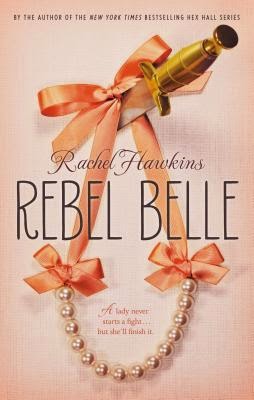
Rebel Belle

by Rachel Hawkins

First sentence: “Looking back, none of this would have happened if I’d brought lip gloss the night of the Homecoming Dance.”
Support your local independent bookstore: buy it there!
Content: There’s some mild swearing, and some (somewhat oblique) references to sex. Plus some violence. None of which is enough to make it “objectionable”, so it’s in the YA section (grades 6-8) of the bookstore.

Harper Price is one of those annoyingly perfect people. She’s the president of everything, super involved in her school. Great grades, popular friends, the Perfect Boyfriend. She’s even going to be crowned Homecoming Queen. (Seriously: about 50 pages into the book. I’m thinking she’s the embodiment of everyone I loathed in high school.) So, the last thing she expected, when she went to the restroom the night of the homecoming dance to touch up her lip gloss, was to get superpowers. She inadvertently stumbled into a world with Mages and Paladins — who are protectors, and it’s the powers Harper ended up with — who have sworn to protect the Oracle. Who just happens to be the person Harper loathes most.

There’s a lot more going on in this novel, including boyfriend drama and a Cotillion, but that’s basically the gist of it.  Harper, the annoyingly perfect girl, gets powers and becomes awesome.

I was in the mood a while back for something completely fluffy, something that was fun, but not taxing, so I turned to an author who I knew would deliver. And Hawkins did. Yeah, there’s probably some inconsistencies in the book and it’s definitely really white. (Then again, it’s Alabama.) No, it’s not as good as Hex Hall. However, it IS fun. It’s got that delightfully quirky Southern feel to it (I loved Harper’s great-aunts), and the magic is clever and different. But mostly, it was just FUN. Which is all I really wanted out of this book.

I even enjoyed it enough to pick up the second one. 

State of the TBR Pile: March 2015

When I was very little, I tended to serve myself a ton of food and my mom would always say “Your eyes are bigger than your stomach.” I have come to realize that I have the same problem when it comes to books. I’m always seeing new ones I want to read, and grabbing them. Then they stack up and I come to realize that I’ll never ever be able to read ALL the books, no matter how much I want to.

And that kind of makes me sad.

On the pile by the nightstand this month…

Provence, 1970, by Luke Barr (I meant to read this when it came out because JULIA CHILD)
The Tapper Twins Go to War, by Geoff Rodkey (I liked his pirate series… well, the first one. And this sounds fun)
Moonpenny Island, by Tricia Springstubb (Curious)
The Kidney Hypothetical, by Lisa Yee (Because I do like Lisa Yee)
Miss Mayhem, by Rachel Hawkins (Because I read Rebel Belle a while back and really liked it)
Hold Me Closer, by David Levithan (Two words: TINY COOPER)
The Wrath and the Dawn, by Renee Ahdieh (Curious.)
An Ember in the Ashes, by Sabaa Tahir (Because M really liked it.)
The Door in the Moon, by Catherine Fisher (Its the third Obsidian Mirror!)
The Trap, by Steve Arntson (for an event in April)
Eddie Red Undercover: Mystery in Mayan Mexico, by Marcia Wells (for an event in April)
Willy Maykit in Space, by Greg Trine
Dash & Lily’s Book of Dares, by Rachel Cohn and David Levithan
With a Name Like Love, by Tess Hilmo

What’s on your pile?

Audiobook: Small Victories

by Anne Lamott
Read by the author
Support your local independent bookstore: buy it there!
Content: She likes the word s**t, and drops about five f-bombs.  Which kind of caught me off-guard. It’s in the religion/philosophy section of the bookstore.

I’ve been curious about Anne Lamott for a while now; she’s an incredibly popular author at the store. I was in between audio books recently and discovered this one, and it was delightfully short. I figured audio was a good way to experience her.

This is basically a series of short reflections on life, God, and the intersection of the two. For the record: Lamott is a liberal, which I don’t mind at all, and was very against the invasion of Iraq in 2003. (Several of the essays are from around that time period.) She belongs to a church in northern California. She has a son, and lots and lots of friends, many of whom are suffering from serious illnesses. She has a good sense of humor, and is honest about her struggles with God, people, and just life in general.

In many ways, the words were just what I needed to hear: we’re all human, we’re all trying. God is in connecting with other people and reaching out to love them.

What I didn’t like so much, was Lamott’s reading of her own work. I understand why she needed to read her own words; it would have been odd otherwise. But Lamott read in such a way that it soundedlikeonereallylongsentancewithoutevertakingapauseorevenraisedorloweredhervoicewithsentenceinflection. When I concentrated to hear the words, I loved it. But her reading of them almost turned me off altogether. I’m glad I stuck it through to the end, for the thoughts and ideas. But, I wish Lamott had been a better narrator.

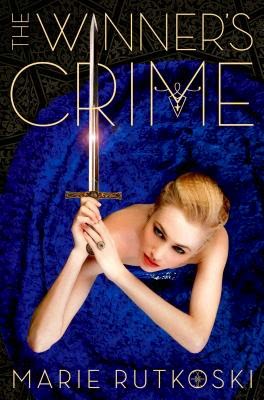
The Winner’s Crime

by Marie Rutkoski
First sentence: “She cut herself opening the envelope.”
Support your local independent bookstore: buy it there!
Review copy snagged from the ARC shelves at my place of employment.
Others in the series: The Winner’s Curse
Content: There’s some violence, sometimes a bit graphic, and mention of sex (but only illusions). It’s in the YA section (grades 6-8) of the bookstore.

There will be spoilers for Winner’s Curse. You’ve been warned.

Kestrel handed Arin his country, a treaty that gave them a pseudo-independence from Valoria after their brief revolution. Even though she’s in love with Arin, she knows she can’t have him. He’s Herran. He was her slave. And, probably most importantly, she offered herself to the emperor to be his son’s bride in exchange for Herran’s independence.

But, of course, things are not simple. She can’t get Arin out of her head. The emperor is cruel and manipulative, which means Kestrel is constantly playing games with other people’s (and her own) lives. Especially because she wants — no, NEEDS — to help the Herrani out. By becoming a spy for them. She’s definitely playing with fire.

First: I LOVED being back with Kestrel. She’s so smart, so wily, and yet feels everything deeply. She’s just a fantastically complex character, and I thoroughly loved being in her head as she went through the paces. I loved hating the emperor (oh, man, he’s despicable). And even though Arin is pretty annoying, I enjoyed his character growth.

That said, it’s very much a middle book in a trilogy. It’s moving things forward, sure, but it’s also very much spinning in place. Kestrel, while fun, doesn’t have any character growth, really, until the end when she does something completely out of character (but leads to a pretty great cliffhanger ending). Arin did grow, however, and after he stops being moody about Kestrel, he has some pretty great scenes. It took me a while to get going, but once I did, I plowed through straight to the end which left me begging for the last book.

Even with the second-book-in-a-series curse hanging over it, it’s still a GREAT read.

Shadow Scale

by Rachel Hartman
First sentence: “I returned to myself.”
Support your local independent bookstore: buy it there!
Others in the series: Seraphina
Release date: March 10, 2015
Review copy snagged off the ARC shelves at work.
Content: It’s pretty complex, when it comes to keeping tabs on everything that’s going on, and it’s fairly long and slow-moving as well. It’s also more mature in its sensibilities, though there’s not much else that would put it in the Teen section (grades 9+). Even so, that’s where I shelve these.

There’s so much going on in this novel that, much like Seraphina, it’s kind of difficult to put all of what’s going on down on paper. (Or the internet, for that matter.) On the one hand, this is a straight-forward road trip: to help her friend Glisselda, who is now queen of Goredd, Seraphina goes on a quest to find the other ityasaari — those who are half-dragon, half-human. She feels that, if she gets everyone in one place, they’ll be able to create a mind-field to keep the renegade dragons out of the city. Seraphina initially thinks this will be a simple task: go into the surrounding countries, locate the ityasaari, get back to Goredd and they will all live happily-ever-after.

Thankfully for the reader, it’s not that simple. There are obstacles in Serpahina’s way, and not least of all is Jannoula, an abused, embittered, scheming ityasaari who has the ability to manipulate the humans (and dragons) around her. She is there every step of the way, adding conflict, tension, and suspense to Seraphina’s path.

Also like Seraphina, there’s much to love about this one. Hartman’s world-building is impeccable, and it’s fantastic to see what she’s done with the other cultures, religions, and people surrounding Goredd. The romance that was budding at the end of Seraphina is still here, but it takes a back-seat to Seraphina’s journeys and allows Seraphina to become her own strong woman independent of anyone else. That said, there’s some surprises by the end of the book, ones that I thought were thoroughly refreshing.

Speaking of the end, about two-thirds of the way through, I worried that Hartman wasn’t going to wrap up the story, but she pulled through. In classic high-fantasy style, she gives us an epic and truly fantastic ending, one that is thoroughly satisfying while staying true to the story, characters, and world she built.

Hartman is truly a writer to keep an eye out for. Whatever she touches is just amazing.