Audiobook: The Help

by Katheryn Stockett
read by: Jenna Lamia, Bahni Turpin, Octavia Spencer, Cassandra Campbell
ages: adult
Support your local independent bookstore: buy it there!

I should probably start by admitting that I’m the last person in the universe to read this book. I’ve been avoiding it for years because, as you all know about me, I really don’t like hyped books. (I should amend that: what I don’t like is the hype surrounding a book. If I catch it before the hype, I may like it just fine.) I figured there was no way this one would live up to its reputation. That, and the subject matter: the relationships between white women and their black maids in 1960s Mississippi just seemed too, well, explosive. Better just to let things be.

Since you all basically know the plot — it’s about two maids, Aibileen and Minny and a white 20-something woman, Skeeter Phelan, and how they come to know each other, and then work together to get a book of memories of black maids published — I’ll just stick with my reactions to the book, as well as the audio production.

First off, this book did nothing to improve my impression of Mississippi. I haven’t had anything good to say about the state since our year there 10 years ago, and the white women in this book — from Skeeter’s overbearing mother to the spineless Elizabeth Leefolt to Hilly Holbrook (especially Hilly Holbrook) — did nothing to make me more sympathetic to the state and the people there.

I also wanted more. I wanted more Celia (and for her to find a friend in Skeeter; I was highly disappointed that didn’t happen), for the main characters to have more spine and stand up (I know: a very 21st-century attitude there), and for Hilly to get some sort of come-uppance (rather than the more true to life “she’ll just have to live with herself for the rest of her life” ending I did get).

That said, I loved the audio book. I think, in many ways, this was the right way for me to experience this book. There were parts that I would have gotten frustrated with if I’d just read it, but I found loving listening to. I adored the inflection the narrators would give to the sentences, the rich Southern accents (and yes, I did find myself speaking Southern more often than I should have), and the voices they’d give to the characters. (Octavia Spencer’s Celia was just perfect.) Because they made the book come alive for me, I was able to connect with it better, and let my objections (and annoyances) slide.

So, am I glad I read it? I guess. It did make for a really good book group discussion, and it was an interesting story. I didn’t absolutely love it, but it surprised me that I liked it as much as I did. Which isn’t a bad thing, in the end.

Ten Miles Past Normal

by Frances O’Roark Dowell
ages: 11+
First sentence: “No one can figure out where the terrible smell is coming from, but everyone on the bus this morning can smell it and has an opinion.”
Support your local independent bookstore: buy it there!

I wish I had read this book when I was 11. Seriously. I was a mixed up, not “normal”, and yet yearning to be, 11-year-old (granted, this is all faded memories now), and I would have loved a book that essentially showed me that you can find your space, that you can be yourself, and that “normal” is really what you make it out to be.

Janie Gorman, age 14, just wants to be normal. She lives on a mini-farm (just goats and chickens on five acres) that when she was 9 years old, she was enthusiastic about. Now, in her freshman year of high school, set adrift from her middle school friends and faced with seemingly endless teasing about the smell of her lifestyle, she’s not quite as enthusiastic. In fact, she’s downright disdainful. Nothing about this year seems to be going right; even her best friend, Sarah, seems to be drifting away.

All Janie really wants to be is normal. Normal life, normal friends, normal interests. And yet, in this small North Carolina town, she slowly learns — through new friends, new interests and getting to know people better — that normal is relative. And that sometimes, being past normal and into your own little thing is a better way to be.

It’s a sweet book, with Dowell’s trademark simplicity and tenderness without being too sappy. Janie felt like a real teenager: she’s not a bad kid, just someone who yearns for something… simpler, something she can hold on to as her own. I loved the characters in this book, and the fact that the message of being yourself is there without being preachy or hitting you over the head.

And I really do wish I’d read it when I was 11.

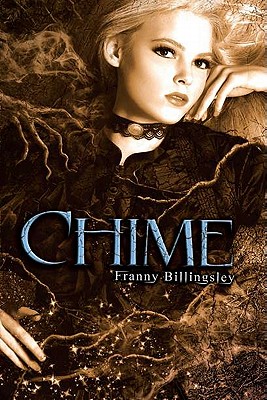
Chime

by Franny Billingsley
ages: 14+
First sentence: “I’ve confessed to everything and I’d like to be hanged.”
Support your local independent bookstore: buy it there!

If I were being totally honest, I’d say that this book didn’t grab me from the beginning. I would admit to being completely confused for about the first third of the book, struggling with it, but still mesmerized by the way Billingsley was telling the story. It was tantalizing in its potential, which kept me going.

And I’m so happy I did.

In the Swampsea there are two kinds of people: those who can see the Old Ones — the spirits of nature and the monsters — and those who can’t. Generally speaking, those who can see the Old Ones are witches. Sure, there’s the Chime Child, a person who is born on the stroke of midnight and whose purpose is to sit in on the trials of the witches, who can see the Old Ones. But no one else. So, that must mean that Briony Larken, who can, is a witch. At least, that’s what Stepmother always said. There’s even proof: Briony called up the wind, which made her twin sister Rose fall and that’s why she’s not completely normal. And Briony called up Mucky Face, the spirit of the river, to injure Stepmother which made her sick, and would have killed her if the arsenic didn’t.

No, Briony isn’t happy. And she can’t love. Not even her sister. Not even her father, who has left his children alone for so long. But then Eldric comes along, bringing with him light, and laughter, and perhaps most importantly, change.

It’s a complex book, as Billingsly peels back the layers of not only the story but also Briony’s psyche. There’s mystery: about Stepmother’s death, about Briony, about Eldric, about Father. That doesn’t even mention the one that Rose carries and drops hints about all through the book. And there’s romance. It’s not a fiery one, full of sparks and swoons, but rather my favorite kind: one where the characters start slowly, are friends first, and then grow into something more.

And the ending? Let me say that I don’t cry easily at books, and this one made me weep.

Very much worth the accolades it’s getting.

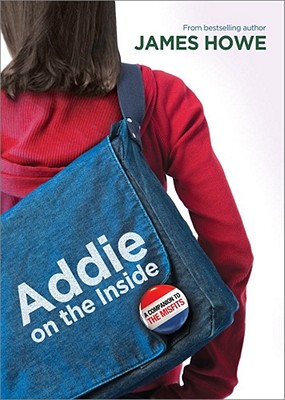
Addie on the Inside

by James Howe
ages: 11+
First sentence: “The poems that follow are written in the voice of Addie on the inside.”
Support your local independent bookstore: buy it there!

Addie Carle is tall, plain, outspoken: basically everything a popular girl is not. It doesn’t really bother her; she believes deeply and is passionate about the things she’s outspoken about, and she has several good friends, though they’re all boys. What does get to her is the constant teasing, the names, the questions. Especially about why her boyfriend, DuShawn, is going with her.

For a novel in verse, where every word is carefully chosen, this book packs a punch. I haven’t read the ones it’s a companion to, but you don’t need to in order to enjoy Addie and empathize with her feelings. She is very much the smart misfit, a middle school girl who both does and doesn’t want to fit in. She’s finding her way, not only at school, but in life. True, that sounds cliche, but perhaps it’s because of the verse that it doesn’t come off that way. In addition, there are issues here: tolerance for those different, women’s rights, bullying… and yet the book is not heavy-handed. Howe does a masterful job giving us a book full of meat and character, and yet not lecturing us on what to think.

Now I want to go back and read the ones that this is a companion to.

Sunday Salon: The State of the TBR Book Pile

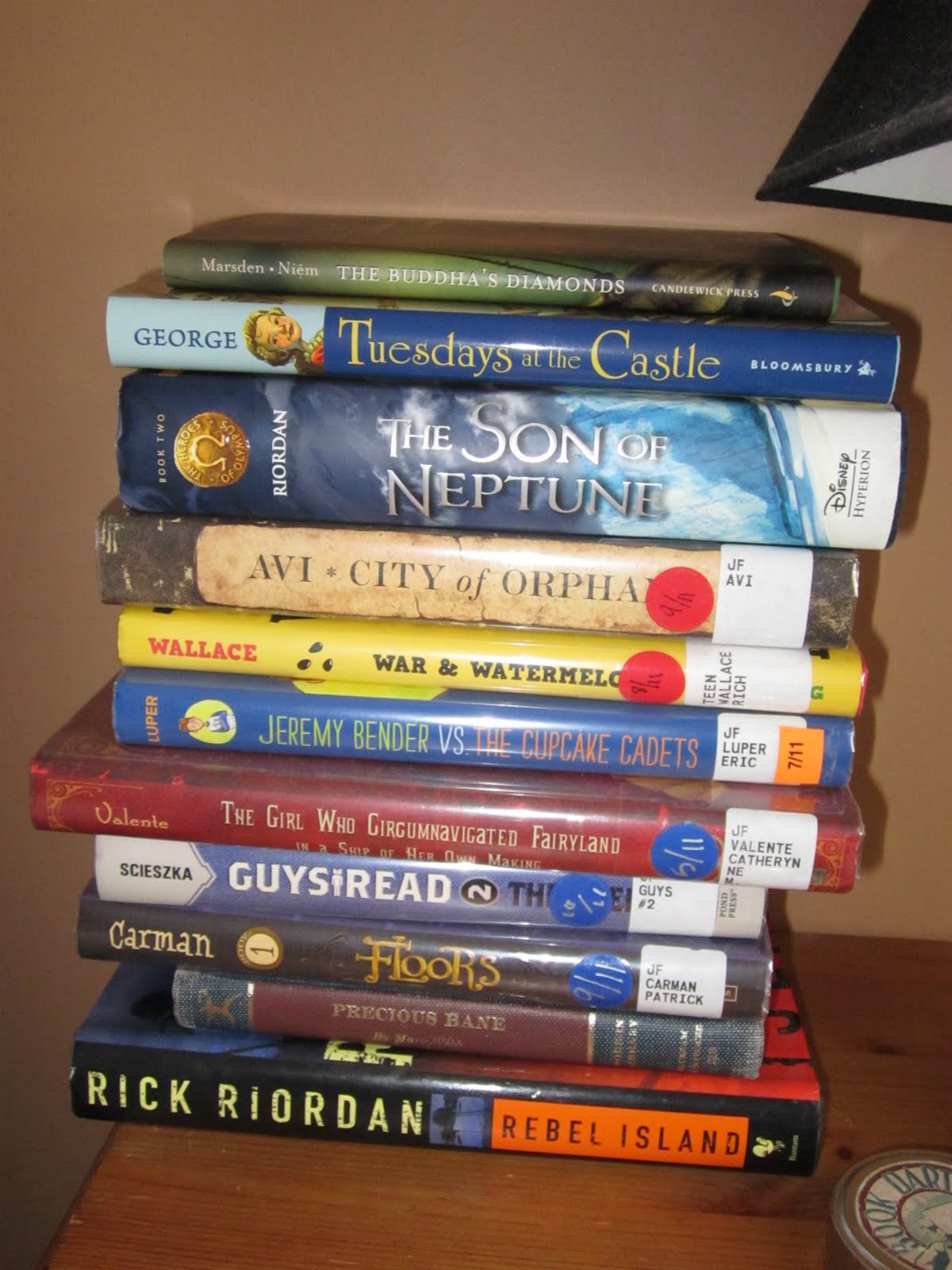
So a couple weeks ago when I was complaining about my physical TBR book pile, it hit me: this could be monthly feature! Since I don’t do Library Loot anymore (and to be honest, the Goodreads widget on my page isn’t always up-to-date), there’s really no way to share what I’ve got sitting on my nightstand.

Now I do! So, without further blathering, here’s my current pile:

LinkLink
The Buddha’s Diamonds (part of Wichita’s Big Read)
Tuesdays at the Castle (recommended by Charlotte and Jen)
The Son of Neptune (I will get to this. Eventually.)
City of Orphans (MG Cybils book that stood out to me)
War and Watermelon (ditto)
Jeremy Bender and the Cupcake Cadets (ditto)
The Girl Who Circumnavigated Fairyland in a Ship of Her Own Making (because I ought to)
Guys Read: Thriller (since I liked Funny Business)
Floors (Charlotte again, I think.)
Precious Bane (on loan from Corinne. I will read it… soonish)
Rebel Island (My goal is to finish this before the end of the year.)

What’s on your pile? Anything interesting?

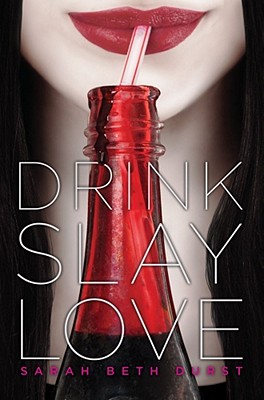
Drink, Slay, Love

by Sarah Beth Durst
ages: 13+
First sentence: “‘One hour until dawn,’ Pearl said.”
Support your local independent bookstore: buy it there!

Pearl is a vampire. And she is completely happy. She’s strong, she’s awesome, she’s got a super-hot (immortal) boyfriend, a favorite snack (in the form of a loser boy who works at the local all-night ice cream joint), the approval of her Family, and she’s about to go through the Fealty Ceremony for vampires. Life is perfect.

And then Pearl is stabbed by a unicorn, which completely throws her for a loop: unicorns are supposed to be mythical, unicorns are NOT supposed to stab vampires, and — most importantly — vampires are not supposed to survive the stabbing. And be able to withstand daylight afterward.

Rather than let it be a deterrent to their plans, Pearl’s Family decides that what she needs to do is go to high school, and lure all those lovely, tasty humans to their doom in order to supply the feast for the King of New England at the Fealty Ceremony.

So, Pearl broaches the world of Daylight, of High School drama and dynamics, and finds herself, well, moved. Which completely throws her for a loop: vampires aren’t supposed to be moved. They aren’t supposed to have a conscience. Humans aren’t supposed to be interesting. And yet…

One of the best things about this book — aside from the swoonworthiness of Evan, a human guy whom Pearl falls in with (though I called the ending about halfway through) — is that Durst is plainly making fun of all the vampire books out there, even as she’s telling a vampire story. There are laugh-out-loud moments, moments in which you have to grin as she pokes fun at vampires, Twilight, and girls who swoon over the whole vampire thing. But, even aside from that, Durst’s telling an interesting story here, exploring ideas of change and reform and self-identity, as well as interfering in people’s lives (or whatever passes for a life if you’re undead). Sure, it’s a romance, and it’s fun, but at it’s core, it’s telling a story of a girl trying to figure out who she is in the face of a drastic change.

And that’s someone everyone can relate to.

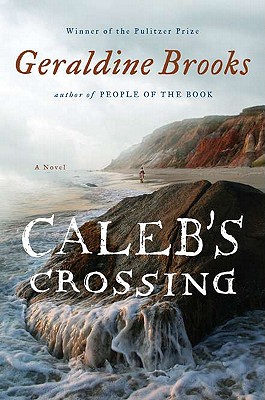
Caleb’s Crossing

by Geraldine Brooks
ages: adult
First sentence: “He is coming on the Lord’s Day.”
Support your local independent bookstore: buy it there!

It’s the 1660s, on what is now known as Martha’s Vineyard. There’s a small group of Puritan settlers there, and Bethia’s father is the minister. He is determined not only to lead the English in the ways of the Lord, but to convert the heathen “salvages” to the Truth.

As a girl, Bethia is consigned to a life of labor, even though she longs to be more like her brother Makepeace and study languages and scripture. She is educated to a degree; her father teaches her how to read and write, though after a while he discourages anything further. She is discontent, though, and wanders the island rather than attending to her chores. In doing so, she meets a Wampanoag boy whom she comes to call Caleb.

They develop a bond — not a romantic one — and the book follows their relationship as Caleb comes to live with Bethia’s family and then goes across to the mainland to attend school — first a primer school, and then Harvard; the first Native American to do so. Bethia follows him, at first working in the school and then working in the buttery at Harvard. The book is named after Caleb, but it’s about Bethia and the whole Puritan culture; Brooks has certainly done her research about the time period. The book is in the form of Bethia’s journal, of sorts (it’s not a daily one), and so not only do the characters put forth ideas and thoughts about the time period — Bethia is the only remotely modern one of the bunch — but Brooks keeps up the pretense even down to the spelling of certain words.

Because it’s a series of Bethia’s reflections and memories, the book is incredibly slow. It’s not a book for the plot-driven or even the character-driven. The only character we get to know in any depth is Bethia herself; because most of the other main characters are men, we’re only allowed to get to know them peripherally, as per the Puritan custom. In many ways, the book was interesting for that: because Brooks did her research, she was able to fully immerse herself in that time, and it came through in the writing. However, because I wasn’t terribly interested in the plot, while I found theanthropological look at the Puritans interesting — I did finish the book after all — it wasn’t enough for me to be completely riveted by the book.

That said, Brooks is a talented writer, and this one isn’t a complete waste of time.