Audiobook: Reckless

by Cornelia Funke
ages: 12+
Read by Elliot Hill
Support your local independent bookstore: buy it there!

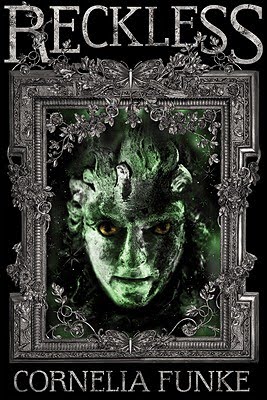
When Jacob was 11, his father disappeared. After a year of missing him, and being angry at his disappearance, Jacob enters his father’s study, and following some cryptic notes, ends up falling through a mirror into a completely different world.

Fast forward 12 years, and Jacob has made a life for himself in the Mirrorworld as a Finder for the Empress Therese of Austry. Then once (and once is all it took) his younger brother Will followed him through the mirror and was attacked by the Goyl, stone people who are at war with the humans. As a result, Will is slowly turning into the jade Goyl, cursed by the Dark Fairy to be the protector for the Goyl king.

Jacob is angry — at himself, at the fairy, at the world, at Will — and has vowed to do anything to save his brother. This leads himself, Will, Will’s girlfriend Clara (who came through the mirror after him), and a shape-shifter by the name of Fox (who’s been Jacob’s companion for years, and wishes that Jacob could realize that she’s more than just his shadow) on an interesting, dangerous and possible futile adventure across the world hoping to save Will from becoming a Goyl for good.

It’s a clever story, turning Grimm’s fairy tales upside down, weaving them through this dark tale. And don’t get me wrong, with the age of the characters and the intensity of the tale, I kept wondering why this was a middle grade novel. It’s scary. It’s intense. It’s not for the faint-of-heart. But it wasn’t until I read the review of it at Charlotte’s Library, that I realized that it really is a coming-of-age story, and not just a fairy tale. Charlotte puts it quite nicely:

Despite the ostensibly already grown-up age of the central characters, this is a book about growing-up, about how the relationships of brothers and friends, and perceptions of oneself, change in terrifying ways as adulthood is entered. Jacob might be 24 on paper, but the young man in the mirror world is more an avatar of oldness exploring a fantasy world than a convincing adult–his character is still very much that of the reckless adolescent, confused by his emotional responses to the questions posed by growing up. Although sex lurks in the background (it’s never explicitly or centrally part of the story), for Jacob it is still the hormonally charged lust of the adolescent–he has yet to learn love (oh poor Fox. I felt for her so very much).

It makes so much more sense when viewed at it this way. Though, like Charlotte, I’d be loathe to give it to the younger middle grade readers, for this isn’t of the faint of heart. And as the jacket flap warns: it’s not a happily-ever-after.

As for the medium, I think I enjoyed listening to it better (though there were times when I
wondered about who was speaking; I gather Jacob talked to himself quite a bit) than I would have reading it. Hill did an admirable job narrating as well as with the character’s voices, which helped me get into the story in a way I wouldn’t have if I’d read the print version. It also helped that I couldn’t look to the end to see if it all turned out “okay”.

Also, props to Funke for creating such an elaborate and interesting world. She, much like Rowling, has an incredible imagination and a gift for making everything pop off the page. It’s a strange book, but one that I think will stay with me for quite a while.
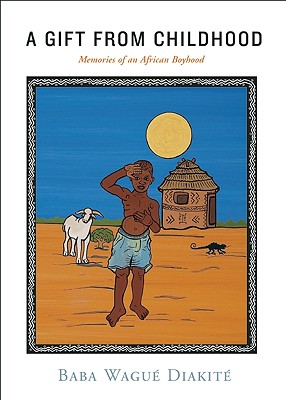
A Gift From Childhood

Memories of an African Boyhood
by Baba Wague Diakite
ages: 10+
First sentence: “A little boy sat on the dirt floor with a bowl of millet porridge between his legs.”
Support your local independent bookstore: buy it there!

I’ve been sitting here trying to figure out a way to summarize this book, and I’m coming up short. How do you summarize a man’s reflections on his childhood, his experiences in a small village in Mali, and the life lessons that taught him? You can’t.

His parents, for cultural if not financial reasons, sent Diakite and his siblings to live in the small village where his father grew up to be raised by their grandparents. He stayed for several years, until he was in his early teens, learning about the ways of the village. While there’s no real over-arching narrative, the stories do follow a bit of a timeline from when he arrived at the village through until he met his wife, came to American and settled in here. The stories themselves are interesting; none are very long, and they each shed light on what life in a small, rural African village is like. There’s some commentary on imperialism and on materialism, but it’s not heavy-handed, or even all that present. The art, done by Diakite as well, helps give the book the feeling of being told African folktales from the hand of an experienced and talented storyteller.

His is a fascinating life, and a good story about how differences, the “other” if you will, can enrich all our lives.

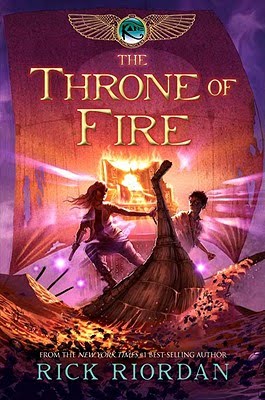
The Throne of Fire

by Rick Riordan
ages: 11+
First sentence: “Carter here.”
Support your local independent bookstore: buy it there!

When we last left our erstwhile heroes, siblings Carter and Sadie Kane, they had defeated the god Set but had realized there was a greater threat: Apophis, the god of Chaos, is rising, and if the Kanes don’t find a way to stop him, he will swallow the sun and the world as we know it will end. To do this, the Kanes need to piece together the Book of Ra — no easy task — and wake the Sun God in hopes that he can rally the gods and magicians in order to put a stop to Chaos once and for all.

It sounds like a tough job, but if anyone can do it Carter and Sadie can — with a little help from new trainees Walt and Jaz, as well as the god of dwarves, and one of my favorite characters, Bes.

A note of warning: it’s a nearly 500-page book, and the first 100 pages are glacially slow. So slow, that for the first time I can remember, I considered abandoning a Riordan book. I stuck it out: it is Rick Riordan after all, and I just didn’t believe he could write a clunker. And he didn’t. I’m going to pull out the tired rock analogy here, because it fits. This book is a huge, enormous boulder. And once it gets going, it really goes. It’s interesting, and funny, and uses magic in clever ways. I still feel like I’m missing something with not knowing my Egyptian mythology well, but for the most part I thought this book gelled better than The Red Pyramid. At the very least, while the book wraps up, it leaves for some interesting threads to be dealt with in the next novel.

There’s something for everyone: twists and turns, adventure and a wee bit of romance, magic and intrigue, humor and suspense. In the end, it’s more than worth the time it takes to get through the beginning.

Enchanted Ivy

by Sarah Beth Durst
ages: 13+
First sentence: “‘Almost there,’ Grandpa said.”
Support your local independent bookstore: buy it there!

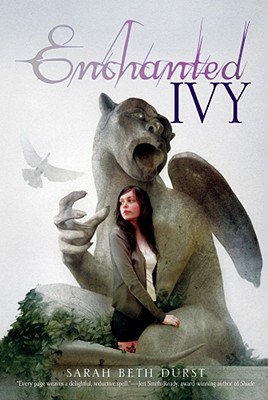
Lily has lived her whole life with her Grandpa and her mom in Philadelphia. Never gone anywhere, never done much, mostly because her mom isn’t quite, well, completely all there. She’s artistic and fun and interesting, but is also subject to brain hiccups.

Grandpa, on the other hand, is a graduate of Princeton, and goes to the reunions every year. And this year, the spring of Lily’s junior year, he’s decided to take both Lily and her mom along, much to Lily’s excitement: Princeton is exactly where she wants to go to school.

But once she gets there, she discovers that not everything is exactly as it seems. The gargoyles talk. Her father is a Knight. There’s a boy with black and orange hair. And there’s a whole alternative Princeton, full of magical creatures. And Lily’s been given a test to find the Key. Little does she know how deeply her family is involved in all this.

It’s a clever premise, making an old institution like Princeton magical, creating a whole alternate universe that’s connected through the Princeton gate. Durst plays with ideas of unity and cooperation as well as touching on fear of the unknown and how that tends to make groups overly cautious. She also addresses the idea of doing wrong for the right reasons. There’s adventure and romance (a bit of a love triangle) as well.

But, even with all that, it didn’t quite work for me. I usually love Durst’s stuff, but this one felt off. The romance didn’t quite work, even though the boys were more than awesome. The bad guy wasn’t evil enough for me. And then there’s the whole fact that she introduced a whole new character two-thirds of the way through the book. Generally, that doesn’t bother me, but it was enough of a plot twist that it threw me for a loop. It changed the game, and it made things a lot darker than they were initially setting out to be. And while I liked the dark element, the timing felt off to me.

That said, it really made me want to visit Princeton.

The Fairy Godmother

by Mercedes Lackey
ages: adult
First sentence: “This is not the way to spend a beautiful spring morning! Elena Klovis thought, as she peered around the pile of bandboxes in her arms.”
Support your local independent bookstore: buy it there!

Elena was supposed to be stuck in a tale. You know, the one where she sleeps by the fireplace, spending her days doing all sorts of grudge work for her step-mother and step-sisters? And then she gets to go to the ball and marry a prince?

Except, she doesn’t.

She turns 21, and her step-mother and -sisters decide that this part of the Kingdom isn’t doing them any favors (not to mention that their debts are mounting), so they take off and leave Elena the house. Which the debtors then claim. Elena figures that she can’t do any worse in life, and so tries to get hired out.

And that’s when her life gets interesting. She is picked up as an Apprentice to the Fairy Godmother. See, in the 500 Kindgoms, there’s this thing called The Tradition: magic that is pushing, pulling, forcing people into tales. And it’s the Godmother’s role to direct, push, pull, prod and help people into, along in, or out of these stories. The best part of the book, I think, was working with Elena as she learned about the magic and how to manipulate the stories. The Tradition is a powerful thing, and if one doesn’t think about what one wishes, or even says, dire consequences abound. There were clever asides to several fairy tales, as well as the categorization of characters. It’s all very organized and delineated, which made me smile.

Of course, there has to be a love interest, and that shows up in the form of Alexander, the stubborn prince who ends up as a donkey for several chapters. He’s arrogant, angry and conceited, but eventually learns his lesson and takes on his own destiny, which includes breaking tradition and falling in love with a Godmother. I expected things to slow way down, but Lackey has got her books down (she should after as many as she’s written), and managed to throw a couple of steamy sex scenes in there as well as giving us a big finale to end on, both which served to, um, keep my interest.

It’s fluff, but it’s fun, enjoyable fantasy fluff. And I can’t say anything bad about that at all.

Sunday Salon: An Ode to Travel Books

(I know it’s Mother’s Day, here in the US. I’m not particularly fond of it — even though I am being spoiled with breakfast in bed served by my beautiful daughters — so I’m not going to write about it.)

At my in-person book group this month, we got to talking about traveling, both with and without kids. At one point, I said that I long to travel and to see new things, and that it sometimes frustrates me that I won’t get to see all I want to see. Then I said, “That’s why I read travel books.” I immediately thought of this piece that I first wrote this for Estella’s Revenge, back in May 2008. I thought it’d be good to share again.

**********

I adore travel books.

By “travel books,” I don’t mean the travel guides that line the shelves of the bookstore with lists of what to do and where to go (though I have to admit, I do like reading those, too), nor do I mean novels where a certain place is essential to the plot. No, what I mean are the non-fiction books, an author taking a journey somewhere, experiencing a different life for a while, and then writing about his or her experience.
Those are the travel books I love.

I have also called them “place books” because, for me, the most important element of the book needs to be a sense of wonder and excitement and anticipation about the places the author sees and the people the author meets. Without some element of respect and wonder, the book just becomes a catalog of events, a journey not worth taking. But with it, the book transports, taking me places and doing things I would never dream of doing (like giving up normal life for a house in Tuscany, or sailing the world following Captain Cook, or walking the length of the Appalachian Trail), experiencing new, unusual, and sometimes incredible places and people.

I love these books for many reasons. It’s because I can be inspired and entertained by these escapades in ways I can’t when they are fictional characters. Real people did these real things: it’s enough to motivate me to be just a little bit better, work just a little bit outside the mold, and think a bit more outside the box. It’s also because they’re accessible: most of these writers are journalists, and they write in a way that resonates with me in ways that novelists sometimes don’t. And it’s partly because it allows me to see the world in a way I couldn’t when I travel, even if I could imagine myself going some of these places. I want to visit Antigua, and live there for a month, and get to know the local people, but time and money and lifestyle just don’t mesh with that ideal. I admire these people, admire their willingness to get up and go and do.

Perhaps there’s a bit of a traveler in all of us, wanting to reach out and experience something beyond our mundane lives. Here is a list of 15 of my favorites, as well as others that sound interesting, to get you started (all descriptions of books I haven’t read came — in part — from Powells.com):

1. There will never, ever be a travel list without some book of Bill Bryson’s. He is, in my mind, the king of travel writers, the epitome of interesting journeys, witty observation, and superb writing. My two personal favorites are Walk in the Woods about his experiences walking the Appalachian Trail and In a Sunburned Country, about his escapades across Australia.

2. Around the World in 80 Days — not the Jules Verne novel, but the one by Michael Palin. Yes, it’s the same guy from Monty Python (and A Fish Called Wanda) fame. He’s spent the last 20 years traveling the world for the BBC in a series of specials. Around the World was the first one, the one that started it all. Watch the shows; they are interesting and fun, but also pick up the companion books. Palin’s a good writer with dry wit and self-deprecating humor, yet he never forgets a love and awe for the places he’s been and the people he’s met.

3. Ciao, America! — Capturing the odd sights and scents of Beppe Severgnini’s destination, Washington D.C., this book is a tale of quirky discoveries in a country obsessed with ice cubes, air-conditioning, recliner chairs, and after-dinner cappuccinos. From their first encounters with cryptic rental listings to their back-to-Europe yard sale twelve months later, the Severgninis explore their new territory with the self-described patience of mildly inappropriate beachcombers.

4. Confederates in the Attic — While Tony Horwitz isn’t usually considered a travel writer, I lump him in because his books usually involve some sort of journey and a strong sense of place. I’ve read all his books, but my favorite (hands down) is this one. If you haven’t read his escapades through the deep south, please do. It’s funny, and that’s the God’s-honest truth. (I had a Southern lady tell me once that Horwitz just “got” Southerners.) His newest is A Voyage Long and Strange: Rediscovering the New World — about the Europeans who preceded the Pilgrims to America. Not a travel book, per se, but it sounds fascinating.

5. Down the Nile — I read the blurb on the back of this book, and thought to myself that Rosemary Mahoney is a woman with cahones, because not many women would even consider doing what she did. She was determined to take a solo trip down the Egyptian Nile in a small boat, even though civil unrest and vexing local traditions conspired to create obstacles every step of the way. Whether she’s confronting deeply held beliefs about non-Muslim women, finding connections to past chroniclers of the Nile, or coming to the dramatic realization that fear can engender unwarranted violence, Rosemary Mahoney’s informed curiosity about the world, her glorious prose, and her wit never fail to captivate.

6. Eat, Pray, Love — Facing an early mid-life crisis at age 30, Elizabeth Gilbert decided to take a year of life to find herself. Traveling to Italy (the art of pleasure), India (the art of devotion) and Indonesia (for a balance between the two), this book is the chronicle of her adventures and insights. An intensely articulate and moving memoir of self-discovery, it’s is about what can happen when you claim responsibility for your own contentment and stop trying to live in imitation of society’s ideals.

7. An Embarrassment of Mangoes — author Ann Vanderhoof and her husband Steve take off for two years on a sailboat and head south from Toronto to the Caribbean. It’s the story of their adventures, of life on a smallish sailboat, and of the people they met on the islands. Wonderful, inspiring and fascinating.

8. The Geography of Bliss — self-proclaimed grump Eric Weiner travels from America to Iceland to India in search of happiness, or, in the crabby author’s case, moments of “un-unhappiness.” The book uses a beguiling mixture of travel, psychology, science and humor to investigate not what happiness is, but where it is.

9. Japanland: A Year in Search of Wa — documentary film maker Karin Muller spends a year in Japan trying to figure out the meaning of wa: a transcendent state of harmony, of flow, of being in the zone. With only her Western perspective to guide her, though, she discovers in sometimes awkward, sometimes awesomely funny interactions just how maddeningly complicated it is being Japanese. She as also written Along the Inca Road, about her journeys in Ecuador, Peru, Brazil, and Chile.

10. No Touch Monkey! — Curator of kitsch and unabashed aficionada of pop culture, Ayun Halliday offers bemused, self-deprecating narration of her itinerant foibles as examples of how not to travel abroad. An admitted bumbling vacationer, Halliday shares, with razorsharp wit and to hilarious effect, the travel stories most are too self-conscious to tell. Besides, who can resist a book with a Steven Colbert blurb on the cover?

11. The Royal Road to Romance — This is the oldest travel book I’ve read. It was written in 1925, but it’s an exciting and amazing tale of Richard Halliburton’s journeys around the world. He literally bummed his way, hitching rides on steamers, stealing trips on trains, biking, walking… things that very few people these days would even think of doing. It’s wonderful to read, with a jaunty style that just captivated me. Halliburton was everything a travel writer should be: rash, daring and a lot of fun to accompany on his adventures.

12. Tales of a Female Nomad – In 1986, at the age of 48 and facing an impending divorce, Rita Goldmen Gelman gave up all her possessions and decided to live in third world countries, experiencing what the natives experience. She no longer has a home, and she only owns what she can carry on her back. It’s a fascinating and inspiring tale of her experiences.

13. Under the Tuscan Sun — A love story by Frances Mayes about a her love for a house, a place, a dream. A truly beautiful book to read: her descriptions of the land, the area of Cortone in Tuscany, the house itself and all the renovations, are fabulous and picturesque. She’s written several other books including A Year in the World.

14. A Year in Provence — Like Under the Tuscan Sun, this month-by-month account chronicles the charms and frustrations that Peter Mayle and his wife — and their two large dogs — experience their first year in the remote country of the Luberon restoring a two-centuries-old stone farmhouse that they bought on sight.

15. Yemen: The Unknown Arabia — Writing with an intimacy and a depth of knowledge gained through thirteen years among the Yemenis, Mackintosh-Smith is a traveling companion of the best sort–erudite, witty, and eccentric. Crossing mountain, desert, ocean, and three millennia of history, he reveals a land that, in the words of a contemporary poet, has become the dictionary of its people.

Do you have any others to add to the list?

Mom

A Celebration of Mothers from StoryCorps
edited by Dave Isay
ages: adult
First sentence: “StoryCorps launched October 23, 2003, in Grand Central Terminal in New City.”
Support your local independent bookstore: buy it there!
Review copy provided by TLC Tours

I didn’t quite know what to expect, going into this one. It’s a series of conversations from the StoryCorps booths about mothers. Since there’s no coherent narrative, and since every story is just a snippet, really, I figured it’d be an easy, but not very substantial read.

On the one hand, I was right: it was an easy read. I breezed through it in an afternoon, but not only because it’s an easy read. It’s also an engaging one. Maybe it’s because I have an odd fascination with oral histories, but I found the stories, even if they were just snippets, to be fascinating.

There’s stories of mothers dying, of mothers caring, of mothers working, of mothers giving up babies, of mothers adopting children, of hard times and good times. It’s a broad collection of remembrances, from every walk of life. It was touching and interesting and sweet, even if it wasn’t especially memorable or life-changing. A lovely antidote to all the extreme mom stories: both the ones that make you feel guilty because you’re not doing enough, and the ones that make you feel smug because you’re so much better than that.

However, I think it was something Dave Isay wrote in the afterward that moved me the most:

I hope you’ll spread the word about our efforts. We want to encourage the entire nation to take the time to ask life’s important questions of a loved one — or even a stranger — and really listen to the answers. We hope to shower this country with more of the sorts of stories you’ve just read — authentic voices that remind us what’s truly important, that tell real American stories, and that show us all the possibilities life presents when lived to its fullest.

It made me want to seek out a booth for a conversation of my own. Which, I suppose, is the best thing you can get out of the book.

I Now Pronounce You Someone Else

by Erin McCahan
ages: 15+
First sentence: “I was switched at birth.”
Support your local independent bookstore: buy it there!

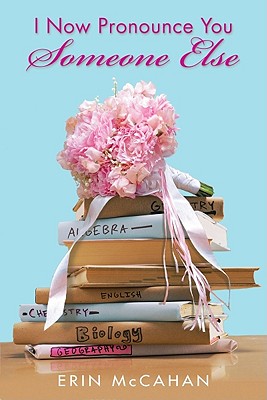
Bronwen Oliver, age 18, doesn’t know who she is.

Well, she does, to a point. She doesn’t know how she fits into her family She’s heard from her overbearing and inflexible mom for years that she doesn’t know where Bronwen came from. Bronwen’s mom tries to make her fit; taking her to dye her hair is just the least of things. Her stepfather, Whitt, is a slight buffer, but has become more distant in recent. All this gave rise to a hopeful fantasy of Bronwen’s, that she still sometimes holds on to: that she was switched at birth, and really belongs in someone else’s family.

She’s just been dumped by her boyfriend, because she won’t put out on prom night (gotta give the book props: Bronwen has decided to wait until marriage, and sticks to her guns). Then she meets Jared Sondervan, college senior, swoon-worthy male extraordinaire, home for the summer. It’s not quite love at first sight, but pretty darn close. Soon, they’re spending as much time as they can together, kissing passionately, telling secrets about their deepest selves in spite of Bronwen’s tendency to not rock the boat, and creating memories.

And then Jared proposes.

At first, in spite of all the objections, Brownwen is all gung-ho about the idea. The Sondervans are an incredible family. Bronwen loves their son, so what if she’s 18 and he’s 20?

On the one hand, I loved this little book. It was sweet, romantic, lovely and funny. (Then again, I’m from Michigan, so I get the Ohio jokes.) But it’s not all sweet, romantic, lovely fun: there’s a darker side about acceptance within your family and of yourself. Is she wanting to marry Jared because she loves him, or just because she hates her family? McCahan weaves the two sides of the book together practically seamlessly; like Sarah Dessen’s books, the darkness gives the fluff depth and makes it work better.

On the other hand, I really didn’t like the ending. I won’t spoil it for you, but know that I wished it had ended less fairy-tale-like.

But that wasn’t enough to spoil the rest of the book for me.

Trash

by Andy Mulligan
ages: 13+
First sentence: “My name is Raphael Fernandez and I am a dumpsite boy.”
Support your local independent bookstore: buy it there!

There are very few books that can both break your heart, keep you guessing, and make you cheer at the very same time. This is one of those books.

Set in an unnamed third world country (that, because of the author’s background, I visualized as the Philippines), it’s the story of Raphael, Gardo and Rat, boys who spend their life going through the garbage to find the worthwhile scraps to sell, and the day they found something truly amazing.

It’s just a wallet, but a wallet with enough pesos in it that catches their attention. Plus there’s a key. Raphael and Gardo take it, of course, but what happens after is beyond their control. It involves abusive police, a very corrupt elected official, some innocent bystanders, and solving a puzzle before the authorities get to them (or it) first.

The best word to describe the book is intense. So intense in parts that I had to put it down for a while, take several deep breaths, and cross my fingers and toes that it will all come out okay. Mulligan flips between several narrators: the premise is that they are all telling this story in retrospect, taking turns with the narrative as each has his (and her) own part to play. It shouldn’t have worked as well as it did; the idea of telling things in retrospect means that the end is given away, right? But, it’s not, and it works beautifully, keeping the reader (at least me) on the edge of their seat.

It helps, too, that Raphael, Gardo and Rat are not only likable but worth cheering for. They are up against incredible odds, and their soul and bravery are amazing. It’s also a book that makes you think: about third world countries, about aid, about corruption.

Excellent.