May Jacket Flap-a-Thon

Happy summer! Perhaps the best thing about the end of May is a move into summer reading. (Am I the only one who reads books seasonally?) The light stuff, the fluff, the summer-feeling books. What are the books you’ve put aside for your summer reading?

Trash (David Fickling Books): “In an unnamed Third World country, in the not-so-distant future, three “dumpsite boys” make a living picking through the mountains of garbage on the outskirts of a large city. One unlucky-lucky day, Raphael finds something very special and very mysterious. So mysterious that he decides to keep it, even when the city police offer a handsome reward for its return. That decision brings with it terrifying consequences, and soon the dumpsite boys must use all of their cunning and courage to stay ahead of their pursuers. It’s up to Raphael, Gardo, and Rat—boys who have no education, no parents, no homes, and no money—to solve the mystery and right a terrible wrong. Andy Mulligan has written a powerful story about unthinkable poverty—and the kind of hope and determination that can transcend it. With twists and turns, unrelenting action, and deep, raw emotion, Trash is a heart-pounding, breath-holding novel.”

Everything this says is true, and yet it doesn’t capture the half of what this novel is. Brilliant.

Enchanted Ivy (Margaret K. McElderry): “What Lily Carter wants most in the world is to attend Princeton University just like her grandfather. When she finally visits the campus, Grandpa surprises her: She has been selected to take the top-secret Legacy Test. Passing means automatic acceptance to Princeton. Sweet! Lily’s test is to find the Ivy Key. But what is she looking for? Where does she start? As she searches, Lily is joined by Tye, a cute college boy with orange and black hair who says he’s her guard. That’s weird. But things get seriously strange when a gargoyle talks to her. He tells her that there are two Princetons—the ordinary one and a magical one—and the Key opens the gate between them. But there are more secrets that surround Lily. Worse secrets. When Lily enters the magical Princeton, she uncovers old betrayals and new dangers, and a chance at her dream becomes a fight for her life. Soon Lily is caught in a power struggle between two worlds, with her family at its center. In a place where Knights slay monsters, boys are were-tigers, and dragons might be out for blood, Lily will need all of her ingenuity and courage—and a little magic—to unite the worlds and unlock the secrets of her past and her future.”

The problem with this one is that it gives away more than it should; it’s pretty much the whole book, even if it keeps one secret. That said, it does make the book sound quite compelling.
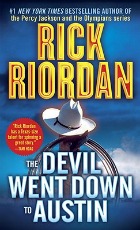
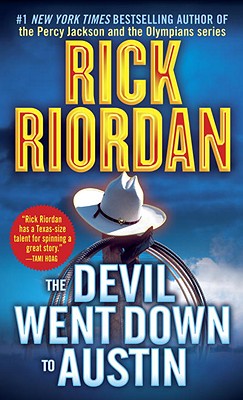
The Devil Went Down to Austin (Bantam): “Rick Riordan, triple-crown winner of the Edgar, Anthony, and Shamus Awards, brings his fast-talking, hard-living, Texas-hip P.I. Tres Navarre to the heart of the Lone Star State—Austin—to unravel a case so dark, twisted, and deadly, it can only involve family…. Tres Navarre, the P.I. with a Ph.D. in literature, heads to Austin for a laid-back summer teaching gig. But he’s in store for a whole lot more. His big brother Garrett–computer whiz, Jimmy Buffett fanatic, and all-around eccentric—is hoping to retire a multimillionaire by the fall. He’s bet his career and the Navarre family ranch to do it. Then Garrett’s oldest friend and business partner is murdered—and Garrett is the only suspect. As Tres delves into Garrett’s bizarre world to find the truth behind the murder, he comes face to face with the damaged relationships, violent lives, and billion-dollar schemes of a high-tech world gone haywire. Connecting them all is beautiful Lake Travis and the shocking secret that lies within its depths. Now, as Tres struggles with his own troubled family past and to clear his brother’s name, he finds himself stalked by a cold-blooded killer—one who could spell the death of both Navarres.”

Yes, the book is as good as the copy makes it sound.

Other books read this month:
I Now Pronounce You Someone Else
Mom: A Celebration of Mothers from StoryCorps
The Fairy Godmother
A Gift From Childhood
The Throne of Fire
Reckless (Audiobook)
Anastasia’s Secret
On Fortune’s Wheel
Our Only May Amelia
Okay for Now
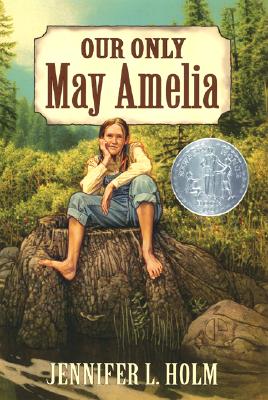
Our Only May Amelia

by Jennifer L. Holm
ages: 10+
First sentence: “My brother Wilbert tells me that I was the first ever girl born in Nasel, that I was A Miracle.”
Support your local independent bookstore: buy it there!

This one has been on my radar for years, but was never quite enough to push me to read it. However, with the buzz about the sequel — The Trouble With May Amelia — I got curious enough to pick up both of them at the library a couple weeks back.

It helps, too, that I’ve been in the mood for middle grade fiction.

May Amelia is the only girl on the Nasel river, in the middle of rural Washington, 1899. She’s twelve, has seven older brothers, and always seems to be Getting Into Trouble. She’s both A Miracle to her family and That Troublesome Girl, something which she finds terribly conflicting. All she wants to do is have adventure: go fishing, maybe hunting, and run around like her brothers, but with her Mama pregnant for the first time in a long while, much of the household work falls to May Amelia. It’s not an easy life but it’s a good one, or at least May Amelia will come to think so.

It’s not a book with a lot of plot — there is some, but to tell you what happens will spoil much of the charm of the book — but it’s one that holds your attention. It’s a grand example of voice: May Amelia’s personality comes through loud and clear, and she’s an interesting, amazing girl to get to know. She feels deeply, and lives fully, wanting to be treated the same as her brothers. Holm’s affection for the stories and the Finnish immigrants is plain in the storytelling; there’s a delightful homeyness to the book that just makes one smile, even through the tough times.

For there are tough times: Holm doesn’t sugarcoat the past at all. It’s gritty, but never so much that it’s not accessible to the middle grade audience it’s intended for. Instead, it gives an honest, yet loving, look at a homesteader’s fate, and life for a girl around the turn of the century. Both of which makes this book priceless.

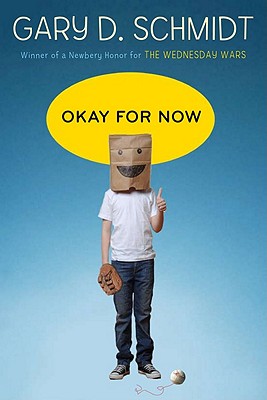
Okay for Now
by Gary Schmidt
ages: 11+
First sentence: “Joe Pepitone once gave me his New York Yankees baseball cap.”
Support your local independent bookstore: buy it there!

Doug Swieteck had a decent, if a bit rough, life. That is until his dad — because of his friend Ernie Eco — up and moves the family to “stupid” Marysville, New York for a new job. It’s 1968, and Doug’s oldest brother is off in Vietnam, and things are tight at home. It’s not easy settling in to the new town, especially since everyone has Doug and his older brother (not to mention his slacker and somewhat abusive father) pegged for hoodlums.

Things go up and down for Doug — who has one of the more personable voices I’ve read in a long time; he’s speaking directly to the reader, but only once does the whole “dear reader” thing — as he discovers James Audubon’s drawings of birds. I’ve never seen the pictures live, but from the illustrations in the book, I can see why they move Doug so fundamentally. It’s a look at how art and nature can influence our lives for the better, if one takes the time to understand it. In fact, if I had to pick a real theme of the book it would be that: people are more than the sum of their parts, and by taking the time to get to know and understand them, the world can be a better place.

The book could have teetered over into the maudlin, with issues of domestic violence and the war in Vietnam. But it never did. It stayed right on the edge of dark and heartbreaking, infused with hope and light and humor. It’s one of the most hopeful books I’ve read in a long time, and definitely one of the most perfect.

The Devil Went Down to Austin

by Rick Riordan
ages: adult
First sentence: “The first time I knew I would kill?”
Support your local independent bookstore: buy it there!

Our erstwhile college professor and PI, Tres Navarre, is off to UT Austin for the summer to teach a class in Medieval English lit. Which means, since he’s not interested in getting an apartment for six weeks, he gets to bunk with his older brother, computer programmer extraordinaire, Garrett.

Except, because it’s Tres, things don’t quite go as smoothly as planned. He ends up going early because he’s found that Garrett’s mortgaged the family ranch to cover costs for his new start-up tech business. Which is failing. Badly. And then, Garrett’s partner and long-time friend, Jimmy, ends up shot dead, and Garrett’s the main suspect. So, it’s up to Tres (well, it’s not, but Tres decides it is) to figure out who, besides his paraplegic older brother, could have done the dirty deed. Throw in a scheming ex-wife, some rich but estranged relatives, and a cutthroat businessman out for blood, and you’ve got some dangerous people to deal with. Not to mention Tres’s ex, a successful corporate lawyer, that he hasn’t seen in two years.

Just like in The Last King of Texas, Riordan piles it on fast and furious. He’s moved the local to Austin, and while he doesn’t have the same affection for that town as he has for San Antonio, he captures the unique flavor of Austin and the UT campus. That said, the town itself takes a backseat to the story, which is all kinds of gripping. It’s an incredibly gritty story, but for different reasons than King was: dealing with domestic issues as well as business ones. Still, Riordan puts the reader through the paces, keeping us guessing as to who the real murderer is. And when the twists come (and they are there), it’s enough to knock you out of your seat. And yet, they are not out of nowhere: the ground has been laid, and it makes perfect sense when they do come, right at the end. But, even with the grittiness and twists and turns, Riordan doesn’t skimp on character: Tres is fleshed out even more, and the relationship he has with his ex is a fascinating, complex one.

I would say I’m finding it hard to believe I’m hooked on these mysteries, but honestly, I’m not. I adore Riordan’s writing. And these definitely qualify as good Riordan writing.

10 Questions for Andy Mulligan

I know, today is supposed to be blogger interviews, but I spaced signing up for one. Thankfully, I have this lovely interview with the amazing and interesting Andy Mulligan, author of Trash (which I loved) for your reading pleasure.

MF: How did you get the inspiration for the story in Trash?
AM: I was living in Manila, and my very well-resourced school was raising money for its polar opposite: a dumpsite school in the most squalid part of the city. I heard so much about it, and finally visited. But the detail that set the story rolling was told by a friend of mine. He told me that the children who worked on this dumpsite spent a large part of their day crawling through human excrement, because so much ends up on the dump. That was the little vision of hell that took hold, and turned into Trash.

MF: Wow. That’s definitely an image that will stick with you. You describe Trash as, first and foremost, a thriller. How did you make the decision to tell the story that way, instead of as a straightforward tale of poverty?
AM: Stories need engines. I’m used to standing in front of a class of children with a story, not a concept: and stories, in some ways, are such primitive things – someone has an adventure. Here is a character you instantly recognize: a boy or girl, not so different from you. You want him to do well – you want him to surprise you. You want to be entertained.

MF: It was definitely entertaining! But, the book also gave me a lot to think about when I was done. What do you hope readers get from reading the book?
AM: I don’t know. I want them to have been entertained, and in some way stretched. The good books that I read stretch me: whether it’s Dickens, Elmore Leonard, John Grisham – they put me in the shoes of someone, and I learn stuff. I fly somewhere. The bad books I read make me more intolerant and more stupid. Specifically, Trash asks the reader to spend some time with some children who are fighting for a better world – there’s a lot of value in that.

MF: Why did you decide to tell the story from the point of view of several narrators, instead of just Raphael’s?
AM: The book was going to be first person Raphael all the way, but his voice was too limited. He saw the world in just one, very clear way. I got frustrated with him, so handing over to his friends was such a relief. It was a decision that made itself, at the desk, when I started another chapter and thought, “Oh, not you again…”

MF: Do you have a favorite character or scene?
AM: Yes. No. The moment I talk about a favourite scene I feel guilty about the others. I guess the bit that cracks me is when Rat saves Pia, and for the first time in his life he is the carer. He mashes banana for her, and is so tender. The denouement, amongst ghosts, flowers and graves, as the typhoon is crashing in – I’m still moved by that, and it’s pure Manila – a city I do love.

MF: From what I can tell, Trash is vastly different from your first novel, Ribblestrop. What were the challenges/similarities/differences between the two novels?
AM: Ribblestrop is about conquering against the odds too – it’s about healing. The children fight, just as the Trash children fight – and they win, and win they must. I was at a Q&A a while ago, and someone asked me if I set out to write “feelgood books”. My thought was, yes, rather than feelbad… I love 1984 and Catcher in the Rye and American Psycho – books that take me to dark, feelbad places. But I like happy endings – I’m with Shakespeare in his last plays, I want reconciliation, and people realizing they need each other. I don’t want to read Zola on my deathbed: I want Dickens, or Rowling, or someone who says things can be and will be better. But that makes me sound like a born again, or some hippy evangelical, which I’m not – I’m actually a very cynical soul. But I don’t want to be.

MF: Did you always intend to write for a younger audience, or did you just somehow fall into it?
AM: I think I’ve spent so long teaching children in schools that the voice comes naturally. I’m also suspicious that I’m not really mature enough to write a grown-ups’ book.

MF: Who or what inspires your writing?
AM: Stories come at you all the time, begging to be written down. And I meet people, all the time, so odd or interesting that I think, “Surely, there’s a book for him.” The main characters in my books are all fused from the children I’ve taught or met, and though it’s hard to get going in the mornings, sometimes, I actually love the process of pushing the chapters forward. Then the revising, then the uprooting, then the replanting. It’s the most satisfying thing.

MF: What’s the last book you read and loved, and why did you love it?
AM: I loved Richard Harris’ “Imperium”, about Cicero and Ancient Rome. And another historical book, “Wolf Hall” about Cromwell. I’m going through a big history fad at the moment, and I love these writers who help me imagine other worlds. “Wolf Hall” in particular makes such sense of the past, in a way that absolutely informs the present. 2011 is clearer to me now, having ready about the 16th century.

MF: What can we expect next from you, if you don’t mind telling us?< Ribblestrop 3 is underway – I finished part one last night, so I know where that’s going now. I hope to have it done by the end of the summer. But my other book, which is top secret, is on my publisher’s desk even now. He may hate it or love it – I really don’t know. It’s for children again, set in a primary school – but it’s very strange and very English. I want to do the American version, which will give me an excuse to spend some quality time in the States – and that’s something I long to do.

MF: Thank you so much for your time!
AM: It’s a pleasure. Thank you for reading.

You can see more about Andy and his books at his website.

Best of 2011, Halfway Through

I don’t have a giveaway for you today, for Armchair BEA. Sorry. On the other hand, at Armchair BEA Central, there is a list of people who will have giveaways for you today. However, as a consolation prize, I do have links to reviews of five of the best books I’ve read (so far) this year.


Trash, by Andy Mulligan


The Last King of Texas, by Rick Riordan


A Tree Grows in Brooklyn, by Betty Smith


The Disappearing Spoon, by Sean Kean


The True Meaning of Smekday, by Adam Rex

And as a bonus, five books I desperately want to get my hands on. Soon.

What’s on your list of favorite books this year?

Hi, My Name is Melissa and I’m a Bookaholic

Hi, Melissa! Tell us a little bit about yourself.

I’ve been blogging here at Book Nut for 6 1/2 years, which makes me a verifiable oldie in the blogosphere. I’m still at it, though, partially because I have a rotten memory for books I’ve read, and it’s quite handy to point people who ask in the direction of my blog. But, mostly, I think, I’m still at it because the book blogging community, possibly because it’s huge and diverse, is a wonderful community to be a part of.

What is it that you like to read?

I like to say I’m a book omnivore, and that I’ll read a little bit of everything. Which is true, though I do have to admit that every single time I try to read one of those true crime thrillers I completely hate them. I’m still wondering why publishers keep pitching them to me. That said, I have a passion for and a general leaning towards kids — middle grade and YA — books.

Why those in particular?

Because I like them. Seriously. Good writing, good stories, tightly told. You really can’t beat a good middle grade or YA book. (Okay, maybe it’s also a little because I don’t want to grow up.)

So, if you’re such a bookaholic, why aren’t you in New York at BEA?

Because I’m a bookaholic who’s married to a university professor and the mother of four daughters. I’d love to go an experience the whole madhouse of BEA, to see other bloggers and just have fun, but I’m allowed one trip a year, and I choose to attend KidLitCon, because that’s where my passion is. Someday, that might change. But for now, I’m sitting in my chair in the corner (or on my bed sometimes), following my twitter feed, being slightly jealous of all the cool things I’m missing at BEA.


Check out the other participants intros on the BEA website!

Sunday Salon: Better Late than Never

LinkI’ve been meaning to do this for weeks, I tell you. And yet, the weeks just seem to get busier and busier, and with school ending this Tuesday (really? EEK! So not ready.) I figured I had to sit down and get these two things out.

First off, it’s time for Mother Reader’s 48 hour book challenge. Woot! If you haven’t done this before, give it a whirl. Pop over here for the guidelines, as well as here for frequently asked questions about it all. And then join us next weekend (where does the time go?) reading as much as you possibly can. (I’m planning on tackling my backlog of publisher-sent books. That is, if I can get through all the library books before hand.)

Secondly, it’s time for Nerds Heart YA again! The shortlist was announced a couple weeks ago — I’ve read three, amazingly — and it’s a great list of books. I’ve got the pleasure of being a first-round judge again, and I’m actually quite excited about the two books I’m judging between. (And my library has both! Woot!) Stay tuned for my decision in about a month, and follow all the first round action at the blog, or on Twitter.

Thirdly, it’s Armchair BEA time (for those of us too cheap/broke/whatever) to actually go and brave the madhouse that is Book Expo America. (Someday….) The schedule for the week is here. I’m going to try and participate (at least a little bit). Stay tuned!

I think that’s about it. Here’s to summer!

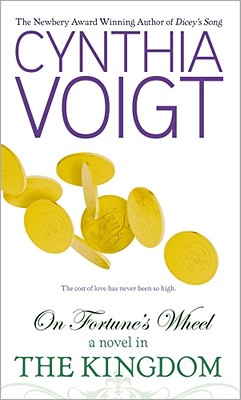
Reread: On Fortune’s Wheel

by Cynthia Voight
ages: 13+
First sentence: “What she saw first was a moving shadow.”
Support your local independent bookstore: buy it there!

One of the benefits of having a blog and rereading a book, is going back and looking at what you wrote about it the first time. At which point, you cringe, and think to yourself, “Dang, I’ve gotten so much better at this blogging thing!”

My last sentence still stands, though: this book is a pleasure to read.

It follows Birle, the daughter of an Innkeeper, who is monumentally unhappy with her life. She’s just agreed to get married, mostly out of desperation, when she spots someone trying to steal a boat from her father. Being a bit foolhardy, she takes off after the thief, and ends up on Fortune’s Wheel. The thief turns out to be Orien, the grandson of the Earl, who is running from his fate as the Earl to be. Their fortune goes from bad to worse as they are marooned on an island, and from there sold into slavery. Throughout it, though, they have the love that they developed for each other. And fortune, for better or for ill.

It’s a lovely, simple story, elegantly told. Voight is a master storyteller, and even if there wasn’t a whole lot going on plot-wise, she manages to make the characters and the situations compelling enough that it doesn’t matter if there’s not much going on. Voight doesn’t go in for flashy things, especially in this historical-feeling book. There’s no magic, no grand intrigue, just two people going through life trying to make the best of the situations thrown at them.

Which makes it an absolutely beautiful book.

Anastasia’s Secret

by Susanne Dunlap
ages: 13+
First sentence: “We are surrounded by guards.”
Support your local independent bookstore: buy it there!
Review copy provided by the publisher

Historical fiction is a tricky thing. Mostly, I think, because the author is taking real people and situations and trying to make them compelling and interesting while fitting in the structure bound by history. It’s a delicate balance, one that requires facts as well as enabling the reader to see past the facts to create a whole (albeit fictional) character.

Dunlap has decided to tackle the Romanov family and the years before the Russian revolution. It’s primarily Anastasia’s story, one of her infatuation and romantic involvement with a palace guard who joins the Bolsheviks, in the end. It spans four or five years of time, from when Anastasia’s 13 until after her 17th birthday. Dunlap weaves the romance in and out of the political situation, providing a setting for this princess and pauper story.

I’ll be up front with it: it doesn’t have a happily ever after ending. Dunlap sticks with history and leaves Anastasia’s ending open-ended. But, aside from that, I felt like this book was unbalanced; the romance and the political situation seemed at odds with each other. Either it was that there wasn’t enough of one or too much of the other, but I never really connected with the book. Everything seemed distant and remote, jumbled and disconnected. I wanted to like Anastasia and her love, Sasha. I even wanted to feel sympathetic to the Romanov family, but I never got there. I’m wondering if it was because it was oversimplified to fit for a younger audience, and that things would have been more fleshed out in a adult novel. Whatever the reason, this one didn’t work as well as I would have liked it to.

That said, it’s a grand introduction to all things Russian.