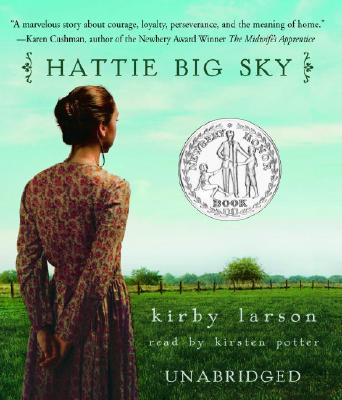
Audiobook: Hattie Big Sky

by Kirby Larson
Read by: Kirsten Potter
ages 12+
Support your local independent bookstore: buy it there!

Hattie is an orphan who, for most of her life, has been shuffled around to distant relatives to live. She’s never felt she’s belonged anywhere, never felt like she had a family. Then, the winter she’s 16, she gets a letter from an estranged uncle leaving her his 320 acre homestead claim in Montana. All she has to do is finish proving up on it, and it’s hers.

So, trying to escape the feeling of being unwanted, Hattie ventures out to the land, three miles northwest of Vida, Montana, and attempts to fill the terms of the claim. In doing so, she discovers things about herself, about people in general, and manages to find a family in the diverse bunch of people out there on the northern prairie.

It is very much a coming of age book: it’s all about Hattie growing and learning and finding a place in her own skin as well as learning that family doesn’t always mean blood relations. But beyond that, it’s an excellent historical novel: Larson manages to give us a picture of homesteading life — shades of Laura Ingalls Wilder — set in the early 20th century, against the backdrop of World War I. The themes that ran through the book, of wartime racism and sacrifice, are (as she mentioned in the author’s note) applicable today. The characters rang true, and the book avoided being too cliche or overly saccharine in the end, which I appreciated.

And the audiobook was quite lovely. Kirsten Potter does a grand job reading the book, capturing the subtleties of the characters. It was a grand way to experience this wonderful little book.

Heat Wave

by Richard Castle
ages: adult
First sentence: “It was always the same for her when she arrived to meet the body.”
Support your local independent bookstore: buy it there!

“Oh, Melissa,” you say. “We know that you are really eclectic in your reading. But, a book written by the main character of a TV show. Really? Isn’t that a bit meta for your tastes?”

Yes. Yes, it is. And yet, it sat out there in cyberspace, it’s sultry cover calling to me, piquing my interest. Eventually, I had to cave in.

“Yes, but it can’t have been a good book. It’s written by a fictional person!”

Well, it wasn’t fine literature, that’s true. And I’m not sure it wasn’t even a good mystery, since I called it about halfway through. It did feel pretty pedestrian as far as books go. But, it was fun, and that’s all I was expecting. I’m guessing the screenwriters wrote it, by the way.

“What makes you say that? Nathan Fillion’s headshot’s on the back cover… they went pretty far keeping the illusion that Richard Castle ‘wrote’ the book.”

I know! And that’s one of the things I liked (besides Nathan Fillion’s headshot on the back cover). It really was an in-joke kind of things for fans of the series. Scenes in the book that were lifted straight from episodes; in many ways it was a mash-up of Castle, season one. Aside from Nikki Heat thoroughly beating up a bad guy while buck naked, of course. (Though honestly, I wouldn’t mind seeing Stana Katic pull that off…)

“So, if it’s just a bunch of scenes from episodes thrown together by the screenwriters, is there even a plot?”

Yes, it does have a plot. Nikki Heat is a NYPD detective and the latest murder is millionaire developer Matthew Starr. Jameson Rook is a celebrity journalist following Nikki around to get background for an article he’s writing. As they investigate Starr’s murder, things unravel about his background, his wife, and his business, centering in on the $60 million art collection in his house. Of course, lives are put on the line, banter is had, and sparks fly. It’s not as fun as the show, and I got annoyed with a few things — like calling Detectives Raley and Ochoa “Roach” — but mostly, it’s was just fluffy fun.

“Even if it is fun, why should we, who don’t really watch Castle or follow Nathan Fillion obsessively on Twitter, read it?”

My response: Why aren’t you? It’s quite fun as TV goes. Great writing, pretty good stories, it’s some serious fun. Seriously, though, if you’re not a fan of the show, I really don’t know why you’d pick up the book. Unless you really, really like mysteries and will read just about anything. But, if you’re a fan (or even if you only just watch the show), it’s a quick, fun, fluffy read.

“*sigh* That means you’re going to read the sequel, doesn’t it?”

Yep. It does.

India Calling

by Anand Giridharadas
ages: adult
First sentence: “As my flight swooped down toward Bombay, an elderly Indian man leaned over and asked for help with his landing card.”
Support your local independent bookstore: buy it there!

M, actually, is responsible for choosing this book. I introduced her (mostly by accident) to the joy that are Hindi language movies, and she fell head-over-heels in love with them. As a result, she’s been requesting books on India for the past few weeks, trying to learn as much about the country as she can. This one just happened to catch my eye. And I’m glad it did.

Anand Giridharadas is the son of NRIs (Non-Resident Indians). His parents came to American in the 1970s, mostly because India wasn’t offering his father the kind of opportunities that he wanted. Anand, raised as a good Indian-American, with only brief trips back to India as a child, felt the siren call of India and shortly after college headed there to live and work. This book is his observations of the “new” India, the way India is reinventing itself, and the consequences — both good and bad — of that.

The book is divided into chapters exploring different emotions and hopes: dreams, ambition, pride, anger, love, freedom. Giridharadas explores how each one has had an impact on the India of his parents and grandparents, and through his observations, travels, experiences in the country, and interviews, he explores how each things are changing — because of capitalism and consumerism — and not changing — because India is an old country, and one with a billion attitudes to change. The book weaves history, culture and religion together, leaving, it seemed to me, no stone unturned. As an Indian himself, he was able to go places a Westerner couldn’t have, and yet as an outsider, he was able to make observations and ask questions that wouldn’t occur to someone who hadn’t been raised outside of India. It was the best of both worlds, that melded into a very thought-provoking book.

It was fascinating, to say the least, even for someone who has had very little exposure to the world that is India.

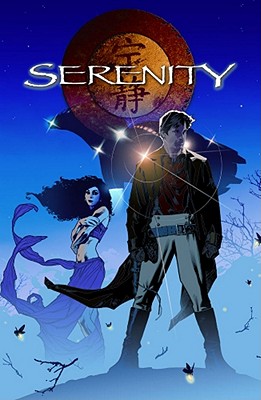
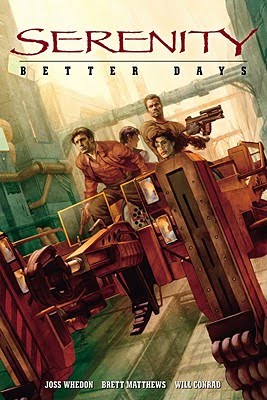
Serenity: The Graphic Novel

by Joss Whedon, Brett Matthews, Will Conrad
ages: adult
vol 1: Those Left Behind
First sentence: “And so I say to you on this fine day, citizens of Constance, that your lives are not defined by that with which you enter this world, but rather with what you leave behind on it.”
Support your local independent bookstore, buy it there!

vol 2: Better Times
First sentence: “I don’t like speeches.”
Support your local independent bookstore: buy it there!

I saw these over at The Written World, and since I was feeling a bit on a Nathan Fillion kick, I picked them up. (Yes, I do like the show because of him. Or maybe I like him because of the show?) I am shameless sometimes. (Yes, I have also caved into curiosity and am reading Heat Wave.)

The graphic novels pick up the world in the time period after the series ended but before the movie Serenity. (That will only make sense to fans.) They’re basically episodes in graphic novel form, something which I simultaneously found entertaining and irritating. Entertaining, because it’s always nice to visit with old “friends”, characters one loves. Irritating because I wasn’ really sure what was going on the whole time; it was a bit confusing in its storytelling. Oh, sure, I think I caught the general arc, but I’m just not a skilled enough graphics novel reader to really capture the whole essence of it all. And, in spite of the drawings looking amazingly like the actors, I missed the actors. You didn’t get Jayne’s sardonic inflection, Mal’s snarky smile. Little things — like intonation and inflection — that make acting a storyline out so much better.

That said, I adored the introduction in the first one by Nathan Fillion. (The second’s introduction was written by Adam Baldwin, and was highly entertaining as well.) Anyway, Nathan wrote about his love of comic books as a kid and how Mal was his favorite role, thanking Joss Whedon for making him, and all of them really, a superhero. That, at least, was very cool stuff.

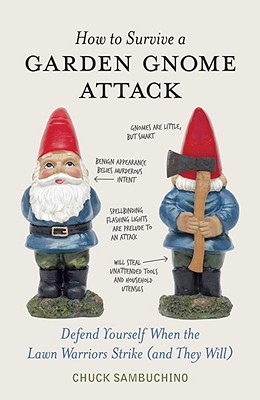
How to Survive a Garden Gnome Attack

Defend Yourself When the Lawn Warriors Strike (and They Will)
by Chuck Sambuchino
ages: adult
First sentence: “Keep reading if you want to live.”
Support your local independent bookstore: buy it there!

You know you have that zombie invasion handbook sitting on your bookshelf. (Or maybe it’s hidden in your personal safe?) But really, zombie invasion? That’s so not happening. The real threat? Those stupid garden gnomes you have in your yard (or if not you, your neighbors). (Yes, I do have one in my backyard, thankyouverymuch.) Thankfully, Chuck Sambuchino has done the research necessary to help you protect yourself (and your friends and neighbors, should you choose to share).

I found this one through Whimpulsive, and knew I had to find a copy for myself. It sounded so hilarious. And in many ways– mostly because it reads like a 1950s bomb shelter advert — it was hilariously funny. There are instructions, illustrated with pictures of gnomes in various attack modes (too funny!), on how to asses the risk of attack and protect and defend oneself against the homicidal maniacs. It’s too far-fetched to even remotely be realistic, but, it also takes itself seriously enough that I could sense myself almost being convinced: yes, I do need to fortify my house! Then I’d do a double-take: it’s only silliness. Ah, the power of propaganda.

At the very least, it’s a fun way to spend an hour. I think I’m going to go check my garden gnome now, though. Just in case.

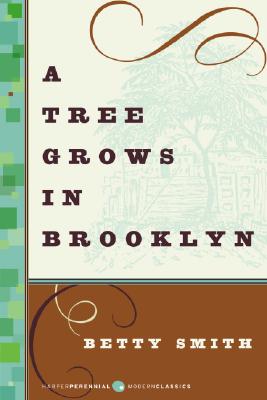
A Tree Grows in Brooklyn

by Betty Smith
ages: adult
First sentence: “Serene was a word you can put to Brooklyn, New York.”
Support your local independent bookstore: buy it there!

I’ve heard about this book for years, mostly from people who absolutely love it. So, while I knew next to nothing about this going in, I did know it was beloved by many, many people whose opinions I respect.

Happily, it lived up to my expectations. As the Anna Quindlen pointed out in the forward, this book is both about nothing and about everything. It’s so hard to summarize: how do you take a childhood and distill it down into a few pithy sentences? It’s semi-autobiographical, Betty Smith’s childhood was probably not unlike that of her main character, Francie Nolan. It’s a childhood in Brooklyn, New York; but it’s not a glorified childhood: Smith holds nothing back. There’s poverty, discrimination, abuse, drunkenness, attempted rape, murder, death. It’s life, in all its griminess, for all to see. And yet, for all that, it’s not depressing.

In fact, while I hesitate to call it lyrical, it is thoughtful and very evocative, of both a life and a place and a time. There were parts to make me laugh, parts to make me think, and while I think it kind of petered out at the end, it petered out in a hopeful note (I was actually very happy there wasn’t an epilogue; that would have killed the book entirely). I found it to be a very touching portrait of a life, and now I understand what everyone is talking about.

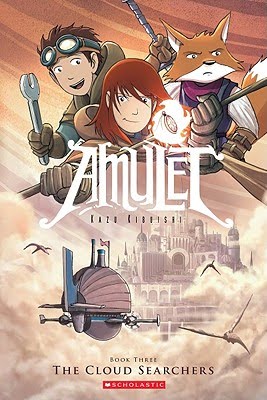
The Cloud Searchers

Amulet, vol. 3
by Kazu Kibuishi
ages: 10+
First sentence: “Luger.”
Support your local independent bookstore: buy it there!

Picking up where we left off, our fearless crew, including Emily, her brother, mother, and assorted robots and guards are off to find the lost city of Cielis, in order to find the Guardian Council to help them overthrow the Elf king. Along the way, they pick up two elf renegades: one just happens to be the elf prince. Emily (and the rest) don’t really trust them, but they also don’t have a choice. And when darker forces come calling, it’s probably a good thing to have all the help you can get.

This book is still just as lovely and as exciting as the first two, but I’m starting to forget the train of the story from one book to the next. Which really isn’t Kibushi’s fault; I’m terrible at remembering things. But, that said, I’m wondering if it wouldn’t be wise to put off reading the rest of this (albeit great) series until the whole story is completed. Because, especially with this one, each book isn’t telling it’s own individual story, being rather a piece in the whole puzzle. And while the puzzle itself is intriguing, it’s not going forward fast enough for my brain to retain the pieces.

Which means I’ll have to get back to the series later.

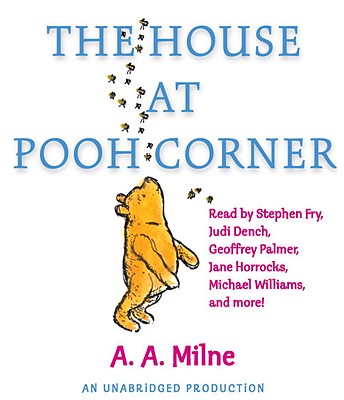
Audiobook: The House at Pooh Corner

by A. A. Milne
Read by: various British actors including Stephen Fry and Judy Dench
ages: 4+
Support your local independent bookstore: buy it there!

What can you say about Pooh Bear? Nothing. Seriously. Pooh Bear is Pooh Bear, and if you don’t love him you are either not a child, don’t have a child, never have been a child, or are a grumpy curmudgeon in need of some humor in your life.

Because the Pooh Bear stories are absolutely wonderful. Funny, sweet, tender, silly, and captivating. How can you not love the characters, Pooh with his earnestness, Eeyore and his sarcastic grumpiness, Piglet and his insecurity, Tigger in his enthusiasm, Rabbit with his bossiness and worry, and Owl with his self-educated importance. I love them all. And the stories: this one has two of my favorites: the one in which Christopher Robin goes to school, leaving a note that says “Gone. Be back son.” and the animals try to figure out what a “backson” is. And Pooh sticks. Yes, I play Pooh sticks with my kids. I love Pooh sticks.

So, when K asked to listen to something for her very own, of course I thought of Pooh. This recording has the benefit of being unabridged, even though it is a full-cast production. I usually prefer a single reader over full-cast, but in this case it worked. It helped K keep track of who was talking — every voice was quite distinct, even if I did find Tigger’s and Piglet’s portrayals a bit grating — and some of them — Stephen Fry’s Pooh and Geoffrey Palmer’s Eeyore, among others — were dead on perfect. I noticed things that I didn’t when I’ve read these to the girls in the past; it’s amazing what a different interpretation of a specific line, what a different emphasis and inflection will do to the meaning of the sentence. And yes, the end in which we have to say good bye did find me teary.

Wonderful, wonderful Pooh.

10 Questions for Clare Vanderpool

When I picked up Moon Over Manifest, Hubby took a look at the author bio, and said, “You should interview her.” Of course, I thought, I really should. And then I put it off (sorry!) for various reasons. And then January came around, and Clare Vanderpool won the Newbery. I despaired; I’ve never interviewed anyone who’s won a big award (save Shannon Hale, but she’s awesome enough to let me interview her anyway), would Clare Vanderpool say yes?

Well, yes, busy as she is, Clare did take time out from her busy schedule to answer my questions about her book, her inspiration, and life after winning the Newbery.

MF: What inspired you to tell the stories of small-town Kansas?
CV: I’m a Kansas girl, so of course Kansas would be the first place I would look to set my story. I chose the real town of Frontenac for my fictional town of Manifest because my maternal grandparents are both from that area. What a stroke of luck that was, as Frontenac and other small towns in southeast Kansas have such a rich and colorful history that really drove the story. With the mining, bootlegging, immigrants, orphan trains, and the Spanish influenza, there was no shortage of drama and intrigue going on in southeast Kansas.

MF: Not many people think of drama when they think of Kansas, though there was quite a bit in our history. You tackled not one, but two time periods. What kind of research went into making that work, and making sure each was authentic?
CV: I did a great deal of research and loved every minute of it. I’m a very nostalgic person so poring through old newspapers, yearbooks, and magazines is a great way to while away an afternoon. I also read books on the Great Depression, World War I, the Spanish Influenza, and bootlegging along with the memoirs of a WWI soldier and the experiences of immigrants traveling through Ellis Island. I find it all interesting but the research/writing process is also interesting in figuring out which parts of the research feed the story and which ones don’t. I don’t care for a story that beats the reader over the head with the historical knowledge of the writer. For me, if it doesn’t serve the story it doesn’t go in.

MF: I agree: as a reader, it’s hard when there’s more historical information than plot. Was it hard (or not) to find the voices of your characters? Did you do anything in particular to find them? CV: The voice of the main character, Abilene Tucker, was very clear from the beginning. I knew she was a level-headed girl with her very practical list of universals – even though she does come to question those throughout the book. Some of the other characters evolved as the story went along. Shady’s voice developed quite a bit. He is a soft-spoken character and for his voice and his character to rise to the surface, I had to focus on his actions as much as his words.
MF: I know it’s hard to choose, but do you have a favorite character or scene from the book?
CV: This is a difficult question to answer. I love all the characters, even the prickly ones. I like the fact that some characters who have their flaws, have opportunities to redeem themselves. If I had to choose one favorite scene, it might be the one with Abilene, Lettie, and Ruthanne, out in the woods at night and Lettie has brought gingersnaps to share. It is in this scene that Abilene realizes that Lettie and Ruthanne know things about each other, unspoken things, through shared experience. For the first time, Abilene begins to question some of her long-held list of universals. And it ends with Lettie singing her down and out train song. The sad mixed with the sweet. I like that.

MF: Did you always intend to write for a middle grade audience, or did that just happen?
CV:Yes, I set out to write a middle grade novel. That age group just seems to be the voice and point of view I settle into.

MF: So, congratulations on winning the Newbery! That must have been quite the experience. What went through your mind when you got the call?
CV: When I got the call and realized it was the chairperson of the Newbery Committee, my heart started racing. I thought she was going to say that I had won a Newbery Honor. And I would have been thrilled. Then when she said it was the Newbery Medal, I went from thrilled to stunned and the tears started rolling. My husband happened to be home and he just stared at me wondering what was going on because a)I’m not normally a spontaneous crier and b)he had no idea the Newbery was being announced that day. I sputtered a few words of thanks but couldn’t say much. It was amazing.

MF: Amazing, indeed! How has winning the Newbery changed things (in your life, your writing, etc.)? Or has it?
CV: My professional life has changed quite a bit. I haven’t done much writing lately, but hope to get back into a routine soon. I have done many interviews and have received invitations to speak around the country. That is exciting as I plan to take my children along on a trip or two. As far as home life everything is pretty normal. We have one computer in the house and with a multitude of snow days, sick days, and assorted days off lately, I have had to beg, borrow, and steal to get time on the computer. My husband and I had a little sit down with the kids shortly after the award was announced and said our plan is to enjoy the whole experience, appreciate the gift that it is, and keep things normal at home. In other words we still shop at Target, nobody gets a cell phone until they’re in high school, and you still have to do your jobs – every week! They seem good with that.

MF: Sounds like you’ve got some good kids. Hopefully, they’ll enjoy the trips! Who or what inspires you to write?
CV: My inspiration revolves around stories. The stories I read as a kid, the stories I read now, and the stories that emerge in my head and wrap themselves around my heart. My influences as a young reader were Scott O’Dell, Madeleine L’Engle, Elizabeth George Speare. In fact, I noticed recently that those three authors won consecutive Newberies in the early 1960’s. I guess that makes them some sort of Newbery Triple Crown.

MF: I like that: the Newbery Triple Crown; I love all those authors, as well. Speaking of reading, what’s the most recent book you’ve read and loved and why?
CV: I just finished Turtle in Paradise by Jennifer Holm and loved it. There were parts that made me laugh as well as sweet, tender, and sad parts. Jennifer is a wonderful story teller and I love her sense of humor. I feel like I just spent time with Turtle and the Little Rascals.

MF: If you don’t mind me asking, what can we expect from you next?
CV: The book I’m working on is about a Kansas boy who is uprooted from his home and put in a boys boarding school in Maine. His story involves a journey, a quest really. Fortunately, I was close to finishing a draft of my current work in progress. I say fortunately, because if I hadn’t been that far along, I think it would be very difficult right now to be trying to create and flesh out the storyline. As it is, the story is clear enough in my head that I think I’ll be able to finish the draft before long and then begin the process of tinkering and editing. I would describe it as moving past the “M & M” stage (what I tend to eat when I’m staring off into space trying to figure out where the story is going) and heading into the “Buckle Down” stage which usually involves more concentration and fewer calories.

MF: Thanks, Clare, for your time!