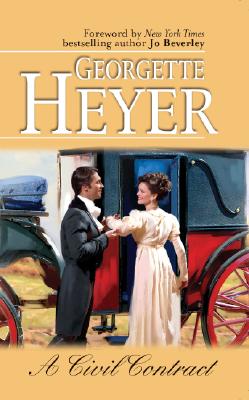
A Civil Contract

by Georgette Heyer
ages: adult
First sentence: “The library at Fontley Priory, like most of the principal apartments in the sprawling building, looked to the south-east, commanding a prospect of informal gardens and a plantation of poplars, which acted as a wind-break and screened from view the monotony of the fen beyond.”

Actually, that first sentence up there is pretty indicative of the whole novel. And part of the reason I bailed halfway through.

See, I wanted to like this. For many reasons: I really liked the last Georgette Heyer, this is the one we’ve put out for my face-to-face book group in a couple of months, it’s the favorite of a really good friend of mine. But… it’s long winded, schmaltzy, and not nearly silly or light-hearted enough.

The basic plot is decent: Adam Deveril is a captain in the army when he learns of his father’s, Viscount Lyndon, death. Upon returning home, he also learns that his father was overly extravagant, and piled up so many debts that Adam is going to be forced to sell not only his horses and London home, but the family seat, also, in order to just pay off his debts and provide for his mother and sisters. However, that will leave him penniless, so he can’t marry the woman he loves: Julia. Instead, in order to save his ancestral seat, he contracts with a wealthy upstart businessman to marry his daughter, Jenny, in exchange for the money to keep his home. Jenny is practical about this: she knows Adam doesn’t love her and even though she feels affection for him, she doesn’t ever really expect to have him feel it back.

And that was the first half of the book. Sure, I get that Jenny is long-suffering and patient and loving, and will venture to say that Adam will soon learn to value her qualities (beauty is not among them) more than he valued Julia’s beauty and singing voice. (They always do, you know. Men.) And I’m sure there will be a soaring conclusion where Adam and Jenny if not fall happily into each others’ bosoms, then at the very least, marriage will not be so odious and they will be happily practical together. Which is all fine and good.

But I couldn’t wade through the exc!mation marks, and the pages and pages of clothing descriptions and bad dialogue to get there. I wanted light-hearted humor, I wanted a dash of adventure, I wanted silliness, dang it. And I didn’t get any of those.

So, Georgette Heyer, all your books are not equal (which is forgivable). I’ll just have to try another one.
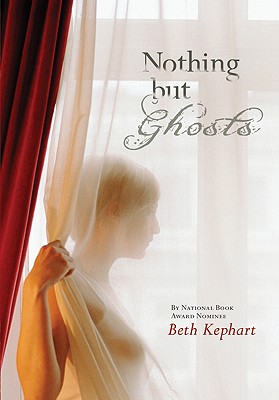
Nothing But Ghosts

by Beth Kephart
ages: 12+
First sentence: “There are the things that have been and the things that haven’t quite happened yet.”

There are some things that stand out about certain authors. A sense of humor, fabulous world building, great characters. In the case of Beth Kephart, it’s the language that grabs you. Haunting and beautiful in its simplicity, it’s what keeps you turning pages, what you remember and savor when you close the book.

Danny got what he was hoping for, which was rain, though this rain is like bright white sheets of fire, a genuine storm.

Katie D’Amore’s mother died last year. She and her father have been making do, slowly getting back to normal. Healing is hard, true, but life — whether fortunately or unfortunately — goes on. Then, the summer after her mom died, Katie gets a job on the grounds crew on the estate of the reclusive Miss Martine. It’s only after she catches her boss, Old Olsen, sifting through the dirt of the assigned summer project — a foundation for a second gazebo — that she starts to suspect something is up. And perhaps, in figuring out Miss Martine she’ll be able to figure out how to live without her own mother.

It’s pretty out here. The moon is less than it was last night, and there are thin shreddy clouds floating around in front of the stars, leaving blanks in the constellations. The airwaves are busy with crickets and cicadas, and Sammy Mack, bless his monkey heart, is oddly, fabulously quiet.

It’s a mystery, but not an edge-of-your toes compelling mystery. Like everything else in the book, it’s reflective and poetic. Katie does do her legwork, and in the process learns a few things about herself. It’s a ghost story, but not a scary, supernatural one. And yes, there is a boy so it does qualify as a romance, but it’s not a swoon-worthy, heart fluttery one. The book is many things, but the real reason to pick up this book (and possibly any Beth Kephart book, since I had a very similar reaction to The House of Dance), is to enjoy her effortlessly descriptive, beautifully evocative language.

Past the drive, the road falls down so fast it feels like bungee jumping. A scrap of air gets caught between me and my backpack, tilts me back for half a second, then is whooshed away, and I’m flying forward, both hands wrapped around the handlebars and the bangs beneath my cap blowing wild across my face.

Which, in some ways, is the best reason of all.

On Commentors and Commenting

I actually thought I’d have a lovely Sunday Salon post musing about the role of comments in the blog world, but it really didn’t work out that way today. So… just the award part. Perhaps I’ll get around to my thoughts on comments later.

The lovely Melissa at One Librarian’s Book reviews gave me a lovely award — The Dragon’s Loyalty Award — for the loyal fan/commenter, whether the recipient is a fellow blogger or just a someone who follows and comments regularly.

First off, thanks, Melissa!

Here are the rules:

* If you have a blog, post it on your blog with a link back to the site who gave it to you.

* Leave them a comment on their site, email, etc. to let them know.

* If you don’t have a blog but have a website, Facebook, MySpace, Twitter or other type account, post there with a link back.

* Pass this on to 3-10 loyal fans.

Hmm… who to pass it on to? (Always hard.)

Amanda at The Zen Leaf
Corinne at The Book Nest
Kailana at The Written World

I could pass it along to more people — I do manage to get a few comments on most posts — but those three are pretty much comment on pretty much every post. Thank you, ladies, for taking time out of your days and passing on the comment love. You are awesome!

Mission Control, This is Apollo

by Anderw Chaikin/paintings by Alan Bean
ages: 8-12
First sentence: “Until 1961, space travel was something that only dreamers and science fiction writers thought about seriously.”

This is an absolutely gorgeous book. Oversized, glossy pages, beautiful paintings by former astronaut Alan Bean — it’s a book that I want to own just so I can page through over and over again, looking at it all.

And the text supports the beauty of the book. Chronicling the Apollo moon missions (Apollo One, and then Seven through Fourteen), Chaikin details the work, the amazement, the passion that the astronauts had for exploring the moon. It’s not a book that’s done in great detail — it is for younger kids after all — but there are some interesting facts in it. Instead of delving into the details of the missions, Chaikin chose to highlight the enthusiasm for space and the moon, the drive to get men there, and the dangerous job they had to do. There were also pages throughout about the practical side of space travel — from going to the bathroom to adjusting to zero G, to the explanation of why astronauts were held in quarantine — fascinating tidbits that made this surreal experience (especially for those of us who weren’t alive when this was happening) more real.

It’s a fabulous book, one that hopefully will inspire people to study space, to want to return to the moon. Or, at the very least, you’ll react like me, and want to watch movies and drag the family to NASA in Houston, just to get another glimpse at this remarkable time in history.

The Key to the Golden Firebird

by Maureen Johnson
ages: 12+
First sentence: “Chome on,” Palmer said, her words dulled from numb-tongue syndrome caused by the Icee she was slurping.”

A review about a Maureen Johnson book shouldn’t be that hard. This is the last one that she’s written that I hadn’t read, and honestly, there really isn’t that much to say that hasn’t already been said before.

(For proof, check out: Girl at Sea, Suite Scarlett, The Bermudez Triangle, Let it Snow, 13 Little Blue Envelopes, and Devilish. Did I miss one?)

The plot of this one is slightly darker than her other books (she usually doesn’t deal with death): May Gold’s dad died of a heart attack a year ago, and she, her two sisters (one older — Brooks — and one younger — Palmer) and mother have been trying to scrape by. The Golden Firebird in question is her dad’s 1967 Pontiac, which has basically been sitting in the garage gathering dust since the day he died. May just turned 16, and the big event in her life is getting a driver’s license. Except that since her mom works nights at the hospital and May is at school and works during the day, there’s no one to teach her. Enter next-door neighbor and nemesis, Pete.

Turns out that dealing with loss is a lot more difficult than any of the Gold sisters would have thought. They’re all dealing with it in different (yet all equally miserable) ways: Brooks comes home every night completely smashed and quits the softball team. May throws herself into being responsible and working hard at both her job and school. Palmer retreats into herself and her softball game but finds it difficult to sleep at nights. It’s not until everything comes crashing around them during the summer that they find a way to deal with their loss and move on.

As I said before, there’s not much to say about this book that hasn’t already been said about Maureen Johnson. It’s not as swoon-worthy as some of her other books, but there’s still much about it that I love in her writing. It’s funny, it’s full of characters you can’t help but love. It’s full of wacky adventures, misunderstandings, and times when you just want to hang people by their toenails for being stupid. It’s not my favorite of her books (that would be Suite Scarlett or Girl at Sea), but it’s definitely worth reading.

A Middle Grade Fiction Panel Squee

Can I tell you how ridiculously excited I am about this?

Not only did the Cybils folk let me participate again this year, they let me be on the same panel that I was last year. Which thrills me to no end. On top of that (as if it could get any better!), look at the panelists:

Panel Organizer: Kerry Millar, Shelf Elf

Panelists (Round I Judges):

Sherry Early, Semicolon
Melissa Fox, Book Nut
Abby Johnson, Abby the Librarian
Kyle Kimmal, The Boy Reader
Becky Laney, Becky’s Book Reviews
Sarah Mulhern, The Reading Zone
Sandra Stiles, Musings of a Book Addict

Awesome, no? Three of us are returning from last year (*waving* Hi, Sherry and Sarah!) AND I get to be on a panel with two of my most favorite bloggy people in the whole world! I don’t know Kyle or Sandra at all, but I’m sure I’ll get to know them MUCH better over the course of the next two (or so months)!

Oh, and don’t forget the very cool judges:

Round II Judges:

Kimberly Baker, Wagging Tales
Stacy Dillon, Welcome to my Tweendom
Monica Edinger, Educating Alice
David Elzey, Excelsior File
Kerry Millar (see panel organizer)

Woot!

Remember, also, you can still nominate books through the 15th: keep ’em coming! I can’t wait to read what you nominate. 😀

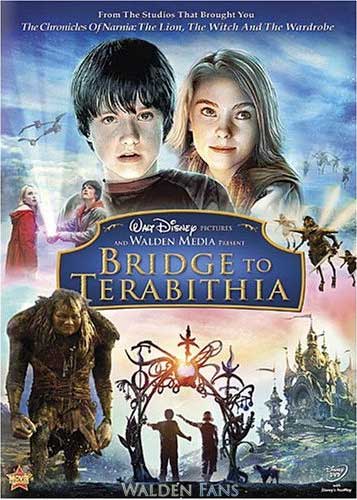
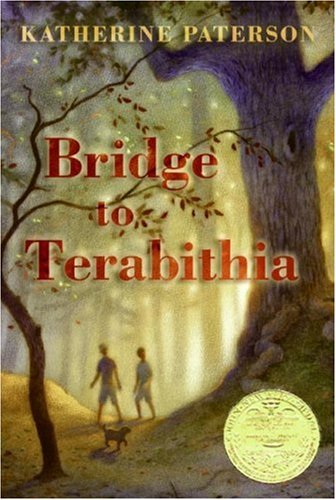
Book to Movie Friday: Bridge to Terabithia

I’d been avoiding this movie for a long time. That is, until Betsy posted her best kids book-to-movie adaptations, and this was on the list. Well, I figured if Betsy liked it, then it must be good. So, the next time I saw it at the library I grabbed it and watched it with M and C.

(We made C read the book first, though.)

I came to this book as an adult, having missed it (among others) as a kid. But that doesn’t mean I didn’t love it or was concerned about the movie, especially after seeing the trailer: they turned Terabithia into a fantasy movie? Eek.

I needn’t have worried. (Actually, as I watched the movie, I remembered what my brother-in-law said the summer it came out: he was angry and felt like he’d been gypped because he thought he was going to go see a fantasy flick and ended up with a tear-jerker.)

Anyway.

I liked that it stayed true to the story, and yet worked as a movie. It wasn’t just scenes from the book, which is a downfall of many book-to-movie adaptations, and yet, they didn’t change it substantially, either. There was a sense of Jess’s father’s sternness, of Jess’s need to prove himself. (By the way, Josh Hutcherson did a fabulous job. Anna Sophia Robb was good, too, but I was a bit more distracted by her acting than Josh’s.) I liked the friendship between Josh and Leslie, how it brought out the best in both of them. And, yes, I liked the way they portrayed Terabithia: sure it was fantastical, but how else to portray what was in Leslie and Jess’s imagination? The filmmakers worked it in pretty seamlessly, moving between Terabithia and the real world.

My only complaint was the ending (if you haven’t read the book, then don’t read this part…). Maybe it was me (it most likely was, since M was bawling): I didn’t get worked up nearly as much as I did while reading the book. I wanted to bawl, I wanted to sob like I remembered doing, but all I got was a little teary eyed.

That said, it’s a minor complaint… and really not worth not seeing the movie over.

Verdict: the book’s beautiful, and the movie does it justice. Hooray!

10 Questions for Jacqueline Kelly

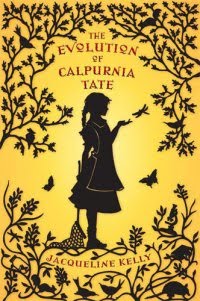
Perhaps it is too much to say that when I finished Calpurnia Tate, I wanted to meet the author behind the book. But, it isn’t too much to say that the instant I got an email from Jaqueline Kellye thanking me for my review, that I jumped at the chance and asked her if she’d be willing to do one. (Happily, she said yes!) Born in New Zealand, raised in Western Canada, she now calls Texas home. If that isn’t interesting enough, she also holds both a medical degree and a law degree (and likes both The Princess Bride and all of the Wallace and Gromit movies!). I could blather on about how interesting Jacqueline and her book is, but I think I’ll just move on to the questions and let them do the work for me.

MF: This is your first novel, congratulations! Can you tell us a bit about how the story came to be?

JK: The first chapter of the book was originally written as a stand-alone short story. It ended by jumping forward in time ten years to one morning when Calpurnia, by then a young woman, smuggled Granddaddy out of the house and took him to the airfield in Luling. There she bought him a ride in a bi-plane and paid the pilotess extra money to throw in some loop-the-loops. She could hear Granddaddy whoo-hooing in happiness as he whizzed by. He died a few months later, still in a fog of happiness.

MF: That sounds like a fun storye! What inspired you to write Calpurnia’s story?
JK: Calpurnia and the entire novel was inspired by my old house out in Fentress. It is a huge old house originally built over a hundred years ago for a large Victorian family. The house is wonderful but it’s falling down around my ears. I did make the house a promise that if I made money from the book, I would use it to restore it to its former glory. Here comes the shameless plug: buy the book and buy the house a foot of plumbing!

MF: Is there anything in your life that influenced the book as you were writing?
JK: What influenced me most while I was writing the book was my writing group. They are the ones who urged me to turn a simple short story into a full-length novel. I couldn’t have done it without them. We have been meeting every two weeks for eight years now and we have more fun than should be allowed.

MF: I adored many of the characters, from Grandpa and Calpurnia to the little J.B. Do you have a favorite character in the book? Who is it and why?
JK: My favorite character is, of course, Granddaddy. I grew up without a grandfather, so I had to create my own. This is actually rather nice because then you get exactly the grandpa you want.

MF: Is there anything you hope readers will get from your book?
JK: I hope that readers will look at the world and nature in new ways. And I hope that girls and women will realize that their great-grandmothers fought for the right to vote. Civil rights must never be taken for granted.

MF: I know you have a background in both the medical professions as well as in law. How did you end up being a writer of children’s novels?
JK: I have wanted to be a writer my whole life. I’m very fortunate in that I presently practice medicine part-time. This allows me to write. It would be almost impossible to write seriously with a full-time private practice.

MF: Do you have a special time or place where you write?
JK: I prefer to write in the mornings upstairs in a guest bedroom that I have turned into a home office. I listen to the local classical music station and I look out into a huge old oak tree where the squirrels and cats chase each other back and forth, up and down. I try to set aside from 9-12 daily but that doesn’t always work.

MF: Are there five books you think everyone should read?
JK: For children: The Wind in the Willows; Alice in Wonderland; The Princess Bride; The Hobbit; The Lion, the Witch, and the Wardrobe.

MF: Who or what has influenced your writing, and why?
JK: I am in awe of Alice Munro. Her language is deceptively simple, yet her stories are incredibly rich and complex. Then there’s Eudora Welty, Flannery O’Connor, Katherine Anne Porter. I would hope that these wonderful writers have had some small influence on me. They are the best at what they do. The rest of us are mere sniveling amateurs.

MF: Thanks for your time!
JK: Thanks so much.

You can find more about Jacqueline and Callie Vee on their Facebook page, which Jacqueline is using as a blog. You can also check out her (very gorgeous) web site.

Go Nominate Your Favorite Book NOW!

That’s an order.

Go here to do it… fill out the forms and press enter. There’s a bunch of categories to choose from — easy reader/early chapter; poetry; fiction and non-fiction picture books; middle grade fiction; middle grade and YA non-fiction; YA books; graphic novels; and science fiction/fantasy — and you can nominate in one or two or ALL of them. It’s easy peasy.

Just don’t nominate my favorite books… okay?