Geeky Classics

This week’s Weekly Geek asks four questions, two of which I’m supposed to answer. Starting at the beginning…

1) How do you feel about classic literature? Are you intimidated by it? Love it? Not sure because you never actually tried it? Don’t get why anyone reads anything else? Which classics, if any, have you truly loved? Which would you recommend for someone who has very little experience reading older books? Go all out, sell us on it!

Ah, classics. I really didn’t read many growing up, except for the ones assigned in English class, and then I don’t think I really liked any of them, except Mark Twain. I’ve always liked Mark Twain (though, admittedly, I haven’t read any of his books in years…). Since then, though, I’ve discovered, while not a real love for classics a very big like for them. (Warning, approaching food metaphor…) I think they’re like the whole grains of literature. If you don’t read at least a handful a year, then you’re suffering from an unbalanced metaphor. However, I also think that if you subsist solely on classics (or whole grains, for that matter), you are missing out on some of the delicious things in life (if perhaps not that filling or even good for you). It’s all about balance, my friends.

Some of my favorites (all older than 100 years, just so we’re on the same page):

All of Jane Austen, of course, especially Persuasion and Pride and Prejudice: Her observations of relationships, personalities, and class are all still valid (and funny) today.

Jane Eyre: Swoon. Really.

Isak Dineson — I especially like her short stories (shock, I know) in Anecdotes of Destiny and Ehrengard: I read this years and years ago (time for a reread?), and remembered being moved by Dineson’s use of language and food, especially in Babette’s Feast.

Room with a View (or E.M. Forester in general): We just watched the Merchant-Ivory movie version last week, and I was reminded how much I liked this book. Fun, light, silly, sweet… perfect Britishness.

My Antonia: Another one that I remember being really affected by. I read all of Willa Cather’s stuff about 10 years ago, and I was really quite moved by this one. Wichita did a Big Read last fall, and this was the book. I never got around to rereading it, but now that I’m thinking about it, perhaps I’ll pull it out again.

Dracula: Oh. My. Gosh. Fabulous.

Huckleberry Finn: It’s the ultimate Mark Twain. Full of humor, social commentary, and a ripping good story. (Or at least as much as I remember. I can’t tell you the last time I read this one…)

Daisy Miller: I’m not a huge fan of Henry James, but I found myself really liking this one. The only thing I could find on it on my blog was this, “A short novella – and an intriguing story about a young American woman in Europe and her lack of “propriety” that eventually leads to her downfall, of sorts. An interesting commentary on propriety and its place or lack of place in society.”

Anne of Green Gables: I adore this book. (But only this one. I’m not much on the sequels.) Anne is impetuous, and darling, and crative, and just so much fun to read about.

3) Let’s say you’re vacationing with your dear cousin Myrtle, and she forgot to bring a book. The two of you venture into the hip independent bookstore around the corner, where she primly announces that she only reads classic literature. If you don’t find her a book, she’ll never let you get any reading done! What contemporary book/s with classic appeal would you pull off the shelf for her?

I’m terrible at this kind of thing. I’m better at one-on-one recommendations. But a couple of books that I thought of, off the top of my head…

I Capture the Castle, by Dodie Smith: I searched, and I don’t have a full review for this one. That’s a crime. I remember being totally enthralled by it.

My Name is Asher Lev (or any Chaiam Potok book, really): In my opinion, this is Potok’s best. A moving story about an artist and his relationship to his family’s Hasidic Jewish religion. Touching.

Austenland: For Austen fans. Light and silly, and really quite fun.

How Green was My Valley

My Name is Psmith (not 100 years old, or it’d be in the classics…)

The Orange Girl, Jostein Gaardner: It’s a wonderful little book. (Hard to find, though.) A letter from a (dead) father to his son (who’s 11 when he reads it), it’s the story of how he and his wife met. Just about perfect.

The Chronicles of Narnia, C.S. Lewis: I know I don’t have reviews for this one, but as far as allegory goes, this one is a masterpiece.

I don’t know if I helped anyone here… but I did discover a list of books that I’d like to go back and reread. So, for that, this was a completely worthwhile endeavor!

WSR Challenge Roundup #3

This week’s quote was provided by bigsis, from the book Vampire in Moscow by Richard Henrick. She described it this way: “An ancient sarcophagus has been unearthed and sent to Moscow to be studied. There are many interested groups and already, and one-third into the book the characters’ lives are entwined…”

Brother Nicholas, you have been chosen to travel to the capital city. Because the time of release is near, you will not go unarmed. Two thousand years ago, our order’s beloved founder received a weapon cut from the very cross on which the Ascended Master was crucified. The divine spear has been kept in our midst for a millenium, when the Beast last walked among . Protect it well, for it is the only device on Earth that can do injury to the unholy creature, whose flesh is impervious to mortal weaponry.

I’m still looking for quotes from the books you’re reading for the challenge; leave them in the comments or email them to mmfbooks AT gmail.com. Oh, and you can find all the reviews here.

On with the roundup:

Erin‘s first book was Garlic and Sapphires, a yummy (and fun) look at Ruth Reichl’s experiences as a food critic in New York. Erin writes, “I don’t think there is a single item of food Ruth wrote about that I would be interested in eating. Her descriptions of tastes and textures were fabulous.” Check out her review for a delightful bit of irony…

Amira checked in with another four (I’m at a loss for words…): Swallows of Kabul (she felt mostly the same way that Jeska did), Hundred Secret Senses (liked it, but not as much as Joy Luck Club), Driving Over Lemons (good; better than another book I’ve never heard of), and Persepolis 2. She wrote, “One of my favorite scenes in the book is when Satrapi points out that it is difficult to be an art student while wearing impractical clothing and is allowed to redesign the acceptable clothing for art students. We hear so much of what is wrong with Iran that it’s good to hear that sometimes, there is at least a little reason (although you can certainly argue that even the redesigned outfits are pretty unreasonable).”

Lily read Chocolat — mmmmm, sounds delightful — and wrote “Chocolat is a small book, but just like a little chocolate truffle, it held a lot of delicious flavors. The writing is truly poetic, I did feel like I was eating my favorite dessert.” I really do need to read this book…

J.C. read one by one of my new favorite authors, Girl at Sea by Maureen Johnson. She complains about the cover, saying it’s nothing like the character Johnson created, writing, “This cover is so generic that it short-changes what’s inside. I’m glad I didn’t judge this book (or 13 Little Blue Envelopes) by its cover. If I had, I likely would have assumed the novel would have been another formulaic teen romance drama. Which it definitely is NOT. Girl at Sea has a great pace and likable characters. There’s a bit of everything here: mystery, romance, drama. It was a great book to read while stuck in winter misery.”

Tricia read the classic A Tree Grows in Brooklyn, noting that while the plot wasn’t that captivating, “it’s told so beautifully that there were passages I actually pored over. It’s a story of love, grief and survival that I certainly recommend.” Another one I need to read.

Our stop in China this week is provided by Corinne with Serve the People: A Stir-Fried Journey through China, Chinese-American journalist Jen Lin-Liu’s look at modern-day China through food. Corinne writes, “Her cooking experiences and the people she meets are fascinating and all the while she is teaching us Chinese history, culture and legend, usually through the personal experiences of the chefs and waitresses with whom she crosses paths. Explanations about the variations in Chinese cuisine and food preparation based on geography were particularly compelling, probably because the cuisine of the culture I’ve grown up in feels infantile compared to the dishes I read about.”

And lastly, but not leastly, Nicole checks in with Animal, Vegetable, Miracle, another book that I’ve been meaning to read for a while. (Hmm… do you sense a theme here?) She writes, “Reading this book inspired me to take a personal field trip to my grocery store to see what I could buy from Arizona. I was shocked to discover that if I was going to go on the Kingsolver diet, Corey and I would have to survive on chocolate milk, bread, and honey.” An interesting diet, to say the least.

Here’s to another good week!

Captain Alatriste

by Aturo Perez-Reverte
ages: adultish
First sentence: “He was not the most honest of pious of men, but he was courageous.”

Call this one the Spanish The Three Musketeers. It’s 1623, Madrid, Spain. Alatriste is a former soldier, who has taken to dueling for hire to keep money in his pockets. He is hired one night by some unknown men, high-born from what Alatriste can tell, to take out two Englishmen. Alatriste doesn’t — mostly because one begs for mercy for the other man — and as a result saves the life of the Prince of Wales. This is not a good thing for Alatriste — for the people who wanted the Prince dead are now after Alatriste’s life. Our narrator through this journey is Inigo Balboa, son of a former soldier and collegue of Alatriste and who has become a protege of sorts to the good Captain.

I liked this book, mostly because it felt like (and made references to) The Three Musketeers. Same time, same feel, similar characters (the Duke of Buckingham, who plays a role in Dumas’ work, makes an appearance, and Richelieu is talked about) — from the noble, yet misguided soldier, to the young impetuous lad (though not as impetuous as d’Artangnan), to the corrupt Church official… it’s all there. I liked the narrator, too. He was circular in his telling (I never could figure out who he was telling the story to; he would call them”Your Mercies”), jumping forward and backward in time, and talking so much about the history of Spain that I felt like Madrid and its people were almost another character. But when the action got going — as it occasionally did — it really got going. (Which, in many ways, is also like The Three Musketeers.)

I knew it was the first in a series when I started it, though I thought it would stand on its own more. It doesn’t end in a cliff hanger, but so many storylines and threads are started in this book, and never resolved, that it’s almost imperative that one read the next book. If only to find out why Inigo keeps calling Angelica a “Devil” because she never really did anything…

I’m just not sure how much I care. I may find myself a couple months down the line thinking about it and wondering what the next step in the story is, though. It’s definately one to mull over. Either that, or I’ll just watch the movie, which I didn’t even know existed. Anyone know anything about it??

Stolen From Facebook

Feel free to pass it along…

25 Random Things About Me
1. I like to read.
2. Check that: I love to read.
3. I read on average four books a week.
4. Which breaks down to between 2 and 4 hours a day.
5. I don’t watch much TV anymore. (30 Rock is about it.)
6. And I let my two youngest watch about 2 hours of TV a day.
7. Granted, I mostly read books for children and young adults.
8. I don’t read them because I’m pre-screening them for my girls.
9. Or because I’m a children’s librarian or a bookseller (though I have aspirations in those directions).
10. I read them because I like stories.
11. And I think they’re fun to read.
12. I do read adult books, just not as many.
13. Mostly because I can’t find as many that I like.
14. My favorite non-fiction is travel books and food books.
15. Especially in January. I hate January.
16. I did, once, want to write books.
17. But I decided that my creativity doesn’t run in that direction.
18. If I did write a book, it’d probably be some sort of travel book/memoir.
19. But that means I’d have to travel. Which we don’t. Not really.
20. I’m much better at writing my opinions about what other people write.
21. Which is why I have a blog.
22. Actually, I started the blog because I have a bad memory and can’t remember what I’ve read a week after I’ve read it.
23. Blame it on four pregnancies.
24. Though I think I’ve always been a bit scatterbrained.
25. Oh, and I like memes, but I hate tagging.

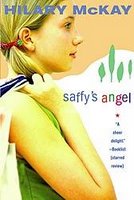
Saffy’s Angel

by Hilary McKay
ages: 10+
First sentence: “When Saffron was eight, and had at last learned to read, she hunted slowly through the color chart pinned up on the kitchen wall.”

Back in November, when I read and gushed about Forever Rose, I made a resolution: I was going to read all the books about the Casson family, starting from the beginning. I finally got around to it this month, and I have to say that this one is just as lovely, charming, funny, enjoyable as Forever Rose was. (Start at the beginning, though. It makes more sense.)

Saffron, called Saffy, at age eight, discovers accidentally that she was adopted by the Cassons — her mother was Eve’s (that’s the Casson mom) sister, sure but that doesn’t make her belong. Fast forward five years, years where Saffy has felt not-quite-right. These feelings all come to a head with the death of the grandfather; he leaves each child something, and to Saffy, he leaves her “angel.” No one knows what that is, and so Saffy, propelled by a desire to know and a new friend, sets off to discover what that is (and in the process, finds home).

It’s not the plot, though, that won me over. I still adore the Cassons. I love the way McKay presents them — from their wacky house (named The Banana House) to their each individual traits. I loved how pragmatic Rose is — the way she “handled” Daddy on the phone was priceless — and Caddy’s ditziness is totally charming. Then there’s Indigo with is protectiveness and determination to overcome all his fears (by sitting in a windowsill), and Saffy herself, with her fierce determination and longing. I loved that McKay tackled difficult life issues with humor (though I won’t say grace, because the Cassons are anything but graceful. Crazy, yes. Elegant, no). I loved the daft English-ness of it all (again with that wacky English movie feel). It just made me smile (and laugh out loud).

(Well, I didn’t like Bill, the dad. He was a bit of a stuffed shirt, but I could understand how an OCD person would really have an issue with Eve and the way she didn’t keep house. I thought, though, that it was nice that he just left and lived in London rather than trying to force Eve into making herself over into something that he could stand. Worked for me, anyway.)

On to the next one, and I’m hoping it’s just as lovely…

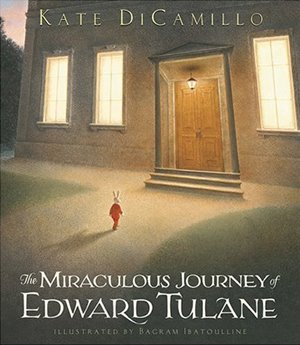
The Miraculous Journey of Edward Tulane

by Kate DiCamillo
ages: read-aloud, any age. Read alone, ages 7-10
First sentence: “Once, in a house on Egypt Street, there lived a rabbit who was made almost entirely out of china.”

C got this one for Christmas from Santa, and her reaction (which made me laugh), was part “Huh?!” and part “That’s stupid. I don’t want to read that.” So, she did voice some opposition when I said that this should be the next one we read aloud. But, since I’m mom, and since I wanted to read it, my desires prevailed. (bwahahaha!)

If you don’t know already, this is the story of Edward Tulane, a china rabbit who is loved, but who is so incredibly stuck on himself that it’s impossible for him to love in return. He is lost on a trip, and then spends years traveling the world (he can’t move himself; he’s passed from owner to owner), learning to love, losing and then learning to hope again.

It’s a simple plot, but an absolutely wonderful book. It’s beautiful, picturesque language was a dream to read out loud. It’s amazing pictures were lovely to look at; C’s biggest complaint while reading it was that she was missing the pictures. It’s got a beautiful moral (yes, I am gushing), but is not heavy handed in the telling of that moral. In short, it’s a perfect book.

C, when we finished last night, told me that she didn’t think much of the book when she saw it on Christmas. “But, Mom,” she said, “I was wrong. I’m glad you read it to me. It’s a GREAT book.”

And she couldn’t be more right.

Library Loot #3

I realized something this morning: because of Library Loot, you all know exactly what I’m reading, and it’s just a matter of waiting for me to get around to reading it and putting up the review. Not much mystery or suspense any more…

I’m not sure how I feel about that.

I also haven’t decided if I like the links or not. So, this week, no links. Tell me if you’d rather I put the effort to put them in, or if you don’t really care either way.

For A and K:
Red Sled, by Patricia Thomas/Illustrated by Christ L. Demarest
The Littlest Owl, by Caroline Pitcher and Tina Macnaughton**
Dora’s Day at the Beach (someday, maybe, I’ll make it back from the library without a Dora book…)
Guess What I found in Dragon Wood, by Timothy Knapman/Illustrated by Gwen Millward

And for Chinese New Year:
The Girl Who Drew a Phoenix, by Demi
The Magic Pillow, by Demi**
New Clothes for New Year’s Day, by Hyun-Joo Bae**
The Pet Dragon, by Christoph Nieman

For C:
Rapunzel and Other Magic Fairy Tales, Illustrated by Henriette Sauvant, Translated by Anthea Bell

For M:
Lady Knight, by Tamora Pierce*
Maximum Ride: School’s Out – Forever, by James Patterson (she liked Alex Rider, and I remembered this when I was at the library. It’s the second in the series, though I don’t know how much that matters…)
The Dead and the Gone, by Susan Beth Pfeffer

For me:
The Geography of Bliss, by Eric Weiner

The roundup is over at A Striped Armchair.

*Ones M finished.
**Picture books we really liked.

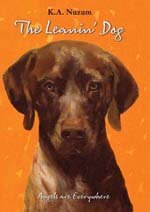
The Leanin’ Dog

by K. A. Nuzum
ages: 8-12
First sentence: “I shoved my braids up into my woolen cap, pulled the itchy thing farther down over my ears and crossed to the cabin window.”

Have you ever noticed how prevalent dead/crazy/absent moms are in kids literature? Me either, until I started reading a bunch for the Cybils. Sherry over at Semicolon was curious about the idea after one of our panel’s chats, and made up a list of all the books with missing — dead or otherwise — moms. There’s quite a few.

Add this one to the list. (Actually, is the second out of three that I’ve read with dead moms in the last week — the other two are Estella Revenge books — and so, I have to admit up front, that colored my opinion of this one. I’m heartily tired of dead moms.)

Dessa Dean lives with her father up in the mountains. He’s a trapper, and she’s an only child. Her mother used to live with them, but she and Dessa Dean got caught out in an early-winter blizzard and Dessa watched her mother freeze to death. That obviously traumatized Dessa: she’s discovered in the time since that she can’t leave the cabin. She’s lonely and sad, and subject to both night- and daymares. Then one day, a wounded dog come scratching at the door when Dessa’s home alone. She takes a liking to the dog, who, slowly, helps Dessa not only through the tough first Christmas without her mother but to begin to heal from the tragedy.

Dead mom aside, I liked how this book felt. For something that deals with death and tragedy so directly (not to mention the general harshness of life alone in the mountains), it was a fairly positive book. I really liked Dessa’s voice; I liked her general determined nature (her stubborn streak, as she put it), but also just the way she looked at things. She’d spend her days doing school work: making up sentences for spelling words or making up math problems. As the book went on, the school work took on a life of its own: how many steps it takes to get to the door, how many times you can pet a dog before she wakes up. I also liked Dessa’s quest to find the dog’s true name. The dog-girl relationship was a sweet one, and I really liked the way Nuzum wrote the dog; it didn’t speak, but rather Nuzum wrote noises and body language so that I could really picture how the dog was acting.

So, in the end, I guess it was a pretty good dead mom book. One that I think kids going through some kind of tragedy could relate to, and possibly others would enjoy as well.

Teaser Tuesday

TEASER TUESDAYS asks you to:

  • Grab your current read.
  • Let the book fall open to a random page.
  • Share with us two (2) “teaser” sentences from that page, somewhere between lines 7 and 12.
  • You also need to share the title of the book that you’re getting your “teaser” from … that way people can have some great book recommendations if they like the teaser you’ve given!
  • Please avoid spoilers!
  • Happy inauguration day! Hope you’re all finding a way to watch…

    This week my teaser comes from The Leanin’ Dog, by K.A. Nuzum. The basic story is a girl, who lives in the mountains — her father is a trapper — has witnessed her mother freezing to death. She’s suffering from grief and guilt and has found that she can’t leave the house. I don’t know how it ends, though; I’m only halfway through.

    From page 117 (the she is a dog):

    “I can’t,” I said, and I heard my voice low and heavy with shame. “I can’t do that; you’ll have to come on back here.” She set down on her haunches and cocked her head, trying to gather my meaning.

    WSR Challenge Roundup #2

    I’m still looking for quotes from books to start this off… leave them in the comments or email me at mmfbooks AT gmail DOT com.

    Since none of you quoted anything, or sent anything, you’re stuck with another one of mine, from The Royal Road to Romance, by Richard Haliburton, which takes place after an encounter with pirates:

    As our little ship moved painfully toward her dock I was standing on deck in my shirt-sleeves beside the unfortunate American tourist who had lost most of his two hundred dollars.
    “Lord, I’m hungry!” he growled at me.
    “Oh, everybody’s hungry,” I replied unsympathetically. “But it’s worth it having such a jolly adventure. “
    “Jolly adventure!” he gasped.
    “Why, of course. I’ve never had such a good time.”
    “Idiot!” he burst out.
    “Fossil!” I retorted.

    We’ve got a fabulous bunch of reviews this week! All the reviews can be found here.

    Amira read another four, and gets this week’s most interesting use of the challenge award, with The Hunger Games (food-hunger, get it?), but she also read Persepolis, of which she said, “I’d like to think that graphic novels (this isn’t exactly a novel though, since it’s non-fiction; maybe a graphic memoir?) like this can open up new knowledge to people who might otherwise not have read anything about the Iranian revolution or a variety of other topics. I hope that many more like this are published.”

    Jeska started with The Swallows of Kabul, the story about two couples in Afghanistan under the rule of the Taliban. She enjoyed it, though, she says, ” Yet it is not easy to read. It is tragic, the way the main characters’ lives are torn apart by the week or so the story covers. In a sense, this is a book that mourns for all of the things that were lost because of the wars Afghanistan has endured: beauty, freedom, the ability to love, Kabul itself. It is a eulogy.”

    She also read News from Paraguay, a National Book Award Winner about Ella and the man she — shacks up with? partners? they never marry… — in Paraguay, who eventually becomes dictator of the country. Of the book, I’mJeska writes, “I really enjoyed reading this book, although it wasn’t necessarily due to the story. The book is written in a very interesting way – we are given brief glimpses of parts of the characters’ lives, usually in short sections that are only a handful of paragraphs or less. This makes the story feel like it is moving very quickly.”

    Beth F read House of Mangoes, which dragged some for her in the middle, but in the end was an intriguing look at India’s push to self-rule. She writes, “I listened to the novel on CD (obtained through interlibrary loan), read by Robert Whitfield. I am no expert on accents, but I was particularly impressed with Whitfield’s ability to speak with an Indian accent that was believable and in no way a parody.”

    April began with the catch all Eat, Pray, Love (one that’s been on my TBR for a while; why didn’t I think to use it?), and enjoyed it as much as everyone else who’s read it had. She says, “[Gilbert] is direct and honest about her experiences, and it is a book I wouldn’t mind having on my bookshelf.”

    Melanie started with one of my favorites of 2007, Pomegranate Soup, and also enjoyed thoroughly it. She pointed out that a book about a struggling cafe would be one thing, but that the Iranian background gave it added depth. She also compared it to Chocolat and Like Water for Chocolate. Perhaps I should delve into one of those…

    Lesley highlights French Milk, which sounds like an absolutely delightful combination of graphic novel, memoir, and travelbook. She says, “Lucy and her mother make the standard Parisian excursions, as well as visiting bookshops, street merchants and cafes, but the real treat in this book is vicariously experiencing the epicurean delights that Paris has to offer.” As a lover of many things French, I have to read this one!

    Tricia read another one of my favorites, 84 Charing Cross Road. She says, “A story about the true nature of kindness and love, humanity and friendship, this is well worth the hour it takes to read it. This book is a real gem. It had me both laughing and teary-eyed. I highly recommended it!” (In other words, if you haven’t read it yet… you really should!)

    Becky checked in with Ten Things I Hate About Me, the story of a Lebanise girl, Jamilah, who is caught between worlds, and is struggling to find a way to fit in with the beautiful, cool people. I liked the quote she pulled out: “I wish I could talk in capital letters at school. Use exclamation makrs and highlighter pens on all my sentences. Stand out bold, italicized, and underlined. At the moment I’m a rarely used font in microscopic size with no shading or emphasis.” Sounds like an interesting character.

    She also read Nefertiti, a sweeping historical fiction work about an Egyptian queen, from the perspective of her younger sister. Go check out the review, and then pop by Becky’s Book Reviews, and enter the contest to win the book.

    Sandra’s giving Amira a run for her money… ; ) She checked in with four books this week. The most intriguing to me was Tomato Girl. Sandra writes, The voice of this girl rang true for me, with all her hopes and fears. Children as protagonists or narrators in adult novels don’t always impress me as real. Ellie was exactly right.” She also has a couple contests going on for a couple of the books; check them out here and here.

    I can’t wait to see what you all read next week…