Maus I and Maus II

by Art Spiegelman
age: adult
First sentence, Maus I: “I went to see my father in Rego Park.”
First sentence, Maus II: “Summer vacation.”

These are two books, but like Persepolis, they’re essentially one story, so they get lumped into one review.

One review in which I’m not sure what the heck to say about the book. I’m always at a loss for words when it comes to the Holocaust; it’s so depressing — humanity at its worst — that I almost would rather not go there. However, these graphic novels — stark and depressing, yet somehow ultimately hopeful — are worth reading.

I’m not sure if this is a story that couldn’t have been told in a different form, but for what it’s worth, it works as a graphic novel. It’s spare, but then, I’m not sure the story of a survivor of Auschwitz could (or should) be anything but spare. Even though Spiegleman didn’t go into detail about the situation, or the harshness, it was all there in its stark, depressing reality.

I was fascinated by the relationship between Spiegelman and his father — how did the Holocaust fit into it? Did the Holocaust make his dad into the grumpy, miserly, bitter, racist person? He fits squarely into the Jewish stereotype, and yet I could sense that Spiegelman was trying to understand his father, understand why their relationship was so strained. I’m not sure any of us got any answers — Spiegelman or the rreader — but I appreciated not having it spelled out or sugarcoated in any way. Something like this shouldn’t be.

I’m sorry I don’t have more coherent thoughts about this one. I think it’s an experience — kind of like the Holocaust Museum is an experience — that’s beyond words. There are horrors out there, and sometimes it’s good to face them. Even if its in a book.

January Jacket Flap-a-thon

I decided I did like doing the jacket flap-a-thon after all. 🙂 Though I think it needs a bit of tweaking. I’ll only post my top few (one per reading “category”, perhaps?), and no worst ones, unless there’s one that’s truly horrible.

I think that’s about all the tweaking I’ll do, though… On we go. This month’s three:

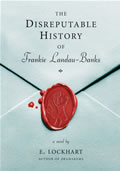
The Disreputable History of Frankie Landau-Banks (Hyperion):
“Frankie Landau-Banks at age 14:
Debate Club.
Her father’s “bunny rabbit.”
A mildly geeky girl attending a highly competitive boarding school.

Frankie Landau-Banks at age 15:
A knockout figure.
A sharp tongue.
A chip on her shoulder.
And a gorgeous new senior boyfriend: the supremely goofy, word-obsessed Matthew Livingston.

Frankie Landau-Banks.
No longer the kind of girl to take “no” for an answer.
Especially when “no” means she’s excluded from her boyfriend’s all-male secret society.
Not when her ex-boyfriend shows up in the strangest of places.
Not when she knows she’s smarter than any of them.
When she knows Matthew’s lying to her.
And when there are so many, many pranks to be done.

Frankie Landau-Banks, at age 16:
Possibly a criminal mastermind.

This is the story of how she got that way.”

Totally, totally draws the reader in. How could you NOT want to read the book after reading the jacket flap?
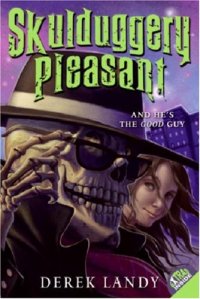
Skulduggery Pleasant (Harper Trophy): “Meet Skulduggery Pleasant: Ace detective, snappy dresser, razor-tongued wit, crackerjack sorcerer and walking, talking, fire-throwing skeleton. As well as ally, protector and mentor of Stephanie Edgely, a very unusual and darkly talented twelve-year-old. These two alone must defeat an all-consuming ancient evil. The end of the world? Over his dead body.”

Short, too the point, and very, very clever.

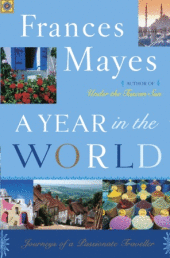
A Year in the World (Broadway Books):A Year in the World is vintage Frances Mayes — a celebration of the allure of travel, of serendipitous pleasures found in unlikely locales, of memory woven into the present, and of a joyous sense of quest. An ideal travel companion, Frances Mayes brings to the page the curiosity of an intrepid explorer, remarkable insights into the wonder of the everyday, and a compelling narrative style that entertains as it informs. With her beloved Tuscany as a home base, Mayes travels to Spain, Portugal, France, the British Isles, and to the Mediterranean world of Turkey, Greece, the South of Italy, and North Africa. In AndalucĂ­a, she relishes the intersection of cultures. She cooks in Portugal, gathers ideas in the gardens of England and Scotland, takes a literary pilgrimage to Burgundy, discovers an ideal place to live in Mantova, and explores the essential Moroccan city of Fez. She rents houses among ordinary residents, shops at neighborhood markets, wanders the back streets, and everywhere contemplates the concept of home. While in Greece, she follows the classic Homeric voyage across the Aegean, lives in a bougainvillea-draped stone house in Crete, and then drives deep into the Mani. In Turkey with friends, she sails the ancient coast, hiking to archaeological sites and snorkeling over sunken Byzantine towns. Weaving together personal perceptions and informed commentary on art, architecture, history, landscape, and social and culinary traditions of each area, Mayes brings the immediacy of life in her temporary homes to the reader. An illuminating and passionate book that will be savored by all who loved Under the Tuscan Sun, A Year in the World is travel writing at its peak.”

This one is so detailed that you almost don’t have to read the book. Still, it does give you a taste of what to expect.

Other books read this month:
Aunt Nancy and the Bothersome Visitors (Candlewick Press)
Chalice (G.P. Putnam’s Sons)
Paper Towns (Dutton)
The Hunger Games (Scholastic Press)
The Musician’s Daughter (Bloomsbury)
Two Girls of Gettysburg (Bloomsbury)
Wild Magic (Walker Books)
Breathing Out the Ghost (River City Publishing)
Babymouse: Rockstar, Babymouse: Monster Mash (Random House Books For Young Readers)
The Leanin’ Dog (Joanna Colter Books)
Saffy’s Angel(Margaret K. McElderry Books)
Captain Alatriste (Plume Books)
The Miraculous Journey of Edward Tulane (Candlewick Press)
The Rule of Won (Walker Books)
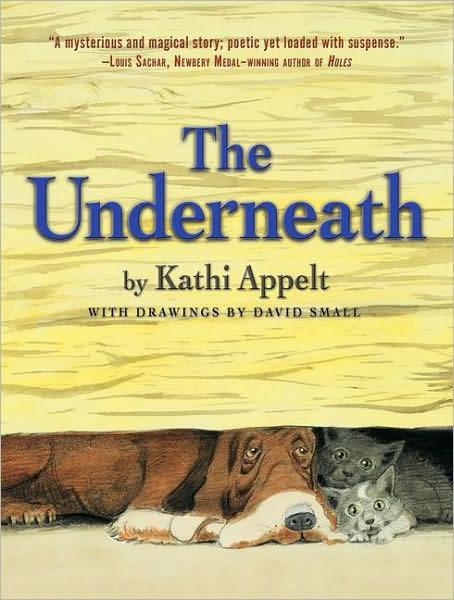
The Underneath (Atheneum Books)
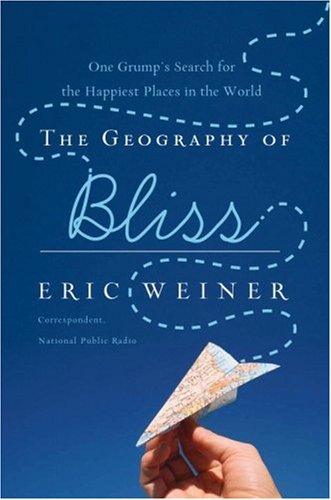
The Geography of Bliss (Twelve)
Chains (Simon and Schuster)

Chains

by Laurie Halse Anderson
ages: 10+
First sentence: “The best time to talk to ghosts is just before the sun comes up.”

Isabel is a slave. But this is not a plantation in the Civil War South; it is 1776, and New York is bristling with the news of an impending British invasion. Isabel and her younger sister Ruth’s former master died, and instead of being set free, like they thought they were, they are sold to a couple of Tories: Mr. and Madame Lockton, and taken to New York, where they are caught in the middle of the revolution. It’s just a matter of time, and circumstances, before Isabel decides which side she will be on. And what price that will cost her.

First: this book is beautiful. I’m not usually a tactile reader, but in this instance, I kept looking at the more-than–perfect cover, stroking the pages, and loving the font. Especially the blurb on the back cover. I could tell much care was taken with the design of the book. And I, for one, appreciated it.

Moving on…

In the interview at the back of the book, Anderson says that the whole slave issue cannot be broken down into “good guys” and “bad guys”. Which is an understatement. There are sympathetic characters on both sides of the revolution — while the politics of the revolution play a role in this book, it is not an indicator of character. (Nor should it ever be.) Chains is thoroughly complex and unflinching, presenting the issues at hand — freedom, slavery, revolution — with honesty. Anderson doesn’t write down to the reader; the book is quite brutal at times. That’s not to say the book is harsh. Rather, interspersed with all the brutality are moments of absolute poignancy. The book just about ripped my heart in two at parts. Isabel as a character is not just compelling, she’s strong and captivating, and honest. I felt for her, I adored her, I cheered for her.

In short, it’s historical fiction at its finest. But then, it’s Laurie Halse Anderson.

(And yes, I do need to read her other books. I know that. Which one to start with, though?)

As John Green Would Say: This is Made of Awesome


I was happy to find out via Fuse #8, my go-to place for all kidlit news, that there’s now a central web place for the kidlit blogging community: Kitlitospehre Central. The general aim is “to provide a passage to the wonderful variety of resources available from the society of bloggers in children’s and young adult literature.” I think this is incredible, and I’m not just saying that because I’m on the list. (I did a happy dance, though… 🙂 Thanks, Pam (and the rest of the board; you’re awesome), for setting this up: it’s an amazing resource, one I hope to make use of regularly.

(Though I think what we need now is a little logo button we can all stick on our blogs…)

Library Loot #4

This week’s haul: (Okay, so I decided that I was being anal about the surprise factor…)

The roundup is over at A Striped Armchair.

For A/K:
Pig William, Arlene Dubanevich
Liberty!, Allan Drummond
Fin M’Coul: The Giant of Knockmany Hill, Tomie de Paola
The Seven Voyages of Sinbad the Sailor, James Riordan and Shelley Fowles
Snoring Beauty, Bruce Hale/Illustrated by Howard Fine**
The Sea Serpent and Me, Dashka Slater/Illustrated by Catia Chien**

For M:
Shield of Stars, Hilari Bell
Sword of Waters, Hilari Bell
Dear Julia, Amy Bronwen Zemser*
Ranger’s Apprentice: The Sorcerer of the North, John Flanagan*
Cybele’s Secret, Juliet Marillier*

For C:
Utterly Me, Clarice Bean, Lauren Child
The Last Dragon, Silvana De Mari
Gregor the Overlander, Suzanne Collins (M really liked this series; I thought I’d see if C wanted to give them a try.)

For me:
Indigo’s Star, Hilary McKay*
The Adventures of Boone Barnaby, Joe Cottonwood
The Bermudez Triangle, Maureen Johnson

*Ones that M finished
**Picture books we really liked.

The Rule of Won

by Stefan Petrucha
ages: 12+
First sentence: “Garish.”
Review copy sent to me by Bloomsbury/Walker Books. (Yes, I am branching out and actually reviewing ARCs on my blog. They have to go somewhere…)

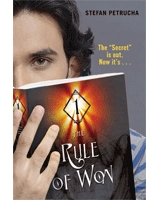
Caleb Dunne is a slacker. Self-proclaimed, all he aspires to do is not work very hard. He got suspended for something he didn’t do (wrong place, wrong time), and now, at the start of a new school year, he’s feeling the results of that: no one’s talking to him, except for his girlfriend Vicky. And she wants him to come to this after-school club, the Crave, and read this book The Rule of Won. The idea is that anything can happen to you or for you if you only think about it hard enough and want it bad enough.

Everything’s fine and good for a while — they do a couple of immanifests (the visualizing and chanting that gets you what you want) that work out, and Caleb is flying high. Until… well, until a teacher gets into a car accident, a close friend attempts suicide and another acquaintance is beaten up and put in the hospital. The book is less about Caleb’s self-discovery and relationships, though that’s a big part of it, and more about the dangers of group-think, and the line between “club” and “cult”. On those levels, it works quite well. Caleb is an engaging character, humourous, slightly dense, earnest, and likeable. His own relationship with the Crave is an interesting one; it starts out being just for Vicky and then morphs into something more challenging, and, eventually, more dangerous. Pertucha did a fabulous job writing group think — the chapters that are the Crave’s message board get more and more creepy as the book goes along, as the members get more and more immersed in the mob-mentality — as well as making Caleb and some of the secondary characters extremely compelling.

But, I think the book falters because there’s this element of mysticism surrounding Ethan’s (that’s the Crave leader) younger sister. Can she do magic? Or all those coincidences? Really? In the end, it’s murky. I think we’re supposed to believe, on some level that Ethan’s sister is making things happen. On the one hand, that’s really quite cool (and the way she does it is very unique). On the other hand, I think it undermines the message (if there’s even supposed to be one) that there’s a fine line between achieving things, and achieving things at all costs.

Even with that teeny bit of misdirection, the bottom line is clear: Fanaticism is a bad thing. Even if you’re fanatic about something as simple (?) as a book.

The Geography of Bliss

by Eric Weiner
ages: adult
First sentence: “My bags were packed and my provisions loaded.”

The premise: self-proclaimed grumpy journalist decides to visit happy nations (as determined by the World Database of Happiness that’s kept in Rotterdam, the Netherlands. He visits a handful of countries for several weeks, interviewing people and sampling the culture trying to figure out what, exactly, makes these people in these particular countries especially happy. And how does it all (can it?) relate to him and his own personal search for happiness?

It sounds trite, and on one level it is. How can a journalist, one who insists upon remaining professional aloofness at that, actually get to the bottom of what makes people happy? And besides, there are millions of people in any given country (more or less), and not all of them are going to be happy all the time, right? Well, yeah. But, I don’t think Weiner is going for depth. Sure, he draws conclusions from the places he visits, and he tries to put it all into some sort of happiness formula, but I think he was just out to meet people and experience things. Which is all good with me.

As for myself, I enjoyed the journey. Weiner is a funny writer — maybe not as good as Bill Bryson or Tony Horwitz at their best (admission: I picked up this book because there’s a blurb on the back by Tony Horwitz, and I thought, well Tony Horwitz liked it and I like Tony Horwitz’s stuff, so maybe I’ll like this…) — but enjoyable. My favorite quote, from his visit to Switzerland:

Our fondue comes in a large bowl, not orange, and it’s good. After a few helpings, the euphoria is gone, but I’m feeling, I think, very Swiss. Satisfied. Neutral. Maybe this explains Swiss neutrality. Maybe it’s not based on a deep-seated morality but a more practical reason. Fondue and war don’t mix.

And I have to admit that I enjoyed the travel aspect of the book. I’ve never been to Bhutan or Qatar or Switzerland or Moldova (not that I want to go there now), and I enjoyed seeing the world, even in a limited sort of way. I found his stops and the people he met interesting, and the conclusions he came to about happiness fascinating. Maybe not life-changing. But definately worth mulling over.

Which pretty much sums up the book: not life-changing, but definately worth paging through.

The Underneath

by Kathi Appelt
ages: 11+
First sentence: “There is nothing lonelier than a cat who has been loved, at least for a while, and then abandoned on the side of the road.”

I wrote this back in December, in the middle of the Cybils shortlist discussion, but didn’t post it. I figured it was safe, now that it’s won a Newbery Honor. I admit that I’m not feeling the love that others have for this book, though I also think that Sarah might be on to something… perhaps it’s one (like The Tale of Despereaux) that really should be read aloud, and maybe if I got a copy of the audio book (or read it aloud to C), I would feel differently.

On with the review…

There are some books that intellectually I get: I can understand why it’s a good book, I can see the craft that went into it, and can understand why it’s getting the buzz it’s getting. But on a visceral, emotional, story-enjoying level, I find myself wondering if the book is all about the hype, the craft, the buzz. Because I couldn’t stand it.

The Underneath is one of those books. Done in a series of short prose-poems, hauntingly done, it tells the story of the friendship between one hound dog, a mother cat and her two kittens. And their trials brought about at the hands of a very disturbed, evil individual named Gar Face. There’s also a sub-plot about Grandmother Moccasin, a water moccasin-changeling, who is engulfed in hatred because her daughter, 1,000 years ago, chose love with a man over her mother. It’s a journey and discovery for both of the stories, enveloped in sorrow and adventure.

Unfortunately, even though I could recognize it’s beauty and sense where Appelt was going, and know that this one will at least get a Newbery Honor [I was right… wow!], I didn’t like it. At all. In fact, I found myself rolling my eyes and yawning. I was bored. Stiff. The pacing was horrible, and even though the language was beautiful, it wasn’t enough to keep me from cringing every time Grandmother Moccasin showed up. “Go back a thousand years…” Um. Let’s not and just say we did. The plot kept jumping between Gar Face’s past, the present with the dog and kittens and the long past with Grandmother Moccasin, which is all fine and good, but after about 100 or so pages of it, I’d had enough. Then there was the animal cruelty. This is not a book for weak stomachs. Or sensitive readers. Don’t give it to the girl who loves her kitty. Or, probably, the boy who’s a bit mean to the dog.

But, I’ve heard it’s a good read-aloud. So, maybe someday, I’ll get an audio version of this book and then decide I really like it. It’s happened before. It could happen again.

We’ll see.

Teaser Tuesday, January 27

  • Grab your current read.
  • Let the book fall open to a random page.
  • Share with us two (2) “teaser” sentences from that page, somewhere between lines 7 and 12.
  • You also need to share the title of the book that you’re getting your “teaser” from … that way people can have some great book recommendations if they like the teaser you’ve given!
  • Please avoid spoilers!
  • The roundup is at Should be Reading.

    My teaser is from The Geography of Bliss: One Grump’s Search for the Happiest Places in the World, by Eric Weiner. This comes from the chapter on Iceland:

    “I smile, though Larus can’t possibly know why, can’t possibly know how please I am to hear the word ‘naive’ used as anythign other than a pejorative. Nearly twenty years ago, I had a run-in with the ‘n’ word.” p. 164.

    What are you reading this week?

    I’ve got to read this now


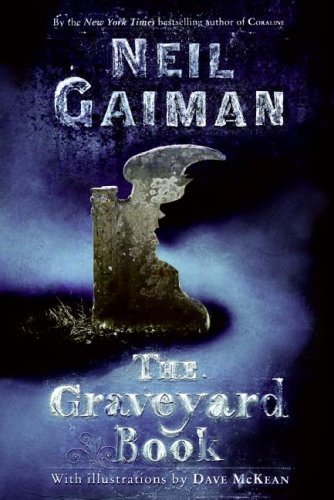
    The Graveyard Book won this year’s Newbery. Congrats to Neil Gaiman!

    Three other shout-outs: Savvy won a Newbery honor (yay!), Frankie-Landau Banks won a Printz Honor, and Mo Willems got the Geisel Award (again) for Are You Ready to Play Outside? All made me quite happy…

    For a full list of all the awards, visit the ALA webpage, here. (The list should be up by 10 a.m. MST today.)