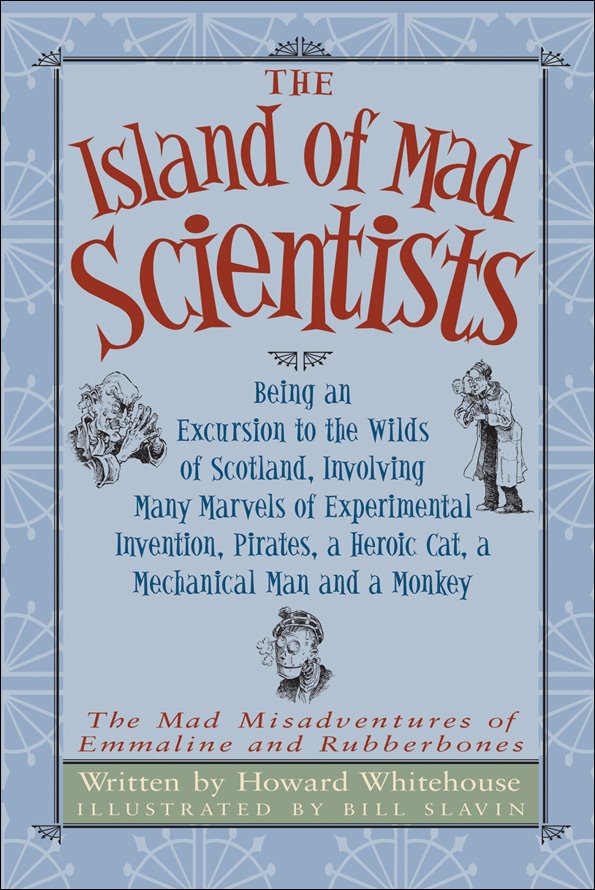
The Island of Mad Scientists

At first glance, this book looks like it’s another one of what I’m calling “The Precocious Kids on an Adventure” books that seem to be all over the place. However, while there are precocious kids (budding scientists, though there is no riddle solving), and adventure, this book is most definately not one of those books.

It’s actually the third in a series that Howard Whitehouse has written. I haven’t ever even heard of the other two, and thankfully (I’m becoming really grateful for this!) it stands on it’s own quite excellently. The plot’s a bit all over the plae, but the fundamentals are: there’s a Collector who collects scientists and wants a boy, Rab, and a girl, Emmaline (who are the budding scientists) to add to his collection. So, he sets thugs after them. In addition, there’s a princess, Purnah, who having escaped (in an earlier book) from an Evil Boarding School, is being pursued by the Authorities in order to put her back where she belongs. So, there’s thugs (and cops) following her. So (of course), they decide to vacation (it’s the middle of November) on an island, called Urgghh (“which means ‘cold and nasty’ in the Scots Gaelic tongue”), off the coast of Scotland, where a colony of Mad Scientists reside.

Clear as mud?

It really doesn’t matter, though, because this book is a grand romp. Hilarious, milk-snorting-through-nose funny, I can’t remember when I’ve had so much fun reading. It’s full of grand asides, amusing language, silly situations… everything a comic novel should have. It practically begs to be read out loud (I’ve already informed C that we’re going to; I can’t wait to do Purnah’s voice!), and thoroughly enjoyed by all, even if one doesn’t get the references to Verne, Stoker, Wells, late-18th-century science and Wodehouse (all of which the author helpfully explains in the note at the end).

Just brilliant. If I do say so myself.

Note #1: Thanks, Betsy, for your short Goodreads review; it gave me the push I needed to read it.

Note #2: Just for the record: because this is a Cybils nominee, I’ve been asked to make sure y’all know this is my opinion only, and not that of the panel.

Because We should All Start our Fridays with a Dose of the 80s

Hubby’s started a new feature: Friday Morning Videos. (Raise your hand if you watched Friday Night Videos. I did. Religiously.) And I think it’s an awesome idea because we should all start our Fridays with a bit of pop culture from the 80s and 90s. Makes the day go down much smoother.

Read the first installment here.

Off the Menu

It’s not often I get a request to be a part of a book tour, and so when I got an email about this one, as part of the TLC book tours, I jumped at the chance.

The novel follows three Asian-American women — Whitney, Hercules and Audrey — two of which are children of immigrants (the other is an adopted child of rich, white parents). All three were valedictorians of the same high school, and have kept up their friendship (albeit a slightly competitive friendship) ever since. It’s an interesting look at women and friendships, Asians and achievement, and how friendships and dreams and parents all work together (or not).

I don’t think I went in with any expectations — good or bad — but I invariably compared it to the Amy Tan novels I read. (I’m sure that Son is going to get a lot of those comparisons…) And I didn’t find it lacking. In fact, while I didn’t get the same cultural feel that one gets from a Tan novel, I did find I could relate to the characters on a more visceral level. Sure, they’re younger than I am and Asian, but what woman (or man) doesn’t have problems with their parents sometimes? Or their friends? Or harbors secret dreams of doing something other than what society expects of her (or him)?

In addition, I liked the characters. Hercules is a vibrant character — brash and abrasive, yet lovable and approachable. She was my favorite, I think, because she worked so hard, and cared so much and yet was completely clueless as to how to show it. I think I liked Audrey the least — she’s brilliant, beautiful, rich, loving, with a totally supportive man… in short, completely perfect. Sure, her mom’s a total control freak, but that didn’t do enough to humanize her in my mind. In fact, when her dreams all worked out for her in the end, I just rolled my eyes. Whitney was somewhere in the middle — good, perfect even, but had enough challenges to make her seem less goddess-like than Audrey came off.

Son managed to balance the three perspectives quite nicely; I never felt like the story was choppy, or that any of the lesser characters were slighted for Whitney’s story (even if hers felt like the main one). My only real complaint is that I felt confused with the passage of time; the events of one chapter would unfold, and then the next would take place three weeks, or six months later. It would always take me a bit to catch up and figure out when everything was going on.

But that’s a minor quibble. On the whole, it was a good, interesting read.

Don’t forget to check out the rest of the tour!
Friday, November 7th: Ramya’s Bookshelf
Monday, November 10th: Pop Culture Junkie
Tuesday, November 11th: 8Asians
Wednesday, November 12th: Savvy Verse and Wit
Thursday, November 13th: In The Pages
Friday, November 14th: She is Too Fond of Books
Monday, November 17th: Planet Books
Tuesday, November 18th: B & B ex Libris
Wednesday, November 19th: DISGRASIAN
Thursday, November 20th: Booking Mama
Monday, November 24th: The Literate Housewife Review
Tuesday, November 25th: Feminist Review
Wednesday, November 26th: Diary of an Eccentric

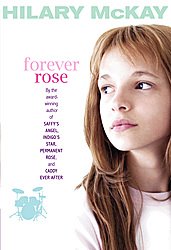
Forever Rose

What planet have I been on that I have not heard of Hilary McKay or read any of her books? Thank heaven for Cybils nominees… though there’s nothing like reading the last one in a series first. (Though it did quite well as a stand-alone.)

This book (and I’m under a strict deadline here; M needs the computer) was a totally, completely, wonderfully fun and endearing read. Loved Rose. Loved the Cassons in general: they were so, well, that Hugh Grant movie English endearing. Just wanted to wrap them all up and put them in my pocket. They made me laugh. They made me smile. They dealt with tough issues (abusive parents, divorce, single parenting) with humor and love.

Granted, I’ve got a huge soft spot for anything English, and this tickled it just perfect. But, even given my preferences, this book was a lot of… well… wonderful.

And as soon as I finish up my Cybils reading, I’m going to go find McKay’s other four books about this lovely family and read them. Most likely in order, too.

(Just for the record: because this is a Cybils nominee, I’ve been asked to make sure y’all know this is my opinion only, and not that of the panel.)

Radiant Girl

Katya is 11 years old. It’s April 1986, and she lives just outside of Chernobyl, Ukraine. For those of you older than 22, you know where this story is going. For those of you younger, let’s just say that April 26, 1986 was a day that not many people will forget: the day that the Chernobyl Nuclear Reactor exploded. Katya’s caught in the middle of it; not only having to evacuate her little village for Kiev, but because her father works for the power plant, having to move back, and deal with life near the Dead Zone. Everything about her life changes that day, from something as simple as her friendships and hair color, to the more complex and worrisome health issues.

Andrea White takes this horrific event and gives it a personal touch, which makes it all the more haunting, in my opinion. She fills the book full of facts (with footnotes!) so that it feels like a memoir, rather than a fiction novel. I liked that touch; it made Katya come alive in ways that a straightforward fiction book wouldn’t have. There’s also sub-issues of conflict between Katya’s party-line father, repeating the Communist Party line that nothing was wrong. There’s an undercurrent of hatred and mistrust for the party leaders, for the things they put their people through in the name of the State and the Party. If I didn’t know that it truly happened, I’d be disbelieving: how could a government do that to their citizens. There’s a line at the end, that Katya believes the coverup of Chernobyl lead to the Ukraine’s decision to leave the USSR by 1991, and I believe it. Moscow treated the Ukranian citizens abominably.

This book is haunting, and difficult to get through, but only because the events were haunting and difficult to get through. White handles this with grace and style and love, and makes it all come alive. Which makes this book worth reading.

(Just for the record: because this is a Cybils nominee, I’ve been asked to make sure y’all know this is my opinion only, and not that of the panel.)

Food, Travel and People Books

I probably should put up a reading list for my own challenge, huh?

I’m going to do one of each:

Food:
The Sharper Your Knife, The Less You Cry, Kathleen Flinn
Bonus – The Fortune Cookie Chronicles, Jennifer 8. Lee
Dear Julia, Amy Bronwen Zemser
Chocolat, Jeanne Harris

Travel:
A Year in the World, Frances Mayes
Bonus – The Ridiculous Race, Steve Heley

People:
Captain Alatriste, Arturo Perez-Reverte
Bonus – Searching for Crusoe, Thurston Clarke

Ellie McDoodle: New Kid in School

I didn’t read the first Ellie McDoodle book, but C absolutely loved it. Thought it was grand. So I was interested in reading this one, and I can see what C was talking about. It is cute. And fun.

Ellie’s being uprooted by her parents the summer before 6th grade (I can relate!). It’s not fun. It’s not exciting. She hates being the new girl. No one likes her. It’s different, it’s unfamiliar, it’s… well, and upside down heart. But, she slowly makes friends, and figures out how to make things work, and in the end, everything turns out okay (I can relate!).

I think this is a good book for less confident readers — the words are interspersed with some fun cartoonish drawings. And I liked that Barshaw tackles a subject like relocating and starting over. She does it with humor and tenderness, and I rooted for Ellie to make things work out for the best. My only real criticism is that it was probably overly simplistic; Ellie was all settled in and comfortable (mostly) in her new environment in a matter of weeks, where in real life (I can relate, remember?) it takes months. But, since this is a story, not real life, I can forgive that.

Interestingly enough, C didn’t like this one as much as she liked the first. Perhaps it was because we relocated her when she was younger than Ellie (only 1st grade, not 6th), and she’s never really had the problems of fitting in and making friends. But I could have seen my 6th grade self really loving this book. And I can see other kids who have had to move just adoring it.

Which means it was a very good book.

(Just for the record: because this is a Cybils nominee, I’ve been asked to make sure y’all know this is my opinion only, and not that of the panel.)

Geeky Repeats

This week’s Weekly Geek is to take one from the past and re-do it. I had fun doing my book cover mosaic (#15), and so I’m going to do that one again.

Have fun… leave your answers in the comments, and I’ll check back and let you know when someone hits upon the correct answer.

1.

2.

3.

4.

5.

6.

7.

8.

9.

10.

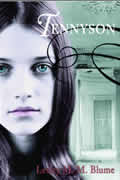
Tennyson

Tennyson lives in the backwoods of Mississippi and is perfectly happy. That is, until her mother, Sadie disappears. Her father, Emery Fontaine, decides to go looking for her and leaves Tennyson and her sister, Hattie, with their Aunt Henrietta, who runs the Fontaine family house, Aigredoux. Once there, Tennyson is faced with an aunt who can’t live in the present, a house that’s falling apart, the fact that her mother may never come back, and most interesting (and haunting) of all, the dreams of her family’s past that she keeps having.

This book is a hard one to pin down. I liked it; there’s a lot going for it in terms of mood and Tennyson is a good, strong main character. I liked the portrait of the deep South, both in the 1930s and the glimpses into the height of the Civil War. It’s full of tragedy and mood and discovery and dreams. I think out of all of it, I liked the dreams the best — Blume captured the essense of the High South, the grand ladies, the southern mannerisms, the Gone-With-The-Wind fierceness in the face of destruction and betrayal. I found the dream sequences fascinating.

Real life was less so. I was pained by Sadie; I cringed even though Blume just skirted the top of the iceberg when it came to Sadie’s mothering. I felt so terrible for the girls, and for Emery who was just trying to keep it all together. There were so many deeper issues in the book; I’m not sure how many would come across to a child reading this, or if it’s just my life and wide reading that makes the neglect and jealousy and betrayal pop out at me.

For that reason, though, the ending worked for me. I could see what Blume was doing with it. Yes, it ended abruptly, but I think this part of Tennyson’s life was finished, and she was moving on. Therefore, the book needed to end, even if the story wasn’t ended. I could see, though, how it can be unsettling, leaving all the ends dangling, the story unfinished.

It’s at the very least a good mood book, and a good Southern book. And a very good one for a cool fall day.

(Just for the record: because this is a Cybils nominee, I’ve been asked to make sure y’all know this is my opinion only, and not that of the panel. Thank you.)

I Haven’t Forgotten

I just had an incredibly busy day yesterday. I didn’t get on the computer at all, or even crack open a book, if you can believe it!!

Anyway. The November Estella’s up… Check out my interview with the lovely Christine Son (the first stop on the TLC book tour; check back here on Wednesday for my review of her book!), as well as two interesting books: The Year We Disappeared and Twenty Fragments of a Ravenous Youth. There’s also lots of other lovely things… I just haven’t had the time to check them out, but I’m on my way.

Oh, and Happy November!