No Cream Puffs

by Karen Day
ages: 10+

Madison’s a girl who likes sports. It doesn’t seem like it should be that big of a deal, but two things happen the summer of 1980 to make her life more complicated. First, Casey moves in and “steals” Madison’s best friend, Sara, with her tube tops, lip gloss, and perfectly manicured nails. Suddenly Sara is no longer interested in bike riding and swimming at the lake. Madison agonizes over not only the loss over her friend — wondering how they could have gone such vastly different directions in such a short of time — but also in figuring out and justifying her own wants and desires. She wants boys to pay attention to her, but they don’t because she’s not labeled, and doesn’t dress like, a “pretty girl”. She spends hours in front of a mirror, wondering what the implications of lip gloss are. And, not since Are You There God, it’s Me, Margaret, have I read about a character who’s as obsessed with her breasts. Madison’s always focusing on them; they’re sources of pride (they’re larger than the other girls), and resentment (same reason) for her.

The second big thing, and probably the more defining one, is that Madison decides to play in the boy’s baseball league. She’s a brilliant pitcher, and is encouraged by her older brother to test her skill in the league (since there isn’t a girl’s league). Because of this, she makes waves in her little town. Some people want to make her a pariah: she’s a girl, she has an unfair advantage because no one will want to hurt her, she’ll bring down the level of the game. Others, her mother included, want to make her out to be a trailblazer, a feminist, someone who stands up for women’s rights. Madison, refreshingly, just wants to play the game. She wins the boys on her team over by her hard work and skill, even though there’s constant competition between her and the other pitcher on the team. And, aside from the desire to get rid of her breasts (she wears a swimsuit under her uniform, so her left boob doesn’t “poke through” the “O” on the team name), she’s more comfortable around boys in her baseball uniform than otherwise.

This is a fun look at a girl’s desire to just be herself, and dealing with the conflicting interests in her life — there’s some sub-plots that involve her divorced parents and a rock star that moves in across the street, too — and finding a way to be her best self. It’s not a perfect book, but it sure is enjoyable to read.

(Just for the record: because this is a Cybils nominee, I’ve been asked to make sure y’all know this is my opinion only, and not that of the panel.)
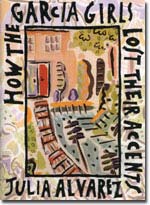
How the Garcia Girls Lost Their Accents

by Julia Alvarez
age: adult

Look, a non-Cybil’s book! (And an adult one at that!) I’ve been reading this at nights (by eliminating my TV watching — only one hour of the John Adams miniseries and a 1/2 hour 30 Rock this week…) for my on-line book group. It wasn’t earth shattering, but I did like parts of it.

The four Garcia girls are the daughters and granddaughters of a fairly powerful clan in the Dominican Republic. However, their father, Carlos, was involved in a plot to overthrow the dictator Trujillo, they have to flee to the United States. There, they try to adjust: Papi finding new patients, Mami taking the lead because she went to school in America for a few years. The girls — Carla, Sandi, Yolanda and Sofia — each make their own way, for better or for worse.

The real “gimmick” of this book is that it’s told backwards. You find out how the girls fared, before you find out how they got to where they ended up. It worked for me, at times, but I think, ultimately, it was more confusing than intriguing. I kept having to flip back to figure out which girl ended up which way (the copy I read had notes in the margins just for that purpose; initially, I was annoyed, but by the end, I was grateful). I think I would have rather a story told with flashbacks to their Dominican childhood.

There was much good about the book, though, especially when it addressed the immigrant experience. Alvarez captured both the initial intrigue of the unknown (near the end of the book, the children would long for the new and unexpected and fascinating things brought back for them from the States) to the challenging and finally accepting of their new culture. I enjoyed some of the individual stories, too, from the descriptions of the compound in the Dominican Republic, to the experiences of each of the girls.

In the end, though the thing that struck me most was that Alvarez writes with honesty and with love for the characters and both their countries. The book made me think about all the immigrant experiences, and the challenges they face when they arrive in a new country. Which is something worth thinking about.

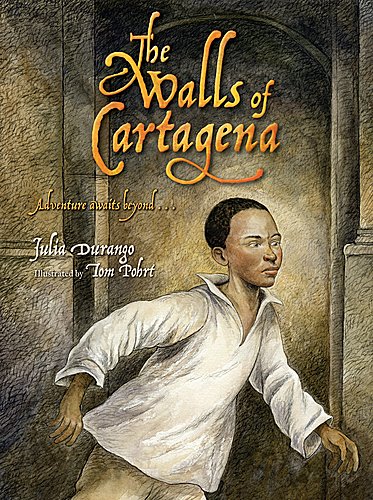
The Walls of Cartagena

by Julia Durango
ages 10+

Calepino has an easy life, especially for one born as a slave. Taken in by Dona Isabel after his mother died when he was born, Calepino has learned to speak eleven languages, can read in several, and spends most of his days lazing around the Dona’s house. That is, until he turns 13. Then Father Pedro, the local Jesuit priest, decides that Calepino needs to earn his keep. So, he is drafted to help translate for the captured Africans who have arrived to be sold into slavery. It’s there that he meets Mara and Tomi, who, along with Dr. Lopez and the San Lazuro leper colony, will change the course of Calepino’s life.

I liked this book — it’s a good, solid piece of historical fiction. Many of the characters, including Father Pedro who was canonized by the Catholic Church in the 1800s (according to the author’s note), were either real, or based on real people. Durango touched upon the evils of slavery, the horror of leprosy, and the Spanish Inquisition and did so in a manner that was serious, but humane and delicate. You understood the importance and horror of the events, but without going into detail that a child couldn’t handle. It’s a good introduction to the topics and the time period, one in which I could see spurring many discussions. In addition, I really liked Calepino as a narrator. He was a likable person, and an eventually diligent and willing one, which made the circumstances that he found himself in (and the ones he propelled) all the more compelling.

Good reading.

(Just for the record: because this is a Cybils nominee, I’ve been asked to make sure y’all know this is my opinion only, and not that of the panel.)

Clementine and Moxy

I started this post with the intention of picking ONE of these two books as the best. But, I can’t do it. It’s like choosing one of my girls as a favorite: I love them all equally, but differently. Just like I love both Clementine and Moxy.

Clementine’s Letter by Sara Pennypacker
Ages: 7 (reading chapter books) +

Admittedly, this was my first dip into Clementine’s world. I bought C a copy of the first Clementine, on a recommendation from Pam (probably, though it could have been someone else; so many people loved the book). She adored it. So much that when she saw The Talented Clementine at a school book fair last year, she bought it with her own money. When this one appeared on our doorstep, she was ecstatic. She nabbed it, went to her room, and came out blissful.

I can’t blame her. Clementine is charming, precocious, lovable, endearing and just plain cute. In this book, she’s just getting the hang of third grade, when her teacher is suddenly pulled away because the principal nominated him for a Teacher’s Only award that would take him away to Egypt for the rest of the year. Clementine is stuck with a substitute for the week, and can’t seem to stop getting in trouble. The only way out is to make sure her teacher does NOT get that award, so when the class is asked to write letters to the judges about their teacher, her’s is about how awful and terrible he is.

The thing I liked most about Clementine’s Letters was Clementine herself. I liked how she was always giving her younger brother vegetable names (makes sense). I liked how she’d try and try and it still wasn’t just quite right, because she’s the sort of girl who colors outside the lines. I liked her family and her friends. They’re quite an awesome bunch. But I think what I liked most of all was the warm fuzzy feeling the book gave me. It’s just so cute and happy I want to wrap it up and put it in my pocket.

(Is that a bad thing for a book to be? I think not, especially when it’s sincerely cute, and not at all saccharine-y and does not talk down to the reader. It’s good, honest cuteness, which is always the best kind.)

Moxy Maxwell Does Not Love Writing Thank-You Notes
Ages: 8+

Moxy on the other hand, is not cute. (Well, she’s not trying to be anyway.) She’s precocious and endearing though. And funny. I laughed more while reading Moxy Maxwell than I did during Clementine, because Moxy is outright funny. I think it’s part Moxy’s voice — always sighing, always trying to get out of what she’s supposed to be doing (and being very inventive about it), and part of is is the way Peggy Gifford writes. As an example I give you:

Chapter 25
In which Mark Says No

“No.”

That’s it. The entire chapter. Which totally cracks me up.

I should back up again and explain the story. Moxy’s had a wonderful Christmas, and she’s looking forward to spending a week in Hollywood with her dad and twin brother, Mark. However, before she goes, she MUST (and there will be “consequences” if she doesn’t) write the thank you notes for her Christmas presents. The whole book is Moxy trying to procrastinate that using various means (including copiers and spray paint). It’s a small premise with grand implications. (At one point, I was laughing so hard, but at the same time thinking that if it was my kid, I would SO TOTALLY kill her. If you read the book, you’ll know which part!)

I like that Gifford isn’t heavy handed in her lessons. We’ve got Moxy dealing with a dad who’s not exactly been the model father (they haven’t seen him in three years!), and a mother who’s giving (in Moxy’s opinion, anyway) unreasonable expectations, and a Christmas vacation that was supposed to be the Best Ever. But… Gifford makes us laugh, makes everything so over-the-top that you can’t help but love Moxy’s ideas and while we’re off looking at the hulabaloo, she sneaks in a quiet message about love and family. That’s talent for you.

And a marvelous book.

(Just for the record: because these are Cybils nominees, I’ve been asked to make sure y’all know this is my opinion only, and not that of the panel.)

Two Books about 11-Year-Olds and Friendship

Eleven, by Patricia Reilly Giff
possibly good for ages 10-12+

Sam MacKenzie is happy in his life, for the most part: he lives with his grandfather, Mack, above their wood shop; the other two store owners: Anima and Onji are also part of his family. Sam is talented with wood, helping Mack in their wood shop. Sam does have trouble reading, but with the support of his teachers and Mack, Anima, and Onji, it doesn’t really bother him much. That is, until the night before his 11th birthday, he’s snooping around trying to find his presents. He sneaks into the attic and finds a box with a newspaper clipping sticking out. It has a picture of him, as a three-year-old, and Sam is able to figure out the words “Sam Bell” and “missing”. Suddenly, his whole life foundation is rocked. Who is Mack? What do these dreams that have started resurfacing mean? He finds himself wondering: who is he, really?

In order to solve the mystery, Sam must read the newspaper article. In order to read the newspaper article, he must find someone to help him. The person he gets to help him is Caroline, a new girl, the daughter of artists, someone who never stays long in one place, and with whom he’s been assigned to work on project at school. Together, they work on figuring out Sam’s past, and in the process discover what frienship truly is.

I liked this book. They mystery is quite intense: at one point, I was imagining all sorts of sordid and wicked and horrible things that may have happened to Sam (what if Mack is some kind of kidnapper?). But that wasn’t the case (and it was most likely me reading into the book more than was there; I’m not sure a kid reading would get what I did out of it), and the ending was sufficently sweet and innocent, but not cloying. I also liked the friendship between Sam and Caroline: they weren’t best friends, but they worked well together, and their strengths played off each other in an interesting way. There was also none of that ew-your-a-member-of-the-opposite-sex stuff; there was a brief reference to it in the beginning, but Sam and Caroline quickly got past it, and worked together notwithstanding.

A good read.

The Trouble with Rules, by Leslie Bulion
possibly good for ages 9+

This one takes a slightly different spin on friendship, though it’s also between a girl and a boy. Nadie and Nick have been friends since kindergarten. They’ve done everything together. But, then they started fourth grade at the Upper Elementary School (grades 4-6; we had one like this when we lived in Macomb), and found out that boys and girls aren’t supposed to be friends. So, they pretend they aren’t. Except for when they’re working on the class magazine, and at home. Then Summer moves in and joins the class. Summer doesn’t know the “rules” and spends her first day “breaking” them, which inadvertantly gets Nadie in a whole lotta trouble. This, in turn, strains her relationship with Nick, and she “loses” her job on the magazine. It takes a couple of very bad weeks, but Nadie eventually figures things out, and learns how to walk against the popular tide.

I probably made it out to be more than it was, but I also liked this book. Mostly because I felt for Nadie. She had two really bad weeks, but they were also really important weeks, because she eventually learned a lesson that I think is important for all kids: it’s okay not to do what everyone else does. Even if that only means being friends with the boys. I liked the way Nadie worked on it, and how she figured out how to be herself and friends with Nick and make things work at school. I also liked Summer, her carefree attitude reminded me of a younger Stargirl — she ate weird, she sat on the boys side, she was friends with everyone. And because of that, she was initially shunned. I’m all for standing on your own, even if it is lonely (because it sometimes can be), because being an individual and not a part of the crowd is the better way to live. And this book addressed that in a way that I think kids could relate to and understand and accept.

Besides, it’s got a great scene with an exploding rotten potato. How can it not be good?

(Just for the record: because these are Cybils nominees, I’ve been asked to make sure y’all know this is my opinion only, and not that of the panel.)

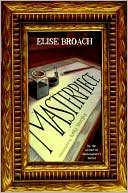
Masterpiece

Name the last book you read where the animal was the main character. Fairly easy, right? Think about the animal: what was it… dog? cat? bird? beetle?

Yup. The main character, for the most part, of Masterpiece is a beetle. Named Marvin. And, honestly, he’s so charming and adorable and… can a beetle be cute?… that it totally carries the book.

Marvin and his extended family live in the Manhattan apartment of the Pompadays: James, 11 years old, his mother, stepfather and baby brother. Marvin has a carefree life (for a beetle): learning to swim in a bottle cap, weekend excursions to the solarium, feasts of PopTarts. Then, on James’s birthday, he is given a pen-and-ink set from his father (who’s an artist). Marvin, wishing to give James something, draws a line drawing of the scene outside James’s window. Which sets off a chain events that eventually involves the work of 16th-century artist Albrecht Durer, a theft, a bunch of lies and a budding romance.

As I said before, it’s Marvin that makes the book worth reading. I was totally and completely charmed by Elise Broach’s imagining of the beetle world, from the descriptions of their house, to the adventures in the solarium, to the everyday workings of staying alive. (The best line, and I’ll have to paraphrase, was during a conversation between Marvin and his parents talking about divorce. Marvin asks why beetles don’t get divorced. His mother says something to the effect of, “Well, our lives are so short, we just want to live them happily and to the fullest.” She pauses, and adds, “Plus, beetles don’t have lawyers.”)

It’s also a book about friendship, as Marvin and James have to learn to communicate, trust each other, and work together. They form a unique bond (are there any other human-beetle pairings out there?) and manage to surpass the prejudices of Marvin’s family, as well as the human tendency to be repulsed at the little scurrying things. I enjoyed the friendship they built. In addition, I thought the resolution was completely plausible; Broach didn’t throw some sympathetic adult in the end, someone who would understand James’s relationship with a bug. James completely figure out how to solve the problem on his own, and managed to keep his relationship with Marvin intact in the process.

It’s not a perfect book, by any means. But there’s so much that’s charming about it that I willingly made it through the slow parts and the art lectures in order to experience more of Marvin’s world. Because it’s a completely captivating one.

(Just for the record: because this is a Cybils nominee, I’ve been asked to make sure y’all know this is my opinion only, and not that of the panel.)

Another World Challenge

Found the Lost in Translation Challenge at Nonsuch Book, and decided it was a grand idea. Sign me up!

The challenge is simple – read six books in translation by the end of 2009. Comment with links to share or email me review URL to post. Check in periodically to see suggestions, reviews and what others are reading as well as articles and posts related to reading works in translation.

My list:

1. Captain Alatriste, Arturo Perez-Reverte (also for my Well-Seasoned Reader challenge)
2. Inkdeath, Cornelia Funke
3. The Death of Ivan Ilyich, Tolstoy
4. The Princetta, Anne-Laure Bondoux
5. Echoes From The Dead, Johan Theorin
6. The Wine-Dark Sea, Leonardo Sciascia

I think I might need some help filling out this list. Any recommendations??

A Geeky-Cybils Pairing

I thought, since the Middle Grade Fiction Cybils panel is taking over my life, that I could share, for this Weekly Geek — highlighting an author — one of the many authors I’ve discovered through my Cybils reading.

Which is a much harder choice than it sounds.

I could do so many. The more popular ones: Hilary McKay, Sarah Pennypacker, Peggy Gifford (a good interview with Becky found here). Or one of the less-known or first timers: Andrea White, Jody Feldman, Howard Whitehouse. But, to make things easy on me (and because I’m really bad at decisions), I’m going to spotlight the author of the book I’m currently reading:

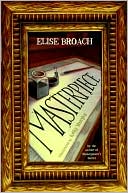
by Elise Broach


Some facts about her (found at her website):

  • She’s written five picture books, and this one is her third novel.
  • She was born in Georgia, but went to Yale (and studied History!). She now lives in Connecticut.
  • She likes reality TV, especially Survivor, The Apprentice, and Project Runway.
  • The fictional character she most identifies with is Lizzy Bennet.
  • Her usual writing spot is, “at a desk in an alcove of my bedroom, with a window that overlooks the woods and a shelf full of my favorite books next to me.”
  • She has three children and an “enthusiastic” dog named Dixie.

From the back cover of the book:

  • She got the idea for Masterpiece “when she lost a contact lens down a bathroom sink. She sat on the tile floor and fantasized about how wonderful it would be if a tiny creature could go fetch it.”

Here’s an interview with her at Cynsations, and a review of Masterpiece at Eva Perry Mock Newbery.

Yay for Christmas!!

It’s that time of year again! From Dewey’s blog: (If you’re interested, sign up here.)

Welcome to the second annual Book Bloggers Christmas Swap!

The second annual what?
Last year, Nymeth organized a Secret Santa swap between book bloggers, and this year I’m helping out.

How does it work?
You sign up by sending an e-mail to xmasswap08 at gmail. You have until the 18th of November to do so. You will then be randomly assigned as another blogger’s Secret Santa.

What you have to do next is send that person a little something – it can be a book, a journal or bookmark, a box of holiday cookies, a mixed CD, whatever you can think of. It doesn’t have to be anything pricey, of course. Second hand books are perfectly acceptable, as are homemade gifts.

A different person will be assigned as your Secret Santa, and you’ll only find out who they are when you get their package in the mail.

Something to keep in mind: Because there are book bloggers from all over the world, this is going to be an international swap. I understand that not everyone can afford to send a package overseas, though, so if that’s the case with you, please don’t feel that you can’t sign up. Just include a note saying so in your e-mail, and we’ll make sure you get a blogger who’s near you.

What else should your e-mail include?
Other than your name, mailing address and willingness to send internationally, you should include your blog url and a short paragraph about what kind of gifts you like, so that your Secret Santa has an idea of what to get you. You could also include links to online wishlists, your librarything catalogue, etc. Anything that you think will make your Santa’s life easier!

Important dates: The most important date is the 18th of November. It’s very important that you sign up before then, because after that we’ll be assigning the Secret Santas, and once that has been done it would be complicated to include new participants.

As for when to mail your package, if you’re sending internationally it’s probably best to post it before the end of November. Last year, I suggested that people post theirs before the end of the first week of December, but that turned out to be a little late. If you’re sending within your own country there’s more flexibility, but remember that the mail tends to be slow around this time of year.

In any case, you should all know who your blogger is around the 20th of November, which leaves you at the very least ten days to get and mail your gift.

One more thing: if you could help spread the word by posting about this on your blogs, it would be very much appreciated!

That’s everything for now. Please don’t hesitate to contact me or Nymeth if you have any questions or suggestions!