My Life as Furry Red Monster

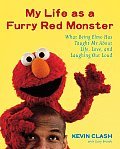
This little book, by puppeteer Kevin Clash (with Gary Brozek, in very small print), is one-part memoir, one-part glimpse into the world of Sesame Street and one-part life-affirming-self-help-ish-type book. I liked two-thirds of it.

The memoir part was fascinating. Have you ever wondered how a 45-year-old, tall black guy ends up playing a 3 1/2-year-old furry red monster? I have. Ever since I found out that the same guy played both Hoots the Owl and Elmo (as well as Natasha the baby monster), I’ve wondered about him. How did he get into puppetry? How did he end up being Elmo, of all muppets… This book answers some of those questions. He had a poor, but loving, and nearly idyllic (if you believe everything he writes) childhood. His parents were awesome — how many parents would take their child’s love of puppets and wholeheartedly support it? And his evolution as a puppeteer and a performer is fascinating, too.

I loved the parts about Sesame Street, too. Jim Henson was probably the world’s best boss, and Clash gives you a little insight into that world. I appreciated the logic and the insider dope on some of the global spin-offs, as well as the Sesame Street’s evolution here. (Especially since I stopped watching the show with my kids sometime in 2002. C was the last one who really watched it. A didn’t have much interest in it, and since we don’t have cable now and the local PBS station’s signal is weak, we don’t even get it anymore.) I haven’t always liked what they’ve done with the show, but I understand the reasoning behind it. Clash took us through the whole process from curriculum design through to rehearsals and test audiences. It was pretty interesting, too.

But when he tried to sum the whole thing up into little bits of advice (good advice: love, joy, creativity, tolerance courage, friendship, cooperation, learning, optimism), it just felt forced. I would have rather read a book about Clash’s life, his experiences with being a master puppeteer, and left the whole life affirming stuff off. Even so, it wasn’t too obnoxious and overbearing. And it was worth it to read about his life and work.

Estella Reminiscing

The March issue of Estella’s Revenge is up (my lone review — February was a slow month — is here)! Andi and Heather have put together another good issue (I love the new look, too!) so stay and browse a while.

I was reminded, that I began writing for Estella (shoot, Estella, in its current incarnation, began) a year ago. It started with a silly little review (as I think about it now, it wasn’t terribly well written) of The Penderwicks. I wasn’t sure if Andi and Heather would even like it, let alone run it; I sent it to them on a whim. I really can’t remember the motivation behind my reaching out. I’d been writing on my blog for two and a half years, content with my readership of 10 people (half of whom were family members). But I saw an announcement somewhere (can’t remember where, now) that this new literary ‘zine was looking for writers, and I thought to myself: “I can do that.” Encouraged by Hubby, I did. And I found I liked it. I like getting ARCs in the mail (as does M — she’s always pilfering through my ARC pile), I like having my name and my writing out there in more (better-read) places. I like interviewing authors. I like having authors read what I write. It’s exciting; a real rush. And it’s something I can do. I won’t say I do it well — I’m not “good” enough to get a job at the local paper, let alone be as respected as, say, Lisa at Bluestalking Reader or Betsey at Fuse #8. I don’t have piles and piles of publisher contacts (time, baby; it’s all about the time. And when you’re home with four girls — two all day! — you don’t have much of that). But I’m having a grand time. And, I’ve come realize, that as long as I’m loving what I “do” then that’s all that matters.

Thanks, Andi and Heather, for accepting and publishing that first piece. It gave me the confidence I needed to realize I could reach out and give “real” book reviewing a try. And the past year has been a grand experience. Here’s to many more.

Graphic Novel Roundup #1

First, an announcement: The Edge of the Forest is up…. and here are my two little reviews; I had fun doing them. Go take a look at the whole issue…

Second, an explanation: I decided sometime last month –partially because C is SUCH a big fan of Babymouse (thanks, Abby!), and partially because the Cybil graphic novel winners got me curious, and partially because of this post (which I found through a link in the comments of this post) — that I would begin exploring the world of graphic novels. Unlike, Hubby, I didn’t grow up reading comic books. Sure, I read comics — Bloom County and Calvin and Hobbes were two of my favorites — and I still do. But comics in the newspaper just aren’t the same as comic books, at least not the way I see it. I don’t think the reason I avoided them was active dislike on my part, more like disinterest. I really don’t have much interested in superhero stories, even though I’ve gone to pretty much every comic book movie that Hubby’s dragged me to. (The best? The second Spiderman and the second X-Files and the new Batman. That last one’s AWESOME. I’m actually excited about the sequel coming out this summer.) But, something in me clicked this last month, and I actually decided that I can give graphic novels a try.

So. My first three graphic novels…

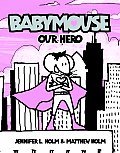
Babymouse: Our Hero (#2)
I know it’s not the first in the series, by Jennifer and Matthew Holm, but I think you don’t have to read them in order. I picked it up mostly because it was lying around waiting for C to come home, and once I started flipping through, I really had to sit down and read the whole thing. It’s a cute little book, spunky and sassy. And I love the snarky narrator comments interspersed throughout the book. As I mention, C eats these up… the only one we haven’t been able to get a hold of is #5, and she’s not-so-patiently waiting for that one. Maybe we’ll just get it for her for her birthday and save her the wait….

Robot Dreams
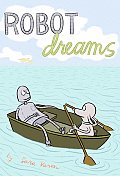
This one, by Sara Varon, had to be the family’s favorite. M and I read it together one evening, and just fell in love. I’m not an artist, so I don’t really know the difference in artistic styles (is it okay to call these drawings “cartoon like”?). We liked the simple story of the dog and the robot, and how the poor robot ends up stranded on the beach. Dog attempts to find another friend, while robot dreams of getting up off the sand. We talked about it so much, that Hubby read it, and then we passed it along to C. Poignant, yet accessible to the youngest reader (there are no words, and A sat and “read” it last night. She got the story pretty well, and enjoyed looking at all the pictures). A wonderful little book.

The Arrival
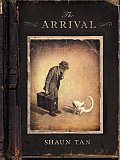
This one is harder to define and to describe. I was entranced by it — the artwork by Shaun Tan is absolutely beautiful — yet I didn’t know if I was “getting” it. It’s the story of a man who immigrates from his country to a new one. It’s a fantastical (I know that’s not a word, really, but I couldn’t come up with another one) world — one that’s strange and wondrous all at the same time. I got the feeling that Tan was using the fantasy element to portray some of the confusion and strangeness that immigrants experience when going to a new country, and I enjoyed and appreciated that. However… there were times — mostly when the people the man met were telling their immigration stories — when I was confused, wondering if maybe I was trying too hard to get the book, and it hindered my enjoyment of it. It got me wondering what the difference between a graphic novel and a picture book was. One of my favorite winter books is The Snowman by Raymond Briggs — how come that’s a picture book and not a graphic novel? What ‘s the difference here? Are graphic novels just grown up picture books? It was because I wasn’t able to fully grasp this one that I felt like I didn’t enjoy it as much as I did the other two. Though, I have to admit, it will be the one that I would probably look through again and again, just so I could look at the artwork. So, maybe it really is the best of the lot.

Stay tuned for the next episode…

The Book Thief

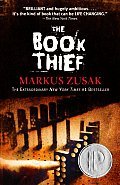
Things I can say about Markus Zusak’s best-seller: I admire it. I thought it was brilliantly written. I thought Death as a narrator was an intriguing premise. I thought it was interesting that the story was set in Nazi Germany, but was about ordinary Germans just surviving. And yes, I cried at the end.

Things I can’t say about The Book Thief: that I like it. (Oh, and that I can spell thief the first time, without a spell-checker. Just can’t do it.)

This bothered me. I read the book — all 550 pages — and two-thirds of the way through I was still unsure what I thought of it. I didn’t hate it; I had no desire to stop reading. I did want to “find out” — though I already knew — what happened to Liesel and Rudy and Max and Hans. I don’t consider it time wasted, or time lost. So I didn’t hate it, or even really dislike it. About 100 or so pages before the end I finally decided that this book would have to be a toss: I was going to admire a book, to recognize it’s literary worth, and yet not like it.

I think my fundamental problem with this story is that it’s not really a cuddly or accessible one. Not that stories set in Nazi Germany can ever be cuddly. And a story about a pre-adolescent girl during this time isn’t necessarily accessible or enjoyable. It is an interesting, and possibly important story — but like “Schindler’s List” or “The Pianist” or Elie Wiesel’s books — it’s not one you want to cuddle up with, to read and reread. The final moral is something along the lines of: words can do good as well as harm, some people are good even in a bad situation, and some people survive. That’s life. In the end, I feel like this is an English class book; one to be respected and studied and analyzed and possibly imitated.

Just not really liked, at least by me. I’m okay with that.