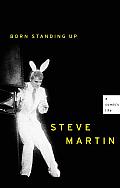
Born Standing Up

I was really glad when I saw that this one came in (Eventually I’ll read Rascal.) at the library. I’ve wanted to read this ever since I saw a bit about it at someone’s roundup of some publishing conference (how’s that for specific) primarily because I’m a fan of Steve Martin. Not a big fan — I don’t love everything he’s done — but I generally enjoy his humor, and I’ve enjoyed his writing in the past. A memoir by him sounded both funny and intriguing.

Martin insists that this book isn’t an autobiography, but rather a biography, because, he writes, “I am writing about someone I used to know.” I enjoyed getting to know that person. While it wasn’t always funny (though there were some great funny bits), it was an insightful, gentle trip into how Steve Martin became the Steve Martin of the late-70s and early-80s. (He’s no longer that Steve Martin. One of my favorite lines was: “At first I was not famous enough, then I was too famous, now I am famous just right.”) I learned that being a comic is work (probably should have figured that), that when people stand up to entertain us, it doesn’t just happen spontaneously. One of the more interesting aspects of the book was the evolution of Martin’s comedy. From magician-banjo-everyguy to hippie-cuttingedge-philosophical guy (get the book just to see photos of Martin’s hippie days… they’re hilarious) to finally what he ended up as: manic-physical-crazy guy. Fascinating stuff. I also learned that his rise to fame was not just a product of hard work (he’d tape his shows and make corrections/adjustments based on what he heard), but also a bit of luck (he got on as a writer on the Smothers Brothers show because an ex-girlfriend’s current boyfriend was a writer), and because he’s basically a decent guy. He was willing to be polite and willing to be humble and willing to make the effort to make it all happen. And it was interesting watching the evolution of it all and finding out why he gave up the life of a stand up comic for movies and writing (well, who wouldn’t?).

The weirdest thing about it all was the writing style. I don’t know what I was expecting and I can’t quite put my finger on it. But there was something about the way it was written that kept nagging at me. Perhaps because he got a bit overly sentimental at times? Or maybe because he kept flipping back between past and future and the foreshadowing just didn’t fit? Or maybe because it wasn’t as funny as I was expecting it to be?

Whatever it was, it wasn’t enough to keep me from really enjoying this trip down Martin’s memory lane. I’m glad he invited us along for the ride.
Let’s Try this Prize Thing Again

It’s March. There’s 70 reviews over at the Expanding Horizons Challenge review page. I know at least one person has finished. Since visiting other people’s reviews and commenting elicited such a piddly response (People, you really ought to read each other’s reviews. There’s some interesting books being read out there.), I’ve decided to do something at little less strenuous.

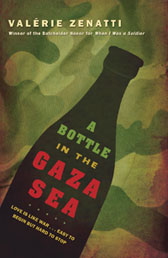
For the prize package — which includes an ARC of A Bottle in the Gaza Sea and chocolate from here (c’mon… who wouldn’t want this stuff?!) — all you have to do is leave a comment in this post with the name of the book you’ve liked best so far (for the challenge, of course), and why.

First, the blurb about Gaza Sea:

A seventeen-year-old from Jerusalem, Tal Levine comes from a family that always believed peace would come to the Middle East. She cried tears of joy when President Clinton and Yitzhak Rabin shook hands with Yasser Arafat in 1993—a moment of hope that would stay with her forever. But when a terrorist explosion kills a young woman at a café in Jerusalem, something changes for Tal. One day she writes a letter, puts it in a bottle, and sends it to Gaza—to the other side—beginning a correspondence with a young Palestinian man that will ultimately open their eyes to each other’s lives and hearts.

Just to show you how easy it is:

I liked Hummingbird’s Daughter best. While it wasn’t a perfect novel, I enjoyed the elements of faith and of magical realism, and I loved Tomas’s journey from a superstitious jerk, to a loving, caring father.

See? Easy peasy. I’ll leave this post up until the 15th, then A gets to do a drawing. She’s very excited.

ACK!

I forgot it was March (how could I; It’s SPRING here!) and that the deadline for the Bookworm’s Carnival is TODAY. I need to go submit something…

Heres’s the info:
This month’s carnival is being hosted by Myrthe, and the theme is Women in Literature.

You can email your link to Myrthe at armenianodar [at] yahoo [dot] com.

Myrthe says:

It can be a review of a book by a female author, a review of a book in which the main character is female, it can be a non-review type post in which you discuss a topic relevant to the theme, a post with your favorite female authors or book-characters. Or something completely different.

Hope I’m not too late…

Negativity Never Hurt. Right?

Via Dewey:

1. When you dislike a book, do you say so in your blog? Why or why not?
Yes. Mostly because my blog is a record of all the things I’ve read, and if I didn’t like it, when I go back to see what I thought of something, I’d like to know if I hated it. I do try to give good, valid reasons for not liking something, and temper with an understanding of what my tastes and moods are. But, if I didn’t like it, I’m going to say it.

2. Do you temper your feelings about books you didn’t like, so as not to completely slam them? Why or why not?

Depends on my mood and the venue. I was more positive than I wanted to be about the reviews I did for The Edge of the Forest, but I realized that they wouldn’t really go for a sarcastic slam. They just don’t do that. And, if an author sent the book to me, I do try to find the positive things, even if I have some criticisms. They’re people with feelings, too. And just because I don’t like it, doesn’t mean that others will have the same reaction.

3. What do you think is the best way to respond when you see a negative review about a book you enjoyed?

I usually just smile and shrug. Everyone’s entitled to their own opinion. And just because you don’t like my favorite book doesn’t mean you’re a bad person. (BTW, I hate anonymous commentors who leave snitty comments on my blog. Drives me nuts.)

4. What is your own most common reaction when you see a negative review of a book you loved or a positive review of a book you hated?

Whatever. Their opinion. Though I have to admit when I see a positive review of a book I disliked, I wonder (on some level) what was wrong with me, and what I missed in reading that book. Especially if I seen more than one. (Case in point: Evil Genius. I hated it, many many other people love it. What did I miss?)

5. What is your own most common reaction when you get a comment that disagrees with your opinion of a book?

That happens a lot. Some people love what I love. Other people don’t. The biggest book I got slammed for (another comment showed up today) was for liking Caddie Woodlawn. But if I got in a snit every time somebody thought I was horrible for liking that book, I’d be a basket case. Other people have opinions. I can’t let them affect what I think/thought about that book.

6. What if you don’t like a book that was a free review copy? What then?

Depends on where it came from and where I’m writing it up. As I said before, if it’s for someplace else, I’ll probably find the positive as well as the negative. But if it’s for here, I have no qualms with saying it’s not all that great. (I do have to admit, that for my middle-grade and YA reviews, I take M’s opinion into consideration. If she liked it a whole lot more than I did, I take into consideration the “adult factor”, and write my review accordingly. I admit that this is “cheating”; not every reviewer has a bookworm child who’s willing to give her opinion on what she reads.)

7. What do you do if you don’t finish a book? Do you review it or not? If you review it, do you mention that you didn’t finish it?

If it’s for somewhere else, I finish it. I won’t review a book for an online ‘zine if I don’t finish it. But, since this blog is a record of every book that passes through my hands, I’ll write something up whether or not I finish it. I need to know — bad memory, remember? — if I couldn’t stomach a book, and why I didn’t finish it.

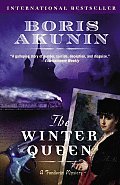
The Winter Queen

I almost got a Russian minor in college. I know, I know… I’m not exactly a connoisseur of all things Russian around here, but I did have an interest in the country during my college days. (That and I had a morbid fear of Calculus. I know, I know… Russian isn’t easier than calculus. But try telling a stubborn 18-year-old that.) Anyway… I was trudging along taking classes, and mostly enjoying them until it came to the last two classes for a minor. One was conversation, and it was taught by a grumpy Russian woman, who told me that if I took her class she’d fail me. I spoke horribly. The other was the Russian literature class. I realized I just couldn’t stomach Russian literature.

Well, either I was horribly wrong (and I’ll admit that I could have been — Anna Karenina wasn’t nearly as horrible as I thought it would be… except for the last 100 pages. They were worthless) or Russian literature has changed a whole lot in the last 20 years.

Because I loved this book.

I’m not a big mystery reader, but I do love it when I find a good one. One that keeps me guessing, that makes me bite my nails, that keeps me up until late hours trying to finish it. Throw in a bit of humor, keep it relatively clean, add a winning/cute/sympathetic, detective, add a real intense ending, and you’ve got me hooked.

There you have it: Boris Akunin’s The Winter Queen in a nutshell. Really. Why bother with a plot summary, when all you really need to know is that Erast Fandorian, while no Sherlock Holmes, is an up-and-coming detective who just happens to get involved in something way over his head. And that he manages to solve the mystery anyway. And don’t forget the ending that had me going, “AAAAHHH! Where’s the next book!”

There’s really nothing more to say.

Alcatraz Versus the Evil Librarians

How I ended up reading this book: Brandon Sanderson was getting a bit of buzz a while back on Hubby’s group blog. I noted it, figured I’d get around to reading something from him eventually. But when I was in the library searching for something for M to read (not unusual), I noticed this one, picked it up, and gave it to her to read. M devoured it, laughed uproariously, couldn’t stop talking about it and now insists that we need to get it. Well, with that big of a reaction from her, I couldn’t resist throwing it on my pile. Especially after reading the author description on the jacket:

Brandon Sanderson is the pen name of Alcatraz Smedry. His Hushlander editor forced him to use a pseudonym, since these memoirs are being published as fiction. Alcatraz actually knows a person named Brandon Sanderson. That man, however, is a fantasy writer — and is therefore prone to useless bouts of delusion in literary form. Alcatraz has it on good authority that Brandon is actually illiterate and dictates his thick, overly long fantasy tomes to his potted plant, Count Duku. It is widely assumed that Brandon went mad several years ago, but few people can tell because his writing is so strange anyway. He spends his time going to science fiction movies, eating popcorn and goat cheese (separately), and trying to warn people about the dangers fo the Great Kitten Conspiracy. He has had his library card revoked on seventeen different occasions.

Who could resist something like that? Not me. I devoured it, laughed uproariously, can’t stop talking about it and agree that we should probably get this one.

Alcatraz Smedry is a thirteen-year-old orphan who’s been bounced around from house to house. The reason? He keeps breaking things. (He can’t help himself. ) His life takes a turn for the interesting when he gets a bag of sand on his birthday. It’s his inheritance, which is pretty weird. It doesn’t get much better: soon his grandfather shows up, babbling about the Free Kingdoms and evil Librarians and Alcatraz is sucked into infiltrating the downtown library in a desperate attempt to rescue the bag of sand. He just has no idea what he was in for.

Sure, there are the Harry Potter comparisons: orphan boy with great untapped power, thrown into a new world with weapons he has to learn to use, in order to fight an evil bad guy (though the evil bad guy is really a consortium of evil bad guys). There’s even horcrux-like elements, as well as an alternative reality hidden from the rest of us (Hushlanders rather than Muggles). But what really makes this book work, for me, is the tone. Alcatraz is snarky about almost everything that has to do with a book. He begins each chapter with an aside about something either to do with the plot, or writing a book (authors are not nice people; they like to torture their readers), or reading… I first thought they were cute, then they annoyed me, but eventually, I caught the tongue-in-cheek idea of it all and decided that they’re really funny, and that I liked it.

I’ve talked about humor before: how it’s an individual thing, and how what I find amusing some others (like Hubby) might find benal or pedantic. I won’t even go so far as to say there are universal funny things. It’s all a matter of your mood, your history, your tastes… I have to admit that as I was talking up this book at breakfast, reading passages to Hubby this morning, his comment was, “Sounds a bit precious to me.” I thought about it: it is a bit precious — walking the line between snarky and smart-aleck — but it worked for me.

And maybe it’ll even work for you. Besides, how can you not want to read a book with an author blurb like that?

Sisters Grimm: The Unusual Suspects

So, when C and I last left the Sister Grimm, they had finally found a home with their Granny Relda and managed to defeat both Jack and the giants. What’s next for our heroic sisters? Nothing other than…. school.

Sabrina, at least, would rather spend her days (and nights) reading the “reference” books at Granny’s house trying to find magical tools to help her find and rescue her mom and dad. Unfortunately, the state steps in, and off Daphne and Sabrina go. Daphne has it easy — Snow White is her teacher — but Sabrina’s lot is another story. Especially when her teacher ends up dead at the end of her first day.

So, of course, they have a mystery on their hands. One that will lead them into much danger, nearly tear the family apart, and lead Sabrina closer to finding her parents.

While this one didn’t have the novelty that The Fairy Tale Detectives did, I still enjoyed reading it out loud to C. Sure, there was a lot of extra plot points (did we really need to know how Daphne did her hair?), but C didn’t seem to mind, and they added a bit of whimsy to what could have been an otherwise dark tale. We both really enjoyed Puck; he’s a fun addition to the Grimm family. There weren’t as many voices to “do” (and I couldn’t remember half of the ones I’d done previously; C was always correcting me), but neither of us seemed to mind (though now that I think about it, there were still quite a handful of fairy tale characters; I just didn’t get into doing voices this time through.) The story itself was fairly gripping, leaving us hanging at several points. It even ended on a cliff-hanger, after which C said, “I hate this book. When can we get the next one?” (She doesn’t like cliff-hangers…) It was a fun, well-told tale. I can’t wait to see what happens next…

Totto-Chan: The Little Girl at the Window

My friend Sarah recommended this one for our in-person book group; we’ve been passing her two copies around since the library doesn’t have one. And it was my turn to have the great pleasure of reading Tetsuko Kuroyangai’s wonderful little memoir.

It’s the most unusual memoir I’ve read recently. It’s in the third person and reads more like a work of fiction than a collection of personal recollections. That, and it’s so simply, so cheerfully written that it’s not just an easy read, but an entertaining one as well.

The story is about Totto-Chan, Kuroyanagi’s childhood name, and her experiences at the Tomoe (to-mo-e) Gakuen school, an alternative elementary school outside of Tokyo designed and run by Sosaku Kobayashi from 1937 to 1945. He believed in a whole education — and this book is as much a portrait of an ideal school as it is a memoir — and letting the child determine his or her place in school. He taught music, believed in exploring nature, used everyday experiences (like lunch) as teaching tool, and created a wholesome environment so that the children attending developed confidence and self-esteem. It was truly remarkable to read about.

I’m sure much could be said about the educational value of the book, and the critique it indirectly gives of modern education. I, however, preferred enjoying it on a simpler level: as a series of sweet reflections of a woman about her idyllic childhood. Either way, it’s a wonderful little book.

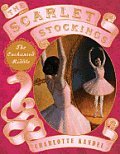
The Scarlet Stockings

I have to admit, I didn’t quite know what to do with this book. It’s an ARC, but it’s too young for Estella’s Revenge. I could have pitched it to the Edge of the Forest, but the email I got sent said it was for my site, so here it is. I usually review books I’ve either bought or checked out on principle (preferring to plug the ARCs I’ve gotten to a wider audience — both ‘zines get much higher reader numbers than I do here). But, since there’s no other place for this review to go, here it will be.

The story, by Charlotte Kandel, is one of a girl with big dreams and a desire to be loved. Daphne is an orphan at St. Jude’s in London when she receives a mysterious package with a pair of silk stockings. It doesn’t take long for Daphne to realize the stockings are magic, but they come with a price: they will help her achieve her dreams, but she must be responsible and choose wisely and pass them up at the height of her fame, or they will lead her to her death.

It’s one part Hans Christian Anderson’s The Red Slippers and one part that story where the girl has magic ballet shoes who help her be good and can’t perform without them until one day when she forgets them and realizes that it’s all her own hard work (can’t remember the name of it right now). It also has an interesting premise behind the story: what would a person do when ambition is confronted with an opportunity too good to resist? An ambitious idea, and one that’s intriguingly set in the world of 1920s ballet.

However, I didn’t especially like this book. My main problem was that I felt like there was too much tell and not enough show. The author’s telling us that people care about Daphne, the author’s telling us that people are upset and angry and hurt, but I’m just not feeling it. It doesn’t help that Daphne — probably on purpose — is the least sympathetic character in the book. I felt bad for all the people who she stepped on — from her adopted parents, to her friends, to her former employers — on her way to stardom. Sure, she’s got ambition, and talent, but what about a heart, or some kindness? She had two emotions: ambition and guilt. Not a pretty picture.

Because the main character was so unsympathetic, I looked to the secondary characters for interest. Some were interesting– like her first boss, Magda, — but most were just stepping stones on the way to Daphne’s eventual success. How could I not feel bad for her adopted parents when she was treating them so horribly? Or her friends that she pledged to be friends forever with? Here they come… there they go. Everyone nice got shuffled off-stage pretty quickly. I didn’t even feel like Ova, the ultimate prima ballerina, got enough stage time to fully develop her whole jealousy of Daphne. (Maybe she didn’t need it. She’s the star, she’s just as self-centered as Daphne, she wants her crowds. Who needs more explanation than that?)

There’s a lot in this story that could have been developed, fleshed out — there’s even a decent moral at the end. I just felt like it was developed enough, or in such a way, for us truly care about Daphne and her experience. Which is too bad.

A Curse Dark as Gold

I was not planning for this to be my next read, but when it arrived in the mail on Tuesday (courtesy of Renay; THANKS!) I did a happy dance (A and her friend H were looking like they thought I was pretty weird) and immediately began reading it.

It’s basically the tale of Rumpelstiltskin, but more organic, less fairy-tale-ish. Charlotte is the daughter of a miller who dies abruptly. She and her sister, Rosie, are the last of the Miller line, and so it’s up to Charlotte to run the woolen mill, thereby supporting the town. But, there’s a run of bad luck (or is it a curse?) which leads Charlotte and Rosie to enlist the services of one Jack Spinner, who can spin straw into gold (among other things). Unfortunately, life only spins (he he) further out of Charlotte’s control from there.

One part fairy-tale, one part ghost story (and an excellent ghost story), one part historical novel, this book — the first by Elizabeth Bunce — didn’t feel like any other fairy tale book I’ve ever read before. It took me a while — 50 pages or so — to get the rhythm of the book, to understand what Bunce was trying to do with Charlotte (she grated on me at the beginning, but eventually I understood, and liked, her as a character), and to really enjoy what I was reading. But once I got past that point, life got put on hold. It was a very intriguing, engrossing, full tale. I liked the characters, I like the ghost story, I liked the resolution. The only thing that really bugged me was all the names (so many people to keep track of), but that’s such a trivial little thing.

I won’t say it’s worth it’s weight in gold… but it is a really good telling of a fairy tale.