Arcady’s Goal

by Eugene Yelchin
First sentence: “I’m a risk taker.”
Support your local independent bookstore: buy it there!
Content:

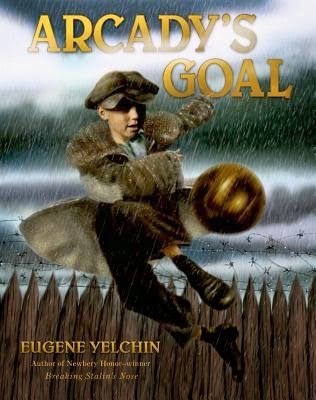
Arcady is the best soccer player. Period. So much so, that when the inspectors of the home he’s been placed in come, the director makes a show out of Arcady’s skills. He — Arcady calls him Butterball — puts Arcady up against increasingly larger players, expecting him to beat them. And he does.

But, when one inspector, who’s not quite like the others, comes to visit, Arcady ends up being adopted. Which is not something Arcady bargained on. Nor he he bargain that his new father, Ivan Ivanovich, comes with secrets of his own.

One of the things Yelchin does best is humanize Stalin’s Russia. It’s so easy to push everything from that era off into Things/People were Bad. And Stalin put everyone in concentration camps. But, Yelchin gives us the stories of the children — Arcady ended up in a home because his parents were taken for being enemies of the state — and how Stalin’s policies affected everyday life. They’re simple stories, but they paint a picture of a people who were wronged — even if they weren’t taken — by their leader.

It’s a simple little book, full of illustrations. And there’s a lot of talk about soccer, so there’s an appeal for the soccer lovers. But mostly it’s a portrait of a relationship between to damaged people, and the path to healing.

Graphic Novel Round-Up, November 2014

I spent a Saturday recently just reading graphic novels to help me out of the slump. I think it might have worked; I feel much more interested in reading a full-length book now. Also, both A and K picked some of these up and found themselves completely engrossed. So, it’s a good batch.

Odd Duck
by Ceci Castellucci and Sara Varon
Support your local independent bookstore: buy it there!
Content: There’s nothing. And the words/ideas are pretty simple. It’s good for reluctant readers as wel as those who just want a good, short story. It’d be in the middle grade graphic novel section of the bookstore.

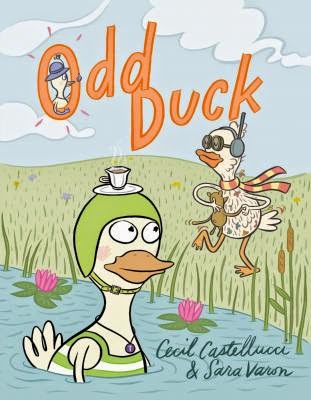
Theodora is an ordinary duck. She does her ordinary duck exercises in the morning, goes for her ordinary duck walk (because she doesn’t like to fly), and reads ordinary duck books in the afternoon. She lives a nice, quiet life and is very happy.

That is, until Chad moves in next door. Chad is not an ordinary bird. He does not do his exercises in an ordinary way (if at all), He dyes his feathers weird colors. He does art (gasp)! Theodora is not happy. But then, come winter, she and Chad bond (because they don’t fly south). They discover that they have things in common, and that they really enjoy each other’s company. And that maybe being different isn’t so bad.

It’s a charming little graphic novel, full of adorable art and sweet little lessons, but it’s never heavy-handed or didactic. Perfect for younger and reluctant readers.

Monster on the Hill
by Rob Harrell
Support your local independent bookstore: buy it there!
Content: Linguistically, it’s more challenging. But it’s probably on par with the Amulet books, which means it’s probably good for 3rd grade and up. Content-wise, there’s some monster violence, but that’s it. It’d be in the middle grade graphic noel section of the bookstore.

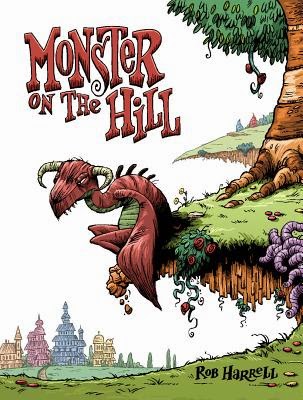
In this version of 1860s England, there are monsters that terrorize every town. But never fear: that’s what the townspeople want. (Seriously.) But, in Stoker-on-Avon, they have a problem: their monster, Raymond, doesn’t do anything but moan and complain. It’s bringing the town down. So, the town leaders send the eccentric Dr. Charles Wilkie (and a street urchin, Timothy, hitches along for the ride) to convince Raymond to buck up and do his job.

This leads to a road trip, a lot of bonding, some lessons learned, and a giant battle against an unstoppable foe before everything is set to rights again.

This one had me eating out of the palm of its hand. I loved Raymond — he was delightfully pathetic — and his schoolmate, Noodles (aka Tentaculor) and their relationship. There was so much that had me just laughing out loud. True, there could have been a female character (just one? Please?)  or perhaps some diversity (though it was England in 1860-something), but for the most part, I found this simply charming.

Hidden
by Loïc Dauvillier, Marc Lizano, and Greg Salsedo
Support your local independent bookstore: buy it there!
Content: It’s about the Holocaust, so there will definitely be things to discuss. It glosses over the worst of the horrors; there’s a passing image of a concentration camp survivor, as well as illusions to other horrors. Even so, it’s very kid-appropriate. It’s in the middle grade graphic novel section of the bookstore.

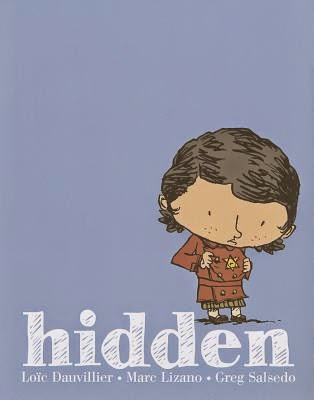
This one is your standard Holocaust fare. Mostly. Framed as a story a grandmother is telling her granddaughter about the time when she was a child, Dauvillier focuses mostly on the Resistance and the people in France who helped those who were Jews get away.

It’s a very tender story of a young girl, Dounia (the grandma) whose parents were taken to the concentration camps in 1942, near the end of the war. Even though Dounia hides during the inital raid, the neighbors (some of whom are part of the reistance), know they’ll be back, looking for her. So, they arrange for her to live with a woman in the country. In the act of escaping, the neighbor’s husband is caught, though he’s only arrested and released. He manages to find his way back to his wife and Dounia. Her main concern, though, is finding her parents again and so they keep looking, especially once France is liberated. Eventually, they do find her mother, and the story ends.

I liked this one well enough, but (possibly because it’s tamed down a bit) it lacks the emotional punch that other Holocaust books have. Still, it’s a good introduction to the topic.

The Port Chicago 50

by Steve Sheinkin
First sentence: “He was gathering dirty laundry when the bombs started falling.”
Support your local independent bookstore: buy it there!
Content: There’s some disturbing moments, not only violence, but also racism. I was made uncomfortable by it (which I think was the point). There is also about four censored f-bombs. Sheinkin is masterful at simplifying data  without being simplistic, so I think this is suitable for 5th grade on up. It’s in the Middle Grade History section at the bookstore.

During the summer of 1944, on a little-known port in the San Francisco Bay where Navy ships were loaded with ammunition, an enormous explosion happened. So large that it killed more than 300 men were killed, the pier and the docked ship were obliterated, and men in the barracks were injured, some severely.

It sounds like a tragedy, but nothing too serious. Except for this fact: of the 320 men who were killed, 202 of them were African American men who had signed up for the Navy and had been relegated to the dangerous job of loading the ammunition. The way the Navy worked in 1944 was that the white men got to serve on the ships; the black ones were segregated out and assigned the menial tasks the white sailors didn’t want.

But it gets better. The men who survived the blast were shuttled to a nearby port, and even though they were suffering trauma from the blast (who wouldn’t be), the were ordered to go back to loading the ships. Fifty sailors flat out refused orders. So they were put on trial for mutiny. And convicted. Even though there was never any plot to defy their superiors or take over the base. They just were tired of being treated differently than the white sailors and wanted to know why.

Some good came out of this: because the Secretary of the Navy was a (mostly) reasonable man (and because Eleanor Roosevelt got involved) the Navy (and soon after the rest of the military) was one of the first places that was desegregated in the country.  But, was the price of being convicted mutineers and spending 16 months in jail too high?

Sheinkin doesn’t whitewash anything that happened during those months and years surrounding the Port Chicago 50 trial. He lets the Naval officers stand for themselves (and any reasonable person would see that they were IDIOTS. Or maybe that was just me), and lets the trial transcripts stand for themselves. Thurgood Marshall even got involved, trying to get the government and the military (the officers of which come off as a bunch of racists; I was going to use a stronger word, but changed my mind) to exonerate these men for being human. Sheinkin pointed out that this was the first event on the long path of the Civil Rights movement, which was something I didn’t know, and something we don’t often remember in history books.

It’s extremely well-written and as intriguing as Sheinkin’s other works. He’s a masterful history writer, and knows just how to make things interesting and informative without being dry.

Excellent.

Audiobook: The Boys in the Boat

by Daniel James Brown
Read by: Edward Herrmann
Support your local independent bookstore: buy it there!
Content: It’s a book about the 1930s, rowing, and Nazism. It’s appropriate for anyone who’s interested in reading about those things, and can handle a long-ish book. It’s in the History section of the bookstore.

In the 1930s, 8-man rowing was one of the most popular sports (who knew). And the west coast — the University of California and University of Washington — was the hot-spot of the sport. And in the years leading up to the 1936 Olympics in Berlin, the Washtington team became the best of the world.

This is the story of how the Washington boys became the Olympic gold medalists.

I think this is one of those books that I really needed to listen to rather than read. While I think it would have been interesting, listening to it made it riveting. I enjoyed the stories of Joe Ranz — who ended up in the number 7 seat in the Olympic boat — and the other boys, and how they came to be at Washington. I enjoyed the conflict that coach Al Ulbrickson had with the California coach. I didn’t enjoy the rehashing of 1930s Berlin, but I think that’s because I listened to In the Garden of the Beasts and this is basically re-hashing much of that territory. For someone who is unfamiliar with Hitler’s rise, it’s pertinent information.

But what I  really loved was the bits about how the sculls were made, about the effort it took to row a race. And the races themselves? They had me glued to my seat, hooked on every word.

It was a remarkable event, a remarkable story. And I’m so glad I know about it, now.

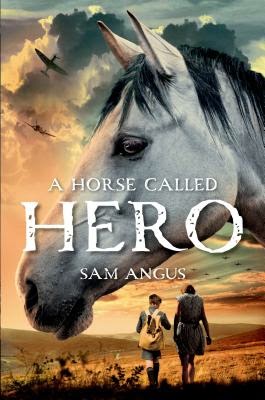
A Horse Called Hero

by Sam Angus
First sentence: “Wolfie stopped, distracted by the stacks of sandbags and newly dug trenches.”
Support your local independent bookstore: buy it there!
Review copy provided by the publisher.
Content: There’s really nothing objectionable for the target audience, though there are letters written in cursive, and I know my 3-5 graders would have problems deciphering those. There’s also several intense situations, so if you have a sensitive child, you might want to shy away from that.

Dorothy and Wolfgang Revel — they go by Dodo and Wolfie, however — are children in London the winter of 1940 when the German bombs start dropping. Their father is called up to serve in the army — he was a celebrated commander during World War I — and they are sent off to Northern England to live with strangers. They’re doing okay, until word comes back that their father was arrested for desertion. Then, they are outcasts in this strange place. That is, until they’re taken in by the school teacher. Whereupon Wolfie chances across a horse being born and adopts it for his own.

If you can’t tell my my enthusiastic summary of the first 50 pages (which is really all that is; this book covers an enormous amount of time), I am not a horse person. And, alas, this book did nothing to help with that. I kind of had hopes that this would be Inspiring and Uplifting and help me see what people find in horse books, but… no. I was bored. The basic plot revolves around Wolfie’s love for Hero The Horse and the kids’ concern about their father. There was an incident when Hero saved them after they got trapped in the bog, and another when Hero helped Wolfie get out of a mine after an explosion, but by then, I was so Bored because of the lack of Real Plot (and the extended time; Wolfie was 5 or so when it started, and 14 by the end), I was just skimming.

I am sure that there are kids who would Love this one, but I am not one of them.

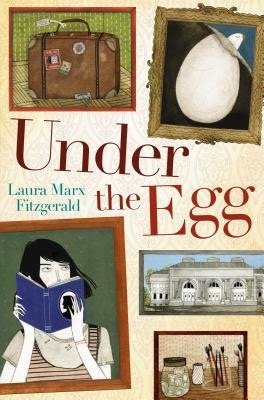
Under the Egg

by Laura Marx Fitzgerald
First sentence: “It was the find of the century.”
Support your local independent bookstore: buy it there!
Content: There some descriptions of horrible events, but nothing graphic. I think younger readers might have problems with the languages — there’s French and Latin, though translations are provided — and some of the names, but it’s in the middle grade (grades 3-5) of the bookstore, and I think it fits there.

Theodora (call her Theo) Tenpenny is the granddaughter of an artist and the daughter of an extreme introvert. She lives in what was once a grand old New York City house, but over the years has become neglected. Her grandpa Jack has kept everything reasonably in shape over the years and has managed to keep the family afloat by being mostly self-reliant. But since he was hit by a car and died (which seems overly gruesome for a guy in his mid-80s), Theo’s been in charge. And she’s struggling.

That is, until she takes her grandfather’s last words — “Look under the egg” — literally, and discovers that he’s been hiding a very old painting underneath the one of an egg that’s been hanging over their mantelpiece for years. Because she’s spent her life in her grandfather’s shadow, going to the Met and other art museums, Theo has a good eye, and realizes at once that this painting is something special. Something, perhaps, worth a lot of money.

However, as she and her new friend, Bodhi, find out, declaring a painting a lost work by a master is easy. Proving it is another matter. Especially when it turns out that this could be looted Nazi treasure.

On the one hand, there’s a lot of information to be had in this slim book. Both art history as well as WWII history play a major role in the plot. But I think that Fitzgerald handles it well, even if all the information and history might make it harder for younger readers to get into the book. But, she gave us a couple of great characters in Bodhi and Theo; they really are a team that works well together. I enjoyed the old-fashioned sleuthing to solve the mystery of the painting, and I liked how the history fit into the larger picture. I did find the ending to be a bit convenient, but even that was explained in a reasonable (if somewhat implausible) manner.

In the end, a highly enjoyable book.

Rose Under Fire

by Elizabeth Wein
First sentence: “I just got back from Celia Forester’s funeral.”
Support your local independent bookstore: buy it there!
Content: there were a lot of f-bombs (I didn’t count them) that came up once at the concentration camp (understandable) and other mild swearing throughout. Also a number of disturbing images and content (Nazi concentration camps don’t make for Light Reading). It is most definitely one I wouldn’t hand to a kid under the age of 13 or 14 (depending on their maturity handling Difficult Situation), whether or not they were on the reading level, so it’s shelved in my Teen section (grades 9-12) at the bookstore.

I don’t quite know where to start with this one. Once I discovered it was a Holocaust novel (as opposed to just a WWII novel), I put off reading it. I don’t like Holocaust novels, mostly because I don’t like being confronted with the evil things the Nazis did. But, because it was Elizabeth Wein, and because it’s a companion to Code Name Verity, I bravely gave it a shot.

And I found myself sucked into the world of women pilots, of strong, resilient women who know how to survive. It’s odd to say this about a Holocaust book, but I loved it.

Rose Justice is an American who has pulled strings to get enlisted as a transport pilot for the RAF. She’s doing her duty, blissfully unaware of the evils of the Nazis. Sure, they’re the Enemy, but the can’t be as horrible as they all say, right? Then, on a mission, she chases after a flying bomb (German pilotless planes loaded with bombs), gets lost over enemy territory, and ends up in Ravensbrück.

Even I, who actively avoids anything Holocaust, know about the horrors of Ravensbrück.

And yet, even though Wein captures the horrors, and the crimes, and the terribleness (I can’t seem to find a word strong enough) of Ravensbrück, it isn’t a hopeless, dark book. Even though Rose is changed permanently by her six months (only six measly months! How did people survive years there?), she retains her will to survive. And Wein has created a cohort of strong, amazing, wonderful (again, there is no word strong enough) women who do just that: survive. It’s amazing — and inspiring — to read.

I’m so glad I did.

Code Name Verity

by Elizabeth Wein
ages: 14+
First sentence: “I am a coward.”
Support your local independent bookstore: buy it there!

Things this book is:
A World War II book.
A book about friendship, between two young women, specficially.  Funny.
A book about torture.
A book about the Resistance.
A book about women pilots.
A book about things a person will do to save their skin.
An amazing example of voice. Seriously, the characters leap off the page.
Unputdownable. (Yeah, I know. Still, it fits.)
Freaking awesome.

Things this book is not:
Trite.
Another Holocaust book.
Boring.

In other words: if you haven’t yet read this story about Maddie and Verity, and been captivated by their story, you are missing out.

And yes, it really is just as good as “they” all say.

Flygirl

by Sherri L. Smith
ages: 12+
First sentence: “It’s a Sunday afternoon, and the phonograph player is jumping like a clown in a parade the way Jolene and I are dancing.”

Ida Mae Jones has always wanted to fly. Ever since she was put behind the wheel (is it a wheel?) of her daddy’s Jenny and taught how, she knew that this was what she was born to do. Except, she’s an African American (yes, I am being politically correct here), and lives in the outskirts of New Orleans. Not only can she not get a pilot’s license because she’s a woman; she can’t get one because she’s the wrong color.

It’s only when her younger brother spies and article about the Army’s WASP program (that’s Women’s Airforce Service Pilots), and that there was a Chinese-American woman in it, that Ida gets an inkling of an idea. She forges her daddy’s pilot’s license, and since she’s light enough skinned to pass for white, she applies. And gets in.

The part in the program is what interested me the most about Smith’s book. I thought that while the conflict between black and white, and Ida’s internal conflict about lying about who she really is, was interesting (and probably worth some thought), I really liked Ida learning how to fly military planes. I liked the challenges posed by the program, the obstacles she had to surmount in order to succeed in a man’s world. It was not only historically interesting, but had a universal appeal: what woman hasn’t faced the “you can’t do it because you’re a girl” and fought her way to success in whatever that is?

It’s books like these that make one grateful for the pioneers, the women who were courageous enough to break the race, sex, or whatever barrier, and achieve their dreams. And it’s good to have a book like this to remind us of it. As well as being a cracking good story.