Dollbaby

by Laura Lane McNeal
First sentence: “There are times you wish you could change things, take things back, pretend they never existed.”
Support your local independent bookstore: buy it there!
Content: One of the protagonists is a teenage girl, and there’s a lot of good historical information. There’s nothing truly objectionable, so even though this is in the Adult Fiction, I wouldn’t hesitate giving it to an avid teen reader who showed some interest.

I picked this one up because a couple of people at the bookstore have been raving about it. “It’s funny,” they said, “If you liked The Help, then you’ll love this one.”

I liked The Help well enough, and I figured it’s the South, set in New Orleans, during the whole Civil Rights movement. I like quirky characters. This one will surely be a good book.

Well… Not so much. Yes, it is set in New Orleans in 1964, when our main character, Ibby (short for Liberty) is dropped off at her grandmother’s house. Her father had recently died in a freak accident, and Ibby’s mother can’t handle being a single parent. Ibby’s grandmother, Fannie, is one of those eccentric Southern ladies, who believes in being proper and feisty and doesn’t trust anyone except her help, who are pretty much like family. (But heaven forbid if her granddaughter takes up with a colored man.)

This just didn’t do anything for me. Sure, it’s got those quirky Southern characters, but that’s about it. The plot was lacking, and I didn’t connect with the characters at all. Maybe I’ve been gone from the South for too long, but I wasn’t even entertained by the quirkiness. Or horrified by the racism. Mostly, I was just… bored.

I ended up skimming the second half of the book, just to find out what happens. Books like these make me wonder if I’ve been ruined for adult books after all.

A Snicker of Magic

by Natalie Lloyd
First sentence: “‘They say all the magic is gone up out of this place,’ said Mama.”
Support your local independent bookstore: buy it there!
Content: Because the main character collects words, some of the vocabulary might be more advanced for some of the younger readers. Also, there’s a bit of a romance(ish; they’re more just really good friends though the hint is there) but it’s pretty tame. Is in the middle grade (grades 3-5) section of the bookstore.

All Felicity Juniper Pickle wants is to stop moving. Sure, she’s used to her mother’s wandering ways — the longest they’ve ever stayed in one spot has been six months — but that doesn’t mean she doesn’t long for the comforts of a true home and the ability to make friends. So when the Pickled Jalapeño (that’s their car) rolls into Felicity’s mom’s hometown of Midnight Gulch, Tennessee, Felicity hopes that they will finally settle down and call this Home.

Of course, getting her mom to settle down isn’t all that simple. And the longer they stay in town the more secrets are revealed about the town’s history. About why the ice cream there is so good. About why Felicity can actually see words floating through the air. And, mostly, about why her mother is so keen on wandering, and how Felicity can get her to stop.

And it all involves… a snicker of magic.

It’s a very quiet book, this, with a quiet sort of magic. And as I was reading this charming little story, the thought that came to me the most was that this felt a lot like Ingrid Law’s Savvy. This one is more Southern and small-town-ish than Savvy is, but at its heart, they’re quite similar. Both have a strong female character at the core, one who is determined to not only keep their family together, but to figure out how she fits in with everything else. And the magic is similar as well. Felicity sees words and “catches” them, by writing them down. (Which leads to a lot of fun word play: in addition to making words up — like spindiddly — words have textures, shapes and colors. It’s pretty cool.) The Blackberry Sunrise ice cream makes you remember. Her uncle sees colors when he plays notes. Someone in town doesn’t show up in pictures. Nothing grand, nothing life-changing, but magic nonetheless.

But it was more the feel of the book, the discovery of finding a home, a place to fit in. And Felicity’s desire to help her mother move past her divorce (dad just walked out on them), and their realization that home can mean a lot of different things. Full of delightful characters and quirky magic, it’s a delight to read.

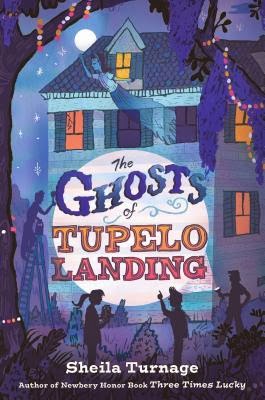
Ghosts of Tupelo Landing

by Sheila Turnage
First sentence: “Desperado Detective Agency’s second big case snuck up on Dale and me at the end of summer, dressed in the happy-go-lucky colors and excitement of an auction.”
Support your local independent bookstore: buy it there!
Others in the series: Three Times Lucky
Content: There may be a few instances of mild swearing (but I really don’t think so), and some talk of abuse, and another (potential) murder. But it really is innocent and happily belongs in the middle grade (3-5th grade) section of the bookstore.

Every once in a while, a series of books captures my fancy so completely that I fall head-over-heels in love with the characters. The Casson family books are that way. As is My Most Excellent Year. I’m adding the Tupelo Landing books to that list. I adore the town, even with all its quirks, and the people in it. I want to live next door and enjoy them every day.

This installment picks up as the school year is starting, and Mo and Dale are about to enter sixth grade. This is a good time as any: one of the amazing things about this book is that while it is a sequel, it really does stand on its own. Turnage works in the story from Three Times Lucky as you go along, in ways — like press releases or newspaper clippings or just dropped comments — that don’t stop the narration of the current story. It was lovely to get a refresher while being immediately immersed in the new story.

The case that the Desperado Detective Agency is working on this time is a good old-fashioned Haunting. Miss Lana and Grandmother Miss Lacy bought the old inn at an auction, mostly because they didn’t like the look of the “city” woman (whom Mo less-than-affectionately calls “Rat Face”) who was bidding on the property. They didn’t want her to come in, tear the dilapidated inn down, and put up condos in place. Unfortunately, buying an inn to renovate and then renovating it — especially when there’s a bona fide ghost lurking about — are two different things.

Mo and Dale get involved because of a history assignment. They’re supposed to interview one of the town “elders”, and Mo’s nemesis, Anna (whom Mo less-than-affectionately calls “Attila”) nabs Grandmother Miss Lacy first. So, Mo — in a fit of pique — says they’re going to interview the inn’s ghost. That sets them to unraveling a 60-year-old mystery of how a girl — one of Grandmother Miss Lacy’s best friends — met her death.

The only real criticism I have of this book is that all the conflict seems a little contrived. The outside city girl just lurks in the background being uptight, and the new character, Harm Cremshaw, turns out to have more bark than bite.  Even the resident town grump, Red Baker, turns out to be mostly harmless. That said, I’m not reading these books for the conflict. Or even for the mystery. (Or the ghost story in this case, though it’s so slight, I’m not really considering this as a “speculative fiction” though it probably is.) No, I read this because I love the characters — Mo’s spunk and observations; Dale’s adorable cluelessness, Miss Lana’s optimism, the Colonel’s stoic nature — and I love the way Turnage writes them.

And that’s why you should be reading these as well.

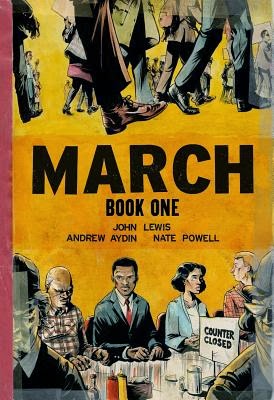
March (Book One)

by John Lewis, Andrew Aydin, and Nate Powell
First sentence: “John, can you swim?”
Support your local independent bookstore: buy it there!
Content: The only objectionable thing in the book is the use of the “n” word (which doesn’t make the white Southerners look good at all). The library has it filed under adult graphic novels, but I think I’d put it with the teen ones. I’m sure even a curious 10- or 11-year-old would get something out of this one as well.

I picked this up because it made the SLJ’s Battle of the (Kids) Books contenders list and I like to (try to) read as many as I can before the competition starts. Like every year, I found a wonderful book I’d have never picked up otherwise.

This is a slim graphic memoir, telling the first part of Congressman John Lewis’s story. (For the record, Hubby knew who Lewis was; I did not.) This volume starts with his childhood in Alabama, and goes through the Nashville sit-ins that he participated in. My favorite thing about this memoir was the framing: It opens with Lewis waking up the morning of Obama’s first inauguration, and the story unfolds as Lewis is remembering his path to D.C. as he tells it to a couple of constituents who have stopped by his office.

It’s your pretty typical Civil Rights story: sharecropper parents save money for their own farm. After an exposure to a different way of doing things (he visited his uncle and aunt in New York City for a summer), child wants an education, rather than be stuck at home doing what his parents do. (I loved the bits about raising chickens, though.) He feels a call to be a preacher, and ends up at American Baptist Theological Seminary in Nashville. There is an interesting aside here: Lewis wanted to go to college in Alabama, closer to home, and actually met with Dr. Martin Luther King, Jr. and his lawyers to talk about segregating Troy State. In the end, though, Lewis’s family didn’t want to chance the backlash, so he stayed in Nashville.

He was very influenced by the school of non-violent protests, and he got involved with a group that organized the sit-ins in Nashville in 1959. I think this was the most moving part of the book; the abuse and hurt that Lewis and his friends endured just so they could have the same services as the white people in Nashville was pretty brutal. This volume ends just after the Nashville mayor decrees that all businesses should be integrated. I’m quite interested to see where Lewis’s story goes from here.

I loved the format as well: there aren’t enough non-fiction graphic novels (at least that I’ve read), and the art — done in stark black and white — adds to the intensity of the story. I’m glad I picked this one up.

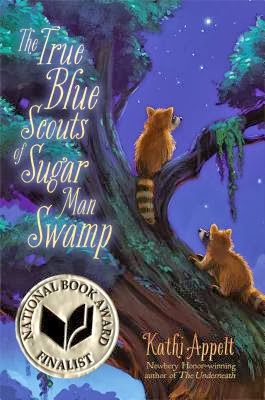
The True Blue Scouts of Sugar Man Swamp

by Kathi Appelt
First sentence: “From the rooftop of Information Headquarters, Bingo and J’miah stood on their back paws and watched Little Mama and Daddy-O trundle away; their stripy gray and black silhouettes grew smaller and smaller in the deepening dusk.”
Support your local independent bookstore: buy it there!
Review copy snagged from the ARC shelves at my place of employment.
Content: There’s a few difficult words but it’s pretty appropriate for anyone. It’s in the middle grade (3-5th grade) section of the bookstore. I think it’d make a great read aloud for younger kids as well.

Bingo and J’miah are the two newest members of the Sugar Man Scouts. Like their ancestors before them, they are the raccoons that keep an eye on the Sugar Man Swamp, listening to the Voice, and keeping ready to wake the Sugar Man in case they need to.

I suppose I should back up and say that Sugar Man Swamp is in Texas (not Louisiana, which is where I thought it was for half the book and where I am convinced it should be) and in it grows this amazing sugarcane. From which Chap Brayburn and his mom make fried sugar pies. Which should be famous, but aren’t because they are off the Beaten Path.

And so, they owe lots of money to a nefarious businessman named Sonny Boy, who wants to sell the swamp to a ‘gator wrestler for a theme park.

Oh, and did I mention that a gang of wild hogs are on the rampage?

That kind of gives you a taste for this tale. And it is a tale. In fact, the narrator was bugging me — it’s a pretty intrusive narrator — until  I realized that this is the sort of book that begs to be read aloud. Once I imagined myself listening to this story, perhaps told by a fantastic storyteller with a fabulous Southern accent, then the book came alive for me. I understood the humor, I understood the whimsical nature of the characters, and — honestly — I fell for it.

It’s not perfect — it’s probably a bit longer than it needed to be — but it’s very, very good. And charming. And enjoyable.

And that’s enough for me.

(Just for the record: because this is a Cybils nominee, I’ve been asked to make sure y’all know this is my opinion only, and not that of the panel.)

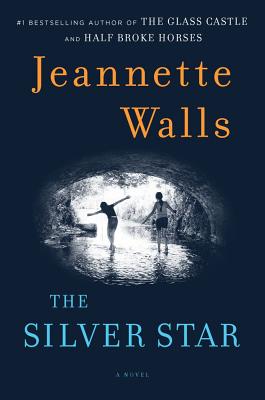
The Silver Star

by Jeannette Walls
ages: adult (though it would be okay for a 14+ teen)
First sentence: “My sister saved my life when I was just a baby.”
Support your local independent bookstore: buy it there!

I read The Glass Castle so many years ago that I didn’t have much memory of it outside of a general liking of it. So, I went into reading The Silver Star with a fairly open mind. The only real prejudice was that I heard this was a good YA crossover. Which was enough to get me to pick it up.

And, surprisingly (to me at least), I quite liked it.

Sisters Liz and Bean (whose real name is Jean) have grown up with their artist/flake of a mom, moving constantly, and dealing with her occasional disappearing acts. Then one time, she doesn’t come back. Liz and Bean manage for a while, but when people start poking their noses around, they decide to up and go across the country to visit the uncle they’ve never met in their mom’s hometown of Byler, Virginia.

Their Uncle Tinsley takes them in, but they find that living in small town Virginia is has own set of challenges. (Especially in 1970-71, which is when this takes place.) In addition to the whole new kids in town feeling, the girls find they have to deal with a lot of Small Town History. The Hollidays used to be the mill owners, and used to be Big People in Town, but have been fading over the years. The current mill manager — Mr. Maddox — is a real piece of work (that’s being nice; ominous music started in my brain about page 100), and there’s a bit of a feud between him and Tinsley. And that only intensifies when Maddox assaults Liz.

Two things I think Walls really got: 1970s politics, and smart kids. The former was evident not only in the race relations, which admittedly she just breezed over, but in the politics of sex crimes. While the way the town and the legal system treated Liz, I was glad Walls wasn’t tempted to modernize this. (Though I wonder how “modern” the legal system really is in this area.) It helped the authenticity and feel of the novel overall.

I also appreciated that she didn’t glorify either small towns or the South; it’s all laid out there, the good and the bad, for better or for worse. And for some people — like Liz and Bean’s mom — it is worse. But that said, family doesn’t necessarily mean blood. And in tough times, good people stick together.

It’s a quick read, and well worth the time.