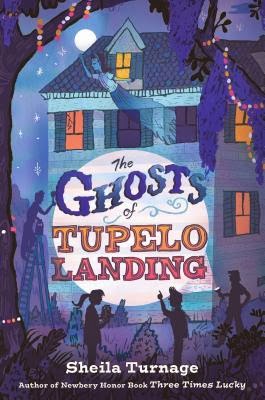
Ghosts of Tupelo Landing

by Sheila Turnage
First sentence: “Desperado Detective Agency’s second big case snuck up on Dale and me at the end of summer, dressed in the happy-go-lucky colors and excitement of an auction.”
Support your local independent bookstore: buy it there!
Others in the series: Three Times Lucky
Content: There may be a few instances of mild swearing (but I really don’t think so), and some talk of abuse, and another (potential) murder. But it really is innocent and happily belongs in the middle grade (3-5th grade) section of the bookstore.

Every once in a while, a series of books captures my fancy so completely that I fall head-over-heels in love with the characters. The Casson family books are that way. As is My Most Excellent Year. I’m adding the Tupelo Landing books to that list. I adore the town, even with all its quirks, and the people in it. I want to live next door and enjoy them every day.

This installment picks up as the school year is starting, and Mo and Dale are about to enter sixth grade. This is a good time as any: one of the amazing things about this book is that while it is a sequel, it really does stand on its own. Turnage works in the story from Three Times Lucky as you go along, in ways — like press releases or newspaper clippings or just dropped comments — that don’t stop the narration of the current story. It was lovely to get a refresher while being immediately immersed in the new story.

The case that the Desperado Detective Agency is working on this time is a good old-fashioned Haunting. Miss Lana and Grandmother Miss Lacy bought the old inn at an auction, mostly because they didn’t like the look of the “city” woman (whom Mo less-than-affectionately calls “Rat Face”) who was bidding on the property. They didn’t want her to come in, tear the dilapidated inn down, and put up condos in place. Unfortunately, buying an inn to renovate and then renovating it — especially when there’s a bona fide ghost lurking about — are two different things.

Mo and Dale get involved because of a history assignment. They’re supposed to interview one of the town “elders”, and Mo’s nemesis, Anna (whom Mo less-than-affectionately calls “Attila”) nabs Grandmother Miss Lacy first. So, Mo — in a fit of pique — says they’re going to interview the inn’s ghost. That sets them to unraveling a 60-year-old mystery of how a girl — one of Grandmother Miss Lacy’s best friends — met her death.

The only real criticism I have of this book is that all the conflict seems a little contrived. The outside city girl just lurks in the background being uptight, and the new character, Harm Cremshaw, turns out to have more bark than bite.  Even the resident town grump, Red Baker, turns out to be mostly harmless. That said, I’m not reading these books for the conflict. Or even for the mystery. (Or the ghost story in this case, though it’s so slight, I’m not really considering this as a “speculative fiction” though it probably is.) No, I read this because I love the characters — Mo’s spunk and observations; Dale’s adorable cluelessness, Miss Lana’s optimism, the Colonel’s stoic nature — and I love the way Turnage writes them.

And that’s why you should be reading these as well.
Grasshopper Jungle

by Andrew Smith
First sentence: “I read somewhere that human beings are genetically predisposed to record history.”
Support your local independent bookstore: buy it there!
Review copy highly recommended by our publisher rep.
Content: Weeelll….. sh*t is Austin’s favorite word, and all grasshoppers do is “f**k and eat”. Which gives you a pretty good idea of the language. And Austin and Robby smoke. There is some drinking and one very unsexy sex scene (and talk of masturbating and erections and sex). It’s in the teen section of the bookstore, but I know I’m going to find it difficult to find a parent willing to buy this one for their kid. (That’s not to say the kids won’t like it. They might.)

The short version, the one I’ve been pitching at work (after I realized it was more than “grasshoppers and sex” — though it is that), is that it’s what would happen if Holden Caulfield found himself in a Stephen King novel. Austin — he’s the 16-year-old, sex-obsessed boy whose head we’re living in — is confused and lonely (even though he has a best friend and a girlfriend) and angsty and more than a little self-absorbed, much like Holden. And yet, the setting is so utterly antithetical to our character: a strain of mutant bacteria gets out and starts changing people into six-foot-tall praying mantises whose sole purpose in life is to eat — everything, including each other — and procreate.

Who dreams up these sorts of things? (Well, Stephen King and Andrew Smith, obviously.)

At any rate, it’s nothing like what I expected. I think with all the advance buzz — not just from our rep, but also Publisher’s Weekly, and just the reviews on Goodreads — I expected something, well, amazing. And I got… well, a sex-obsessed, selfish, confused 16-year-old boy. I can deal with that, for the most part (I did make it through Winger after all), and I appreciated Smith for giving us a confused sex-obsessed boy; Austin’s not only confused about life, but also about his own sexuality: how can a person be in love with — and desire — both of his best friends at once?

But, reading through the Goodreads reviews, I stumbled upon one from Kellie at Stacked that made points that I think had been at the back of my mind while reading this book. Nominally, it boils down to this: a woman couldn’t have written a book like this about a girl talking so frankly about sex or her vagina and have it receive the same amount of buzz and acclaim that this one is getting. And secondly: Austin treats girls and women as objects.

The first point, I can see and understand and am a little bit miffed about. It really does go back to this “boy books” and “girl books” thing we (publishers/sellers/parents) have gotten into. We “need” this book because boys “need” this book (because they’re not reading anything else). But that least me to point number two, which is what was bothering me while I read the book. I had chalked it up to being inside a 16-year-old boy’s mind, which is not a comfortable place. But, looking back, it’s really because, to Austin, all women (well, perhaps all people) are a means to an end: sex. He says he “loves” his girlfriend, but honestly, he just wants to jump her. And this — at my very core — bothered me. (In fact, when Robby finally confronts Austin and tells him he’s selfish, I cheered. More of that, please.)

I was talking to a friend at work about this and she pointed out that maybe, just maybe, it was meant to be satirical or ironic. That perhaps we, as readers, were meant to see that Austin is a complete jerk, and find humor in that. Or at the very least, self-reflection.  Perhaps. All I found was discomfort.

There were other things I was disappointed in: Austin’s circular telling of his own personal history, his constant repeating of people’s names (yes, I know Shann’s name is Shann Collins and her stepfather is Johnny McKeon, can you PLEASE stop already?), and just the general uneven pace of the narrative. That said, there were things to admire: actual sentences that made me laugh aloud. Or the fact that Austin’s (and Robby’s for that matter) sexuality was just a thing, and not an “issue”. Or six-foot-tall unstoppable praying mantises.

But I don’t think the positives outweigh the negatives on this one.

Better Nate Than Ever

by Tim Federle
First sentence: “I’d rather not start with any backstory.”
Support your local independent bookstore: buy it there!
Content: There is some bullying, a bit of swearing, and some frank talk about sexuality and alcoholism. I probably wouldn’t give it to a third grader (it just feels more mature than an 8-year-old, but you know your kid), but a 4th or 5th grader would be fine with it. It’s in the middle grade (3-5th grade) section of the bookstore, though the library has it in the teen section (which surprised me).

Nate Foster is a 13-year-old kid living in the blue collar town of Jankburg, PA (just outside of Pittsburg). His dad is a “maintenance engineer” and his mom runs a slowly dying flower shop. They have put all their hopes, dreams, and expectations on Nate’s older brother, Alex, the sports star. Which leaves Nate as the… well… outcast. It doesn’t help that he’s a Broadway musical fanatic, knowing them all, singing away, quoting incessantly. Which leaves his family (and the town) baffled.

Of course, Federle is playing off of stereotypes here: people in blue-collar towns are (obviously) backward and don’t understand Culture. People — boys especially — who like musicals are (obviously) gay. (There is much too much discussion about Nate’s sexuality here. And while his position is “I’m 13, how would I know if I were gay?” it bothered me that musicals are, necessarily, lumped in with being gay. Can we just get over that, now, please?) Boys who are short, overweight, and awkward are (obviously) bullied at school (and by his — jerk is not a strong enough word — older brother).

When Nate finds out about open auditions for a new musical based on the movie E. T. he jumps at the chance. And because he knows his backward parents would never let him, he takes the opportunity (with the help of his friend Libby) to run away to the auditions. He was supposed to go there and back again in a day, but (of course) things don’t quite work out. Which brings us to another cliche here — the kid from the backward blue-collar town has NO IDEA how to make it in New York City. (Which may be true, having never run away to the big city when I was 13.)

Even with all the cliches and stereotypes, this wasn’t a terrible book. And I think what saved it, for me at least, was Nate himself. Federle caught the voice of an awkward, insecure, hopeful kid someone who has been beaten down his whole life, and yet still remains optimistic about everything. He’s adorable, and heart-warming, and just plain fun. It was this that kept me reading, and when I finished, it was this that made the book a good one for me.

Additionally, it’s one of those books that’s good to have out there, if only because it addresses stereotypes. There aren’t that many books out there where the male main character gets to be something other than stereotypically male. Hopefully, boys will pick this up and give it a shot. If only to increase their empathy.

There’s a sequel — Five, Six, Seven, Nate — which just came out. I may even like Nate enough to give that one a shot.

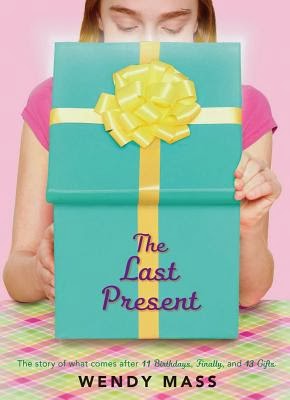
The Last Present

by Wendy Mass
First sentence: “When you’ve drawn breath for nearly a hundred years, not much surprises you.”
Support your local independent bookstore: buy it there!
Others in the series: 11 Birthdays, Finally, 13 Gifts
Content: There some kissing (a first kiss) and a bit of fudging the truth, but other than that, nothing objectionable. Sits quite happily with the rest of the series in the middle grade (3-5th grade) section of the bookstore.

Amanda and Leo have gone without talking for a year. Again. This time, though, it wasn’t a fight that did it: Angelina — the mysterious, magical woman in the town of Willow Falls — asked them to. Because when Amanda and Leo don’t talk, they have the power travel through time.

This time, they’re tasked with going back in time to fix their friend’s sister’s birthday party. See, Angelina bestows a “benediction” of protection on all the children of Willow Falls, something that will keep them safe. But she didn’t make it in time to help Grace (that’s the friend’s sister), and every attempt she made in the intermittent 10 years didn’t work either. And she’s tasked Amanda and Leo with going back and making sure that Grace’s benediction happens. Three times.

It sounds simple, and in many ways it is: Amanda and Leo head back to a different year each day over the course of a week, and all they have to do is fix one little thing at each birthday party. But as they find out, it’s not as easy as it sounds. And then there’s the problem that all this might be more about Angelina than it is about Grace.

While it’s nothing earth-shattering or ground-breaking, it’s a very sweet little book. I liked how Mass brought in all the elements of the whole series, and though this is Amanda and Leo’s follow-up story (they were always my favorite, anyway), Rory and Tara do have parts to play. It’s very much one of those “on the cusp of adulthood” books: Amanda and Leo have their first kiss, and they are beginning to make decisions that will effect their future. But even with that, it’s a simple, sweet (I know: I keep saying that. There really is no better word.) story about moving on and making things right.

And a fitting end to this series.

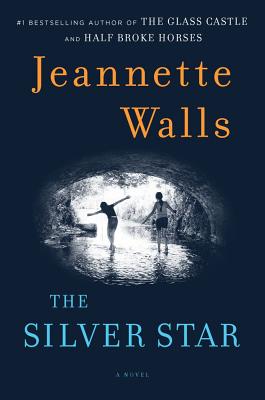
The Silver Star

by Jeannette Walls
ages: adult (though it would be okay for a 14+ teen)
First sentence: “My sister saved my life when I was just a baby.”
Support your local independent bookstore: buy it there!

I read The Glass Castle so many years ago that I didn’t have much memory of it outside of a general liking of it. So, I went into reading The Silver Star with a fairly open mind. The only real prejudice was that I heard this was a good YA crossover. Which was enough to get me to pick it up.

And, surprisingly (to me at least), I quite liked it.

Sisters Liz and Bean (whose real name is Jean) have grown up with their artist/flake of a mom, moving constantly, and dealing with her occasional disappearing acts. Then one time, she doesn’t come back. Liz and Bean manage for a while, but when people start poking their noses around, they decide to up and go across the country to visit the uncle they’ve never met in their mom’s hometown of Byler, Virginia.

Their Uncle Tinsley takes them in, but they find that living in small town Virginia is has own set of challenges. (Especially in 1970-71, which is when this takes place.) In addition to the whole new kids in town feeling, the girls find they have to deal with a lot of Small Town History. The Hollidays used to be the mill owners, and used to be Big People in Town, but have been fading over the years. The current mill manager — Mr. Maddox — is a real piece of work (that’s being nice; ominous music started in my brain about page 100), and there’s a bit of a feud between him and Tinsley. And that only intensifies when Maddox assaults Liz.

Two things I think Walls really got: 1970s politics, and smart kids. The former was evident not only in the race relations, which admittedly she just breezed over, but in the politics of sex crimes. While the way the town and the legal system treated Liz, I was glad Walls wasn’t tempted to modernize this. (Though I wonder how “modern” the legal system really is in this area.) It helped the authenticity and feel of the novel overall.

I also appreciated that she didn’t glorify either small towns or the South; it’s all laid out there, the good and the bad, for better or for worse. And for some people — like Liz and Bean’s mom — it is worse. But that said, family doesn’t necessarily mean blood. And in tough times, good people stick together.

It’s a quick read, and well worth the time.