The Darkest Part of the Forest

by Holly Black
First sentence: “Down a path worn into the woods, past a stream and a hollowed-out log full of pill bugs and termites, was a glass coffin.”
Support your local independent bookstore: buy it there!
Content: There’s a few f-bombs and some teen drinking at the beginning. And some intense kissing, not to mention violence. It’s in the Teen section (grades 9+) of the bookstore.

Siblings Hazel and Benjamin have grown up in Fairfold, where they know that faeries are in the forest. They know not to mess with the fairies, but since Ben was blessed (cursed) to make gorgeous music as a child and Hazel has always been drawn to the forest, they really didn’t listen. They made up stories about the prince that was in the glass coffin, they fought some bad faeries, and Hazel even made a bargain with the Alderking to help with Ben getting some musical training.

But all that was in the past. Hazel, now 16, is reckless with boys’ hearts and Ben stopped making music years ago.

And now the prince in the coffin is awake and Hazel’s life is falling apart. The question is whether or not Hazel can figure things out before her life is completely destroyed.

I love Black’s storytelling. Wholly and completely. She pulls you into the world she creates, and makes you believe everything she writes. I loved Hazel in her brokenness, and her relationship with Ben. I loved that there were faerie characters and human characters in all shades of the rainbow (both in terms of skin color and morality). I loved the myth she spun around the town and these characters, and the way she worked with the whole idea of the fey.

I just loved the book. Period.

Lost in the Sun

by Lisa Graff
First sentence: “When we were real little kids, Mom used to take Aaron and Doug and me to Sal’s Pizzeria for dinner almost every Tuesday, which is when they had their Family Night Special.”
Support your local independent bookstore: buy it there!
Review copy snagged from the ARC shelves at work.
Release date: May 26, 2015
Content: There’s some bullying, and some tough subjects and a couple of instances of mild swearing. It’ll be in the middle grade (grades 3-5) section of the bookstore, though I would hesitate giving it to the younger end of that spectrum.

Eight months ago, Trent was the cause of a fatal accident. He hit a hockey puck into the chest of one of his friends, who then died. Not really from the hockey puck: his friends had a heart condition that no one knew about, and that’s what caused the death. But Trent is convinced that it’s his fault. And he feels like everyone — well his father, his brothers, and his former friends — blames him for what happened.

Now, on the first day of sixth grade, Trent is completely depressed. Until the “weird” girl, Fallon, decides that they need to be friends. Fallon’s the one everyone shuns, mostly because she has a scar down her face. Everyone asks how it happened, but she keeps the true story close, choosing instead to make up ones. Over the fall, Fallon and Trent deal with his grief, guilt, and anger, as he tries to make life work.

A lot of books deal with grief from dead or sick parents, or dead or sick siblings. But the idea that a kid could be the catalyst for a friend’s death hits home and deep. I thought Graff captured those emotions perfectly, from Trent’s self-loathing to his feelings like everyone hated him. And because we saw the rest of the world through Trent’s eyes, I could tell which adults were reaching out (his homeroom teacher, eventually) and which adults just needed a good smack (his father). The longer Trent’s self loathing went on, the more I was afraid that Graff wouldn’t be able to give Trent a good resolution. But, in so many ways, she did. I was thoroughly satisfied with Trent’s arc, and with the way things weren’t neatly tied up in a bow.

Quite good.

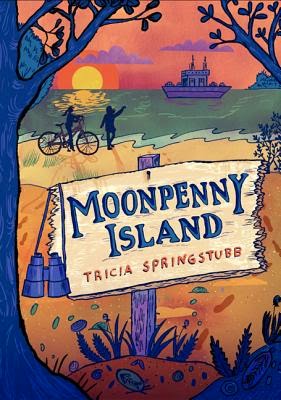
Moonpenny Island

by Tricia Springstubb
First sentence: “Transparent.”
Support your local independent bookstore: buy it there!
Review copy pilfered from the ARC shelves at my place of employment.
Content: It’s pretty basic, language-wise, with short chapters and simpler words. Good for anyone who likes friendship stories. It’s in the Middle Grade (grades 3-5) section of the bookstore.

Flor and Sylvie have been best friends forever. Growing up on a small island in the middle of Lake Erie (it’s doesn’t exist, but it’s possible, though I had to look it up) on the Ohio side, they were pretty much all they had. Which was just find with Flor. Then things change: Sylvie is sent to Cleveland to live with her aunt and go to school there. And Flor’s mother leaves as well, and they don’t know when — or if — she’s coming back.

With her life falling apart, how can Flor cope?

Once I got over my annoyance about the whole there’s an island in Lake Erie by Toledo thing… I found I really liked it. It’s not magical quirky, but it does fit with the whole small-town quirky thing. I liked how Flor knew everyone on the island, and was willing to stick up for the less “acceptable” members of their community. I liked how Springstubb introduced a scientific-minded, homeschooled girl into the mix, and how she wasn’t weird or unusual or super-religious. I felt like Springstubb tackled everything — from problems at Flor’s home to problems with her friends — with an evenness that suited her audience.

The only thing that bothered me, really, about the story was that it had the feel of a first person narration, but it wasn’t. For the most part, I was able to flow with it, but every once in a while, it pulled me out of the story.

But that’s a small quibble in an otherwise good book.

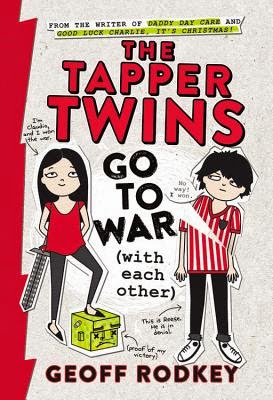
The Tapper Twins Go To War (with each other)

by Geoff Rodkey
First sentence: “Wars are terrible things.”
Support your local independent bookstore: buy it there!
Review copy picked up at Winter Institute for me by my co-workers
Content: There’s a lot of silliness, and it’s a “notebook” book and told in an oral history form, which means lots of pictures, not a lot of exposition, and a generous mix of technology. Perfect for reluctant readers. It’s in the middle grade (grades 3-5) section of the bookstore, but it’d be good up through 7th, I think.

The Tapper twins, Claudia and Reese, are at war. They disagree on how it started, but both are pretty invested in making each other’s life miserable now. It escalates from name calling to pranking (a dead fish left in a backpack) to online bullying to out-and-out destruction in an online gaming forum.

It’s told as an oral history; Claudia is the narrator, and nominally the one telling the events as they unfold, but she interviews friends and family (well, she uses text messages from her parents) and neighbors to defend or refute her point: that Reese is the one who started the War, and that he Deserved It. Of course, Reese totally rejects that idea.

Sure, this isn’t a lot of things, but it IS a lot of fun. And honestly: that’s what kids want and like. Personally, I loved the dynamic between the twins, their push and pull with each other. And while it’s an upper-middle class life that they live (computers, tablets, phones, babysitter, private school), and while it’s yet another New York City book, it’s a fun “fantasy” life for those of us in middle class, Midwest America (although yeah, I’d like to have their life and their problems) and a fun look at kids in New York City. It got me laughing, aloud at times, and sometimes that’s exactly all you want out of a book.

And I’m sure kids will love it.

The Penderwicks in Spring

by Jeanne Birdsall
First sentence: “Only one low mound of snow still lurked in Batty Pederwick’s yard, under the big oak tree out back, and soon that would be gone if Batty continued to stomp on it with such determination.”
Support your local independent bookstore: read it there!
Review copy intercepted when opening freight at my place of employment.
Release date: March 24, 2015
Others in the series: The Penderwicks, The Penderwicks on Gardham Street, The Penderwicks at Pointe Mouette
Content: It’s a bit more advanced than the younger end of the reading spectrum can handle by themselves, but it makes a wonderful read-aloud. It will be in the middle grade (grades 3-5) section of the bookstore.

The Penderwicks are back! I can’t tell you how happy this makes me. So SO very happy. In fact, I sat down and devoured this book in one day, and then was immediately sad because I should have savored it.

It’s been four years since the last Penderwicks book, and the girls have aged appropriately. Rosalind is off at college, Skye is a senior in high school (as is Jeffrey) and Jane is a junior. That leaves Batty as a fifth grader, the oldest of the younger Penderwicks, her step-brother 8-year-old Ben, and their half sister, two year old Lydia. That’s a lot of responsibility for Batty, who is used to being the youngest. Add to that her beloved Hound’s death (six months prior), and Batty finds herself struggling this spring.

She does make some good discoveries. Their neighbor Nick Geiger has come home from a tour in Iraq, and he inserts himself in the lives of the Penderwicks with nothing but wonderful results. And even though Skye is having some issues with Jeffrey and Jane is surrounded by boys and Rosalind brings home an absolutely awful boy from college, Batty’s finding her own way.

The most wonderful thing about this book is that’s it’s just as good as all the other Penderwicks books. Birdsall is such a fantastic author, capturing the innocence of childhood as well as the more complex of emotions: frustration with being young, a bit of despair, a bit of helplessness. It’s a funny book — the Penderwicks are witty and wonderful — but it’s also one that tugged at my heartstrings and made me cry in the end.  It’s honest, and simple, and absolutely wonderful.

The Jupiter Pirates: Hunt for the Hydra

by Jason Fry
First sentence: “Tycho Hashoone was doing his math homework when the alarms started shrieking.”
Support your local independent bookstore: buy it there!
Content: There’s some intense moments, and a lot of off-screen deaths. And the names are pretty challenging to sound out. But, it’s a short book that reads quickly, and would be in the middle grade (grades 3-5) section of the bookstore, though I think 6-8th graders would enjoy it as well.

Tycho is part of one of the great pirating families of the Jupiter alliance. They’ve been capturing ships for booty for generations, flying the same starship, the Comet, making their name and their living. The captainship is handed down from parent to child, and the current captain, Diocletia, is Tycho’s mom. Which means that Tycho, his twin sister Yana, and their older brother, Carlo, are all in competition to be the next captain.

Lest you think that’s the focus of the book, it’s not. Even though their competition is a huge part. No, the real story is the disappearance of Jovian privateers (as the pirates are now called). When the Hashoones capture a freighter that happens to have an Earth diplomat on it (Jupiter and Earth have been at war for decades), that sets off a chain of events that will involve the Hashoones figuring out the dirty politics behind the disappearances.

On the one hand, this is freaking cool. Pirates! In Space! (or as A pointed out, a book version of Treasure Planet.) And, I like the world building that Fry did. He’s come up with some creative ideas for the future, and I liked the way the privateers/pirates balanced politics with business, just on the legal side of outlaw.

But.

The writing was pedestrian, the competition side of the story took up too much time and what I came to consider the “real” story took too long to develop  and was wrapped up too quickly. (Though that last scene was pretty dang awesome.) While I really enjoyed that this was a family business, Fry was juggling too many characters so I felt like I never really got to know any of them. And maybe this is all quibbling — I mean, will kids really care? — but it made the book a less-than-stellar read for me.

Fairest

by Marissa Meyer
First sentence: “She was lying on a burning pyre, hot coals beneath her back.”
Support your local independent bookstore: buy it there!
Others in the series: Cinder, Scarlet, Cress
Content: There are some sexytimes, but it’s entirely off-stage and only vaguely alluded to. It’s in the YA section (grades 6-8) of the bookstore, like the rest of the series.

This wasn’t the Marissa Meyer book I was expecting to review this year. I wanted Winter, the final installment in my series, the one that will hopefully bring everything to a satisfying conclusion. So, I kind of jokingly asked our Macmillian rep when he was here a couple weeks back if he had an ARC of it for me. His response? “Oh, you haven’t heard? They’ve pushed that off in favor of telling Queen Levana’s backstory.” Me? “WHAT?”

This one goes back an unspecified number of years (10? 15? 20?) to when Levana was 15, the younger sister of a very beautiful, and very cruel princess. A princess who used her mind-manipulation powers to control Levana. To make Levana do things she wouldn’t usually do. To hurt Levana. It’s also the story of the damaged (emotionally and physically) Levana trying to find love in inappropriate places (ie, with a married guard), and manipulating people to get what she wants. And, it’s the story of how Levana became queen (mostly by an accident of fate), and how she ended up with Winter.

Sometimes, going back and telling a character’s backstory works. Say, like Kristin Cashore’s Fire. It was needed to fully understand what she was going to tell in Bitterblue. But this? I enjoyed Levana as a cardboard villain, the fairy tale Bad Queen. I really wasn’t looking to find her sympathetic, to understand Why she was the Bad Guy.

But I read this anyway. And I still feel the same: I’m not sure it was a necessary diversion, but perhaps I’ll be proved wrong when Winter finally comes out.

Dory

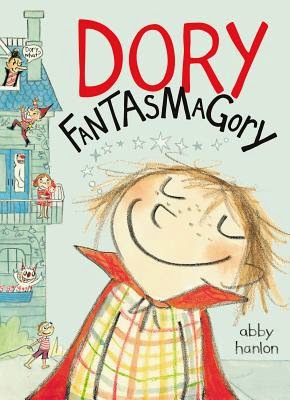
Dory Fantasmagory
by Abby Hanlon
First sentence: “My name is Dory, but everyone calls me Rascal.”
Support your local independent bookstore: buy it there!

Dory and the Real True Friend
First sentence: “My name is Dory, but everyone calls me Rascal.”
Support your local independent bookstore: buy it there!
Review copy snagged from the publisher rep.
Release date: July 2015
Content: It’s pretty basic, short, and liberally illustrated with pencil sketches throughout. It’s in the beginning chapter book (grades 1-2) section of the bookstore.

I don’t often read beginning chapter books anymore. K is past that age (and prefers graphic novels, anyway), and it’s just not where my interest lies. That said, every once in a while, a book comes along that I just have to pick up, and in the end, just makes me smile. I ended up reading this one becuas while it’s been on my radar for a while, it was making it as a finalist for the Cybils that convinced me  I really ought to read it.

And I was thoroughly charmed.

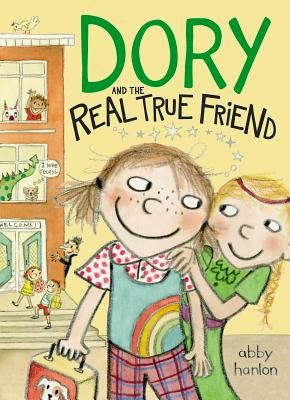
Dory is a 6-year-old with a VERY active imagination. She’s the youngest child, and her two older siblings don’t ever really want to play with her. So, she plays with her imaginary monster friend, Mary, and goes on a ton of adventures. That’s really all there is to the plot. (Well, in the second book, she goes to first grade and eventually makes a “real” friend, whom everyone thinks is imaginary.) But what these have going for it is that Hanlon gets first graders. Seriously. She gets their quirks, their habits, their curiosity, their silliness. And she makes Dory an absolutely fantastic character. She’s someone you want to spend time with, laugh with, and who just makes you happy.

My only criticisms are superficial: I’m going to have a hard time getting boys to read this. But, much like Princess in Black, I think that boys are really going to enjoy Dory and her crazy imagination. And secondly, everyone’s white. It’s a little thing, but Dory didn’t have to be white, and her best friend didn’t have to be white, but they are.

Even so, they are adorable books. And adorable wins every time.

I’ll Give You the Sun

by Jandy Nelson
First sentence: “This is how it all begins.”
Support your local independent bookstore: buy it there!
Content: There is some teen drinking, a (non-graphic) rape scene, and several f-bombs. That, and because of the subject matter, puts it in the Teen section (grades 9+) of the bookstore.

Noah and Jude are twins, separate people but connected in thought and purpose (generally). So much so that they’ve become NoahandJude, pratically inseparable. That is, until the summer they turn 14. Then everything starts to fall apart. Jude becomes “wild”; Noah retreats into his own world until a new boy shows up next door. They end up “dividing” their parents, each vying for the other parent’s attention and love. On top of that, they are fiercely competing to get into the local prestigious art high school. It’s a mess.

Two years later, things aren’t much better. Jude made it into the school; Noah (who was arguably the better artist) did not. They’re still dealing with the aftermath of their mother’s fatal accident. They harbor secrets. And they’re no longer NoahandJude. They’re not even Noah and Jude. They’re two separate planets, who never talk to each other. It’s different from what it was before, but no better.

Did I mention that Jude sees the ghost of her dead grandmother, and senses the presence of her dead mom?

It’s thanks to the two ghosts that Jude searches out Guillermo, sculptor extraordinaire and Latino Mystical Guide, and finds not only salvation but True Love.

Yeah, the book derailed just about there.

For the record: everyone in this book is a Tortured Soul Needing Redemption. And they all find it together. I did enjoy Guillermo — in fact, he was the most interesting character — but that doesn’t change the fact that his role in the book was to cause a change in the white people around him. He was Passionate Lover, he was Father Figure, he was Spiritual Guide. And sometimes he was a living-breathing person, but those times were rare.

And don’t even get me started on the whole Soul Mate thing. Ugh.

What saved this book from being Truly Horrible was the writing — Nelson paints the world vividly, and I do have to admit that there was some good chemistry between Jude and her Soul Mate, even if that’s a trite trope and needs to be done away with. But what I really loved was the art. I loved Guillermo’s giant sculptures and the way Nelson depicted the process of art. I loved Noah’s chapters and the way he’d come up with paintings for everything. I loved how she considered fashion an art.

In the end, I did respect what Nelson was trying to do. But it’s not a perfect book by any means.

Chasing Power

by Sarah Beth Durst
First sentence: “Razor blade.”
Support your local independent bookstore: buy it there!
Review e-copy sent to me by the author.
Release date: October 14, 2014
Content: It says it’s for 14 and up, and maybe they did that because most of Sarah Beth Durst’s books lately have been aimed toward that crowd. That said, there’s really nothing that I think a 7th- or 8th-grader couldn’t handle (mild swearing, some pretty bad parenting, etc.). It’ll be in the YA section (grades 6-8) of the bookstore.

Kayla and her mother — Moonbeam — are on the run. They have been for eight years now, moving frequently, changing their names, trying to keep a low profile. Why? Because Kayla’s dad killed Kayla’s sister, Amanda. Why? Because Kayla — and her sister, presumably — have magical powers.

Kayla’s powers aren’t that big, and mostly she uses them to steal little things — cash, jewelry — to help keep her and her mother afloat. Thing is: her mother doesn’t want Kayla to use her powers. She says it’ll help her dad find them. And then, one day, someone does find her. His name is Daniel, and he knows about her and her powers. And he needs her help to rescue his mom.

What Daniel starts is an epic quest to find not only Daniel’s mother, but Kayla’s past. And not everything is as it

I adore Sarah Beth Durst (and I’m not just saying this because she offered me this e-book (and an interview!), I really do enjoy her writing and world-building. I loved Kayla for her strength and for her insecurities. I was often annoyed with Moonbeam and her “I know better, trust me, it’s for your protection” routine, but in the end, she was someone worth cheering for as well. And I love the way Durst used the magic — both Kayla’s telekinesis and Daniels transporting — to forward the story; the quest couldn’t have happened without their powers, rather than them just being incidental to the whole story.

A fantastic read.