Lips Touch Three Times

by Laini Taylor/Illus. by Jim Di Bartolo
ages: 12+
First sentence: “There is a certain kind of girl the goblins crave.”
Review copy picked up from the ARC exchange table at KidlitCon 09.
Support your local independent bookstore: buy it there!

Wow.

Oh, I knew Laini Taylor had a fabulous imagination, having adored both Blackbringer and Silksinger, but, really: wow.

This one is three short stories in which the only connection is the act of kissing. Taylor explores what that “means”, but because it’s Laini Taylor, the exploration is not what you’d expect. Or maybe you would, if you’d read her other stuff. In short, it’s weird, wild, entrancing and just plain fabulous. Without giving too much away…

The first story, “Goblin Fruit”, takes something that every girl wants — to be noticed by the popular, cute boy — and turns it ever-so-slightly sinister. Kizzy has a weird immigrant family, one that she’s embarrassed about. It’s all she can do to avoid their practices, beliefs, superstitions, especially those of her (now-dead) grandmother, who believed quite strongly that there are goblins out there waiting to capture your soul. Kizzy tries to live a normal life, even from the sidelines of her high school, but she wants. Wants — to be popular, to be in the arms of the cute boy — so badly it’s palpable. So, when Jack Husk — beautiful, amazing, wonderful Jack Husk — shows up and pays attention to her, she goes with it. It’s got a bit of an open ending: what really does happen to Kizzy, but it doesn’t really matter. In this story, it’s the getting there that counts.

The second story, “Spicy Little Curses”, was my favorite. Taylor played off of Hindu religion and myth on this one, not only setting the story in Imperialist India, but giving us a devil in Hell who thrives off of making life (and death) miserable for humans. There’s a human liaison to Hell who tries to temper what this devil does, but one day — in exchange for twenty two souls — she allows the devil to curse the daughter of the Political Agent. The curse: if she ever speaks, she’ll kill everyone in the sound of her voice. She manages never to speak, but of course, she grows up into a lovely young woman and a soldier falls in love with her. There is not a happy outcome (again, of course), but the twists and turns and the language (oh, the language!) make it simply a joy to read.

And, finally, “Hatchling”. It’s the longest of the three stories, the most developed, the most interesting world-building that I’ve read in a while. Taylor takes were-lore and vampire-lore and develops it in a new and fascinating way in giving us the Druj. Not quite werewolves (and yet they shape shift), not quite vampires (and yet they use and abuse humans for their own pleasure), they terrorize and terrify humans. Mab was one of those, and for some reason, she managed to escape from the Queen. She was pregnant at the time and with her daughter, Esme, she has been in hiding ever since. Fourteen years later, Esme wakes up one morning with one blue eye and one brown eye. This not only terrifies Mab, but leads Emse to the destiny that she never knew she had, changing the way the Druj interact with each other and the world in the process.

I know I didn’t quite capture the wonderfulness that is this book. But it truly is amazing.

Ancedotes of Destiny and Ehrengard

by Isak Dinesen
ages: adult
First sentence (of the first story): “Mira Jima told this story.”

I bought this book ages and ages ago (maybe 12 years?), and although I read it when I first got it, I have to honestly say it’s been sitting on the shelf, mostly unwanted. It’s managed to survive a few move-induced book purges, so there must have been something I liked about it. I just couldn’t remember what. Thanks to the Classics Challenge, I got it off the shelf, dusted it off, and cracked it open to see if I could remember what I liked about it.

Out of the five short stories and the novella, I liked two: the novella and one story. (I do have to admit that I didn’t even read one of the stories. I tried, but I couldn’t get into it.) Two out of six isn’t good odds, but the two are positively sublime. (I suppose I could go into a reflection of Dinesen’s unevenness, but I won’t.)

Babbette’s Feast is the short story that I enjoyed, and the remembered reason for keeping the book. It’s set in Norway. Two sisters of a fairly Puritan sect run by their father take in a refugee from the French Revolution, Babette. She lives with them for 12 years, and then one day, she informs the sisters that she won the lottery and is the recipient of 10,000 francs. Babette decides that what she really wants to do is cook a meal for her benefactresses, and cook she does. Unfortunately, they don’t quite understand what that means until it’s almost too late, yet, in the end, realize what a work of art and grace and service the meal was. I had misremembered it as having a magical realism slant, which it doesn’t. However, that doesn’t mean it wasn’t thoroughly captivating. Actually, at one point, I thought that it reminded me quite a bit of A.S. Byatt’s writing at its best: beautiful, evocative, dense, and somehow sublime.

The novella, Ehrengard, is much like Babbette’s Feast in its descriptiveness. It’s peripherally the story of a prince and princess who fall in love, but don’t quite manage to wait until their wedding day. In the need to cover up the royal faux pas, the Grand Duchess consults with Herr Cazotte, a famous artist as to what to do. They decide to send the prince and princess off to a remote mountain estate and surround them with people who are very loyal and very trustworthy (of course, Cazotte will be included). Among the people is Ehrengard, a daughter of a retired general. She’s beautiful, loyal, and Cazotte decides that he must paint her. However, he doesn’t just want to paint her, he wants to capture her, make her his own, so that the whole world will know that she belongs to him (I never could quite figure out if this was sexual or not…). At any rate, the plot is immaterial. Again, it’s Dinesen’s language that makes the story compelling. Her descriptions, the passion in which Cazotte is captivated by Ehrengard.

What Dinesen doesn’t do is endings, which I think is part of the reason I didn’t like the other stories. They wrap up, but somehow I’m always left feeling like there should have been something more, like I was left dangling in the wind. They — even the ones I like — feel unfinished. I’m sure it’s something she did on purpose, but that doesn’t take away the unfinished feeling I had when I was done reading.

Even with that, though, the two stories were enjoyable to re-read. And so the book will remain on the shelves for the time being.

The Dragon’s Son

I picked this one up to round out Becky’s King Arthur Challenge, mostly because I felt bad that I didn’t finish the John Steinbeck book. I found it through a random search of the library’s catalog; I knew I wanted a young adult or middle grade book, but that was all. After a bit of looking, this one popped out at me. Sarah Thomson takes a new and interesting approach to the legend: not only does she go back to the earliest Welsh stories of Arthur, she tells the story from the point of view of the lesser-represented characters (Nimue, Morgan, Luned and Medraud/Mordred) rather than from the usual perspectives.

Essentially a collection of four short stories (everyone gets a few chapters to tell their tale), I was impressed not only with the stories themselves, but with the way they were used to propel the entire myth forward. Thomson manages to tell the entire Arthur story — from conception to death — in 181 pages, and while it wasn’t as in-depth as it could have been, I don’t feel like I missed anything.

The book begins with Nimue, and tells her story from her meeting Myrddin through their relationship to his death. It covers a huge amount of time, but her primary role is to tell about the conception and birth of Arthur. Morgan comes next, but her fundamental character has been changed: she’s not a witch or even a Lady of Avalon. Instead, she’s a bitter, slighted sister of Arthur. She saw her father’s murder by Uther, and she was never able to forgive Myrddin for that. So, when she married Arthur (interesting twist, I thought) and he took her to the castle, she left him because he wasn’t willing to get rid of Myrddin. The story then switches to Luned, who is the handmaid to Elen, Morgan’s sister. This one I found the most fascinating. It involves Lancelot, called Owain here, and how he came to marry Elen/Elaine. Thomson made Elen terrified of men, mostly because she was married off at 12 to a brute of a man. Luned is Elen’s voice, her strength, her solace. It’s only after Luned brokers a marriage to Owain for Elen’s saftey (after her former husband’s death), that Elen learns to love. Unfortunately, Owain’s heart belongs to another, and Elen pines away in a monestary. It moves the story forward, though, because Elen is given Gwydre, who is Arthur’s heir (another interesting twist; Morgan had twins) to raise. The last story is Medraud/Mordred. His is the most tragic, the most bitter. Growing up as the son of Morgan, he is not only influcenced by her mother’s wanton ridding of sons (she gives up Gwydre to Arthur without any complaints), but by Arthur’s neglect. He resolves to kill Arthur, not just because his mother is bitter and wants revenge, but also because Arthur is unwilling to recognize Medraud as his rightful heir. He wages a war of words, rumors against his own brother, and eventually after a confrontation with Arthur, leaves and comes back with an army. And we all know how that turns out.

I liked the changes to the traditional story that Thomson made– the basics were the same, but details were different. I found that interesting and, yes, refreshing. It was nice not to read the same story hashed out. Seeing the story from the minor characters point of view also made it more intersting. A lot of the other elements we usually associate with Arthur were done away with, too: magic, aside from Myrddin’s few prophecies, was essentially non-existant. As were most elements of Druid worship (there were some references to “old ways” but that was it).

I always feel good when I manage to find a book on my own that I like. So, I’m feeling pretty good today, because I liked this one. A lot.

Djinn in the Nightengale’s Eye

A couple years ago, when I read Possession (also by A. S. Byatt), my friend Julie recommended this collection of fairy stories, saying that I would LOVE it. She’s almost right: I liked it, but it fell short of LOVE. (Sorry, Julie.)

I really liked the first three stories: “The Glass Coffin”, which was a Snow White-esque story with a tailor instead of a prince waking up the imprisoned princess; “Gode’s Story,” a somewhat complex story about a man who wanted a woman, cursed her to wait for him, dumped her when she became haunted, married another and then became haunted when the first woman killed herself; and, my favorite,”The Story of the Eldest Princess,” where she goes off on a quest, but because she’s read so many stories, ends up opting out of the whole quest thing and instead hooks up with an old healer woman.

The other two stories — “Dragon’s Breath” and the title one — were okay, but not nearly as enjoyable. My complaints with Djinn, especially, are similar to the ones I had about Possession: too much extra stuff, but not enough plot. When it finally got around to the plot, I really enjoyed it: what would you do if you had access to a personal djinn? (And, what is it that a woman most desires? They never answer that one.)

It really was a collection of stories about stories. Sometimes, it worked — like in “The Eldest Princess”; sometimes, not so much, like in “Dragon’s Breath”. But when it worked, it worked really well, and I was captivated by the writing — Byatt is a really descriptive writer; I just wish she’d be a tighter writer. Perhaps that’s why the shorter stories appealed to me more: the writing was tighter, the stories more linear and less circular. They worked better for me.

Maybe sometimes I do “get” short stories. Funny.

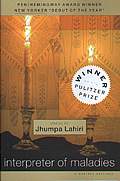
Interpreter of Maladies

I was supposed to read Mistress for my last Expanding Horizons Challenge book. But I’ve had it on hold at the library for two months, and I just don’t think it’s coming (mostly because it’s currently listed as in the display case). So, I cast about looking for a last book to fill the Indian requirement, and my friend Sarah lent me this book.

For those of you (like me) not in the know: it’s a series of short stories written by Jhumpa Lahiri, an Indian-American. The stories feature people in various situations — dealing with death, with affairs, with tourists, with life — and places. Some are in America, some in India, some in England. One of the things that bothered me is that I kept trying to come up with some overarching theme, some reason why these stories were supposed to be together in a book. That was foolish of me (I don’t read enough short story collections): each story was meant to stand on it’s own, a little snapshot into the lives of the characters.

On the one hand, I loved this book. The prose is very eloquent (I can see why it won the Pulitzer Prize; it seems to be that sort of book), the images very picturesque. And yet, I felt on some level like it was calculated. It bothered me the same sort of way poetry bothers me — it’s beautiful, but I feel like I’m missing something. It’s like seeing a snapshot of an event versus experiencing the whole event. And, when I read at least, I often prefer the whole event to a little slice. I felt like I wanted more, needed more, and just when it was getting interesting, the story ended. That’s not to say I didn’t like the stories. “Mrs. Sen’s” was a very touching look at being an immigrant and adjusting to a new life in a new country. “This Blessed House” was amusing — a newly married couple kept finding Christian iconography (for lack of a better word) around their newly bought house — and an interesting look at the compromises people have to make when they get married. And, my favorite, ” The Third and Final Continent” was a nice portrait of a man’s immigrant journey and the people he encountered before and after arriving in the U.S. to settle. It’s also a glimpse into what the second immigrant generation loses.

Even though I wasn’t ultimately satisfied by it, it was a good read, something that I’m not sorry to spend my time on. Maybe one of these days, I’ll even “get” it.