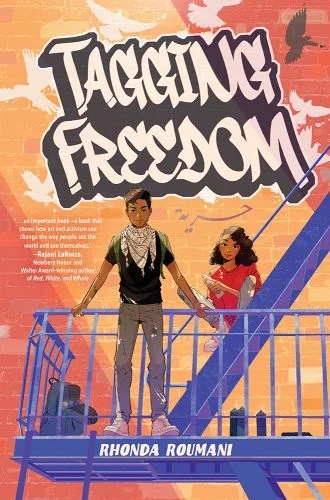
Tagging Freedom

by Rhonda Roumani
First sentence: “Kareem picked up the black spray paint and studied the sandy-colored wall.”
Support your local independent bookstore: buy it there!
Content: There is some talk of war and protests where gunfire opens up. There are also instances of microaggressions and blatant racism. It’s in the Middle Grade (grades 3-5) section of the bookstore.

Kareem is a 13-year-old in Syria in 2011, right as the protests and the civil war began. He is fired up about the abuses by his government and wants to help do something so he and his friends take to spray painting slogans and art on the buildings around Damascus. This lands him in trouble – with his parents, not the government, fortunately – and they ship him off to live with his aunt and uncle and cousin in America.

Said American cousin, Samira, is having her own problems. She wants to join the Spirit Squad, but the girl who runs it is the same girl that bullied Sam all through 4th and 5th grade. But people change, right? And it’s 7th grade now. But joing the Spirit Squad makes her end up fighting with her best friend, and when her cousin arrives, it makes everything a lot more complicated.

The most striking thing in this book is the huge juxtaposition between Kareem’s Syrian life and the way he cares deeply about his family and friends who are still being affected by the uprising and government retaliation and Samira, who is concerned with, well, #firstworldproblems. If there is anything that brings to light the huge disparity (and nonchalance) that we Americans (even children!) have with the other world, this is it. I thought Roumani handled it well – making Kareem care so deeply, you can’t help as a reader but care about what he cares about. And I liked Samira’s growth arc, and the way she shook off superficial concerns compared to the problems that Kareem and his family have.

And because it has a lot of similarities with the genocide in Gaza right now, it was that much more powerful and relevant. An excellent book.

Ink Girls

by Marieke Nijkamp and Sylvia Bi
Support your local independent bookstore: buy it there!
Content: There are some intense moments. It’s in the Middle-Grade Graphic Novel section of the bookstore.

Cinzia is a printer’s apprentice in the fictional city of Siannnerra, where her master is insistent that the city’s people need to know the Truth. But when she puts out an avvisi about the Lord Councilman, the principessa’s brother, it gets her arrested, and Cinzia is on the run. She makes an unusual friend – the principessa’s daughter – and the two of them work together to find the proof that the Lord Councilman really is as corrupt as the avvisi says he is. It’s not easy, especially for a couple young girls who are on the run from the soldiers.

I really liked this graphic novel. I like the historical feel of it – it feels like medieval/Renaissance Italy, even though the setting is fictional. And I liked that the girls worked together with the people of the city – the ones those in power ignore – to bring down a corrupt official. There was enough tension and action to keep the pages turning, and I liked how the girls’ characters came across.

I haven’t read Nijkamp’s other books, and I think I need to fix that.

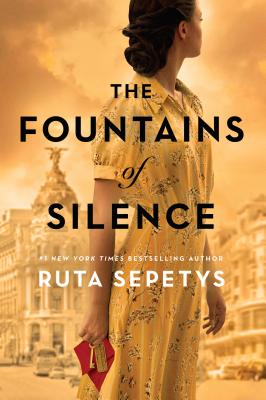
The Fountains of Silence

by Ruta Sepetys
First sentence: “They stand in line for blood.”
Support your local independent bookstore: buy it there!
Release date: October 1, 2019
Review copy provided by the publisher.
Content: There’s some violence, and some talk of sexual assault and affairs. It will probably be in the Teen section (grades 9+) for more “mature” themes than the YA section usually holds.

The one thing that Sepetys does better than any other person writing historical fiction out there is finding the stories underneath the major events, and focusing in on what the decisions of dictators – in this case, General Francisco Franco of Spain — have done to ordinary people. (Well, she did write one book that didn’t head in that direction, but go with me here.) She looks at the lives of the peasants — in this case Ana and her siblings, who were children of people involved in the resistance during the Spanish Civil War — and how the strict rules and the fear effect their daily lives.

It’s 1957, and Ana has gotten a job at the Castellana Hilton, a posh hotel that has opened up in hopes that Americans will go to Madrid on vacation. One such American is Daniel, the son of a Dallas oil tycoon, who would much rather be a photojournalist than go into the oil business. They strike up a friendship (romance?) as David looks into the hidden worlds under then shine that is the Castellana Hilton.

There’s more going on than that in this book: Sepetys touches on the kidnapping of children — the government would take newborns away from parents, and tell them that their children had died soon after birth — and on the general fear that the Guardia Civil inspired in the population. It’s a lot for one book, but Sepetys handles it all without letting it overwhelm the more personal stories of the book.

Very highly recommended, like all of her books.

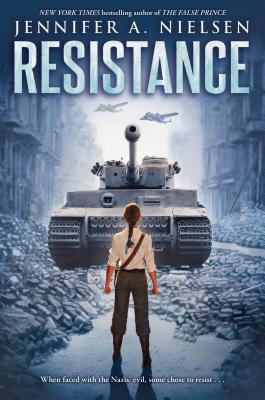
Resistance

by Jennifer A. Nielsen
First sentence: “Two minutes.”
Support your local independent bookstore: buy it there!
Content: There is a lot of violence, and talk of death. It’s in the middle grade (grades 3-5) section of the bookstore.

Chaya is a teenager in the Krakow ghetto during World War II, and after her younger sister and brother disappeared (presumably put on a train to the death camps), Chaya decided that she wasn’t going to sit idly by and let the Nazis destroy her world. So, she joined the resistance as a courier. She could pass as a Polish (non-Jewish) girl, so she took to smuggling supplies into the ghetto and people out.

But her path didn’t end there: when things on a raid go wrong, Chaya and her friend Esther find themselves on the road to Warsaw, dodging Nazis and Nazi sympathizers until they get to Warsaw and are able to join the Jewish resistance for the Warsaw Ghetto uprising (which was a real thing).

This is really good historical fiction, if you’re not already tired of World War II stories. I got the distinct impression that Nielsen was trying to use this as a lesson for the climate in the US today — there were multiple references to people who just sit idly by and watch the horrors of the world being on the wrong side of the fence — but honestly? I’m tired. I know Holocaust stories are important. And I believe that everyone should learn about them, so we don’t repeat history. I’m just, personally, quite done with them. I liked Chaya well enough, I respected her journey, I got that Nielsen was telling me that I needed to be more pro-active in resisting hate and evil in this world.

But all that said, I didn’t quite like the book. I think it’s me, though, and not the book.