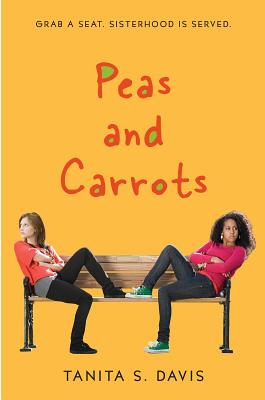
Peas and Carrots

peasandcarrotsby Tanita S. Davis
First sentence: “By the door,on the other side of the sheet that divides the room, Baby cries in his car seat.”
Support your local independent bookstore: buy it there!
Release date: February 9, 2016
Disclaimer: I’ve met the author, working with her for KidlitCon in Sacramento and I find her an absolutely delightful person.
Review copy snagged off the ARC shelves at my place of employment.
Content: There are several instances of mild swearing, plus some illusions to adult drug and alcohol use. Because there are no f-bombs, it’ll be in the YA section (grades 6-8, though it might be better for the older end of that spectrum) of the bookstore.

Dess is a 15-year-old girl stuck in the foster care system. Her deadbeat dad’s finally in jail, as is her mom. Dess’s grandmother gave up trying to care for her and her baby brother years ago. Dess is determined: she doesn’t need anyone. And so when she gets placed in a new home, one of an affluent family, she figures it’s not going to last.

Hope’s parents are stable and happy and take in foster kids, including Dess’s brother Austin, to give back to the community. Hope’s used to the revolving door of kids, but there’s never been one close to her age. Until now. And since Dess is doing pretty much everything to keep people at arm’s length, Hope knows that living with Dess is going to be a challenge. She just doesn’t know if she’ll be able to adjust.

First test: which one of these girls is African American and which one is white? (Answer: Dess is white. Did you pass?) That’s actually one of the first things I liked about this: Davis takes your (my) assumptions about foster care, about the State of the Country, and turns it upside down. In this story, the white girl is the one who’s on the run from an abusive family and the black girl who has the stable life. And Davis doesn’t leave it there; there’s discussion about race and class and belonging, which I respect.

And, as an unofficial foster parent myself, I found myself nodding and agreeing and loving the entire book. Yes, the kids come with baggage and a backstory that usually isn’t pretty. Yes, their lives can be changed by living in a stable, more affluent (though we’re not nearly as well off as Hope’s parents) situation. But Davis also got the corollary to that: having a foster kid in your home is challenging, sometimes disruptive, but is also life-changing. And, if you let yourself — as Hope and Dess eventually find out — you will be better off for it.

Definitely worth reading.
Between the World and Me

betweentheworldby Ta-Nehisi Coates
First sentence: “Son, Last Sunday the host of a popular news show asked me what it meant to lose my body.”
Support your local independent bookstore: buy it there!
Content: There is some swearing, including a couple f-bombs and the use of the n-word. It’s in the Sociology section (I think) of the bookstore.

By now, most of you will have either heard of this or read it, I think. There’s not much to say, summary-wise; it’s a letter from Coates to his son concerning what Coates thinks about being a black man in America. It’s sort of rambling, and kind of disjointed; it feels like a series of random thoughts jotted down on a piece of paper as Coates was musing about his place in this world. Which fits, I think.

What it is, really, is damning. Especially if you, as Coates put it, think you’re white. There’s a complacency that comes with being white, with being privileged (even if you’re “just” middle class), that isn’t afforded to those who are not. And Coates, rightly, forcefully, reminds us of that. Reminds us that to be black — particularly a black male, since he’s writing from his own experience — is to bear the burdens of all our complacency. That our “freedom” isn’t free, and that it’s not the military who are paying for it. That all these shootings that are making the news aren’t new, that they have been going on for hundreds of years, and those that think they are white just throw up their hands and turn a blind eye.

One passage that really struck me:

I am ashamed I made an error, knowing that our errors always cost us more. This is the import of history all around us, though very few people like to think about it. Had I informed this woman that when she pushed my son, she was acting according to a tradition that held black bodies as lesser, her response would likely have been “I am not a racist.” Or maybe not. But my experience in this world has been that the people who believe themselves to be white are obsessed with the politics of personal exoneration.

It’s a difficult read, because he condemns everyone and offers no answers. There’s no solutions, possibly because Coates doesn’t have any, and I found that a difficult thing to swallow. I want to know HOW I can change, what I can do to make a difference. Perhaps reading books like this is a start; it has made me aware that there are black men and women who think this way, who believe that they are lesser because we let police arrest and shoot them. Who are not given the same opportunities because they can’t afford to buy a house in the suburbs. Who are treated differently when they walk into stores just because of the color of their skin.

It does make me feel hopeless, in a way. But, on the other hand, I’ve read this and I’ve been made aware. Maybe that’s a start.

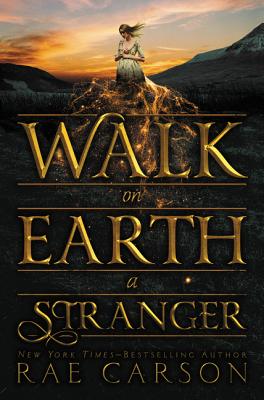
Walk on Earth a Stranger

by Rae Carson
First sentence: “I hear the deer before I see him, though he makes less noise than a squirrel — the gentle crunch of snow, a snapping twig, the soft whuff as he roots around for dead grass.”
Support your local independent bookstore: buy it there!
Review copy picked up at Children’s Institute and signed by the author (who I fangirled over).
Content: There’s some violence, including a few deaths, and some talk about sex (but none actual). It’s in the YA section (grades 6-8) of the bookstore.

Leah Westfall has a talent for finding gold. Well, maybe more than a talent: she can magically sense gold out in the wilderness. But, in northern Georgia in 1849, gold is getting pretty scarce. Even so, she and her parents get by. She’s fairly content. Then, her parents are brutally murdered by a man wants to control her “talent”, so she disguises herself as a man, runs away and head for the place where gold is most plentiful: California.

That’s basically the premise, as this book is primarily concerned with Leah’s — Lee’s — journey getting to California. It’s full of action and suspense, but it’s ordinary action and suspense. Robbers, rough rivers, threats from the known and unknown. It doesn’t seem like much, but it kept me turning pages.

This book deviates from Carson’s other works in that it’s more of a historical fiction piece and less of a magical one. Sure, Lee has magical abilities. But (so far), that’s the only magic. The rest of it, from the inherent sexism and racism to the trials they face while crossing the plains is historical. Even though I like Carson’s magic, I think I enjoyed this one more because the magic was so understated. It did help Lee out, on occasion. But for the most part, she was making her own way on her own terms. Which was awesome.

The other thing is that this is the first of a projected trilogy, but I have no idea where Carson is heading. Sure, the Big Bad isn’t taken care of, but he wasn’t a real threat in this novel either. I was actually content with the way this one ended: Lee survived the journey, she got to California, she can live happily ever after. However, I will follow Carson down whatever road she wants to take, and I wouldn’t mind reading more of Lee’s story at all.

Full Cicada Moon

by Marilyn Hilton
First sentence: “I wish we had flown to Vermont instead of riding on a bus, train, train, bus all the way from Berkeley.”
Support your local independent bookstore: buy it there!
Review copy sent to me by the publisher rep.
Content: There isn’t anything objectionable, and it’s a novel in verse so it’d be appropriate for the younger readers. Good for conversation as well. It’ll be in the middle grade (grades 3-5) section of the bookstore.

Mimi Yoshiko Oliver is obsessed with space. It’s 1969, the height of the space race, and she wants to be an astronaut. The problem? She’s a girl. No one takes her desire seriously, especially in her school in Vermont. It also doesn’t help that she’s Afro-Asian, one of the only people of color in an all-white community.

As she goes through seventh grade and the beginning of eighth, Hilton gives us Mimi’s struggles and triumphs, from her attempts to get into shop class — there are some pretty strong gender norms in the late 1960s —
to her struggles to make friends. There are lots of stories about racism in the south in the 1960s. It was actually quite refreshing to be reminded that even northerners had issues with civil rights.

It’s a lovely novel in verse, as well. Hilton captured Mimi’s sense of wonder an awe at the world around her as well as her desire to go into space. It wasn’t overly detailed, something which might bother some readers but I found I didn’t mind. Perhaps it’s because I’m older, and I remember what it was like (sort-of). But, I also think it was a conscious choice on Hilton’s part to make it more accessible to those reading it. So, on the one hand, it’s historical fiction. But the other, it didn’t really feel all that much like it.

Even so, I thoroughly enjoyed spending time with Mimi and her family, as they adjust to a new home, broaden their horizons, and have a memorable year.

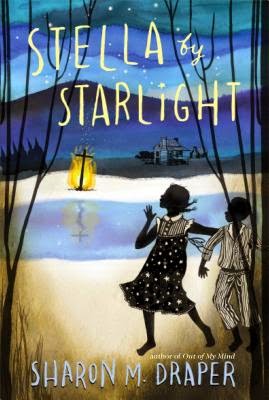
Stella By Starlight

by Sharon M. Draper
First sentence: “Nine robed figures dressed all in white.”
Support your local independent bookstore: buy it there!
Review copy snagged off the ARC shelves at my place of employment.
Content: There’s some pretty intense stuff going on in this book, by Draper never lets it get too dark. She knows her audience and (rightly) assumes they can handle anything that is thrown at them. Be prepared, however, for some discussion. It’s in the middle grade (grades 3-5) at the bookstore.

It’s 1932, North Carolina. The whole country is in the throes of the Great Depression, Franklin D. Roosevelt is running for office. For Stella and her family, this doesn’t really matter. They’re more concerned about making ends meet. And avoiding the local Klu Klux Klan.

And they’re doing a pretty good job until Stella’s dad, pastor, and a family friend decide to exercise their constitutional right and vote. Then, all hell breaks loose.

There’s actually a lot more going on than that: Draper knows her history, and paints a picture of what life was like for African Americans struggling to get ahead in the 1930s. The one-room school, with a teacher who handles all grades next to the white school where they get new books. The small houses and hand-me-over clothes. Having to enter in the back door of shops. Or, most tellingly, a white doctor who won’t come help Stella’s mother after she’d been bitten by a rattler.

And Stella is such an engaging character to go through all this with. She’s an observant, smart girl, but one who also struggles with writing in school. She’s trying to figure out her place in life, how to navigate the injustices of her situation, and still come out ahead. She’s got fantastic parents, and a supportive community. There’s so much that I found admirable about the way she deals with her situation. And so much to discuss (I know; I ended up talking to my family) when you’re done.

The Madman of Piney Woods

by Christopher Paul Curtis
First sentence: “The old soldiers say you never hear the bullet that kills you.”
Support your local independent bookstore: buy it there!
Content: There’s nothing, language wise. However, Curtis tackles some pretty heavy issues: slavery, of course; but also Irish immigration, abuse, racism. It’s in the middle grade (grades 3-5) section of the bookstore, but I would exercise caution about giving this to sensitive children. Good for discussion, though.

It’s 1901, and Benji is a pre-teen in the all-black town of Buxton, Canada. He has a couple of younger siblings that get on his nerves, a best friend who is a good orator, and is both an aspiring newsman and someone who loves the woods. Red is a pre-teen in the nearby town of Chatham. His grandmother was an Irish immigrant, and he’s positively scared of her wrath. He spends his days in school, with his friends — one of whom has an alcoholic, abusive father — and at home dealing with his grandmother.

They’re the most unlikely of friends, but when they do meet, they hit it off.

Which comes in handy the night that the Madman of Piney Woods — a local homeless black veteran of the Civil War — is shot. It’s up to Benji and Red to make everything turn out, if not okay, then at least better than it could have ended.

Perhaps I should have taken the time, once I figured out that this was set in the same place, to reread Elijah of Buxton. Maybe I would have connected to it better. But, I think the main problem I have with this one is that the plot took a long time to show up. It’s told in alternating chapters, one Benji (who was more interesting than Red), one Red. And it took FOREVER for them to meet. (More than halfway through the book!). Once they met, the plot picked up, and I was able to finish fairly quickly. I did appreciate that Curtis was exploring ideas and themes that are tough to manage: the way humans treat other people being the primary theme. It’s an important thing to expose kids to, and to do so with a bit of a mystery story (more or less) is a good thing.

But that wasn’t enough to make me love this book, even though I really wanted to.

The Port Chicago 50

by Steve Sheinkin
First sentence: “He was gathering dirty laundry when the bombs started falling.”
Support your local independent bookstore: buy it there!
Content: There’s some disturbing moments, not only violence, but also racism. I was made uncomfortable by it (which I think was the point). There is also about four censored f-bombs. Sheinkin is masterful at simplifying data  without being simplistic, so I think this is suitable for 5th grade on up. It’s in the Middle Grade History section at the bookstore.

During the summer of 1944, on a little-known port in the San Francisco Bay where Navy ships were loaded with ammunition, an enormous explosion happened. So large that it killed more than 300 men were killed, the pier and the docked ship were obliterated, and men in the barracks were injured, some severely.

It sounds like a tragedy, but nothing too serious. Except for this fact: of the 320 men who were killed, 202 of them were African American men who had signed up for the Navy and had been relegated to the dangerous job of loading the ammunition. The way the Navy worked in 1944 was that the white men got to serve on the ships; the black ones were segregated out and assigned the menial tasks the white sailors didn’t want.

But it gets better. The men who survived the blast were shuttled to a nearby port, and even though they were suffering trauma from the blast (who wouldn’t be), the were ordered to go back to loading the ships. Fifty sailors flat out refused orders. So they were put on trial for mutiny. And convicted. Even though there was never any plot to defy their superiors or take over the base. They just were tired of being treated differently than the white sailors and wanted to know why.

Some good came out of this: because the Secretary of the Navy was a (mostly) reasonable man (and because Eleanor Roosevelt got involved) the Navy (and soon after the rest of the military) was one of the first places that was desegregated in the country.  But, was the price of being convicted mutineers and spending 16 months in jail too high?

Sheinkin doesn’t whitewash anything that happened during those months and years surrounding the Port Chicago 50 trial. He lets the Naval officers stand for themselves (and any reasonable person would see that they were IDIOTS. Or maybe that was just me), and lets the trial transcripts stand for themselves. Thurgood Marshall even got involved, trying to get the government and the military (the officers of which come off as a bunch of racists; I was going to use a stronger word, but changed my mind) to exonerate these men for being human. Sheinkin pointed out that this was the first event on the long path of the Civil Rights movement, which was something I didn’t know, and something we don’t often remember in history books.

It’s extremely well-written and as intriguing as Sheinkin’s other works. He’s a masterful history writer, and knows just how to make things interesting and informative without being dry.

Excellent.

Dollbaby

by Laura Lane McNeal
First sentence: “There are times you wish you could change things, take things back, pretend they never existed.”
Support your local independent bookstore: buy it there!
Content: One of the protagonists is a teenage girl, and there’s a lot of good historical information. There’s nothing truly objectionable, so even though this is in the Adult Fiction, I wouldn’t hesitate giving it to an avid teen reader who showed some interest.

I picked this one up because a couple of people at the bookstore have been raving about it. “It’s funny,” they said, “If you liked The Help, then you’ll love this one.”

I liked The Help well enough, and I figured it’s the South, set in New Orleans, during the whole Civil Rights movement. I like quirky characters. This one will surely be a good book.

Well… Not so much. Yes, it is set in New Orleans in 1964, when our main character, Ibby (short for Liberty) is dropped off at her grandmother’s house. Her father had recently died in a freak accident, and Ibby’s mother can’t handle being a single parent. Ibby’s grandmother, Fannie, is one of those eccentric Southern ladies, who believes in being proper and feisty and doesn’t trust anyone except her help, who are pretty much like family. (But heaven forbid if her granddaughter takes up with a colored man.)

This just didn’t do anything for me. Sure, it’s got those quirky Southern characters, but that’s about it. The plot was lacking, and I didn’t connect with the characters at all. Maybe I’ve been gone from the South for too long, but I wasn’t even entertained by the quirkiness. Or horrified by the racism. Mostly, I was just… bored.

I ended up skimming the second half of the book, just to find out what happens. Books like these make me wonder if I’ve been ruined for adult books after all.

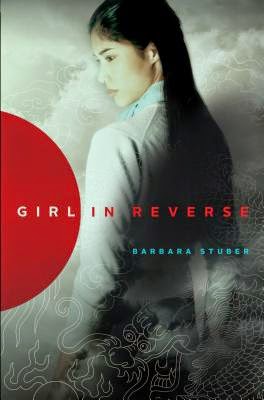
Girl In Reverse

by Barbara Stuber
First sentence: “Say it, Lily.”
Support your local independent bookstore: buy it there!
Content: There’s some mild swearing and kissing. It’s probably a more complicated plot than the Middle Grade section warrants, so it’s in the YA section (grades 6-8) of the bookstore.

Lillian Firestone is an adopted daughter of Chinese heritage. Which makes her a target in Kansas City in 1951, the height of the Korean War. She took the bullying and name-calling when she was younger, but now that she’s 16, she’s taking a stand. Sort of. She walked out of class and school one day, and that act started a domino chain of events that led to the discovery of her birth parents.

There’s art involved and a lot of Chinese culture as Lily goes on this journey.

(I’m tired. Can you tell?)

I wanted to like this book. I love the cover, I love the ideas, the conflict. But I could never connect with Lily. She drove. me. nuts. Completely. And so I started skimming, skipping ahead just to see what happens. And yeah, everything’s tied up in a nice little bow.

It had potential, and I’m sure some readers will really love the art and China elements. But I wasn’t really one of them.

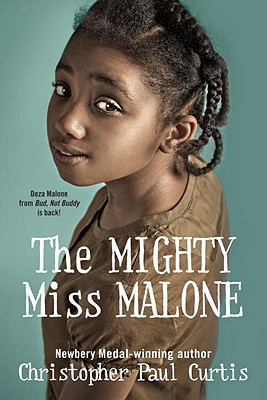
The Mighty Miss Malone

by Christopher Paul Curtis
ages: 9+
First sentence: “Once upon a time…”
Support your local independent bookstore: buy it there!

Deza Malone has a pretty good life in Gary, Indiana. She loves school, she has the best big brother in the whole world (so what if he can’t spell or write? He has the most beautiful singing voice), and her mom and dad love her to pieces.

Sure, it’s the middle of the Great Depression, and her dad is out of work, but they’re making it. It’s tough, but they’re making it.

Then her dad decides to go on a fishing trip to Lake Michigan, and everything changes. Her dad goes missing for a few days, and when he comes back, he’s different. Then, he decides that what he really needs to do is go to Flint, Michigan, to look for work. He takes off. And because families are supposed to stick together, Deza, her mother, and her brother uproot themselves from wonderful Gary and head to Flint to find him.

There are many good things about this one (there’s a reason Curtis has a Newbery and an Newbery Honor to his name), but chief among them is Deza’s voice. From the opening pages, you get a sense of this girl, and I dare you not to love her. She’s a smart girl, observant, and creative. She’s fiercely loyal to her family and her friends, and yet she can adapt and make new friends pretty easily. Sure, the book brushes on darker issues of poverty, of homelessness, of racism. (I was disappointed at how racists the Michiganders were. Seriously. What good is integrated schooling if you are just going to write off the black kids? Ah… and that’s the crux of the situation, isn’t it?) But even though it deals with some heavy issues, the book is never heavy, depressing, or down. Deza’s interminable spirit lifts the whole book and lets it soar.

Which makes it a pretty good read.