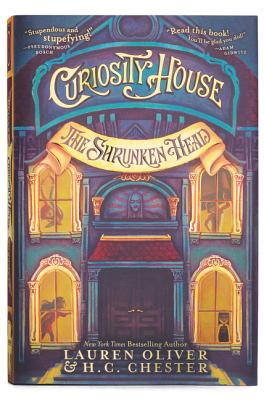
Curiosity House: The Shrunken Head

curiosityhouseby Lauren Oliver (and H. C. Chester)
First sentence: “Ladies and gentlemen, boys and girls: step right up and don’t be shy.”
Support your local independent bookstore: buy it there!
Review copy pilfered off the ARC shelves at my place of employment.
Content: There’s murder and some adult smoking and drunkenness. It’s in the middle grade section (grades 3-5) of the bookstore.

Orphans Philippa, Sam, and Thomas have basically grown up in Dumfrey’s Dime House, a place where unusual kids like them — Philippa is a mentalist, Sam is a strong man, and Thomas is a super-math-genius — are welcome. But, soon after Max (knife thrower extraordinaire) arrives, Mr. Dumfrey’s prize shrunken head goes missing and then people around the city start dying. It’s up to the four kids to figure out what is going on. And, in the process, figure out who they Really Are.

I found the mystery end of this delightful. I thoroughly enjoyed the four kids as they learned to work together and puzzle out who exactly was the person behind the killings. I figured it out before they did, but not much before, and I loved that the clues were there for anyone to pick up. Even the big twist ending wasn’t a huge surprise. It’s only vaguely speculative fiction (mentalist abilities and all that), so it’s perfect for those who don’t want much magic or ficitonal places. The only complaint is one I remember Ms. Yingling having: I wish the historical context was more explicitly put out there. Like her, I was able to figure it out, but I’m not sure that kids would get it (in fact I know so: this is one that my kid review group at work read and they didn’t even notice). Though that’s probably not something that would bother them.

At any rate, it’s a lot of fun.

(Just for the record: because this is a Cybils nominee, I’ve been asked to make sure y’all know this is my opinion only, and not that of the panel.)

Jinx’s Fire

by Sage Blackwood
First sentence: “Sticking to the path won’t always take you where you need to go.”
Support your local independent bookstore: buy it there!
Others in the series: Jinx, Jinx’s Magic
Review copy pilfered off the ARC shelves at my place of employment.
Content: There are some scary moments, but mostly it’s good for the fourth-grade and up crowd. It’s in the middle grade section (grades 3-5) of the bookstore.

Things aren’t looking good for Jinx and his friends. The Urwald is surrounded by warring armies — one of which is headed up by Jinx’s former friend, Reven. The Bonemaster is up to something, but Jinx doesn’t know what. And Simon is still trapped in goo, and it’s not looking good. The question is: how will Jinx solve everything and keep the Urwald (and the trees) safe, especially when he’s not very good at diplomacy?

Sometimes, an ending comes along that is just. so. perfect. that you have to love it. While it took me a bit to get into this one (being quite a long time since I’d read the other two), once I did, I fell again into loving the world that Blackwood created. I love Jinx and his grumpy demeanor. I love his friends, especially Elfwyn. I love the adventures that Jinx went on and the way Blackwood had him solve the problems he created. I adore the magic and the way Blackwood used it.

But, mostly I loved how Blackwood wrapped everything up, satisfyingly but not so neatly that it was implausible.

This series is definitely worth reading.


The Blackthorn Key

by Kevin Sands
First sentence: “I found it.”
Support your local independent bookstore: buy it there!
Review copy provided by the publisher.
Content: There’s some violence, but it’s not grisly and mostly off stage. There’s a lot of white space and fairly large print, so even though it appears long, it goes fast. It’s in the Middle Grade section (grades 3-5) of the bookstore.

Christopher Rowe has a good life, especially considering he was brought up in an orphanage. He’s apprentice to an apothecary, he has a best friend, and he’s given a bit of freedom. Until the Cult of the Archangel strikes, killing off apothecaries one by one. And finally, they reach Christopher’s master.

Suddenly Christopher’s stable life is turned upside down: the Guild, the King’s men, and the Cult are all after him. And he’s got to figure out the cryptic note that his master left in the ledger before they catch up.

It’s a simple premise, and yet it’s SO much fun. Seriously, people: So. Much. Fun. And no magic, which is really refreshing these days. It’s historic fiction — set in 17th century London — and I loved that it didn’t get too bogged down in history. Sands keeps a balance between historical tidbits and action so that it feels like it’s 17th century London, but it moves like a modern book. There’s a mystery of who is in the Cult, and who is behind all the murders. Sure, it’s pretty much white boys (I think there was two female characters, and no people of color), which means it’s same-old in that respect. But, I can forgive it for that because it was SO much fun. (I’m just going to say it again. You want some fun action/adventure/mystery? This is it!)

I couldn’t put it down.

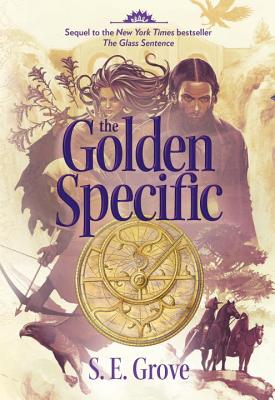
The Golden Specific

by S. E. Grove
First sentence: “Dear Shadrack, You ask me for news of the Eerie, and I can tell you that there is no recent news of them in the Indian Territories.”
Support your local independent bookstore: buy it there!
Others in the series: The Glass Sentence
Review copy provided by the publisher rep.
Content: It’s a long book, and it’s one of those that take some investment. Probably not for the younger end of the middle grade spectrum, even if it’s in the Middle Grade section (grades 3-5) of the bookstore. I’m actually wondering if these might do better in the YA (grades 6-8) section, with the Philip Pullman books…

I’ll be honest: I don’t really remember what happened in the first book. The good thing? You don’t really need to. There’s no real sum-up at the beginning (thank heavens!) but you get the sense, fairly quickly, about what’s going on. And Grove is nice enough to let us know what we need to know as the book progresses.

Which helps, because there are three story lines going here. One is Sophia’s continuing quest to figure out what happened to her parents 10 years ago. This involves going to restricted libraries and ending up across the Atlantic (accidentally by herself) in the Papal States, looking for the lost land of Ausentintia. (I read that Austen-tia every. single. time.) Her adventures there are weird and wild, and the way Grove messes with time, religion, and fantasy are quite mesmerizing. She makes new friends, particularly Errol and Goldenrod, who are fascinating additions to the world Grove has built.

The second story line is related: it’s the diaries that Sophia goes looking  for, the writing of her mother that Sophia was looking for. (This is a second in a trilogy, so there’s a lot of loose ends.) This was the least interesting part to me; yeah, I was curious about Sophia’s parents, but not especially invested in their journey, so to have the story I was interested in interrupted with this one was a bit annoying.

The third — and my favorite this time around — story line was that of Theo, who stays behind in Boston, and attempts to prove that Sophia’s uncle Shadrack didn’t, in fact, kill the prime minister. It’s a fascinating plot line, full of deceptions and intrigue. Additionally, it has the most intriguing characters; Theo’s new friend, Nettie, is the daughter of the police inspector, and absolutely delightful.

I don’t know if it’s as strong as The Glass Sentence was, but I do think that this will be a compelling series once it’s completed.

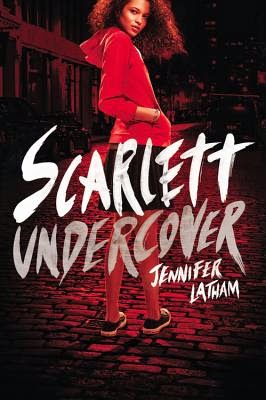
Scarlett Undercover

by Jennifer Latham
First sentence: “The kid was cute.”
Support your local independent bookstore: buy it there!
Content: There’s a bit of mild swearing (s**t) being the “worst” one, plus some kissing and references to (adult) smoking. It’s in the YA section (grades 6-8) of the bookstore, but I wouldn’t mind giving it to a savvy 5th grader.

I adored Nancy Drew as a kid. Seriously. I devoured them all. I loved the mystery, I loved Nancy Drew’s pluck. It was what I wanted.

This, however, is Nancy Drew for the Modern Age: she’s sassy, smart, and street-wise. And I loved it just as much (if not more).

Fifteen-year-old Scarlett is many things: an orphan (dad was murdered, mom died because of cancer); brilliant (she graduated from high school two years early); Muslim; and, perhaps most importantly, a detective. No, it’s not really official: she mostly does inside jobs for the Las Almas police department, and sometimes she hustles and gets a case locating something missing. Nothing that prepared her for when 9-year-old Gemma walks through her door.

Gemma’s worried about her older brother: something has happen to change him; he’s become distant, angry, and mean. But, more than that: Gemma’s convinced that her brother is responsible for the “suicide” of his (former) friend. And she needs Scarlett to find out what’s going on. Little does Scarlett realize the rabbit hole that she’s just opened up.

One of the things I loved most about this book was that Scarlett came from a religious family (she wasn’t non-religious; she just wasn’t as religious as her older sister), and there was a huge support in the surrounding community. But, it wasn’t an issue: it was just who Scarlett was. She greeted people in Arabic, she said her prayers, she observed Islamic customs and traditions. And she solved cases. It was so perfect in so many ways.

I also liked that she was sassy. She had an attitude, but one that suited her and the narrative, and it came through loud and clear. If I was my 11-year-old self, I would have adored Scarlett. (Which my mother may not have appreciated it.) I also loved that Scarlett, was capable: she got into some dangerous situations, and she had the know-how (and the tools) to get herself out. It’s really fantastic.

There is a vague hint of the supernatural — talk of djinn and portals and such — but it didn’t develop in a speculative fiction way, which actually made me very happy. I love speculative fiction, but it would have been out of place here.

I’m willing to talk this one up as much as possible; I do hope it finds a ton of readers.

Momo

by Michael Ende
First sentence: “Long, long ago, when people spoke languages quite different from our own, many fine, big cities already existed in the sunny lands of the world.”
Support your local independent bookstore: buy it there!
Content: If you can read The Phantom Tollbooth, then this one is for you. It’d be in the Middle Grade (grades 3-5) section of the bookstore.

This book is one of the reasons why, busy as I am, I won’t give up an in-person book group. (I’ve been a slacker with my on-line one lately…) While I read The Neverending Story by Ende as a child (when the movie came out…), I had no idea (and no inclination to find out, for some reason) that he’d written any other books. But, because it’s probably been 30 years since I’d read Neverending Story (or seen it for that matter; we may have tried showing it to the kids), I had no idea what to expect.

What I got was a sweet little fable. Momo is a little orphan girl that shows up in this town and moves into the old amphitheater. What endears her to the people in this town to Momo is twofold: she has a remarkable imagination, and she truly listens to them. Then one day, the grey men show up and infiltrate the town, stealing time from people. Suddenly, no one has enough time for Momo to listen to them, and everyone except the children stay away. And even the children are different. Momo happens to find out the grey men’s plan, and then sets out on an adventure to get her friends back.

It reminded me most of The Phantom Tollbooth: it was a bit on the preachy end — YEAH I get it, unplug from being busy and actually CONNECT with people — but it was also sweet and tender and had that late-60s/early-70s feel to it. It’s nothing earth-shattering, but it is very sweet.

The Map to Everywhere

by Carrie Ryan and John Parke Davis
First sentence: “Fin crouched behind a rack of bootleg flavors, trying hard to ignore the taste of rat fur and broccoli juice seeping from the grungy bottles.”
Support your local independent bookstore: buy it there!
Content: It’s kind of long, there’s some difficult made-up words, and it does take a bit of time to get into, so not really for a reluctant reader. Then again, there’s some great illustrations… Either way, it’s i the middle grade section (grades 3-5) of the bookstore.

Marrill has lived a life of adventure, following her parents around the world. Now, what was supposed to be a temporary stop in Arizona has become (mostly) permanent: her mother has cancer, and they need to stay close to doctors. But the prospect of school and a stable home doesn’t make Marrill happy.

Across the universe, Fin is the opposite: stuck in the Khaznot Quay, where he was dropped off as a baby by his mother (who then disappeared), Fin has become a master thief, mostly because he’s the guy who can’t be remembered. Literally: people look at him and as soon as they look away, they don’t remember him anymore. It’s very convenient when you tend to steal things.

But when Marrill’s and Fin’s paths cross — it has something to do with the Pirate Stream (a magical time/space continuum thing; you can sail a ship almost anywhere in the universe on it) — they end up teaming up to stop a rogue wizard from destroying the stream, and therefore the universe.

This is a perfectly fine fantasy adventure, once it got started. The main problem for me was that it took too long to get started. I almost put it down several times as I was waiting for the adventure to start, wading through the new world, and how everything connected. However, once the people and things were in place, I really did enjoy Marrill and Fin’s adventures.

I’m not sure if I’m invested in the series, but I think the kids will like it.

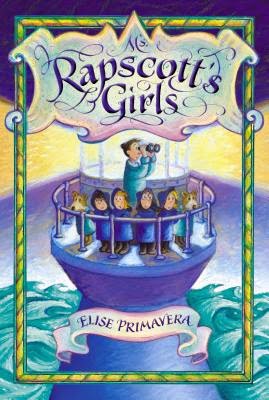
Ms. Rapscott’s Girls

by Elise Primavera
First sentence: “Attention, Busy Parents!”
Support your local independent bookstore: buy it there!
Release date: March 10, 2015
Review copy handed to me by the publisher rep.
Content: It’s a good mix of illustrations and print; while it’s out of the beginning chapter book phase, it’s a good one for reluctant readers. It will be in the middle grade (grades 3-5) section of the bookstore.

Ms. Rapscott likes things rough. An orphan at an early age, she figured out how to make her Way in Life. And this is a skill she wants to give to young girls. Especially young, neglected girls of Extremely Busy parents. At the start of this summer school term (though you wouldn’t know it by the weather at the lighthouse that serves as the school; it’s always storming), five girls are on their way — arriving by pre-paid post (yes, in boxes) — for Ms. Rapscott to mold. There’s angry Beatrice, lazy Mildred, timid Fay, and competent Annabelle as well. And, of course, Dalhlia, who was so tiny (and her parents so absent-minded) that she fell out of the box and went missing.

At first glance, it’s easy to call this one a modern-day Mary Poppins. Ms. Rapscott serves as a kind, but firm nanny (or boarding school mistress) who gives the girls cake and ice cream for dinner and pie for breakfast, and yet demands tidiness and hard work. There’s a slight magical element — flying boxes, for one, but also her assistants, two dogs who handle the day-to day operations. It definitely feels like one of those books. (I felt chastised, reading it as a busy parent, for not being more attentive to my kids. And I’m pretty attentive. Maybe I was just having a down day when I read this.)

But it’s more than that: Ms. Rapscott doesn’t just straighten up these unruly daughters of busy parents; she helps them learn to be parents. I’m not quite sure what kids will think of this — I need to get K to read it — but as a parent, I saw that Primavera was advocating for the need for variety in a kid’s life: too much pie is bad, but some pie is good. Too much TV and staying in PJs all day is bad, but sometimes, it’s what is needed. Adventure, exploring is good, and can be Learned From. But, mostly, being helpful, cheerful, and optimistic is the best. And, perhaps, that’s something we all need to be reminded of.

It’s a delightful little read.

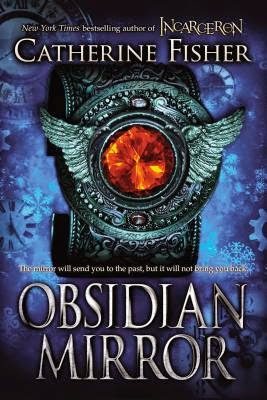
Obsidian Mirror

by Catherine Fisher
First sentence: “The boy put on the mask outside the door.”
Support your local independent bookstore: buy it there!
Content: Nothing objectionable, but it’s slow to start and is a  bit confusing. Not for the reader who gives up easily. It’s in the YA (grades 6-8) section of the bookstore.

This has been on my shelves for a long time. Seriously. I had the ARC, but gave that up, and finally, again, decided that I really needed to read this one. And I was in the mood this past weekend to indulge myself.

I shouldn’t have put it off. (Or maybe I should have: I’ve got the second one waiting to be picked up at the library. Shhhh. I know I said I wasn’t going to. But it’s CATHERINE FISHER.)

There’s three parts to this story. One is Oberon Venn, a very wealthy explorer who has spent the last two years in a depression because he was he cause of the accident that killed his wife, Leah. He will do anything to get her back. Including time travel. He and his trusty slave — there’s more to that than meets the eye — Piers are hidden out at Venn’s estate, trying to do just that: travel through time through the Obsidian Mirror.

The second player in this drama is Jacob, the son of Venn’s best fried. Who is missing and presumed dead. Or at least that’s what Jake thinks. So he’s headed, along with his unsuspecting teacher, Wharton,  to Wintercombe Abbey to force answers from Venn. Little does he know the web he will be tangled in.

The final player is the most complicated one: Sarah is possibly an escapee from an insane asylum. Or perhaps she’s a traveler from the future, a future where the mirror has destroyed the world, in order to destroy the mirror and prevent Venn from bringing his wife back.

There’s so much going on in this one, it’s hard to know where to begin. Yes, it’s slow and incredibly confusing to start with. I kept thinking “HUH?” But, I know Fisher’s work, so I stuck it out, and was richly rewarded. It’s time travel mashed with a mystery mashed with faery stories (yes, the Fey show up, and play a role), and if you give it time, it will begin to play out — it’s the first of a trilogy — in some incredible ways.

I can’t wait to read the next one.

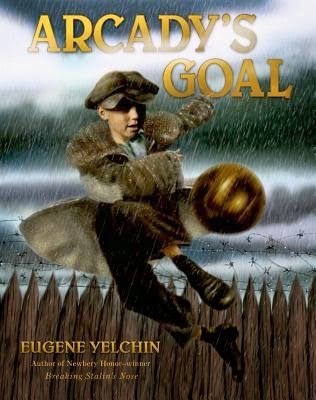
Arcady’s Goal

by Eugene Yelchin
First sentence: “I’m a risk taker.”
Support your local independent bookstore: buy it there!
Content:

Arcady is the best soccer player. Period. So much so, that when the inspectors of the home he’s been placed in come, the director makes a show out of Arcady’s skills. He — Arcady calls him Butterball — puts Arcady up against increasingly larger players, expecting him to beat them. And he does.

But, when one inspector, who’s not quite like the others, comes to visit, Arcady ends up being adopted. Which is not something Arcady bargained on. Nor he he bargain that his new father, Ivan Ivanovich, comes with secrets of his own.

One of the things Yelchin does best is humanize Stalin’s Russia. It’s so easy to push everything from that era off into Things/People were Bad. And Stalin put everyone in concentration camps. But, Yelchin gives us the stories of the children — Arcady ended up in a home because his parents were taken for being enemies of the state — and how Stalin’s policies affected everyday life. They’re simple stories, but they paint a picture of a people who were wronged — even if they weren’t taken — by their leader.

It’s a simple little book, full of illustrations. And there’s a lot of talk about soccer, so there’s an appeal for the soccer lovers. But mostly it’s a portrait of a relationship between to damaged people, and the path to healing.