Two Middle Grade Verse Books

I read these two back to back while getting my hair done a while ago. And since they were so similar in style and tone, I figured I needed to review them together.

Eva of the Farm
by: Dia Calhoun
ages: 9+
First sentence: “On top of the hill, I lean against the deer fence and write a poem in the sky.”
Support your local independent bookstore: buy it there!

Twelve-year-old Eva lives on her family farm in Eastern Washington. For the most part, she’s been happy, but tough times have hit the area, and things are Changing for her. Her best friend’s family lost their farm and had to move to Seattle, and they’ve grown apart in the months since. And since finding out her family’s finances — not to mention the mounting medical bills from her younger brother’s illness — were more than precarious, Eva’s been trying to find ways to help, to find Hope in her life again.

For the most part, the book is a lovely verse novel. I liked that Calhoun tackled the plight of small farmers, and how hard it is to keep the small family farm going in this era of Big Farm. I enjoyed the imagery, and I especially liked the relationship Eva has with the Bead Woman, and the things about Hope and Love she learns. The thing that didn’t work for me was the poetry within the poetry. See, Eva’s a poet, and her poetry played a big role. But I almost felt like it was overkill: to have a novel in verse, and then throw in extra poetry. It just didn’t work for me. (And, yes, I skipped all the poems.)

But, otherwise, it’s a lovely little book.

Looking For Me
by: Betsy R. Rosenthal
ages: 9+
First sentence: “I’m just plain Edith.”
Support your local independent bookstore: buy it there!

This one is a slim historical book about a large Jewish family in Baltimore based on the author’s mother’s life. Edith is number four in a family of 12 children, growing up during the Depression. Her father is remote, trying to make ends Follow my blog with Bloglovinmeet running a diner. Edith doesn’t really know who she is: she’s always being bossed around by her older siblings and being expected to take care of her younger ones. She doesn’t think she’s the brightest person (she doesn’t know all the big words, and she can’t spell terribly well). But she has a good heart.
 
While enjoyable, Looking for Me lacked the emotional punch that I wanted from this story. Maybe it had something to do with the form — though usually, verse novels don’t turn me off — but, I wanted more from this one. There’s a death that wracks the family, but I felt… nothing. I wanted to feel pain and hurt, and hope when Edith began recovering, but I was kept at a distance by the novel, and I found that ultimately disappointing. Also, while she got the business and crowdedness of a big family, she missed, somehow, the deep friendship and love that exists in a family that large.

It wasn’t bad, but it wasn’t brilliant either.

Follow my blog with Bloglovin

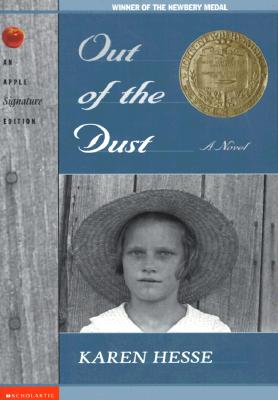
Out of the Dust (reread)

by Karen Hesse
ages: 11+
First sentence: “As summer wheat came ripe, so did I, born at home, on the kitchen floor.”
Support your local independent bookstore: buy it there!

My original “review”, from a long, long time ago was this: “Out of the Dust, Karen Hesse: Free-verse poetry about the Dust Bowl in Kansas. I’m not crazy about the free-verse idea; I found it difficult to ‘get into’ the story.”

First off: I was wrong. It’s the pan-handle of Oklahoma, not Kansas. Now that I live here, that’s a very important distinction to make. We’re not just all plains states lumped into one category out here.

Secondly: I’ve come to  actually really like novels in verse. And I think it suits this book; it’s spare like the environment is out here, especially during the Dust Bowl in the 1930s. It works as a form, and it doesn’t bog the story down.

That said, this book is SO depressing. 

It’s the story of Billy Jo, age 14, in 1934, the height of the Great Depression. It’s just her and her parents, out on the prairie; her father keeps trying to beat the odds and grow some wheat. Her mother is pregnant when tragedy strikes and both she and the baby die. Billy Jo, who is also injured in the accident, and her dad stick it out, trying to make everything work, even as it all is falling apart.

See? Not exactly cheery.

Other than elegance of the form and the depressing story, there isn’t much to say. It’s not my favorite out of the Newbery winners, but it’s not too bad, either.

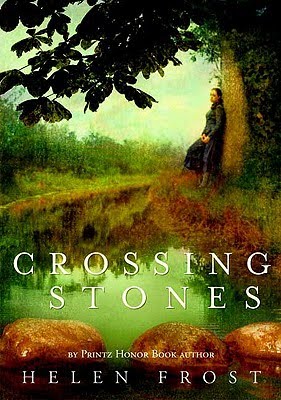
Crossing Stones

by Helen Frost
ages: 14+
First sentence: “You’d better straighten out your mind, Young Lady!”
Support your local independent bookstores: buy it there!

Muriel Jorgensen is living a pretty ordinary life in late-1917’s Michigan. She’s about to graduate from high school, and she’s not terribly thrilled with President Wilson’s decision to enter into World War I. Her friend (and possible beau) Frank has decided to join the army, to go serve in France. And then her younger brother Ollie sneaks away to join up, also. What is Muriel to do, especially when she wants to do something, but everyone tells her that girls can’t do much of anything, except cook, clean, and have babies. Thankfully, there’s Aunt Vera and the suffrage movement to help Muriel figure things out.

That sounds trite, but this novel is anything but. Helen Frost has a way with words, yes — it’s a novel in verse, and Frost finds ways to do things with form that make the novel beautiful to look at as well as read — but it’s more than that. She’s written about a time in American history that I don’t think we talk about much anymore. There’s incredible relevance though: the impact of war, both on the boys who served as well as their families and communities. It’s a very pacifist book; the implicit message is that there is no such thing as a “good” war. Or, at the very least, all war has negative consequences. Combined with that is Muriel’s desire to speak out against the war, to find a way to express her opinion, which is difficult, considering there is no outlet for women at that time. Enter the suffrage movement, and the impact that it had on this country (women didn’t get the right to vote until 1920? Really? If I knew that, I’d forgotten.). There were brave women; not just the leaders of the movement, but the individuals out there trying to make a difference. But, most of all, this book is a moving story, powerful in its simplicity.

Another reason to really love novels in verse (and Helen Frost).

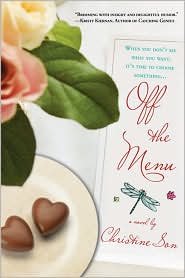
Off the Menu

It’s not often I get a request to be a part of a book tour, and so when I got an email about this one, as part of the TLC book tours, I jumped at the chance.

The novel follows three Asian-American women — Whitney, Hercules and Audrey — two of which are children of immigrants (the other is an adopted child of rich, white parents). All three were valedictorians of the same high school, and have kept up their friendship (albeit a slightly competitive friendship) ever since. It’s an interesting look at women and friendships, Asians and achievement, and how friendships and dreams and parents all work together (or not).

I don’t think I went in with any expectations — good or bad — but I invariably compared it to the Amy Tan novels I read. (I’m sure that Son is going to get a lot of those comparisons…) And I didn’t find it lacking. In fact, while I didn’t get the same cultural feel that one gets from a Tan novel, I did find I could relate to the characters on a more visceral level. Sure, they’re younger than I am and Asian, but what woman (or man) doesn’t have problems with their parents sometimes? Or their friends? Or harbors secret dreams of doing something other than what society expects of her (or him)?

In addition, I liked the characters. Hercules is a vibrant character — brash and abrasive, yet lovable and approachable. She was my favorite, I think, because she worked so hard, and cared so much and yet was completely clueless as to how to show it. I think I liked Audrey the least — she’s brilliant, beautiful, rich, loving, with a totally supportive man… in short, completely perfect. Sure, her mom’s a total control freak, but that didn’t do enough to humanize her in my mind. In fact, when her dreams all worked out for her in the end, I just rolled my eyes. Whitney was somewhere in the middle — good, perfect even, but had enough challenges to make her seem less goddess-like than Audrey came off.

Son managed to balance the three perspectives quite nicely; I never felt like the story was choppy, or that any of the lesser characters were slighted for Whitney’s story (even if hers felt like the main one). My only real complaint is that I felt confused with the passage of time; the events of one chapter would unfold, and then the next would take place three weeks, or six months later. It would always take me a bit to catch up and figure out when everything was going on.

But that’s a minor quibble. On the whole, it was a good, interesting read.

Don’t forget to check out the rest of the tour!
Friday, November 7th: Ramya’s Bookshelf
Monday, November 10th: Pop Culture Junkie
Tuesday, November 11th: 8Asians
Wednesday, November 12th: Savvy Verse and Wit
Thursday, November 13th: In The Pages
Friday, November 14th: She is Too Fond of Books
Monday, November 17th: Planet Books
Tuesday, November 18th: B & B ex Libris
Wednesday, November 19th: DISGRASIAN
Thursday, November 20th: Booking Mama
Monday, November 24th: The Literate Housewife Review
Tuesday, November 25th: Feminist Review
Wednesday, November 26th: Diary of an Eccentric

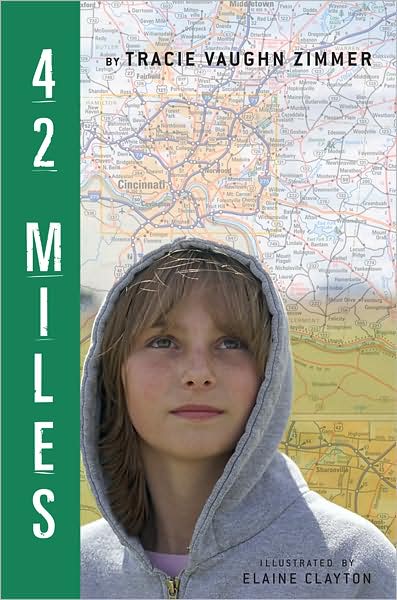
42 Miles

Continuing my light, quick and delightful reads…

JoEllen is the child of a divorce. With her mother, she is Ellen, lives in the city, going to movies and eating Chinese take-out. On weekends, with her father, she is Joey, and lives a carefree life on the farm. It’s hard keeping up a dual life, and shortly before her 13th birthday, JoEllen decides to take charge and not only bring her two halves of her life together, but forge a new one for herself.

This book’s charm, however, isn’t in its plot. It’s written in verse, and while I still have a “thing” about poetry, I’m finding that I manage to “get” novels written in verse. I liked JoEllen’s voice, I loved the poems. I am always amazed that an author, in this case Tracie Vaughn Zimmer, can pack so much into so few words. I also felt that Zimmer caught the feelings of a divorced child (or what I imagine a divorced child must feel, not having experience there myself), being torn between two parents, two worlds.

While I wasn’t blown away with excitement over it, I did enjoy the time spent, and I even managed to come away with a favorite poem, which interestingly enough is about poetry, and which I think captures the essence of the book perfectly:

The Poems I Like Best
The poems I like best
wear classic black
with vintage accessories
and smell like a new book,
and the spine just cracked.
They’re the chitchat overheard on a city bus
or nonsense
volleyed between toddlers
on swings at the park.

My favorite poems
squeeze your hand
on a crowded street and say:
Look.

The poems I like best
wear blue jeans
and smell
like the tack room of a barn:
worn leather and horse.
They’re the varied verses
of a mockingbird’s song
or syllables traded between brothers
scratching scruffy chins
over the dark mysteries of an engine.

My favorite poems
hold a wooden spoon of words
and whisper:
Taste.

(Just for the record: because this is a Cybils nominee, I’ve been asked to make sure y’all know this is my opinion only, and not that of the panel. Thank you.)