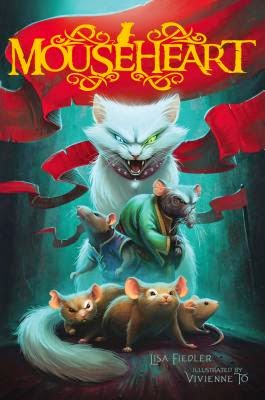
Mouseheart

by Lisa Fielder, illustrated by Vivienene To
First sentence: “The young rat prince knew he was taking a monumental risk.”
Support your local independent bookstore: buy it there!
Review copy given me by our Simon & Schuster rep, via my boss.
Content: There are some mild scary parts, and some mild violence, but really, it’s quite happy in the middle grade (grades 3-5) section of the bookstore.

I have to admit that I was a little turned off by the cover. It just looks so…. I don’t know. Juvenile, maybe. Or lame, perhaps. But, either way, I was completely unprepared for the awesome found inside.

I do have to qualify the word “awesome”: if you don’t like fantasy or talking rats, you may not find this awesome at all. The thing is: usually I don’t either. I liked  The Tale of Despereaux well enough, and Mrs. Frisby and the Rats of NIMH okay, but I didn’t like Redwall, and I have studiously stayed away from the Warriors series. So, talking animals, not exactly my thing.

But the story of a pet-store bred mouse, Hopper, who — ends up beneath the subways of Brooklyn in the sewers — got to me. Perhaps it was his insecure optimism that won my heart over. Or the fact that his sister, Pinkie, was a bully and my mom-sense (kind of like Spidey-sense) kicked in. Or perhaps it was that he found a civilization of rats underground that has a tentative peace with feral cats. Or maybe it was the prophecy of the Chosen One, and the complications that brings.

What I really enjoyed was the way that Fiedler had the rats interact with the human world. How they taught themselves to read, and how Hopper figured out the subway system. How they used cast-off items (and some scavenged ones, too) to furnish their world. It was fantastic.

Maybe, too, I was just in the mood for a straight-up fantasy adventure with talking rats and a mouse with a heart of gold. I didn’t know that I was, but I found I couldn’t put this one down.

The Inventor’s Secret

by Andrea Cremer
First sentence: “Every heartbeat brought the boy closer.”
Support your local independent bookstore: buy it there!
Content: There’s a couple of intense romantic moments, and the characters talk of “wanting” each other, but no actual physical contact takes place other than kissing. There is talk of an affair a character’s dad had, and there is quite a bit of violence. It’s in the YA section (grades 6-8th) but I wouldn’t blink at giving it to a savvy 5th grader.

It was the cover that caught my eye. The steampunk dragonfly with the explosion in the background promised really cool things. And since I hadn’t read any Cremer before (she of the Wolf series), I wasn’t really expecting anything.

So, I was more than blown away when I was pulled into an alternate history where the American Revolution failed, Boston converted to a maximum security prison, and the “traitors” were hanged for their crimes against the crown. And they were the lucky ones. In the years since the failed revolution, the Empire has just become stronger and more stratified. The elite live in the Floating City, New York City, in levels rising up into the sky. The lower you are, the worse off. There’s still a rebellion, out in the woods outside of the city, where the adults are trying to topple the Empire. And the children? They’re in the Catacombs, underground, safe from harm until they turn 18 and go to join the rebellion.

The Catacombs is all Charlotte remembers. She and her older brother, Ash, have been there since they were 5 and 7, respectively. And now, at nearly 18, Ash is in charge. This is where the plot gets a bit tricky to describe. Too much, and it sounds silly. And maybe it is.  I do know there was more romance than I was expecting, and it was a bit hackneyed and overwrought as well. But I loved the world. I loved the combination of history and mythology and technology. I loved how the class issues were at the forefront. I loved the imagination that Cremer put into the book, the cool little things — like mice bombs, or Pocky the gun — she littered everywhere.

No, it’s not perfect. Far from it. But it IS fun. And that’s exactly what I needed right now.

All These Things I’ve Done

by Gabrielle Zevin
First sentence: “The night before my junior year — I was sixteen, barely — Gable Arsley said he wanted to sleep with me.”
Support your local independent bookstore: buy it there!
Content: There’s talk of sex and a lot of kissing, but nothing graphic. And there’s talk of violence, but again, nothing graphic. It’s in the YA section (grades 6-9) of the bookstore.

This one is a hard one to sum up, partially because the world Zevin created is so complex. It’s futuristic, but not exactly a post-apocalyptic or dystopian. It’s a world where things are strictly rationed, and coffee and chocolate and books are illegal. So, much like alcohol in the 1920s, there is a strong black market for those items. And our main character, Anya Balanchine (her friends call her Annie), is part of the Balanchine mafia family that has a strong presence in the chocolate market. Her father was the head of the family until he was shot and killed (in front of her) when she was 9. Annie and her older brother, Leo (who is slightly mentally disabled due to another hit meant for her father that killed their mother and disabled Leo) and younger sister Natalya have been raised the past 7 years by their grandmother, whose health is slowly failing.

Over the course of the year, things spin out of control for Annie. Her ex-boyfriend, Gable, ends up poisoned by chocolate, and Annie ends up in juvenile prison because of that. She falls for and dates the son of the assistant DA, in spite of the extreme pressure to break it off. She stresses about Leo, especially since he begins working for the family. And her grandmother finally passes away.

All that managed to fill up the book, which I wanted to like very much. But, aside from world creation, there really isn’t much there. Annie is a fascinating character, but I got tired of her waffling. I wanted her to step up and take charge. It’s not good when the most interesting character is the head of the Japanese mafia family who shows up for probably 10 pages. I hoped for more out of this one, and was disappointed.

I might give the second one in the series a try, just to see if it gets any better.

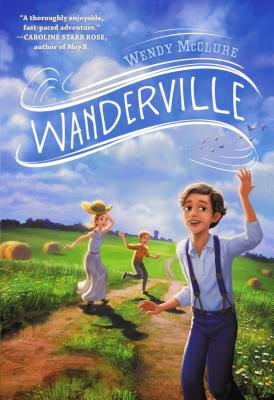
Wanderville

by Wendy McClure
First sentence: “Jack didn’t notice the smoke until there was far too much of it.”
Support your local independent bookstore: buy it there!
Content: There’s a some bullying and a fire that kills a family member of a main character, but that’s about it. It’s short enough to be a beginning chapter book, but it might be too challenging for most 1st and 2nd graders. Definitely belongs in the middle grade (3-5th grade) section of the bookstore.

Jack lives in a walk up in New York City in 1904. Their family is poor, but making it. That is, until a fire takes both their building and the life of Jack’s older brother. Frances and her younger brother Harold are orphans and living off the charity of one of the many orphanages in the city. Both find themselves on a train headed west, as part of the efforts of the Society for Children’s Aid and Relief Office. But, as all three find out, the best intentions of adults don’t always translate into good things for kids.

Faced with being separated from her brother, and looking forced labor in the eye, Frances, Harold and Jack decide to jump off the train before they reach their final destination. They’re wandering the Kansas prairie when they find Alexander, another orphan train escapee. He’s decided to start his own town, called Wanderville, and while it doesn’t look like much (or anything, really) it’s not his own. Unfortunately they way they get supplies is by “liberating” them from the nearby town. Which, obviously, is going to lead to trouble.

I wanted to like this one. It’s got a good idea — exploring the world of the orphans from the orphan train — and it’s set here in Kansas. I was hoping that it’d be a good contribution to historical/Kansas middle grade fiction. But it’s not. Perhaps it was me, but I didn’t like the characters, and felt the text itself was too condescending and predictable. I felt that if I had a checklist I would have ticked every single cliche off.  Bully on the train? Check. Evil man exploiting the system for his own gain? Check. Rugged and slow cop? Check. Sisterly figure who always knows better than the boys? Check. Adorable 7-year-old who is Wiser Than His Years? Check.) That’s not to say that kids won’t like it. I’m sure many will.

I just didn’t.

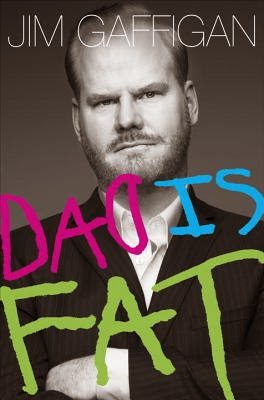
Audio book: Dad is Fat

by Jim Gaffigan
read by the author
Support your local independent bookstore: buy it there!
Content: Some mild swearing (like, less than a dozen times) and it’s all about parenting, so I’m not sure how many kids would be interested. It’s in the humor section at the bookstore.

Jim Gaffigan is a comedian (whom I hadn’t heard of) and a father of five kids. In New York City. He lives in a two-bedroom apartment in a five-story walk-up. And as you can imagine, all this leads to an immense amount of hilarity, most of which he turns into comic gold. (Well, not gold, really.)

Like most comedians (and humor really), it’s really quite subjective. This one tickled my funny bone, partially because I could relate to it (one tweet I sent out: “So true: ‘When children see animals in captivity, it makes them want ice cream.’ – Jim Gaffigan), perhaps because I have nearly as many kids as he does. And partially because he’s honest about himself and his abilities as a parent. I want to sit down with him, swap horror stories, and say, “Yeah, I think I suck at this parenting gig, too.”

I’m not sure I would have liked it if I had read it, but Gaffigan is a terrific narrator of his own material (see: stand-up comedian), and I often found myself guffawing (yes, I do guffaw) along with his hilarious and often ridiculous (see: five kids in NYC) stories. As I was telling a friend of mine: there’s nothing like listening to the war stories of someone who’s got it more challenging than you to make you feel good about your life.

And this was a thoroughly diverting ego boost.

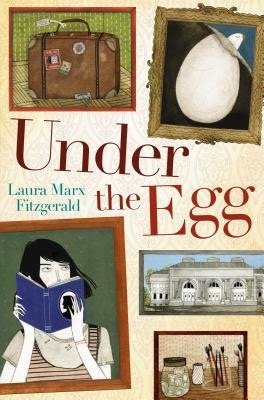
Under the Egg

by Laura Marx Fitzgerald
First sentence: “It was the find of the century.”
Support your local independent bookstore: buy it there!
Content: There some descriptions of horrible events, but nothing graphic. I think younger readers might have problems with the languages — there’s French and Latin, though translations are provided — and some of the names, but it’s in the middle grade (grades 3-5) of the bookstore, and I think it fits there.

Theodora (call her Theo) Tenpenny is the granddaughter of an artist and the daughter of an extreme introvert. She lives in what was once a grand old New York City house, but over the years has become neglected. Her grandpa Jack has kept everything reasonably in shape over the years and has managed to keep the family afloat by being mostly self-reliant. But since he was hit by a car and died (which seems overly gruesome for a guy in his mid-80s), Theo’s been in charge. And she’s struggling.

That is, until she takes her grandfather’s last words — “Look under the egg” — literally, and discovers that he’s been hiding a very old painting underneath the one of an egg that’s been hanging over their mantelpiece for years. Because she’s spent her life in her grandfather’s shadow, going to the Met and other art museums, Theo has a good eye, and realizes at once that this painting is something special. Something, perhaps, worth a lot of money.

However, as she and her new friend, Bodhi, find out, declaring a painting a lost work by a master is easy. Proving it is another matter. Especially when it turns out that this could be looted Nazi treasure.

On the one hand, there’s a lot of information to be had in this slim book. Both art history as well as WWII history play a major role in the plot. But I think that Fitzgerald handles it well, even if all the information and history might make it harder for younger readers to get into the book. But, she gave us a couple of great characters in Bodhi and Theo; they really are a team that works well together. I enjoyed the old-fashioned sleuthing to solve the mystery of the painting, and I liked how the history fit into the larger picture. I did find the ending to be a bit convenient, but even that was explained in a reasonable (if somewhat implausible) manner.

In the end, a highly enjoyable book.

The Diviners

by Libba Bray
First sentence: “In the town house at a fashionable address on Manhattan’s Upper East Side, every lamp blazes.”
Support your local independent bookstore: buy it there!
Content: There wasn’t any language (at least that I noticed), and there was only illusions to sex. What puts this in the Teen (grades 9 and up) section of the library is the violence. There are 5 gruesome murders, spouse abuse, and other assorted violence. And then there’s the whole occult/creep factor, not to mention the teenage drinking. However, I’d give it to a 12- or 13-year-old if they weren’t overly sensitive.

Evie hates her small-town Ohio life. She’s a modern ’20s woman, and hates being shackled, especially by her Prohibition-supporting mother. So, when Evie makes big blunder with her talent for “reading” objects — she accuses the town’s Golden Boy with knocking up a maid — and she’s shipped off to Manhattan to stay with her admittedly odd uncle, she’s more than happy. She’s thrilled: finally, her life can Begin!

But while Evie makes some good friends, and goes to a couple of thrilling events, things aren’t all coming up roses. There’s a serial killer out there, brutally murdering people and leaving occult signs on the bodies. Her uncle — who runs the Museum of American Folklore, Superstition, and the Occult — has gotten involved with the investigation into the murders, and Evie, being the Modern Woman that she is, weasels her way into that. Which brings a whole mess of problems.

One of the strengths and weaknesses of Bray’s book is that Evie’s isn’t the only story. Bray is weaving a huge tapestry here, with multiple story lines that weave in and out of each other. She’s setting up a huge confrontation, of which the murders only play a small part, but I didn’t mind because the characters themselves were so engaging. To the tortured Ziegfeld star Theta, to the daughter of union supporters Mable, to the charismatic thief Sam, to the tortured Jericho, to the African American bookie runner Memphis, they were all characters I wanted to spend time with and get to know. But in many ways, there was almost too much. The book comes in at nearly 600 pages, and it’s only a first in a series. That’s a lot of set-up going there. And while the overall plot line — the murders — gets resolved, the last 40 pages are spent setting up the next book, which dampened my enthusiasm for it.

But dampened isn’t a dislike. There really is so much to love about this one, from the creepy to the characters.

Better Nate Than Ever

by Tim Federle
First sentence: “I’d rather not start with any backstory.”
Support your local independent bookstore: buy it there!
Content: There is some bullying, a bit of swearing, and some frank talk about sexuality and alcoholism. I probably wouldn’t give it to a third grader (it just feels more mature than an 8-year-old, but you know your kid), but a 4th or 5th grader would be fine with it. It’s in the middle grade (3-5th grade) section of the bookstore, though the library has it in the teen section (which surprised me).

Nate Foster is a 13-year-old kid living in the blue collar town of Jankburg, PA (just outside of Pittsburg). His dad is a “maintenance engineer” and his mom runs a slowly dying flower shop. They have put all their hopes, dreams, and expectations on Nate’s older brother, Alex, the sports star. Which leaves Nate as the… well… outcast. It doesn’t help that he’s a Broadway musical fanatic, knowing them all, singing away, quoting incessantly. Which leaves his family (and the town) baffled.

Of course, Federle is playing off of stereotypes here: people in blue-collar towns are (obviously) backward and don’t understand Culture. People — boys especially — who like musicals are (obviously) gay. (There is much too much discussion about Nate’s sexuality here. And while his position is “I’m 13, how would I know if I were gay?” it bothered me that musicals are, necessarily, lumped in with being gay. Can we just get over that, now, please?) Boys who are short, overweight, and awkward are (obviously) bullied at school (and by his — jerk is not a strong enough word — older brother).

When Nate finds out about open auditions for a new musical based on the movie E. T. he jumps at the chance. And because he knows his backward parents would never let him, he takes the opportunity (with the help of his friend Libby) to run away to the auditions. He was supposed to go there and back again in a day, but (of course) things don’t quite work out. Which brings us to another cliche here — the kid from the backward blue-collar town has NO IDEA how to make it in New York City. (Which may be true, having never run away to the big city when I was 13.)

Even with all the cliches and stereotypes, this wasn’t a terrible book. And I think what saved it, for me at least, was Nate himself. Federle caught the voice of an awkward, insecure, hopeful kid someone who has been beaten down his whole life, and yet still remains optimistic about everything. He’s adorable, and heart-warming, and just plain fun. It was this that kept me reading, and when I finished, it was this that made the book a good one for me.

Additionally, it’s one of those books that’s good to have out there, if only because it addresses stereotypes. There aren’t that many books out there where the male main character gets to be something other than stereotypically male. Hopefully, boys will pick this up and give it a shot. If only to increase their empathy.

There’s a sequel — Five, Six, Seven, Nate — which just came out. I may even like Nate enough to give that one a shot.

The Impossible Knife of Memory

by Laurie Halse Anderson
First sentence: “It started in detention.”
Support your local independent bookstore: buy it there!
Review copy snagged off the ARC shelves at my place of employment.
Content: There’s a fair amount of swearing, but no f-bombs (I’m pretty sure, anyway), and some violence (some of domestic) and drinking and drug use, some of which involve teens. For that reason, it’s in the teen (grades 9-12) section of the bookstore.

Part of me wants to get off doing the easy thing here and say, “It’s Laurie Halse Anderson’s newest book. OF COURSE YOU SHOULD READ IT.”

Because, really? That’s all you NEED to know.

But, I suppose, you would like to know the plot?  Okay…. Hayley, 17, returns to school after being on the road with her rig-driving, veteran father for the past five years. The reason they move back to his home town is that he can’t seem to keep a job anymore. And that seems to be the case, now. Her father (who had several tours in both Iraq and Afghanistan) spends his days and nights drinking and smoking pot. How could she WANT to go to school and “assimilate” when the life of someone she loves is going to hell?

Or perhaps the reason you should read this (other than it’s Laurie Halse Anderson)? Because even though Anderson writes about PTSD, she doesn’t just write about the disease. She writes about the people.  The people you come to know and love. And she doesn’t just write about the disease, she writes about the issues surrounding it, like how hard war is on both the vets and the families; and how the community, however well meaning they may be, doesn’t always understand how hard war is; and like how no matter how much you love a person, they’re not going to be able to get help until they want to get help.

And then there’s Finn. Oh, man, I fell for him. But I don’t want to make it seem like this is a love story (it’s not, even though there is kissing! In a pool!) or that he saves the day (he doesn’t, though he is a catalyst and a support).

No, you should read this because it’s the story of a father and a daughter who have lost their way, and how they find it again.

Or you could just read it because it’s Laurie Halse Anderson.

The Wells Bequest

by Polly Shulman
First sentence: “The Wednesday when the whole time-travel adventure began, I was fiddling with my game controller, trying to make the shoot button more sensitive.”
Support your local independent bookstore: buy it there!
Content: The main character is a bit obsessed with the girl (too much for my taste in a time-traveling, science fiction adventure book) and there’s a terrorist threatening to destroy NYC. It’s in the middle grade (3-5 grade) section of the bookstore, though I personally would hesitate before giving it to just any third grader, though I’m not sure I could pinpoint why.

Leo is the son of Russian immigrants who really only expect two things from him: excellence and to be scientifically minded. Leo — for better or for worse — is neither of those. At least not in the traditional sense. Leo is a Tinkerer. He loves taking things apart and putting them back together. He loves building new and better things. Which makes him perfect for the page program of the New York Circulating Material Repository. He gets there in a weird, round-about way, though: a time-traveling version of himself and an unknown girl (Jaya Rao, who was in the first book of this series The Grimm Legacy. Thankfully this one stands on its own, however.) stops in his room to tell him to read H. G. Wells’ The Time Machine.

I’d like to say that an adventure starts there, and there is a bit of an adventure that involves NikolaTesla, Mark Twain, and a crazed British page that has a raging crush on Jaya. I while I did enjoy reading this book, mostly I felt like it was a set-piece for Shulman to show off all the Really Cool Things that could come from reading science fiction books. There are many references to classic science fiction (which I got, but I wonder how an elementary school student would handle) and the inventions that come out of them are really neat. But I felt like that was the entire point of the plot. And I kind of wanted more action and less cool inventions.

(There’s also the side issue of Leo being Obsessed — though not in a crazy way — with kissing Jaya. I know he’s a hormonal pre-teen boy, but get on with it already. It’s a science fiction time travel book. I felt like it was a distraction.)

Even with my qualms, it was a fun story. And I’m curious about the first one as well.

(Just for the record: because this is a Cybils nominee, I’ve been asked to make sure y’all know this is my opinion only, and not that of the panel.)