Anya’s Ghost

by Vera Brosgol
ages: 14+
First sentence: “What’s for breakfast?”
Support your local independent bookstore: buy it there!

When you pickup a graphic novel that has a blurb from Neil Gaiman on the front (“A Masterpiece!”) and has been getting a lot of buzz, you invariably have high expectations.

And in many ways this graphic novel lived up to my expectations. Dealing with issues of inclusion, it tells the story of teenage Russian immigrant Anya Borzakovskaya, . Sure, she’s been here since she’s 5, and sure, she doesn’t have much of an accent, but she does have the baggage that many children of immigrants have: parents who can’t speak English well, traditions that are held over from the old country, a funny last name that she’s embarrassed about. She’s struggling at her private school; her mom wants her to be friends with the other Russian kid, Dima, who’s just the world’s biggest nerd. All she wants to do is skip and hang out with her one friend, Siobhan, and smoke.

Then she falls down a hole and meets a ghost. Not just any ghost, but one that wants to stay with Anya, and help her, and experience life. Creepy, no?

Well, yes. It’s a ghost story after all. Which is what disappointed me. I wanted more creepyness. I wanted to be scared out of my skin, and while I got a little bit of my wish near the end, I was disappointed that it wasn’t as scary as, say, Coraline.

That’s not to say it doesn’t work: it does, as one of those good-girl-at-heart-finds-her-way-back-into-the-fold books. Just not as a ghost story.

At least, not for me.

Nerd Camp

by Elissa Brent Weissman
ages: 9+
First sentence: “It was so late that it was almost tomorrow.”
Support your local independent bookstore: buy it there!

Gabe is a nerd. Seriously. He’s smart, he loves math and poetry and reading, and he’s just been accepted into the Summer Center for Gifted Enrichment — a six-week sleepaway camp that you have to take a test to get into.

He’s okay with all this — well, in fact, it’s more than okay: he’s really, really excited — until he meets his soon-to-be stepbrother, Zach. Who is not a nerd. In fact, he is disdainful of all things nerdy. Gabe doesn’t quite know how to react to that: he really, really wants to get along with his new brother (he’s always longed for a sibling), but he doesn’t want to give up all the things he loves.

Thankfully, there’s SCGE camp to help him out: are the adventures he has over the course of the summer negated by their nerdiness, or cool in their own right?

I adored this book. Seriously. Perhaps it’s because I’m a mother of nerds, and one myself, but I thought Weissman just got the whole nerd kid culture — not  to mention that wonderful awkwardness of being 10-years-old — spot-on. Every little thing, from the awkwardness around new girls to the learning pi to the 20th digit, was adorable. (Perhaps I shouldn’t call a boy book adorable. It’d turn the boys off. But seriously, it was.) I loved Gabe from the get-go, and it didn’t take long for his camp friends Wesley and Nikhil to grow on me, either. I also really, really wanted to go to the camp. I’m not much into logic proofs, but Weissman made them seem really, really cool.

The only down side was that I felt Zach was a little shallow: all “cool” kids aren’t down on reading or horrible at spelling. (There’s also the side issue of why everything has to be either/or: do we really have to be smart OR cool? Maybe in 5th grade, yes…) But, because Zach was hardly a character, it didn’t bring the awesomeness level of this one down.

I suppose the question, in the end, is: will the boy nerds read this one? I hope so. Really.

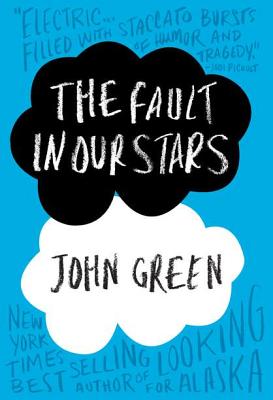
The Fault in Our Stars

by John Green
ages: 14+
First sentence: “Late in the winter of my seventeenth year, my mother decided I was depressed, presumably because I rarely left the house, spent a lot of time in bed, read the same book over and over, ate infrequently, and devoted quite a bit of my abundant free time to thinking about death.”
Support your local independent bookstore: buy it there!

I love John Green, the person. I adore his blog, think he’s a smart, insightful, funny guy, and would absolutely love to have him (and his wife and kid) over for dinner sometime.

I have not, however, been a really huge fan of his books. Saying that almost makes me an outcast in Nerdfighteria, but I’ll live with that. Sure, he has moments of brilliant hilarity, but I have always thought that he tries too hard to be Deep, which too often comes off as pretentious.

That said, I think he’s one of those writers that as he gets older, he gets better. I’ve liked each one of his books better than the last, thinking that maybe he’s figuring out the balance between angst and thoughtfulness, human observation and invention.

Which leads me to The Fault in Our Stars: I honestly can say that this is a John Green book that I loved. Seriously, wonderfully, amazingly loved. (No, I didn’t cry. I’d figured it out before it came along, and I managed to steel myself, but I do admit that I was moved.)

Hazel is 16 and dying of cancer. Sure, she’s had a miracle drug that’s prolonged her life, but really: she has cancer, she is slowly dying, mostly because her lungs are “crap”. Tethered to an oxygen tube, she basically exists, waiting to die. Then she meets Augustus Waters. Hot, amazing, full-of-life (even though he’s got cancer as well), Augustus Waters. We get to watch them slowly fall in love, as they share Thoughts, and Books, and Ideas, and Hopes, and Fears. Sure, there’s an improbable trip (cancer perk!) to Amsterdam to meet the douchebag author (as M called him) of the book that Hazel adores (and Augustus grew to love as well).

But really it’s mostly one of those books that Makes You Think. But, this is where John’s gotten better: it’s not pretentious. Really. The emotions are honest; the cynicism, the reflections, the quoting of improbably sophisticated literature all works in this context. And yes, it is heartbreaking and hilarious, as everyone promises.

In other words, if you want the best that John Green has to offer, this is it. (Until he writes another book.)

Nerds Heart YA, Round 1: 8th Grade Super Zero vs. MindBlind

8th Grade Super Zero
by Olugbemisola Rhuday Perkovich
ages: 12+
First sentence: “Everyone know’s what’s up, because it’s the first day of school and I set the tone.”
Support your local independent bookstore: buy it there!

Reginald Garvey McKnight did not start the school year off well. Which means, for this eighth grade year, he’s stuck in loserville because of an unfortunate vomiting incident on the first day of school. Reggie’s content putting his head down and just surviving, even with the constant (nasty) teasing by his former friend Donovan. But then his church youth group does a service project at a local homeless shelter. For many reasons, this moves Reggie, and suddenly what was going to be a low-key year of just surviving becomes something more. And as he gets involved, he finds that he’s becoming something more.

I loved the characters of this one — the ethnic and religious diversity, as well as just their genuine heart — as well as the issues it discussed. It’s very broad: there are issues of homlessness and community responsibility, as well as religion, bullying, race relations, sibling rivalry, as well as a parent that’s unemployed. You wouldn’t think with so much going on that it would work, but it does. Perhaps because it’s a slice of life: the conflict is minimal, though real, and lets Reggie’s inner struggle and questions shine. I also liked how it treated everyone (even the bullies) with respect.

MindBlind
by Jennifer Roy
ages: 12+
First sentence: “Open File: C:\MyFiles\genius\first_time.avi (Date: 1/14/99)”
Support your local independent bookstore: buy it there!

Nathaniel Clark is not a genius. He’ll be the first to tell you that. Sure, he’s 14 and has graduated from college already, and yeah, so he has Asperger Syndrome, but in order to be a “genius”, he needs to have use his talents to make a contribution to the world.

Getting through daily life seems to be quite all he’s able to do, with his math, and the friends he does have — Molly, his bowling partner; Cooper, the boy next door; and Jessa, a friend that Nathaniel wants to be more than a friend — and keeping everything in check, so he can appear “neurotypical.” And that’s not even mentioning his stubbornly obtuse father.

As we follow Nathaniel around, we get to know him and his quirks, how he thinks and feels, and experience the world from his fascinating perspective. We learn about his life through flashbacks (he accesses his memories as computer files and watches them like movies). We experience good times, when he’s doing well, as well as times when he crashes and retreats into N-world, his own safe place.

It’s all very captivating and interesting, but Nathaniel is also more than that: he’s a winning character, a sympathetic person: fascinating and engaging and cheer-worthy.

Decision:
It was difficult to decide between these two books, both of which were fantastically written and captivating to read. But, in the end, I think I’m going to go with Reggie and 8th Grade Super Zero for breaking the mold, for giving us a story of a God-fearing, caring, interesting, black boy, who wants to help and not be shoved into any of the black male stereotypes. That definitely is something to cheer about.

Sean Griswold’s Head

by Lindsey Leavett
ages: 12+
First sentence: “Nothing creates a buzz like an Executive Deluxe day planner.”
Support your local independent bookstore: buy it there!
Review copy provided by the publisher.

Payton Gritas has been sitting behind Sean Griswold pretty much every day since third grade (it’s an alphabetical order thing), but has never really noticed him. Then, she’s thrown a bombshell at home: her dad has had MS for the last six months, and they’ve not bothered to tell Payton. No, he’s not dying, but his life is going to change, and she’s not happy that they excluded her from the loop.

Her parents insist upon her going to counseling when she gets sullen around them (completely understandable, though), and the counselor (it really is just the high school counselor) suggests Payton pick a Focus Object to write about as a way to work through her feelings. Payton, for lack of a better thing (well, there were probably better things, but there wouldn’t be a book if she chose a pencil sharpener), she picks Sean Griswold’s head. At first it’s just an exercise, but with a little pushing from her friend Jac, soon an exercise becomes a crush. And it turns out that Sean Griswold may just be as interested in Payton as she’s becoming in him.

This is a sweet little book. There are some laugh-out-loud moments, the romance is sweet, and the crisis is, thankfully, not cancer. It’s interesting to see a different disease tackled, one that changes lives as much as cancer does, but in a different way. It’s refreshing to have a good, positive family dynamic, one in which they’re dealing with mistakes, sure, but for the most part, the family is healthy and intact. It’s nice to see first love blossoming, and to deal with Payton’s awkwardness. She’s not fat, she’s not anorexic, she’s smart but not nerdy: she’s just a good half-Latina girl who’s trying to adjust to the fact that her dad has MS, there’s nothing she can do about it, and by the way the boy who’s sat in front of her for years is actually really pretty cute. And nice. And fun.

Sweet without being cloying, a disease book without being issuey. Gotta love that.

Geektastic

Stories from the Nerd Herd
edited by Holly Black and Cecil Castellucci
ages: 14+
First sentence: “I awake tangled up in scratchy sheets with my head pounding and the taste of cheap alcohol and Tabasco still in my mouth.”
Support your local independent bookstore: buy it there!

I was looking forward to this. I mean, it’s got stories from Scott Westerfeld, John Green, David Leviathan, Wendy Mass, Sarah Zarr and Lisa Yee. It has to be good right? I had heard rumors that it’s not all it’s cracked up to be, and yet I still held out hope.

But you know what? It’s not as good as it should have been.

It starts out with a bang: Holly Black and Cecil Castellucci combine for a wonderfully geeky story using cons and dressing up and the animosity (of sorts) between Star Trek and Star Wars. It’s a brilliantly fun story: engaging, entertaining, often hilarious. Perhaps they, as editors, should not have started off with that one, because it all went downhill from there.

Oh sure, there were some highlights in the mix: I particularly liked David Levithan’s quiz bowl geek story, Garth Nix’s live action role playing one, and Wendy Mass’s astronomy one. But, for the most part, they all seemed repetitive: take a geek (music, film, theater, dinosaurs, band) and let them fall in love. They all seemed, one way or another (notable exception being John Green’s and Sarah Zarr’s stories), to be about geeks falling in love. Which isn’t bad in itself: geeks fall in love as well as non-geeks, but it just seemed tiresome in story after story. I wanted something different after a while. Some other aspect of geekery. Something uniquely geeky, instead of just feeling like it was a normal story set in a geeky setting.

Not that I could have written one.

That said, I did like that they covered all aspects of geekery: there’s a story here for everyone. Multiplayer Online Games? Check. Majorettes in the marching band? Check. Theater geeks? Check. Rocky Horror Picture Show? Check. Buffy? Check. My favorite comic — the stories are interspersed with one-page comics — was “What Kind of Geek Are You?”. There are so many ways to be geeky, and it’s nice that the editors found a way to embrace them all.

And for that, Geektastic is truly fantastic. Perhaps it really is too much to expect it be fantastic in other ways, too.

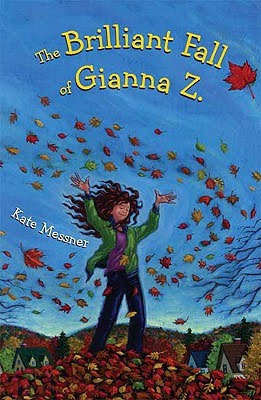
The Brilliant Fall of Gianna Z

by Kate Messner
ages: 10-13
First sentence: “Forty one minutes to cross-country practice.”
I received the ARC from Bloomsbury.
Support your local independent bookstore: buy it there!

Seventh grader Gianna Zales loves art and running, especially cross-country. However, she’s not so good at deadlines, and her spot at cross-country sectionals is in jeopardy: if she doesn’t get her science project — collecting and cataloging 25 different leaves — completed and in on time, then her spot is going to go to arrogant, popular Bianca. Which Gianna doesn’t like, because in her own words: sparkly girls don’t run. Runners do.

Over the course of a week, her best friend Zig tries to keep her focused and spending time searching for leaves, except it’s not as easy as it sounds. A funny thing called life keeps getting in the way, whether it’s her father’s job — he runs a mortuary — or her beloved Nonna’s increasingly alarming inability to remember things, or her mother’s rising stress level and denial about Nonna’s problems.

It’s a quiet book, funny at times, as Gianna struggles to not only complete her leaf project in time but to deal with the impending change with Nonna. What Messner does best with the book is give a sense of place: the sights, sounds, smells and feel of a Vermont fall literally popped off the page. Messner also helps by intertwining Robert Frost poems amid the science and running: it broadens the scope of the book and grounds it in ways that it wouldn’t be without the poetry connection.

The only real complaint is the stereotypical plot: Gianna is neither popular or unpopular, in spite of her running prowess, and has to waffle between being friends or not with the two outcast girls, Ellen and Ruby; the friendship-but-is-there-more with Zig; the overbearing and irritating mom; the popular versus nerdy conflict with Bianca (two guesses who gets to go to sectionals; it’s not difficult to figure out).

Still, even though it was pretty predictable, it is an enjoyable read. Enough so, that I’m looking forward to what Messner has to offer in the future.

(Just for the record: because this is a Cybils nominee, I’ve been asked to make sure y’all know this is my opinion only, and not that of the panel.)

An Abundance of Katherines

This book, without a doubt, is a book for nerds. I don’t think it matters what kind of nerd — I’m only a book nerd, after all, with a dabbling of music and math nerditry — but I think you might have to be at least a little bit of a nerd to truly enjoy this book. (And since I think most people are at least a little bit of a nerd…)

Colin — former child prodigy and recent high school graduate — has a tendency to not only date girls named Katherine, but to get dumped by them. After the most recent dumping — by Katherine XIX — he and his friend Hassan decide to go on a road trip. They end up in Gutshot, Tennessee, where they learn a little about themselves, about relationships, and about trusting in the unknown.

That’s the basic plot, anyway. What I really liked about the novel, and the reason I think it’s worth it to read, is the footnotes. I’m an obsessive footnote reader, which sometimes gets in the way of the reading experience. But in this case, they made the book for me. They were snide, funny, and oh-so-John Green (at least the way he comes off in his vlog). And the afterword/appendix was fascinating, too (although Green wrote that it was “optional” to read.) The book was pretentious, like Looking for Alaska, but in this case the pretention wasn’t taken so seriously and therefore worked better. Sure, Colin was soul-searching, looking for the Truth and the Meaning of Things. But it wasn’t so weighty, so oppressive a search as Miles’s was. And I think Green’s style works better when he’s not being so Heavy. (A side note about the language: it was cleaner than Looking for Alaska, but only because there’s a wonderful homage — which I didn’t know was one until they spelled it out for me — to Norman Mailer. If you’ve read him — I haven’t — you’ll know what I mean. If you haven’t, well, then, you’ll either have to read some Mailer, or read this book.)

I’m glad Green’s writing books (especially ones where the nerd gets the girl, and it doesn’t come off as forced or contrived); it’s about time nerds got some respect. And Green’s just the person to give it to them.