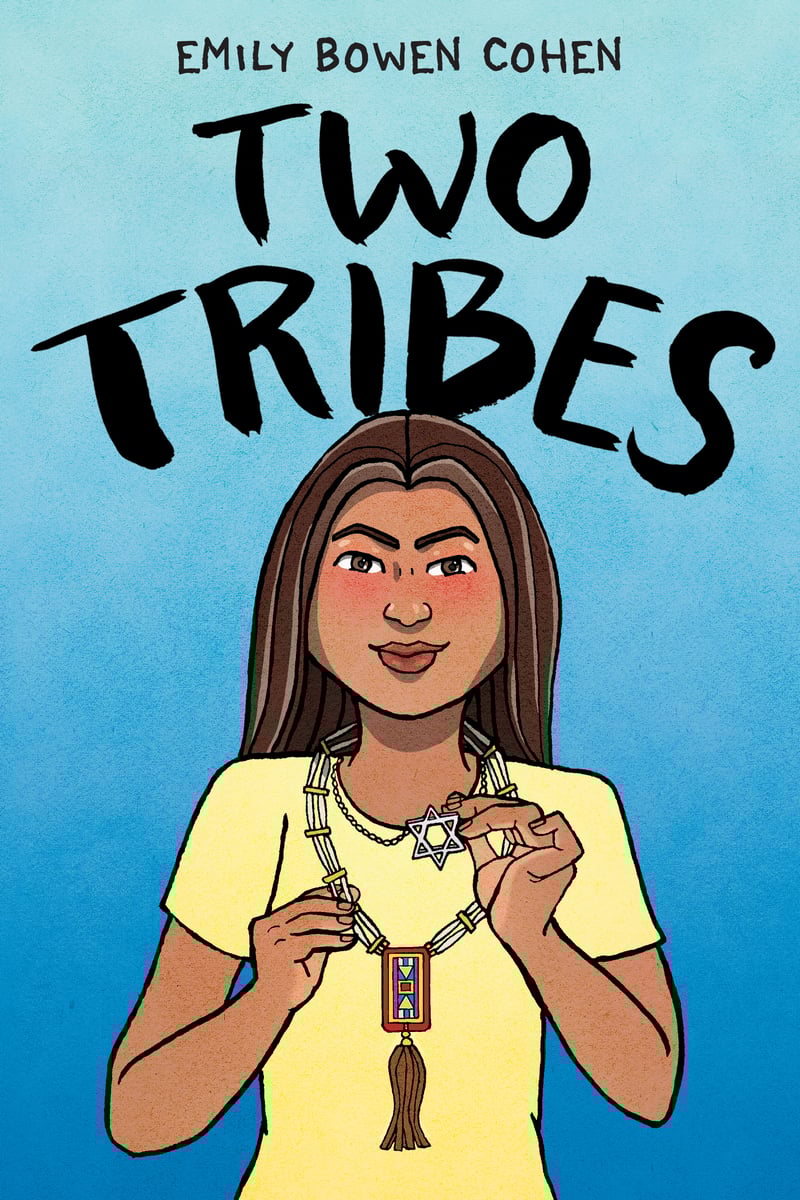
Two Tribes

by Emily Bowen Cohen
Support your local independent bookstore: buy it there!
Review copy provided by the publisher
Content: There is bad-mouthing by divorced parents of the other parent, a runaway kid (nothing happens), and some slurs against Native Peoples. It’s in the Middle Grade Graphic Novel section of the bookstore.

Mia lives with her Jewish mother and stepfather in LA, and goes to a Jewish school. Which is all good, except her father is Muscogee and she longs to learn about her Native side of the family. Her mom is not really open to talking about Mia’s dad, or her Native family, so Mia hatches a plan to take a bus to Oklahoma and visit them, without her mom’s knowledge or approval. Once in Oklahoma, she meets relatives she barely remembers, learns about the traditions, and goes to a powwow. Once her mom figures out what she’s done, however, she is whisked back to LA. There, she finds the courage to confront her mother about wanting to learn more about both sides, both tribes, that she has inherited.

On the one hand, I think this is an excellent story about kids struggling between identities, with divorced parents who aren’t on good terms with each other. It’s a basic primer about Native peoples – there is a confrontation with a kid at the Jewish school who insists she can’t be Native because they “aren’t even alive anymore.” There’s also a side bit about a book that perpetuates negative Native stereotypes. And a confrontation with her Rabbi about using a slur – something he didn’t even register.

On the other hand, I’m not sure I really liked it. I liked parts of it, sure, and I liked the Idea behind it, and I think it’ll be good for kids to have access to. But, the story felt flat. It all happened too quickly. There wasn’t enough development with the character or her family. Mom turned on a dime (I wanted a story about mom, honestly). It just lacked the depth I think it could have had.

But it’s still a good graphic novel.
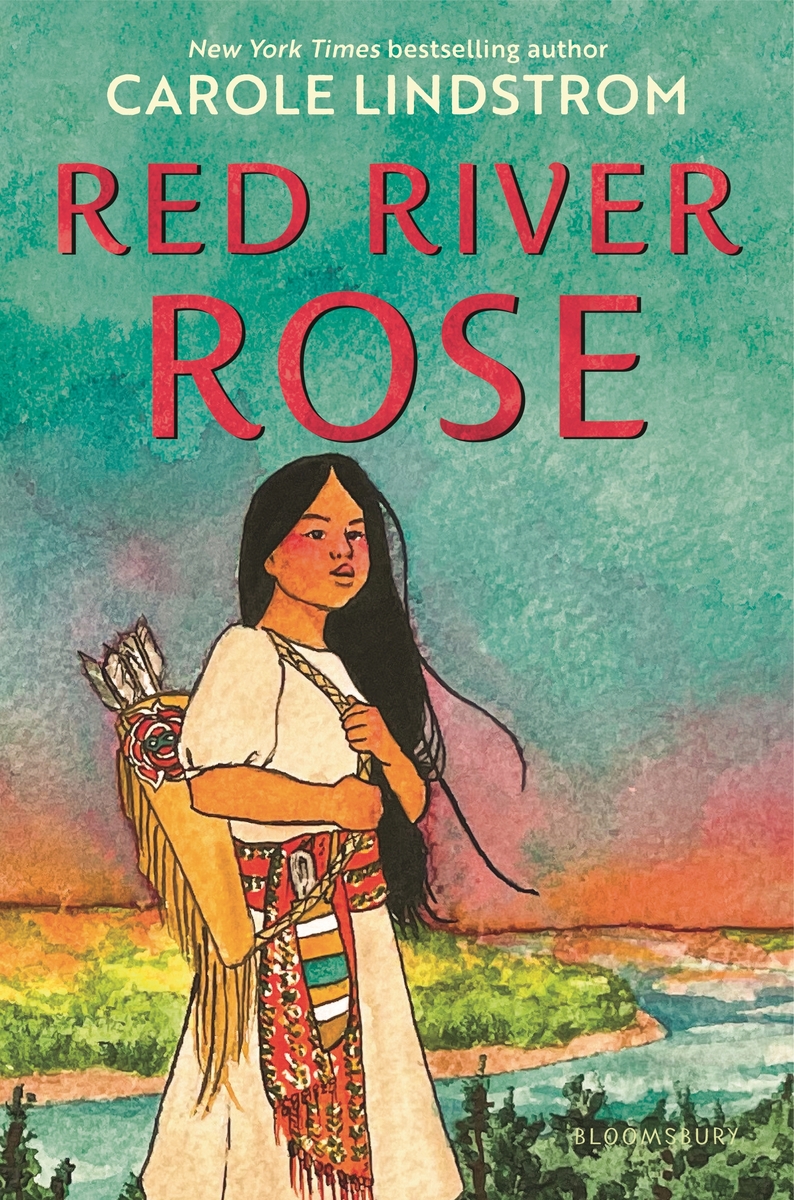
Red River Rose

by Carole Lindstrom
First sentence: “‘Hurry up, Delia, I want to stop at the ferry on the way,’ said Rose, trying not to tug her sister’s arm too hard.”
Support your local independent bookstore: buy it there!
Release date: March 17, 2026
Review copy provided by the publisher.R

Rose is a Métis girl living her beset life in Batoche, Saskatchewan in 1885. She helps take care of her sister, she goes hunting with her father and uncle, she enjoys watching the ferry on the river. However, one day, she overhears the elders talking about how the Canadian government want to come take their land – and that they should resist. Rose agrees: she doesn’t want to lose the only home she’s ever known, but as a 12-year-old girl, how can she help her people stand up against the government?

In the author’s note at the end, Lindstrom mentions that she wanted this to be a Native Little House on the Prairie, and I think she succeeded. It has the same quiet tone, an engaging and relatable heroine, and an insight into what life might have been like for the Métis in 1885. It was a bit simplistic (but it’s for kids!), but overall, I loved the storyline, I loved how Rose wanted to help her family and her neighbors, and I admired her willingness to take chances. Lindstrom created a great heroine, and I would love to experience more of her story.

It’s an important book – there always needs to be more stories of historical events from the Native perspective – but it’s also a good one.

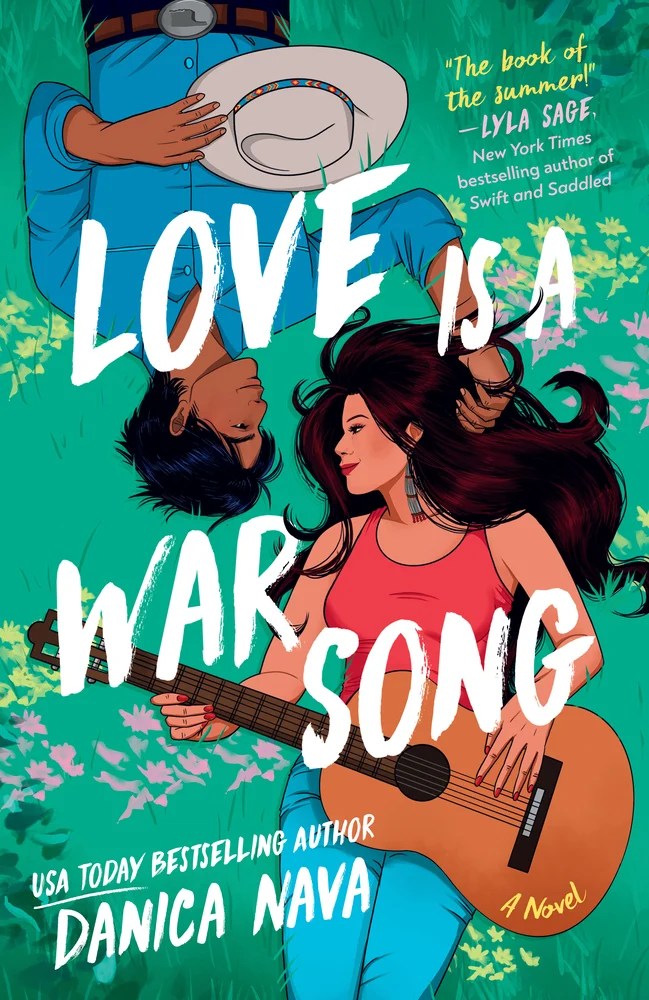
Love is a War Song

by Danica Nava
First sentence: “Three nearly naked men drenched in oil gyrated around me, their things barely covered in short tan-hide loincloths that dangled between their thighs.”
Support your local independent bookstore: buy it there!
Review copy provided by the publisher.
Content: There is swearing, including multiple f-bombs, and a couple of on-page sex scenes. It’s in the Contemporary Romance section of the bookstore.

Avery has spent her whole life in LA – first as a child actor, and now trying to break into the music business. Sure, she just wants to write her own songs, but her mom (who is also her manager) keeps telling her that she has to pay her dues. So, she listens when the record label gives her a “Native-inspired” song (since her mother says they’re Muscogee) and films a video for it. Plus there’s a Rolling Stone cover. But when they come out, there is a huge backlash: what they thought was “taking back stereotypes” ended up just being deeply racist. So, to get away from death threats, her mother sends Avery to her estranged grandmother’s house in Broken Arrow, Oklahoma, to hide. And maybe to learn a bit about this heritage she has claimed but knows nothing about.

Once there – on her grandmother’s working ranch – she meets Lucas, a Muscogee ranch hand who has a chip on his shoulder, especially when it comes to her and her music. Except, he’s hot. And while she is often annoyed at him, she also kind of likes being around him. And she comes to respect him. And maybe there’s more to Broken Arrow than she thinks.

I’m not sure I liked this one as much as I liked The Truth According to Ember, but I did like it. I like that Nava looked at how being a Native person in Hollywood/the music industry isn’t an easy thing. I liked the juxtaposition of city girl/country boy. Nava is good at writing banter, and I liked how she wove in Native culture and mannerisms throughout the book. Additionally, both Avery and Lucas grew as people, which was satisfying to see.

In short: I really liked this one.

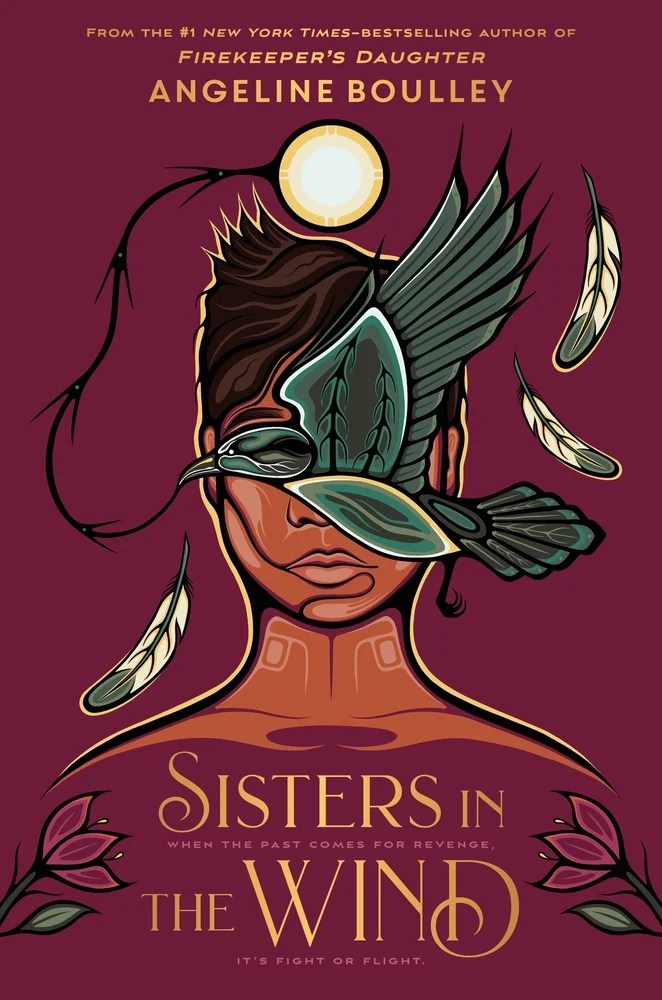
Sisters in the Wind

by Angeline Boulley
First sentence: “My heart races when the handsome Native guy enters the diner.”
Support your local independent bookstore: buy it there!
Release date: September 2, 2025
Review copy sent by the author
Content: There is violence against women; off-page teen sex and teenage pregnancy; and swearing, including a few f-bombs. It will be in the YA Contemporary (or maybe 2009 is history?) section of the bookstore.

Lucy’s dad died years ago, and she’s bounced through foster care. She’s finally on her own, and is making ends meet when two things happen: a Native man finds her and tells her that he’s a friend of her dead half-sister, that she didn’t know she had. And then a bomb blows up the diner where she worked and she’s injured. She’s thrown into a new world, one where Daunis and Jamie are supporting her and fighting for her, and introducing her to her mother’s family – a part of Lucy’s world that she didn’t want anything to do with, having been told her whole childhood that her mother “gave up her maternal rights”. As the mystery of who bombed the diner (and why), Lucy comes to terms with her Native heritage and with the trauma of being a part of the foster care system.

I adore Boulley’s storytelling, how she tackles tough subjects (foster care can be good, but is often terrible, especially for non-white kids) with grace and with heart and with characters that are complex and fully real. This one is told through a dual timeline – you see Lucy go through her father’s death and the subsequent foster care when her stepmother refuses to take care of her, and then the contemporary timeline after the blast and figuring out who is after Lucy. Boulley doesn’t shy away from dealing with the harm that white people have done to Native people, and doesn’t shy away from illustrating the results of that harm.

In short, this, like Boulley’s other books, is a powerful look at one girl’s story and the impact that knowing her heritage and family has on her.

Excellent.

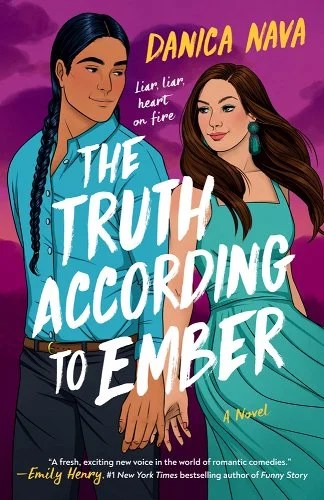
Audiobook: The Truth According to Ember

by Danica Nava
Read by Siena East
Support your local independent bookstore: buy it there!
Or listen at Libro.fm
Content: There is blatant racism towards Native people, as well as some swearing including a few f-bombs. There is on the page, pretty spicy sex. It’s in the Romance section of the bookstore.

Ember Lee Cardinal hasn’t been able to catch a break. She had to drop out of college because she used her college money to bail out her younger brother from jail, but he skipped bail so she lost the money. She’s working a dead-end job at a bowling alley in a less-than-desirable part of Oklahoma City. And all her applications for better jobs come back as rejected. So she decides to be creative: she exaggerates her qualifications and checks the white box instead of the Native American one. (Her dad is white, so it’s not a super big stretch on that one.) She lands a job as an accounting assistant at a tech firm where she meets Danuwoa Colson, the IT guy and fellow Native. He even seems to be interested in her as well. Things are looking up. But when she gets an unexpected (and unwanted) promotion to the Executive Assistant to the CEO and when a coworker finds Ember and Danuwoa in a bit of a compromising position (they were kissing on an elevator at an offsite conference), her lies begin to build and get out of control. With everything – her job, her life, the relationship with Danuwoa – at stake, will Ember be able to come clean?

This one was a ton of fun. There was a bit of second-hand embarrassment as Ember’s lies kept piling up, but I got why she kept doing it. The motivations were always there. Nava was great at making the spice pop as well as weaving in elements of what Native people have to deal with in the corporate workplace (it was SUPER cringe). I loved Ember’s best friend Joanna (not sure of the spelling of that, since I listened) and the way it was incredibly centered in Oklahoma. Additionally, East did an excellent job narrating, making all the characters come to life.

It ended up being one of those books where I kept driving just so I could keep listening, and there really isn’t any higher praise than that.

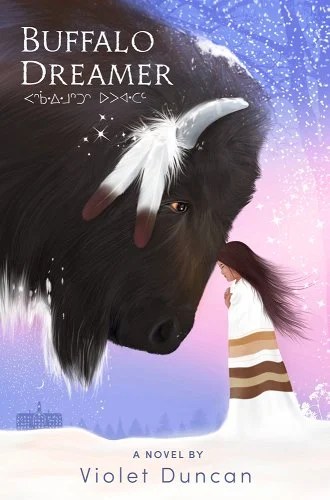
Audiobook: Buffalo Dreamer

by Violet Duncan
Read by Ashley Callingbull
Support your local independent bookstore: buy it there!
Or listen at Libro.fm
Content: There are some tough subjects, including the residential schools, but they are handled in an age-appropriate way. It’s in the Middle Grade (grades 3-5) section of the bookstore.

Summer is looking forward to a relaxing summer at the rez in Alberta where her mom grew up. But this year, there is a change: they have discovered a mass grave at a closed-down residential school where Summer’s grandfather was forced to attend. Additionally, Summer is having vivid dreams about a girl who ran away from a residential school and walked through a blizzard to escape.

It’s not a long book or even a harrowing one. But it is a sweet story about respecting and learning history, even (or maybe especially) hard history. Summer’s mom and aunties doesn’t think she’s ready to learn the history, and her grandfather is hesitant to speak about it, but when Summer shares the dreams, they are more willing to admit that talking about the hard and painful history can be a healing thing. I also appreciated learning about Summer’s heritage and family traditions as we went along; Duncan was excellent at weaving the small details in with the larger story.

The narrator was excellent as well; I really love listening to books by Native authors in audio because I know I would have no idea how to pronounce some of the words. I thoroughly enjoyed this one.

The Serviceberry

by Robin Wall Kimmerer
First sentence: “The cool breath of evening slips off the wooded hills, displacing the heat of the day, and with it come the birds, as eager for the cool as I am.”
Support your local independent boIokstore: buy it there!
Release date: November 19, 2024
Review copy provided by the publisher.
Content: It’s small and thin, with illustrations, nothing super difficult, so even interested younger people could read it. It will be in the Science section of the bookstore.

In this slim book, Kimmerer reflects on the inherently service- and gift-oriented nature of, well, nature, and how humans can learn from that. It’s a simple thesis, but one that I think is inherently radical: if we gave up a market economy, where people are expected to earn and consume and live for the individual, and moved toward a more gift-based economy, where if you had enough you shared with others, regardless of what they did or did not have, the world would have to change.

My religious tradition espouses this, at least on paper, and so I was interested to read how Kimmerer approached it. She was very much “wow, wouldn’t this be a better way to live?” I kept thinking of the Bill McKibben books I’ve read, and how forthright and outspoken he is about the climate, culture, and how capitalism isn’t good for the earth. Contrast that with Kimmerer: she’s saying many of the same things but is much less, well, cranky about it. She is out there witnessing that she finds fulfillment in giving to others, and finds joy in the knowledge that others have received of her bounty. She lambasts those who take without care of those who have less – she tells a story about someone who stole the stand that the free farm food was on, and compares it to companies who take from the earth without thought or consequence. Perhaps her method is a better way of getting people to think about the costs of capitalism: she’s soothing, she’s kind, she’s reflective, and she’s out there reminding people that giving of your excess, rather than hoarding it, is in fact the way to a better, happier life.

This is one I’m going to buy and reread because it’s a good reminder of what’s good in life.

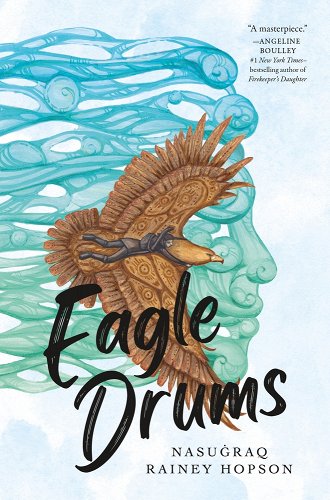
Eagle Drums

by Nasuġraq Rainey Hopson
First sentence: “Sweat trickled down his back.”
Support your local independent bookstore: buy it there!
Content: There are some intense moments and talk of death. It’s in the Middle Grade (grades 3-5) section of the bookstore, but I’d give it to the older end of the age range. I read this book for the Cybils, and this is a reflection of my opinion and not that of the whole panel.

Pina (that “n” isn’t right, but I don’t know how to make the letter on my keyboard) is the son of Iñupiaq people, who live by themselves and work hard to survive each year. His two older brothers went missing, presumed dead, a couple of years ago, and so his parents are loathe to let him leave. And yet, they need obsidian for their spears and knives. So, they send Pina to the mountains. There he meets Savik – one of the Eagle Gods – who tells him: come with me and learn what we have to teach you, or die. So, Pina makes the only choice he can (the one his brothers didn’t make): he goes with Savik. He lives in the mountains, and learns singing, dancing, storytelling, and how to build a gathering place. All because the Eagles want to be remembered, and want their people to gather together.

This is based on a folk legend of how the Iñupiaq Messenger Feast (which is still held) began. It reads like an extended folk tale: often the prose calls the main character “the boy” and while the tasks he is given aren’t impossible, they are daunting and he has to Overcome them to return home. I liked the book, but I am not sure it’s meant for children. Sometimes that happens when a main character is a child’s age, the publisher thinks it’s for kids. But I can’t imagine a 10- or 12-year-old sitting down to this one and actually enjoying it. It lacks action, it lacks conflict (except for the main conflict of getting Pina back to his parents), it lacks humor. That’s not to say it isn’t worthwhile: it is, very much so. I just am not sure it’s a kids’ book.

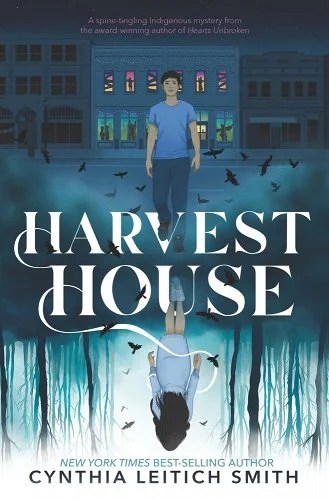
AudioBook:Harvest House

by Cynthia Leitich Smith
Read by Shaun Taylor-Corbett and Charley Flyte
Support your local independent bookstore: buy it there!
Or listen at Libro.fm
Content: There are some intense moments involving danger for young indigenous women, instances of racism, some mild swearing, and mention of murder. It’s in the YA section ( grades 6-8) of the bookstore.

It’s the fall, and since the play at school has been canceled, Hughie Wolfe has been looking for something else to do with his time and talents. Enter Sam, who talks Hughie into volunteering at the Harvest House haunted house. This sounds like a good idea until the person in charge decides to set up an “Indian” burial ground and lean into the legend of the “Indian Maiden” ghost at the crossroads. This makes Hughie, who is Muskogee (I think; at least that’s what is sticking in my head and I don’t have the book to check), angry, and so he and his friends decide to investigate the legend and see what truth lies behind it.

It’s part high school drama set in a small Kansas town, nearby Lawrence – Hughie is a sophomore, so there is some drama with bullies and he has his first date with Marie, who is Ojibwe, in addition to the drama about cutting the funds for the drama department – part ghost story. Hughie’s chapters are interspersed with Celeste’s, who is the ghost of the crossroads and whose mission is to protect indigenous girls from the predator that lurks there.

I liked a lot of this book. I liked that it’s an indigenous story set here in Kansas, I liked Leitich Smith’s portrayal of indigenous kids in a non-reservation environment. She really leaned into the racism – so many instances of racism by white people towards the native kids, and in ways they didn’t even think about. I felt like she didn’t go hard enough in the ghost story and backed away from a truly macabre ending, but it is a young YA book, so I can’t really fault that. The narrators were good, though I thought it was dragging by the end, and I sped up the listening speed just so I could finish.

I’m glad it’s out there, though, and I hope it can find its audience.

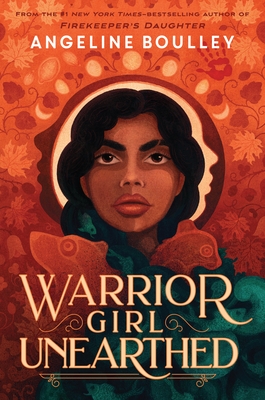
Warrior Girl Unearthed

by Angeline Boulley
Support your local independent bookstore: buy it there!
Release date: May 2, 2023
Content: It addresses r*pe, sexual assault, predatory behaviors, and missing Indigenous women. There is some swearing and talk of drug use. It’s in the Teen section (grades 9+) of the bookstore.

What Perry Firekeeper-Birch wanted for the summer: to be lazy, to go fishing, to enjoy the sunshine. What she got: a job with the Ojibwe summer intern program, working at the Tribal museum. What she expected: the summer to be Boring. What she got: a fascinating education in her Tribal history, and in the repatriation (or not) of the items stolen by museums and colleges, including the local Mackinac State University.

That’s just where the summer starts, though. It’s 2014, and there is unrest in the country, with the shooting of Michael Brown, and that hits close to home because Perry’s dad is half Black. Additionally, Indigenous women in the community have gone missing, and her sister, who is working with the Tribal police, is helping look for them. But it all comes to a head when Perry discovers unearthed graves in the yard of a local “businessman” who was going to donate artifacts back to the tribe, but instead gives them to Mackinac State.

It sounds like a lot – and this is just scratching the surface – but Boulley is a talented enough storyteller to weave these seemingly disparate story threads together into a very satisfying whole. The story is less about missing Indigenous women and repatriating lost/stolen artifacts than it is about Perry learning how to take responsibility and be a leader in her community. It’s her growth arc – though the characters of her friends and twin sister (and yes, Daunis from Firekeeper’s Daughter shows up) are fully fleshed out and not simple caricatures. I love how Boulley is able to weave in the Ojibwe language and traditions in a way that feels respectful but is also informative for those of us who are not Ojibwe. It’s a feat to be able to put so much into a book and have it flow seamlessly.

In short: I loved it.