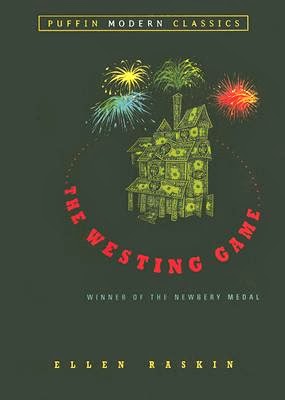
The Westing Game

by Ellen Raskin

First sentence: “The sun sets in the west (just about everyone knows that), but Sunset Towers faced east.”
Support your local independent bookstore: buy it there!
Content: There are about three mild swear words, and some talk of murder. Plus a couple of bombs. It’s in the middle grade (grades 3-5) section of the bookstore (actually, I have a Newbery Award Winner section; it’s in that), and I can see no reason for this not to be there. 
Review copy provided by the publisher as a complimentary copy for my bookgroup.
There are very few books I have fond memories of from when I was a kid. The Little House books, and Wrinkle in Time are a couple. And this one. I’m not sure why I remember it so well; maybe it was because it’s a pretty decent puzzle book/mystery, or maybe I just liked the spunk that Turtle Wexler has. Either way, this one has stayed with me throughout the years as a charming, fun little book.

I’m happy to say that this is still — even after all these years — a charming, fun little book. For those who don’t know the plot, it’s this: Sam Westing has died, and 16 people –all connected to Sam Westing in some way — are called into solve the mystery of his “murder” in order to win his inheritance. It’s a rag-tag collection of people, from a judge to a doorman, to a dysfunctional family, to a couple of restaurant owners. There are several sympathetic characters: Doug Hoo, the resident jock/track star; Theo Theodorakis, an incredible support to his disabled older brother; and (my favorite) Turtle Wexler, 13-year-old spitfire. There are also some despicable characters, most notably Turtle’s mom. She is the epitome of overbearing mothers who have good intentions but go about it all wrong. Pushing her older daughter (at age 19!) into a marriage she doesn’t want, and emotionally abusive to Turtle… I disliked her with every fiber of my being.

I’m not sure if the puzzle was terribly well-plotted. I knew the answer, having remembered it from a previous read (maybe 10 years or so ago), but A read it and kind of felt the answer came out of nowhere. That didn’t much matter; she enjoyed the story for the characters. And perhaps that’s the real charm of the book. Raskin created a group of people that we can’t help but identify with and either love or hate. Either way, we’re more than happy to go on a bit of an adventure with them. 

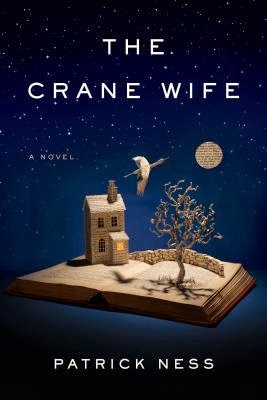
The Crane Wife

by Patrick Ness
First sentence: “
Support your local independent bookstore: buy it there!
Review copy given me by the Penguin rep.
Content: Multiple f-bombs and other language, some off-screen sex. Rightly sits with the adult fiction at the bookstore.

George is your very typical kind-of-loser guy. He’s divorced (nine years) with a child (who’s in her 20s) and can’t seem to keep a relationship (he’s too nice; they always break it off, but he’s always friends with them after). Even though he’s the owner of a print shop, he’s a bit of a pushover, letting his one employee, Mehmet, push him around. But, because he’s nice, because he’s George, when a crane with an arrow piercing its wing unexpectedly lands in his suburban London backyard in the middle of the night, he helps it out.

The next day, a woman named Kumiko shows up in George’s print shop. And suddenly, George’s life — and the life of his daughter, Amanda — are irrevocably changed.

Yes, this is a fairy tale. A very charming, sweet, wonderful fairy tale. Ness divides its time between George, Amanda, and Kumiko’s tales, but does so in a way that doesn’t feel awkward or forced. But it’s not just a fairy tale — or at least not just a one-dimensional fairy tale — art (in this case, paper cuttings) and a slight Japanese-inspired tale within a tale play major roles, which gives the book depth and substance.

But what I enjoyed most with this one was Ness’s use of the language. The fact that one of his characters, Rachel (who is very confused and not at all nice), speaks entirely in questions. Or the way he uses “…” to represent silence. Or the way George and Amanda think of themselves. And descriptive sentences like “He loved physical books with the same avidity other people loved horses or wine or prog rock.” (60) or “Stories do not explain. They seem to, but all they provide is a starting point. A story never ends at the end.” (141-142) or “She stopped, her face scrunching up in some really, really unattractive crying.” (161) There were others, but those are the ones that I marked.

It did all the things I want a book to do: it gave me characters to care about, and transported me away from the dreary winter months. It delighted me, and made me wish I was even a tiny bit artistic.

Delightful.

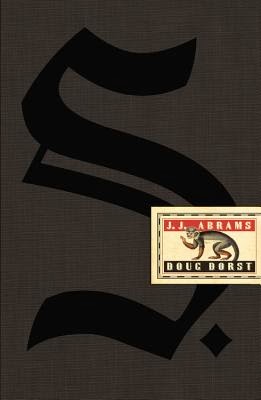
S.

by J. J. Abrams and Doug Dorst
First sentence: “If found, please return to the workroom B19, Main Library, Pollard State University.”
Support your local independent bookstore: buy it there!
Content: Language, including lots of f-bombs. And some violence. It’s in the adult section of the bookstore.

The thing that piqued my interest about this book was the buzz about the form. We had a sample copy and I perused through it. The format — a book published in 1948, stolen from a high school library, with notes scribbled in the margins — was intriguing. Enough so, that I bought myself a copy for Christmas, and eagerly dove in. It IS an intriguing concept, reading someone else’s notes, figuring out the story as you go.

It’s an incredibly layered book: the “book” is one Ship of Theseus, written by the mysterious V. M. Straka. A book where the main character, S., has amnesia, and goes on a journey to figure out who he really is. In doing so, he finds out that he was involved with some shady figures. The second layer is the work that a disenfranchised grad student, Eric, is doing to figure out the real identity of V. M. Straka. All that’s really known about him is that he was involved in this mysterious organization, the S. Eric gets help on this quest from a struggling undergrad, Jen, who finds Ship of Theseus laying in the stacks and begins a conversation. Which brings me to layer three: Jen and Eric’s story. They work together, and over the course of the book, develop their own relationship.

I realized fairly early on that the layers were too dense for me. I couldn’t hold everything in my mind, for starters. I ended up giving up the main Ship of Theseus story, partially because it was boring, but also because I just couldn’t keep multiple storylines in my head. Call it being out of practice, or lack of interest, but I just couldn’t do it. But there was also the fact that the story’s told  inside out and backward. I did think that maybe if I had read it in shifts — read Ship of Theseus first, then the inked-comments, then maybe it would have made sense.

So, in the end, this was all form and no substance. In the end, all the thrills, chills, and mystery They were promising weren’t there. It was a simple story, one that tries to give grad school a mystique and make it cool (it doesn’t succeed). It did succeed in being a homage to paper books — there’s no way this would make a decent e-book. But it wasn’t much else.

And in the end, I found that disappointing.

Rebel Island

by Rick Riordan
ages: adult
First sentence: “We got married in a thunderstorm.”
Support your local independent bookstore: buy it there!

Tres Navarre has finally married his longtime (on and off) girlfriend, Maia, and now they’re off (with Tres’s brother Garrett in tow) to they’re belated honeymoon to Rebel Island: an old haunt of the Navarre family, and not really one that has good memories. And because Tres is who he is, and trouble seems to follow him around, they encounter a weekend like no other: a major hurricane on top of a killer on the loose.

It doesn’t get much better than that.

Except, well, it does. Out of the several things I noticed while reading this, the one that stood out the most was that it really didn’t need to be written. Mission Road was a good stopping point for the series, and while I guess it’s nice to know that Tres and Maia got married, and are having a kid, it’s not really necessary to have a whole book about that point. The other thing was you can tell that Riordan consciously pulled back on these novels; while there’s still language in this book, it’s not nearly as gritty as the earlier Tres Navarre books are. You can almost see him thinking, “Dang! I’ve got kids reading my books. What if they want to read these, too? Better not make them as foul as they used to be.”

On top of that, it just didn’t read as well as the earlier Tres Navarre books. It was a quick read, but unfortunately predicable (at one point, I thought, “Oh, man, I hope he doesn’t make him out to be the bad guy…”), and even the little twist at the end didn’t redeem it for me. It was all ho-hum, formulaic, and not particularly exciting.

It’s not that it was a bad book; I just didn’t feel Tres and company were up to the standard that I’ve come to expect.