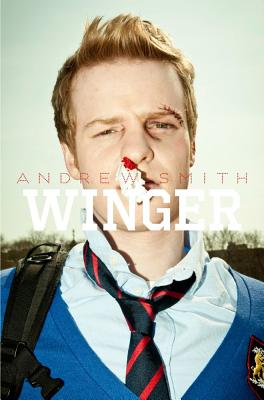
Winger

by Andrew Smith
ages: 14+
First sentence: “I said a silent prayer.”
Support your local independent bookstore: buy it there!
Review copy picked up at ABA Winter institute for me. Yes, I have taken that long to get to it.

Ryan Dean (yes, that’s his whole first name) West has a lot going for him: he’s a junior at Pine Mountain, a boarding school for troubled rich kids (his dad’s a high-powered Boston lawyer) in the Pacific Northwest. He is first string winger (think running back in football, but more intense) for the rugby team. He’s pretty smart.

But there are some downsides: he got transferred into O-Hall this year because he was caught hacking into a cell phone account at the end of last year. And, to top it all off: hes only 14.

And when you’re in O-Hall with all the delinquent football and rugby players? It’s not going to be a stellar year.

Add to that some major girl drama (he’s in love with his best friend, Annie, but snogging his roomate’s girlfriend), late night poker games (let’s just say that Ryan Dean is not a good drunk), and lots and lots of testosterone-induced fights. Let’s just say, I was impressed that Ryan Dean — who was decent human being underneath all the 14-year-old boy nonsense — survived until Thanksgiving.

I’m of two minds about this book. On the one hand, I can sum it up in two words: sex and rugby. Actually, the sex is all in Ryan Dean’s mind: he’s incredibly immature, and objectifies EVERY girl, and EVERY situation becomes about sex. In other words: he’s a normal 14-year-old boy. But unlike Carter’s Unfocused One-Track Mind which I couldn’t get through (and which is the best comparison to this one), I found myself endeared to Ryan Dean. Maybe it was the underdog element. Maybe it was because although he was annoying, he was almost mostly harmless. Maybe it was because he really did mean well, in the end.

Because, I found myself compelled by this. I was invested in Ryan Dean’s drama. I loved the camaraderie of the rugby team. I enjoyed Ryan Dean, dork that he was.

My only real problem was with the ending. See: Ryan Dean becomes good friends with the rugby captain, Joey, who also happens to be gay. Joey’s sexuality isn’t a big deal for Ryan Dean (though he feels the need to comment that he isn’t a lot), but it is for other guys in O-Hall. And in the last 20 pages of the book, it takes a sharp left turn and stops being a fun boarding school drama, and becomes Something More. Not that I minded something more, it was the sharp left turn that threw me. It didn’t work. I didn’t feel pain, or anguish, or anything at all at the end, because I was flabbergasted that a fun and entertaining book so suddenly became Serious. It came off as bad pacing and lack of focus rather than anything more substantial.

It didn’t ruin the book for me, but it did take some of the shine off. Which is too bad, because I was having fun with it before then.

Aristotle and Dante Discover the Secrets of the Universe

by Benjamin Alire Saenz
ages: 14+
First sentence: “One summer night I fell asleep, hoping the world would be different when I woke.”
Support your local independent bookstore: buy it there!

It’s the summer of 1987, and 15-year-old Aristotle — Ari; he hates his given name — is a bit lost. He’s the caboose in a Mexican-American family; he was born after his father returned from a tour in Vietnam. He’s got older twin sisters and an older brother, but since he’s in prison, no one talks about him. Ari’s got a whole lot of bottled up angsty feelings, and is quite directionless with his life.

Then he meets Dante, who is everything Ari is not: vibrant, interesting, talkative. They become friends — best friends — and slowly over the course of the year, that friendship blossoms into something more.

I think I need to just come to terms with the idea that the 1980s are historical fiction now. Though, I’m still at a loss as to why this couldn’t have been contemporary. It’s set in El Paso, and the world that they inhabited didn’t feel like it needed to be in the 80s. Their parents were incredibly accepting of Dante’s homosexuality, and the experimentation with drugs and alcohol could have happened just as well today as it did back then. There side plot that involves violence against Dante for being gay, but again: not necessarily something that needed to be in the 1980s. In fact, even with the violence, it seemed… tame. We have come a long way in the last 30 years.

Though — and maybe it was me — I never really found myself connecting with this book. I think part of it was that I don’t do 15-year-old boy angst well at all. I just found it hard to relate to Ari, to all his angst and his non-communication. And I’m not sure that the spare prose — as lovely as it was, sometimes — helped the situation much. While I understood Ari, and what he was going through, I found I couldn’t sympathize with him. And I do have to say that while I didn’t have a problem with the end, I didn’t think it was terribly convincing, either.

In short, it wasn’t a bad novel, just one that I don’t think was for me.

Lola and the Boy Next Door

by Stephanie Perkins
ages: 14+
First sentence: “I have three simple wishes.”
Support your local independent bookstore: buy it there!
Review copy provided by an ARC sent me from the amazing A Jane of All Reads

I need to say, first off: I completely and totally regret what I wore to my senior prom. It was white, it was totally late-80s, and it was completely forgettable. What I should have done was be daring (like Lola, who wants to attend her mid-winter formal as Marie Antoinette) and completely memorable.

So, one of my favorite things about this book was all the costume changes that Lola went through. I never knew what she was going to wear, and somehow, that made the book that much more enjoyable for me.

The plot is pretty simple: Lola and Cricket used to be neighbors. Then they were more than neighbors. And then he moved away because his family is pretty invested in following his sister Calliope’s dream of being an Olympic figure skater. But before that happened, he hurt Lola, so she’s spent the last two years trying to forget that Cricket ever existed. It’s worked so well, that she’s happily in love with Max, who’s a punk rocker and (gasp) five years older than she is (she’s barely 17). Then, one day, Cricket (and his family) move back in. Lola figured she was over him, but she didn’t count on him not being over her.

Second thing I adored about this book: Cricket. Seriously. He’s nice. No: he’s wonderful. Swoon-worthy, geeky, genius, awkward, and much, much too good for Lola. It was an interesting twist having the guy be the “good” one, the one that Lola has to aspire to “deserving”. (I find it’s often the guys who are the cads, but in many ways Lola is in this book.) At first she pushes Cricket away, but eventually realizes that she still has *feelings* for the boy next door.

I found, in this book, that it was the little things that made it enjoyable. Anna and St. Clair are back, and even though they only play a small role, they light up the pages they’re on. Lola’s two dads are also a delight: it’s nice to have a gay couple shown as stable and loving without making a big deal about it. (Additionally: they’re great characters in their own right.) That said, I still have issues with True Love (always have, always will) and this one is all about finding and recognizing True Love, but it wasn’t enough to get in the way of me thoroughly enjoying this book.

Perhaps it comes down to the awesome Marie Antoinette dress after all.