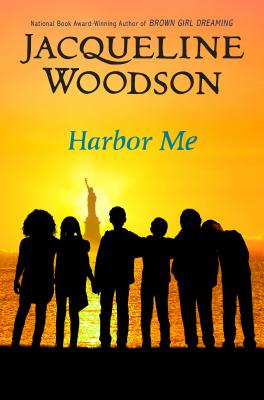
Harbor Me

by Jacqueline Woodson
First sentence: “We think they took my papi.”
Support your local independent bookstore: buy it there!
Review copy provided by the publisher.
Content: This deals with some heavy topics: immigration, guns, police brutality, etc. but it does so in a way that’s accessible and approachable for younger kids. It’s in the middle grade (grades 3-5) section of the bookstore.

In this classroom in New York City (I’m assuming… it’s a very diverse classroom), six kids are allowed one hour each week to talk, unsupervised by adults. The idea, hatched by their teacher, is that they would be able to talk about things on their minds, big and small, unencumbered by  adult approval/disapproval and interference.

The six kids are Esteban, whose father has been recently taken by ICE and is being held in Miami, possibly to be deported back to the Dominican Republic; Amari, a black boy whose father has recently had the talk with him about how to act in public, which bothers him deeply; Ashton, a white kid who recently moved from Connecticut, and who is often bullied at school; Holly, an upper-middle-class black girl; Tiago, a Puerto Rican whose mother doesn’t speak much English; and our main narrator, Haley, a biracial whose mother died in a car crash and whose father is in jail, and who is being raised by her uncle.

While Haley’s our main narrator, and her story is the one that we learn the most about, this really isn’t a plot-driven book. It reads much like the idea behind it: as a safe space for 4-6th graders (mostly, though maybe kids younger or older would be interested) to explore tough topics and feelings about things in the news today that may be bothering them. It’s less about the characters than it is about the ideas and themes. Which isn’t a bad thing; kids hear news and are probably more aware than adults give them credit for, and to have a book that addresses their fears  — even if they don’t solve them — and is a space for them to discuss their fears, is a good thing.

And Woodson’s writing is as lyrical as always. It’s a really tight book; there isn’t an extra word in it.

Worth reading.

Front Desk

by Kelly Yang
First sentence: “My parents told me that America would be this amazing place where we could live in a house with a dog, do whatever we want, and eat hamburgers till we were red in the face.”
Support your local independent bookstore: buy it there!
Review copy provided by the publisher.
Content:  There are some uncomfortable and intense moments, but nothing too graphic. It’s in the middle grade section (grades 3-5) of the bookstore.

Mia Tang and her parents are immigrants from China. Which means, even though her parents are highly educated, they’re scrambling for jobs.So, when one comes up managing a hotel — for $5 a room per night, not counting the first week, but they can live there for free — they jump at the chance. Except it’s not as easy as all that. It’s a lot of work for two people (no cleaning staff!) to handle, so Mia takes to running the front desk. Even though she’s only 10. And even though she learns to love the hotel and the weeklies — the people who pay by the week, not by the night — she can’t talk about what her parents do or where she lives at school. Because she’s not like the other kids.

There is a small plot to this one: Mia’s parents take in Chinese immigrants who have fallen on hard times, usually for only one or two nights, and hide them from the owner. Mia wants to be a writer, except her mother doesn’t think she can because English isn’t her first language. and she enters a contest to run a hotel in Vermont. She makes friends and makes choices and learns the power of the written word. There’s not much going on plot-wise, but the characters are compelling, and it’s an excellent look into the things immigrants do (and white/rich people do to them!) in order to make it work here in America. It was definitely enlightening.

So, while there’s not much to talk about, it’s an important — and excellent — book.

That Time I Loved You

by Carrianne Leung
First sentence: “1979: This was the year the parents in my neighbourhood began killing themselves.”
Support your local independent bookstore: buy it there!
Review copy provided by the publisher.
Content: There is some sex (on-screen but not graphic) and swearing, including a few f-bombs. It’s in the adult fiction section of the bookstore.

Set in a suburb of Toronto, specifically on one street in a particular neighborhood, this collection of connected short stories  follows the inner workings of a dozen people of all ages.  The characters are mostly women, except for one black teenage boy, and many of them are immigrants. Leung explores immigrant expectations and prejudices toward them. She explores female dynamics both with other females and with males. She touches on sexual assault and racism and emotional abuse. It’s a lot. And yet, it works.

I usually have problems with short stories, but I think because these are connected — the characters in the stories appear in their own as well as in the background of other stories — it felt more like a novel. We got to know the characters, we get to know the neighborhood, and because each story focuses on a different person, we get to know them intimately and it means more when they show up in a different story.

I really enjoyed this one!


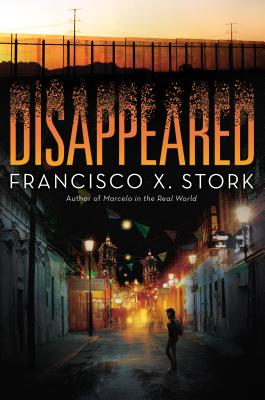
Audio book: Disappeared

by Francisco X. Stork
Read by: Roxana Ortega and  Christian Barillas
Support your local independent bookstore: buy it there!
Listen to it on Libro.fm
Content: There is talk of selling and doing drugs, of girls being kidnapped and sold into the sex trade and there’s violence.  It’s not explicit, but it is there. It’s in the Teen (grades 9+) section of the bookstore.

This one is hard to describe: nominally, it’s the after-effects of what happens to one reporter in Juarez, Mexico, when she won’t stop trying to find her friend who disappeared one night. Sara has spent the last four months trying to honor her friend, mostly through telling the stories of all the girls who have disappeared over the years in Juarez. But, she hits too close to home, and she sets off a chain of events that puts her and her family — her mother and brother — in danger.

But it’s also the story of her brother, Emiliano, who has fallen for a rich girl. The problem: he’s not. Sure, he works hard, has a small folk art business, helps out his family. But he can’t provide for this girl the way her family wants him to. Not without going into “business” in the one trade that makes money in Juarez: drugs.

I’ve not read all of Stork’s writing, but every time I read one of his books I am reminded what a powerful storyteller he is. He weaves together Sara and Emiliano’s stories in a way that they compliment each other, coming to a head at the climax. He had me on the edge of my seat (figuratively, since I was driving much of the time) wondering what was coming next. And while it isn’t a happy ending, it’s an honest and hopeful one.

And the readers were fabulous. Both of them make the story come alive, helped me connect to this tale.

Highly recommended.

You Bring the Distant Near

by Mitali Perkins
First sentence: “The swimmers have finished their races and are basking in the sun.”
Support your local independent bookstore: buy it there!
Review copy provided by the publisher.
Content: There is some mild swearing. It’s in the YA section (grades 6-8) of the bookstore.

This one is a difficult one to describe plot-wise. It’s a slice of life, looking at three generations of women in an Indian family as they move to America and make a life here. It starts with the mother, Ranee, and her two daughters, Sonia and Tara, as they move from London to New York in the early 1970s. Each of the daughters reacts differently to coming to America, each looking for their own way to cope. Ranee isn’t as adaptable: she complains about their apartment in Flushing, she complains about her husband sending money home. Then he passes on, and Ranee is forced to adapt to this country as her daughters grow up and get married, one to an Indian, the other to a black American man.

The book then picks up when Ranee’s granddaughters, Anna and Chantal, are in high school. They are dealing with their own issues: Chantal is bi-racial and is trying to figure out her own identity. And Anna, though American, was raised in Mumbai where her mother is a Bollywood star, but has recently moved back so she could go to high school and college in America.

Perkins handles all this admirably; giving us a taste of Bengali culture, as well as the things immigrants do in order to fit in. One of the more interesting parts of the novel, for me, was set after 9/11, when Ranee goes through her own transformation as a reaction to the terrorist attacks. She figures out what “American” means to her. And that sentence may be what’s at the heart of this delightful novel: what does “American” mean? Perhaps it has become an individual expression for everyone, and there isn’t a “norm” anymore. (That was probably always the way it was, but we pretended otherwise.) Which is, as posited by this book, a very good thing.

An excellent read.

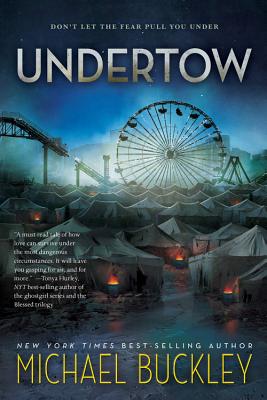
Undertow

undertowby Michael Buckley
First sentence: “You can hear them coming from blocks away, a low thrum like the plucking of a bass string.”
Support your local independent bookstore: buy it there!
Review copy provided by the publisher (I think).
Content: It’s violent. There is an attempt at a sex scene, but it doesn’t get off the ground. There is some domestic abuse. It’s in the YA section (grades 6-8) of the bookstore, but I’d be wary about the 6th grade end of the scale.

In this alternate not-so-distant future, there are these humanoid creatures called the Alpha, which have come out of the ocean and onto the shores near Coney Island, sending the community — and the country — into a tailspin. The Alpha aren’t exactly like humans — they have scales and different coloring, and sword-like things coming out of their arms. It’s not been an easy adjustment for the humans in Coney Island and the surrounding area. In fact, many of them haven’t adjusted at all, choosing instead to fight the “intrusion” of the Alphas on their territory.

For Lyric and her family, the appearance of the Alpha has caused some conflict, because Lyric’s mom is one of them. Sure, she’s been “passing” for 20 years, pretty sure her people abandoned her. But, since their appearance, the other Alphas that have been passing are being targeted. They’re outcasts among their people, and they’re outcasts among the humans as well. And things are getting more complicated: the government is insisting that select Alpha attend school, which just complicates matters more. Especially since Lyric is tapped for one-on-one lessons with the Alpha prince. Fathom.

I’m not doing a very good job describing this one. I suppose it sounds weird, but the thing that struck me most, especially in this political climate, was the whole immigration deal. You could substitute Alpha for any ethnic group, and you’d have a story that’s reflective of the way America currently reacts to immigrants. Sure, it’s exaggerated, but the hate and the discrimination are there. I found it all a fascinating way to deal with the whole issue. Buckley’s also being clever with the Atlantian myths and I thought that the whole Alpha-mythos building was quite unique and clever.

As for the rest of it, it’s a fairly typical YA dystopian. Buckley’s fairly brutal with his characters, which adds a level of intensity. And, sure, there’s a romance and the ending is sufficiently open-ended to make room for the sequel. It was a clever take on this genre, and definitely a fun read.

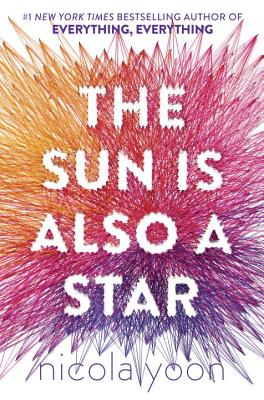
The Sun is Also a Star

sunalsostarby Nicola Yoon
First sentence: “Carl Sagan said that if you want to make an apple pie from scratch, you must first invent the universe.”
Support your local independent bookstore: buy it there!
Review copy provided by the publisher.
Release date: November 1, 2016
Content: It’s mostly swearing; there’s a lot of swear words, plus a handful of f-bombs. There’s some penis jokes as well, and references to wanting sex, but none actual. It will be in the Teen section (grades 9+) of the bookstore.

Natasha is being deported. They came to NYC from Jamaica when she was eight so her father could pursue an acting career. It didn’t work out the way he envisioned and now (after a drunken night and several missteps) they’re being deported.

Daniel is being forced into a life he doesn’t really want. His parents, Korean immigrants, want him to go to Yale (“second best school”) and be a doctor, so he can have the life they never really had. He knows this, he wants to make his parents happy, but his life seems so… narrow.

Then on one fateful day, Natasha and Daniel are in NYC at the same time, and they just happen to bump into each other. And they just happen to connect. And, well, the  rest is history.

This is an Epic Love Story for the ages. Seriously, people. It’s got fate, chemistry, romance, angst, second chances, near misses, and a whole lot of heart. I adored both Natasha and Daniel, and it was absolutely delightful watching the wonderfully messy way they fell in love. It’s not a simple love story, and it goes deeper than just fluff; Natasha and Daniel talk about the immigrant experience, how it’s hard being in this country, and the ways in which things are different, and sometimes difficult, for children of immigrants. There’s science and poetry and karaoke, and it’s absolutely wonderful.

And I loved that the ending wasn’t perfect. There was no magical save or happily-ever-after, but rather a peek and a hope. It made me cry honest tears, which are the best kind.

It’s a wonderful, wonderful story.

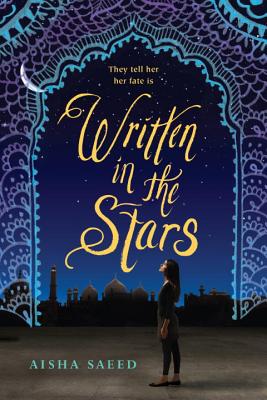
Written in the Stars

writteninthestarsby Aisha Saeed
First sentence: “‘Naila, I wish you didn’t have to miss the game,’ Carla tells me.”
Support your local independent bookstore: buy it there!
Review copy provided by the publisher ages and ages ago.
Content: There’s a (non-graphic) rape and some REALLY bad parenting. It’s in the Teen (grades 9+) Section of the bookstore, but if a 12- or 13-year-old were interested, I’d recommend it.

This was one I’ve been meaning to read for a long, long time. I have no excuse for not getting to it, except that I have a LOT of books to read (so much so that I’m actually starting to panic about my piles. There’s just not enough time!) and many things competing for my attention.

But, recently, I picked this one up and gave it a try. And finished it nearly in one sitting. It’s just THAT compelling.

Naila is the daughter of Pakistani immigrants, ones who are fairly traditional. While she can go to public school and is not required to wear a hijab, she’s not allowed over at friends’ houses, to date, to drive, and college is still up for grabs. (An interesting side-note: Saeed never spells it out, but the discrepancy in treatment between Naila and her younger brother is both unsurprising and frustrating.) She happens to have a boyfriend, though, one she keeps secret from her parents. And when her secret gets out, her parents react by whisking her away to Pakistan where they go about arranging a marriage for her. Behind her back.

It’s awful.  Seriously: I know that arranged marriages like this happen, and that they’re not always bad, but Saeed makes no bones about it: the way Naila’s parents go about this, in order to “save” her honor from the boy she picked, is just awful. And that’s being mild.

It’s an interesting thing to think about though: the balance between choice and tradition, between religious principles and progressive thought (I’ve been trying to think of a better way to say that, and I just couldn’t), between The Way Things Have Always Been and what individuals want. It was especially interesting reading it as a parent because I could see that while her parents thought they were doing right, they were so, so very wrong. And that’s a tough thing to see.

It’s excellently written, highly diverse (hardly any white people at all!), and an intriguing story. One that I hope many, many others will read.