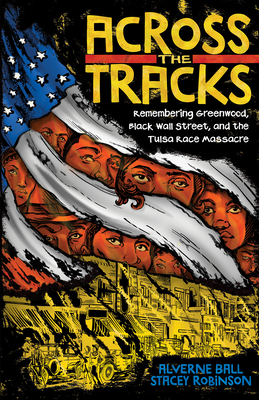
Across the Tracks

by Alverne Ball and Stacy Robinson
Support your local independent bookstore: buy it there!
Content: There are depictions of violence, including lynching. It’s in the graphic novel section of the bookstore.

In the early 1900s, due to Jim Crow, the Blacks in Tulsa developed their own community. They had stores, libraries, doctors, and were a thriving community. Of course, because of white supremacy, the white people in town couldn’t have the Blacks getting all successful. They invented a reason to arrest and lynch a Black kid, and then, when the Black families rose up in defense, burned the Black part of town, killing and unhousing families. The Black people built things back, but it wasn’t ever the same, and the white people swept history under the rug.

This is a very good history of that moment in time, highlighting the achievements of the Black people — doctors, lawyers, businessmen, educators — as well as the maliciousness of the white people. The text is pretty frank, and the art reflects that: it’s realistic and descriptive.

I think this is an important graphic novel and one that everyone should read. But, I’m not sure it was a great graphic novel It was lacking something to bring me into the story – perhaps because it was history and not really a story. it lacked a personal element, something to make me really care when the Black part of town burned. (That sounded harsh; I mean I care that white people were awful and racist and destructive. I just meant the story lacked an emotional core, if that makes sense.)

Recommended for the history.

Undefeated

by Steve Sheinkin
First sentence: “Jim Thorpe looked ridiculous and he knew it – like a scarecrow dressed for football, he’d later say.”
Support your local independent bookstore: buy it there!
Content: There are problematic elements regarding Native representation. It’s in the kids biography section of the bookstore.

As part of our Native people unit in this class I am taking, we had to choose a problematic book to read. I was super surprised to see Sheinkin’s work on the list for problematic; I have a hih respect for his work, and assumed that all of his research wa sipeccalbe.

In this instance, he’s looking at the Carlisle Indian School, a residential school — for “civilizing the natives” — run by the government in the late 1800s though the early 1990s. They ended up with a football program, one that went up against the “big” schools of the time — Harvard, Penn, Yale, and Princeton — even though they were a lot smaller and more poorly equipped. It’s also the history of Jim Thorpe, who ended up being the one of Carlisle’s — and possibly the sport’s — greatest athletes. Where Sheinkin ends up being problematic is in the way he talks about the school and about Thorpe’s Native history. As a white person, Sheinkin doesn’t even know what he doesn’t know, and doesn’t know what it is how it is that he needs to write about it. It makes sense that the book would end up being problematic. .

Truthfully, the part of the book I found most fascinating was the history of football. Sheinkin is an excellent writer and was able to write about the games in a way that made them leap off the page. It was interesting to learn about what the game was like in the early days. And it was interesting to learn the role that Carlisle Indian School played in developing and changing the game.

So, yeah: problematic. But still interesting.

Audio book: God Save the Queens

by Kathy Iandoli
Read by the author and Bahni Turpin
Support your local independent bookstore: buy it there!
Or listen at Libro.fm
Content: There is a lot of swearing, including many f-bombs, and the use of the n-word. It’s in the Music section of the bookstore.

This is what book clubs are good for: I would have never picked this one up without it. I know very little about hip hop (as evidenced by the fact that they kept saying names and I knew very few of them) and I don’t know that I ever really cared enough about hip hop to read a musical history of the women in the business.

That said, this comprehensive history covering women and their role and place in hip hop, was interesting. Even if I couldn’t keep names straight.

Things I took away: the business (still) is not friendly to women.It just isn’t. It’s full of misogyny and promoters who feel like there’s only room for one woman hip hop artist at a time. The business started women super young — like teenager young — in the 80s and early 90s, which couldn’t have been good for their mental health. There’s this unspoken competition in hip hop that I don’t understand — why was everyone “fighting” all the time? I don’t get it. But, I do get that these women had a lot of obstacles to overcome, and that that decks are stacked against them. (For example: being someone who doesn’t really delve deeply into music, I didn’t recognize any of the women’s names until about the late 90s. I can’t say that about the men. That says something, I think.)

I enjoyed Turpins narration (Ianodli only narrated the prologue and epilogue, where she got a bit overly sentimental about the Strength of Black Women. It felt unnecessary, I think.) though it really didn’t give Turpin’s talent for doing voices and accents much to do. That said, I will listen to anything she narrates. Period.

I may have enjoyed this one more in print rather than audio, though: I kept wanting pictures and I would lose track of who was who in the audio version. That said, I didn’t dislike it, even if I probably wasn’t the target audience.

We the Corporations

by Adam Winkler
First sentence: “In December 1882, Roscoe Conkling, a former senator and close confidant of President Chester Arthur, appeared before the justices of the Supreme Court of the United States to argue that corporations like his client, the Southern Pacific Railroad Company, were entitled to equal rights under the Fourteenth Amendment.”
Support your local independent bookstore: buy it there!
Content: It’s long and dense. It’s in the history section of the bookstore.

I heard about this book when it came out a few years back and thought that it’d be interesting to pick it up, just to see what Winkler meant by the subtitle: How American corporations won their civil rights. I reminded myself of this a few months back when discussion at a (virtual) book group lent itself to Citizen’s United and how people trust corporations more than government.

It took me a month to read this, not only because I was busy, but because it’s a lot more scholarly than I was expecting, and because there’s a lot of leagalese. That said, it’s a fascinating look at the history of the relationship between corporations and the Supreme Court, and how, over 200 years, corporations and corporate lawyers won corporations many of the same rights that individual citizens have, and how Citizens United and the Hobby Lobby birth control case are natural outgrowths of that.

Winkler leaves no stone unturned. He begins at Jamestown, which was essentially a corporate town, and how corporations of some sort have basically been part of US history since the beginning. He even calls the Constitution basically a corporate charter. And from the beginning, corporations have been pushing against government regulations and trying to exert their “right” to do as they please.

It’s dense, but it’s fascinating. I came away with a couple of thoughts: 1) the Supreme Court was never apolitical. If you think it’s apolitical, then you’re mistaken. They have always been influenced by outside sources, and since corporations have the money to be influential, then they have done much of the influencing. While the Supreme Court has done good things (enforcing desegregation, gay marriage, Roe v. Wade) they are also very much a problematic branch of government. Ordinary citizens have no say (as seen by the confirmations of Gorsuch, Kavanaugh, and Barrett) in who gets to sit on the court, and yet the court wields an undue influence over the laws in our country. (I”m not sure that’s a take-away everyone would get from the book; Winkler does a good job of being balanced. I don’t know for sure he’s against Citizen’s United; he just sets out to prove that it’s a logical outgrowth of 200+ years of Supreme Court rulings.)

And, in spite of number 1, there are some interesting justices who understood, over time, what might happen. For me, the most interesting one was Louis D. Brandeis, in the early 1900s, who basically predicted Amazon and Walmart in a dissent in 1933. Winkler writes:

Brandeis argued that the law [a Florida law designed to limit the spread of chain stores] should be upheld because the rise of nations chains. “by furthering the concentration of wealth and power” and reducing competitions was “thwarting American ideals; that is making impossible equality of opportunity; that it is converting independent tradesmen into clerks; and that it is sapping the resources, the vigor, and thee hope of the small cities and towns.”

He went on to write that the “great captains of industry and finance” were “the chief makers of socialism.” All of which I found fascinating. Later in the book, another dissenting justice basically predicted what we have now: drug companies putting out advertisements for individual prescription drugs in the hopes that consumers would ask their doctor for them by name.

Anyway. I’m not sure how much of this will retain, and at one point I was complaining to R that it all felt hopeless: how does one change something that’s been embedded in the system since the beginning. I guess the answer is: one step at a time. And knowing that the system is this way — pretty rigged in favor of corporations having “rights” and against regulation — is a step in the right direction.

24 Hours in Ancient Athens

by Philip Matyszak
First sentence: “Welcome to Athens in 416 BC.”
Support your local independent bookstore: buy it there!
Content: There’s some frank talk about sex. It would be in the History section (I think) of the bookstore, if we had it.

This little book is a quick, accessible, peek into what life was (probably) like in ancient Athens. Beginning at midnight and going for 24 hours, each chapter (which is an hour on the clock) highlights a different person, from slaves to merchants, soldiers to priestesses, doctors to smugglers. There are “famous” people, like Sophocles and Hippocrates, but most people are invented by Matyszak, based on the research he’s done into Athens.

So, it’s not really history, because most of the people are fictionalized. But it’s also not really fiction, because the information is based in fact. It’s this weird grey area.

It’s also not something I’d usually read, but a friend of mine teaches a class about Ancient Greece and she picked it for our book group. I ended up finding it fascinating though. It’s not one that needs to be read straight through (the stories don’t really build on one another), but can be dipped into on occasion. It’s very readable and accessible, even though there are a lot of names of places and people that I had to let wash over me.

I’m not sure who I’d recommend it to, though. If you have an interest in the daily lives of the people who lived in Athens, then this is the book for you.

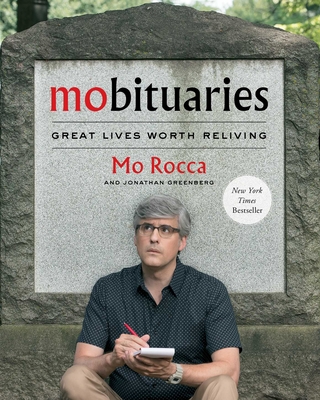
Audio book: Mobituaries

by Mo Rocca
Read by the author.
Support your local independent bookstore: buy it there!
Or listen at Libro.fm
Content: There may be some mild swearing. And sometimes the topics are kind of gross. It’s in the biography section of the bookstore.

I picked this one up because I like Mo Rocca on Wait Wait Don’t Tell Me. Which is also the reason I picked to listen to it rather than read it. I enjoyed listening to Mo tell these stories — some of which I knew, most of which I didn’t — about people and ideas that have passed on. The problem? In audio, while it was going, I was interested and entertained. Afterward, though, I couldn’t tell you a single thing about what I heard. Maybe it’s just how I retain knowledge, maybe it was a bit the way the book was structured (it was more a trivia book than anything else), but I didn’t retain a single thing. It’s very much a bathroom book: read a story while you go to the bathroom, and then put it down.

That does’t mean it was bad. Mo is very entertaining, both as a writer and a reader, and some of these stories were quite fascinating. But it just didn’t stick with me in the long run.

So: entertaining, but not really informative.

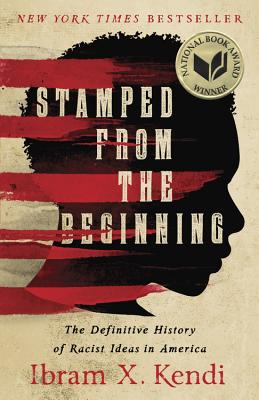
Stamped From the Beginning

by Ibram X. Kendi
First sentence: “Every historian writes in — and is impacted by — a precise historical moment.”
Support your local independent bookstore: buy it there!
Content: There is some swearing, including a few instances of the f-bomb and many of the n-word. It’s in the history section of the bookstore.

I picked this one up after listening to Stamped, which is a remix for younger readers of this history. I didn’t know what to expigect, but what I got was a book that made me rethink my perceptions of race, race relations, and class, and rethink what I was taught in history classes.

The basic idea that Kendi sets out to demonstrate is this: racial discrimination leads to racist ideas which lead to ignorance and hate. It’s the reverse of everything I had been taught which is: ignorance and hate lead to racist ideas which lead to discrimination. It’s a lot to wrap a (racist) brain around at first, but over the course of the 500 pages, Kendi does an excellent job showing how, throughout history, racism starts with racist people being self-interested and creating racist policies. I learned a ton.

I don’t know if there are any solutions to be found in the book. Except for the conclusion that self-sacrifice (of Blacks) and uplift suasion (Black people being “more like White people”, which is a racist idea), and educational persuasion (if white people just had “all the facts” about racism they wouldn’t be racist) don’t work. It will take a concerted effort of White people and Black and Brown people to realize that it’s in the best interest of ALL people to do away with racist policies.

I don’t know what the political and economic solution for this is (except maybe tax the wealthy and refund all the social programs that have been axed over the years). But I do know that it is important for corporate media (!) and White people to stop generalizing and stereotyping Black people.

As for me, this book made me rethink ideas I’ve had in the past, rethink the way I interact with the media and politics, and perhaps made me a little more antiracist. I can only hope.

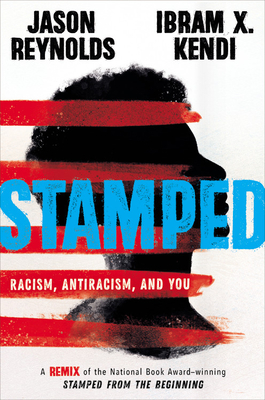
Audio book: Stamped: Racism, Anti-racism, and You

by Jason Reynolds and Ibram X. Kendi
Read by Jason Reynolds
Support your local independent bookstore: buy it there!
Or listen at Libro.fm
Content: There is frank talk of slavery and rape and they use the n-word a couple of times. It will be in the Middle Grade History section of the bookstore.

The publishers — and Reynolds himself — are calling this a “remix” of the National Book Award- winning Stamped, by Kendi, and a brilliant remix it is. Reynolds takes the ideas in Kendi’s book — which is a look at racism from the first recorded instance in the 14th century to the present day — and distills them down so that kids == it’s aimed at the 10 and up crowd — can easily grasp the ideas and the history.

And Reynolds makes it fun. It’s a “not history history book”, one where Reynolds talks about IDEAS and how they fit into the grander scope of history. It’s incredibly engaging to listen to (and read!) — Reynolds is a fabulous narrator — and it made me look at history in a new light. It’s an important book — I’ve checked the original out from the library because I’m interested in what Kendi’s research — especially in this day and age. It’s incredibly helpful as a white person to understand that racism is systemic and built into the framework of our society. And maybe by understanding that, we can all become a bit more aware.

Excellent and highly recommended.

Queen of the Sea

by Dylan Meconis
Support your local independent bookstore: buy it there!
Review copy provided by the publisher.
Release date: June 25, 2019
Content: It’s a historical graphic novel, so it’s a bit long. It will be in the graphic novel section of the bookstore, though I’m sure a younger reader, interested in English history, would be interested in this one.

On the one hand, I finished this. And didn’t dislike it. I liked the art, I liked the humor, and I liked that the main character wasn’t the queen or a courtier, but rather an orphan girl, Margaret, stranded on an island with a bunch of nuns. It was an interesting story — of the exile of Queen Eleanor of Albion (read: England) after her sister takes over the crown. Eleanor befriends Margaret, or rather, Margaret befriends Eleanor, and they figure out a way to escape and take back Eleanor’s crown. Kind of. It’s mostly about Margaret’s relationships she has with both the island and those on it.

On the other hand, who is the audience for this? Really? A graphic novel loosely based on the childhood of Queen Elizabeth I, no matter how excellently done, is really really niche.

Hopefully, it will find its audience — whoever they are — and there will be people to enjoy this well-done, but really rather odd book.

American Dialogue

by Joseph Ellis
First sentence: “Self-evident truths are especially alluring because, by definition, no one needs to explain why they are true.”
Support your local independent bookstore: buy it there!
Content: It’s a work of scholarship, even if it’s written for a mass audience. There are footnotes and endnotes, etc. It’s in the history section of the bookstore. 

I picked this one up because I was curious after hearing an interview with Ellis on the New York Time Book Review podcast. I’m not quite sure what it was that he said that made me want to pick it up, but after hearing it, I put it on hold at the library. 

The basic premise is this: Ellis takes a look at four of the American founders — Jefferson, Adams, Madison, and Washington — each through a prism of an issue that is both relevant back then and today. Jefferson gets race; Adams, equality (monetary, not gender); Madison, law; and Washington, war. Ellis dissects each man’s letters (easiest to do with Adams, most difficult with Washington), speeches, and papers, in order to come up with what they were thinking about when they framed the country — from the Declaration to the Constitution, but especially the latter — and what we can learn from that. 

And I think that the take-aways are striking. Ellis starts from the position that slavery and the genocide of the indigenous peoples are America’s original sin, the things that we have yet to redeem ourselves from. We (especially today) have forgotten that the Constitution was never meant to be written in stone, but is, in fact, a living document that’s supposed to change and adapt to the needs of a growing and changing country. He admits that the founders were geniuses, but they were also human, with flawed logic and changing opinions. 

I’m not sure it’s a book everyone Must Read, but I found it fascinating to learn about these men and the ideas they had.