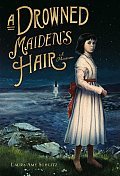
A Drowned Maiden’s Hair

I’ve heard nothing but good about this one, by Laura Amy Schlitz. I liked the Newbery winner she wrote, and so I figured with those two recommendations, I couldn’t go wrong with this one.

Thankfully, I was right. I loved this little story. Schlitz deftly weaves a bit of mystery, some beautiful scenery and a lot of longing into a not-so-traditional orphan story. Wonderful.

Maud, an 11-years-old orphan, is singing in the outhouse of Barbary Asylum on the best day of her life: the day that Hyacinth Hawthorne decides that it’s Maud she wants to adopt. She has always longed for a home, or at least ever since she was 5 and someone adopted her older brother and younger sister and not her. She goes home with Hyacinth, meets her two sisters Judith and Victoria, and then discovers that she’s to play a part in the “family business”. She makes the best of it, vying for Hyacinth’s attention and affection, and eventually finds happiness in the bargain.

That’s a terrible plot summary, but I don’t know how to do the book justice while not giving too much away. I loved Maud as a character: feisty and spunky yet with so much longing to be loved it made my heart break. I thought it was an interesting look at family and death and separation and surviving… and so much. I liked the relationship that Maud had with Muffet (the deaf house maid in the Hawthorne home); how Maud came to understand Muffet and how their relationship developed. I really liked the ending, even though I saw it coming. I thought it was just perfect, and very satisfying.

M’s only quibble with the book was the subtitle: A Melodrama. She finished the book and said that it didn’t really read like a melodrama (or at least how Hubby defined a melodrama to her). (My only quibble is that Schlitz seems to like colons in her titles. They all have one.) According to trusty old Webster, a melodrama can mean both “a work characterized by extravagant theatricallity and by the predominance of plot and physical action over characterization” (doesn’t quite fit) or something “appealing to the emotions” (fits better). Maybe M’s right: it’s not quite a melodrama (though I think it was melodramatic at some parts). But it is a really wonderful book.

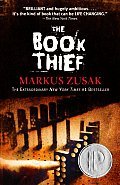
The Book Thief

Things I can say about Markus Zusak’s best-seller: I admire it. I thought it was brilliantly written. I thought Death as a narrator was an intriguing premise. I thought it was interesting that the story was set in Nazi Germany, but was about ordinary Germans just surviving. And yes, I cried at the end.

Things I can’t say about The Book Thief: that I like it. (Oh, and that I can spell thief the first time, without a spell-checker. Just can’t do it.)

This bothered me. I read the book — all 550 pages — and two-thirds of the way through I was still unsure what I thought of it. I didn’t hate it; I had no desire to stop reading. I did want to “find out” — though I already knew — what happened to Liesel and Rudy and Max and Hans. I don’t consider it time wasted, or time lost. So I didn’t hate it, or even really dislike it. About 100 or so pages before the end I finally decided that this book would have to be a toss: I was going to admire a book, to recognize it’s literary worth, and yet not like it.

I think my fundamental problem with this story is that it’s not really a cuddly or accessible one. Not that stories set in Nazi Germany can ever be cuddly. And a story about a pre-adolescent girl during this time isn’t necessarily accessible or enjoyable. It is an interesting, and possibly important story — but like “Schindler’s List” or “The Pianist” or Elie Wiesel’s books — it’s not one you want to cuddle up with, to read and reread. The final moral is something along the lines of: words can do good as well as harm, some people are good even in a bad situation, and some people survive. That’s life. In the end, I feel like this is an English class book; one to be respected and studied and analyzed and possibly imitated.

Just not really liked, at least by me. I’m okay with that.

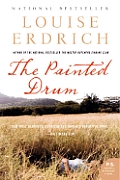
The Painted Drum

This is me exercising my right to give up on a book that I just am not enjoying.

This is me giving up on trying to enjoy Louise Erdrich’s books (this is the second one I’ve disliked).

This is me not writing what I really think about this book (though Hubby dared me to).

I had fairly high hopes for this one. I know I didn’t like Birchbark House, but I figured maybe it was that because Erdrich is usually an adult-fiction writer, that she just didn’t quite know how to write well for kids. It’s not that she doesn’t write well — some of her passages were quite beautiful. It’s just that there was nothing else. And after a while I lost interest in the whole first section — the story of Faye and how she came to have the drum. So, I skimmed to the second section, the story of how the drum came to be, hoping that it would be better. It was, but only marginally. And not enough for me to even care about the last two sections of the book. I wasn’t moved, I wasn’t touched, I wasn’t captivated.

So, I abandoned it. I’ve got better things to do with my time.

Song of the Sparrow

I loved this book.

Sure, I have a bit of a soft spot for books about the Arthurian legend, and so I would have probably liked this book anyway. But, it was a beautiful story, a captivating take on the legend, masterfully written.

It’s written in free verse, and I couldn’t imagine it being done any other way. The simplicity of the text brought out the story, the emotions, the choice of words that much stronger. And because of that, they — and the story — resonated in a way that longer, more detailed works haven’t.

Lisa Ann Sandell takes a new perspective on the story, writing it from Elaine’s point of view. (She’s the infamous Lady of Shalott; if you’re good, you will have read Tennyson’s poem. If you’re like me, you will mostly know her from Anne of Green Gables.) Elaine’s mother died 8 years ago, and ever since then, she’s lived with her father and brothers in the war camp. Lancelot is her hero, her friend, as is all the rest of the men: Arthur himself, Gawain, and (in an intriguing, and brilliant, twist) Tristan (from Tristan and Isolde). Elaine’s happy enough, spending her days mending and healing and being in nature. And then life changes: Arthur becomes the dux bellorum (the war chieftain), and Gwynivere arrives.

It’s a simple enough plot, but between the characterizations (I had tears streaming down my face at the end), and the elegance of the poetry, the book is a captivating read.

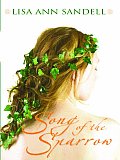
I really have only one complaint: the cover. It’s a beautiful enough cover, but I became annoyed with it because of both the description on the blurb (“Elaine has a temperament as fiery as her long red hair”) and this passage:

Eyes of hazel-green like forest ferns
and mud,
and long, thick hair my father once told me
was the color of wheat and summer strawberries.

I ask you: does that girl have hair the color of wheat and summer strawberries? No. She has dishwater blonde hair, the color mine was in high school. This is wheat and summer strawberries:
I do have to admit that it wouldn’t bother me as much if I didn’t have a red-haired daughter. Still, I won’t let the cover get in the way of highly recommending this book. It truly is wonderful.

Enter Three Witches

Novelizing Shakespearean plays. Novel idea, right? I have this feeling that the recent “trend” (I’ve read three different takes on three different plays in the last four months) isn’t really new; that somewhere out there other authors have taken on Shakespeare and tried to make him more accessible.

If not, then why not? He’s just loaded with story ideas…

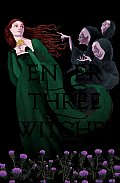
This one, by Caroline B. Cooney takes on Macbeth. It’s not exactly a happy play; but as far as tragedies go, I like this one best. Granted, it’s been years since I’ve read or seen it (and since I couldn’t remember it well, I kept wondering how the book measured up; but it isn’t necessary to understand the book), but I remember thinking that it was not only a good, cohesive play (it makes more sense than Hamlet!), but it’s got enough of the supernatural in there to scare you silly.

I think that Cooney did a marvelous job re-creating the mood of the play. The narration flips back and forth between characters, some of whom are Shakespearean. We follow Lady Mary (who isn’t in the play), daughter of the Thane of Cawdor (who is), and ward of Macbeth and Lady Macbeth. We learn about Swin, the cook; Ildred, Lady Macbeth’s lady-in-waiting, as well as Seyton and Fleance (who are mentioned in the play, but has an expanded role). It’s a complicated thing, flitting between narrators, and generally I find it distracting. But I think it helps with the mood in this case; we are supposed to feel a measure of confusion and uncertainty, and having different people tell us different aspects of the story helps with that. I also like that the book feels spooky. The undercurrent of the witches are there… and Macbeth’s (and others) descent from the noble to the cursed is visible and affecting.

I did have a few issues with the book — Lady Mary as a main character was fairly weak; she spent much of the book lurking around wondering what she should do. It’s understandable; being the 14-year-old daughter of a traitor leaves her in a precarious situation. Still, it wasn’t until the last third of the book that I actually began to like her as a character. I liked the other narrators, though, so they kept me going when Lady Mary was uninteresting. And the plot point where Ildred became pregnant and had a baby which was killed in the course of the book, I felt like it came from nowhere. I did go back and read some sections after finishing and realized that the hints were there, but they were sufficiently subtle that I completely missed them. So, it may just be me.

Overall, though, I liked the book and think it’d be a good companion read with the play. (Maybe I’ll even get around to reading/seeing it again someday.)

Roll of Thunder, Hear My Cry

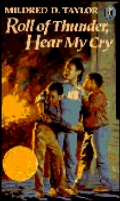
For me, this book falls into the “important but very painful to read” category. It was depressing, disheartening, and yet an important look at race relations in the south in the 1930s.

The basic story is a year in the life of the Logans, as told from 9-year-old Cassie Logan’s point of view. She and her family live in Mississippi, north of Vicksburg, on a former plantation. Her family is different than the other tenant farmers in their area: they own 400 acres of their own land. It was a fluke: a Yankee had bought some after the Civil War and ended up selling some to Cassie’s grandfather. Yet, it’s the land — and owning it — that allows Cassie’s family a measure of freedom that the other families don’t have.

The interesting thing (to me) is that the other black families don’t hold it against the Logans do what they can to help out their neighbors and work hard at making ends meet. It’s the white people that claim the Logan’s are putting on airs, getting uppity and the like. In the end, it’s the land that both dooms them and saves them. (Which sounds ominous, I know, but really that’s the way it happens.)

Mildred Taylor doesn’t spare any one or anything. When Cassie disobeys, she gets whipped. She gets humiliated for just being black, and manages to get her “revenge”. It’s very much a world of get and try and give back. The children get splattered every morning on their way to school by the white bus going by (on purpose), and they take their revenge. Which sets off a chain of events. I think more than race relations, this book is about consequences. The consequences of choices, of decisions, of being black (or white) in Mississippi. There’s a strong sense of family, too. The Logans deeply care for their children, wanting what’s best for them. They are also concerned for their safety, navigating the difficult path of what’s right versus what’s best.

It was a very powerful book, one that I’m sure will stay with me for quite a while.

Good Masters! Sweet Ladies!

In a word: delightful.

Other words to describe this: gem, fascinating, funny, captivating, beautiful.

Amazing.

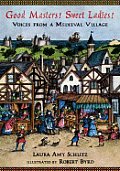
It’s amazing how much information Laura Amy Schlitz packed into 81 pages. There are 22 captivating characters, each one with their own story, separate, yet interconnected. It’s a well-researched (but never dull) peek back in to Medieval times, the harshness of it, as well as the simple little joys. I liked that Schlitz didn’t glamorize the lives of these children, but I liked that she kept it accessible to kids of today. I liked that much of it was poetry: beautiful, simple, powerful. (And this is from someone who isn’t necessarily a fan of poetry.)

I want to own this book. I have a feeling that M and C will enjoy it, too. I can even see them putting on one or two of the plays themselves. It’s a treasure, and well worth the Newbery it won this year.

Loving Will Shakespeare

I picked this up on a whim at the library a month or so ago, partially because Erin reviewed it and liked it well enough (at least I remember her reviewing it, but now I can’t find the link) and partially because I’ve read and like some of Carolyn Meyer’s other stuff.

And this one was okay. Nothing spectacularly brilliant, but nothing really bad either. It’s the story of Anne (Agnes) Hathaway, and how she came to marry Will Shakespeare. It’s an interesting enough story, but a less-than engaging one. I liked Agnes/Anne, but I really didn’t feel that connected to her. I was interested in her life at the beginning, but after a while I just got bored. So her mother died when she was little, and her father married a shrew. So she fell in love with a rogue and accidentally set fire to her father’s barn. So a man she was engaged to died from a fever. So she was 26 when she married an 18 year old because he got her pregnant. I really wasn’t all that interested. Which is sad; I should have been. There is so little known (the author’s note, while brief, was fascinating) about Shakespeare and Anne, that this really could have been a compelling love story. But it wasn’t. Maybe it was because of the length of time involved: the book covers 47 years, beginning with Will’s birth and ending when he comes back to Stratford-on-Avon from London five years before his death. Maybe I just wanted more… I seem to be wanting that from a lot of YA books these days. (Well, maybe not “a lot”, but this isn’t the first time.) But it just felt like a very long list: this happened, then this happened, then several months passed and this happened. And that doesn’t make for a very engaging story.

The Hummingbird’s Daughter

I have had a hard time with Latin@ (see, turtlebella? I do learn!) literature in the past. Magical realism and I have not been good friends. I hear over and over again people loving these books and I read them, and… I think they’re just weird.

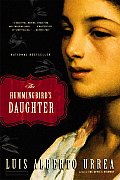
But this one, by Louis Alberto Urrea, is different. Maybe it’s because though the magic is there, it’s not nearly as prevalent as in other books. But I think it’s mainly because it’s a work of historical fiction, and more than that: it’s a work of love.

The story is that of Urrea’s great-aunt Teresa. She was the bastard daughter of Thomás Urrea, a patrón of a ranch in Mexico. She flies under the radar for the most part during her early life, living in squalor and unloved by her aunt (her mother left when Teresa was small) until she came under the guidance of the local healer, Huila. Then she learns the secrets of the Indians (of which she is half), and how to heal and dream and guide. Eventually, after the ranch moves north to a different location, he and her father become reconciled (though it’s more like “become introduced”) and she moves in the main house with him. She learns to read, her life is pretty quiet. Until one day, when a vaquero attacks her in her sacred grove of trees. She dies… and is resurrected. And from there, we see the evolution of Santa Teresa, the woman who will help the masses rise in revolution against the dictatorship.

Writing that, it sounds very simple, but this book is anything but. It’s immense. It’s lyrical. It’s funny. It’s sorrowful. The one thing I could tell is that Urrea really cared about his subject. The love and respect he has for Teresa, as well as all the years of research he did, is evident in every page. And because of that, the book (for me, at least) soars. I couldn’t put it down. I hung on every beautiful descriptive word. An example:

Only rich men, soldiers and a few Indians had wandered far enough from home to learn the terrible truth: Mexico was too big. It had too many colors. It was noisier than anyone could have imagined, and the voice of the Atlantic was different than the voice of the Pacific. One was shrill, worried, and demanding. The other was boisterous, easy to rile into a frenzy. The rich men, soldiers, and Indians were the few who knew that he east was a swoon of green, a thick-aired smell of ripe fruit and flowers and dead pigs and salt and sweat and mud, while the west was a riot of purple. Pyramids rose between llanos of dust and among turgid jungles. Snakes as long as country roads swam tame beside canoes. Volcanoes wore hats of snow. Cactus forests grew taller than trees. Shamans ate mushrooms and flew. In the south, some tribes still went nearly naked, their women wearing red flowers in their hair and blue skirts, and their breasts hanging free. Men outside the great Mexico City ate tacos made of live winged ants that few away if the men did not chew quickly enough.

It’s books like this that make me glad I read as much as I do.

Anahita’s Woven Riddle

Say you are a 16-year-old Afshar girl, daughter of the kadkhuda (he’s the tribal leader). Your father has decided to arrange a marriage with the kahn (he’s the tribal chief who represents the tribe with the government)… except the kahn’s old(ish), has buried three wives, and is arrogant and self-absorbed. You don’t want to marry him. What do you do?

What Anahita proposes to her father is this: every Afshar girl weaves a wedding qali (that’s a rug). She proposes to weave a riddle into the rug, and she will marry whomever can solve the riddle. With that, you have the premise of this engaging book by Meghan Nuttall Sayres.

I have to admit, that this book is a bit clunky to start with. Sayres weighs down the first section with information about the place (Iran), culture (Persian), language (Farsi), as well as nomadic life. Much of this information was necessary in order to understand Anahita and her world, as well as the suitors who would most likely have a chance to win her hand. But I felt like I had to push through the early chapters; all the extra elements slowing me down.

After I got through that section, though, the book soared. Anahita — who has a bit of a reputation for being outspoken — has to convince her father first that marrying the kahn is a bad idea. Then she has to convince him that a riddle contest is a good idea. Then she has to deal with the repercussions of that decision, which effect not only her but the entire tribe. I enjoyed that part; I felt like Sayres was very honest with Anahita by not letting any minuscule part of her rash — and unorthodox — decision go unexplored. I felt that Anahita’s responses were honest, too. Her unwillingness to settle for anyone which gives way to the slow realization of how her stubbornness affects other people. She matures very beautifully.

But what I enjoyed most was the love story. Anahita has three serious suitors, and Sayres makes each one of them desirable and worthy of Anahita’s hand. We meet them in snatches: there’s the prince who meets Anahita only briefly; the good friend who sees her every day; and then the scholar and teacher who comes into the picture late. In this book, there’s is only one bad choice (the kahn); everyone else is varying degrees of good. I was, in turn, hoping for each one of the suitors to win her hand, even though I suspected that there was one true front-runner. However, I was very satisfied with the way it turned out.

It’s also a book for weavers and spinners. Sayers (who’s a weaver herself) takes the qali-weaving through the entire process, from carding and spinning the wool, through dying (all-natural; no synthetic dyes here), and finally through weaving the pattern. Even though I’m not a weaver, I know a few, and I thought of them as I was reading those passages. I could tell that Sayres has an affection for the craft, for it came through in those passages. I’m not sure it made me want to weave, though it did give me an appreciation for all that goes into the process.

One last thing. In the authors note at the end (very informative, by the way), Sayers mentions that she’s donating proceeds from this book to help the people of Iran in recovery from a December, 2003 earthquake in Bam. If you do decide to purchase it, the royalties will go to development enterprises in Bam that serve women and children.

Just think: you get a good story and can help people at the same time. Happiness all around.