Love & Saffron

by Kim Fay
First sentence: “Dear Mrs. Fortier, I hope this letter finds you well.”
Support your local independent bookstore: buy it there!
Content: There’s really nothing objectionable. It’s in the adult fiction section of the bookstore.

I haven’t read a good epistolary novel in a long time, and this one fit the bill: short enough to read in an afternoon, and charming enough to keep me entertained.

The correspondence takes place in the early 1960s between two women, Joan – a 27-year-old single woman living in LA, and Imogene, – a 60-something woman living in the Seattle area. They start corresponding because Joan writes a fan letter to Imogene who writes a column for a national magazine. From there, they develop a deep friendship that lasts years, sharing details about their lives and bonding over food.

It really is a charming little novel. I know the title is “Love & Saffron” but it made me hungry for tacos. It’s a love letter to food and friendship and definitely worth a couple hours to enjoy.

Devil House

by John Darnielle
First sentence: “Mom called yesterday to ask if I was ready to come home yet I went directly to San Francisco from college, and I’ve been in Milpitas for five years now, but she holds fast to her he story that eventually I’m coming back to San Luis Obispo.”
Support your local independent bookstore: buy it there!
Review copy passed along to me from my boss.
Content: There is some mild swearing, including a few f-bombs, descriptions of grisly murders, and domestic abuse. It’s in the Adult Fiction section of the bookstore.

The problem with a book like this is that the plot is secondary. The why you need t read the book, the reason to keep coming back, is for, well. Hm. I was going to say the story, but that’s what the plot usually is, right?

The “plot” is following true-crime writer Gage Chandler, as he works to unravel the mystery of a set of grisly murders in the “Devil House” in Milpitas in the mid-1980s. But, it’s more meandering than that. It explores the story of Chandler’s first book, about the White Witch, and the story of the Devil House murders, with a side detour through a weird medieval section.

But, while the story was interesting, and kept me engaged (they usually say “nonfiction that reads like fiction” but this was “fiction that reads like memoir”), I think it was the slow burn that kept me coming back. I wanted to know where Darnielle was going to take me next, what thing Chandler was going to think or find or reveal. And in the end, I realized this book was about the myriad of ways we look at each other, and about who is entitled to tell someone’s story. And maybe that’s what kept me coming back and turning pages.

Whatever it was, I found it fascinating to reflect on, and interesting to be immersed in. Definitely worth the time.

Friends Forever

by Shannon Hale and LeUyen Pham
Support your local independent bookstore: buy it there!
Others in the series: Real Friends, Best Friends
Content: There is talk of crushes and “going together” and mental illness. It’s in the middle-grade graphic novel section of the bookstore.

It’s eighth grade, and Shannon finally feels like things are going to go Her Way. She’s basically found her people in the drama club and thinks she understands how to navigate middle school. Except, she doesn’t feel beautiful, compared to her best friend, Jenn. There are friendship ups and downs. Her classmates keep asking whether she and her other best friend, Andrei, are “going together”. It’s hard when everything everyone says sticks in her brain, rumbling around, making her question her worth. (I get that.) Is she “good enough”? Can she even be good enough? Will anyone really gruly get and like her?

This is such a smart book: Hale and Pham get not just the mid-1908s (it’s the 1987-1988 school year), but the inherent angst of being 13/14. There are good moments, ones where Hale captures the silliness of young teenagers, but also ones that she uses as teaching moments, like the time she was assaulted by a mall Santa. She is open about her mental illnesses, and the mistakes she made (and her parents made) as a teenager — most telling was the way he “threw” her appointment with a therapist. It was the 1982s; therapy was only for “bad” people, and she didn’t want to be seen that way. It does have a hopeful ending, though. And Pham’s art captures everything perfectly.

I am going to miss this series, but I can’t wait to see what Hale and Pham do next.

Starfish

by Lisa Fipps
First sentence: “I step down into the pool.”
Support your local independent bookstore: buy it there!
Content: It’s in verse, so good for reluctant readers. Though her mother is… not great.. which may be triggering for some. It’s in the Middle Grade section (grades 3-5) of the bookstore.

This is a book about Ellie. Ellie, who has been called “splash” since her 5th birthday party, when her older sister christened her that, after a huge cannonball into the pool. Ellie, who is bullied mercilessly at school by, well, pretty much everyone. Ellie, whose mother is constantly nagging Ellie about what she eats, how much she weighs, and lamenting that Ellie’s life would be better if she was just, well thinner.

This is a book about Ellie learning — through the help of a therapist (yay!) — that she has worth as a human being, no matter what she weighs; that she can stand up for herself at school and to her mom; and that true friends will have your back always.

Oh my heart, I loved this book. I loved Fipps poetry, the way she made Ellie three-dimensional as a character, though everyone else from teachers and kids at school to her siblings and mom (except her dad; there’s probably a whole essay on why it was her mom that was always picking on her weight and not her dad) kept trying to define her by how she looked. It says so much about society that we can’t see fat people as anything but “fat”, and not as people, and I think Fipps hits upon that. It’s always age appropriate — Ellie is in 7th grade, and she feels like a 7th grader — but Fipps is dealing with bullying, self-acceptance and self-love, and confidence no matter what “people” say about you.

It’s an incredibly rewarding book, which I thoroughly loved.

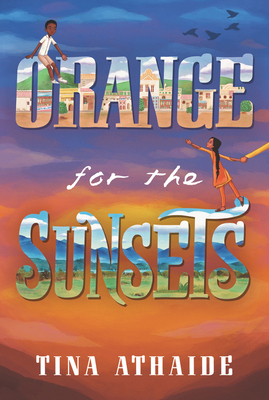
Orange for the Sunsets

by Tina Athaide
First sentence: “Yesofu glanced at his watch.”
Support your local independent bookstore: buy it there!
Content: There is some violence and name calling. It’s in the middle grade section (grades 3-5) of the bookstore.

History I didn’t know about: The British colonized Uganda and brought in Indians to do work for them. When the British left, the Indians stayed, filling the hole that the colonizers left. Then, in 1972, there was a military coup, and Idi Amin took over the country. One of the things he decided was that Uganda was for the Black people who have been oppressed, and the Indians — many of whom were citizens or had been born there — needed to get out. He gave them 90 days.

Asha is an Indian, whose best friend is Yesofu, the son of her family’s (Black) servant. They’re best friends, inseperable. That is, utnil Amin gives the order for the Indians to leave. Suddenly they find themselves on opposite sides: Asha believing she is Ugandan and deserves to stay; Yesovu wanting to have what Asha always has had: a good job, a nice house, running water.

There is more to the plot, as the book follows the 90 day countdown. Asha’s father is involved in getting people out of the country; Yesofu is friends with another kid who is incredibly militant about Amin’s orders, to the point of harming Asha.

I am uncertain what I think about this. On the one hand, it’s a story about a part of history I knew nothing about. I do think it’s important to tell those kinds of stories. But on the other hand, this book wanted me to sympathize with the colonizers, to feel bad that Asha and her family, the Indians who had lived in Uganda, were getting expelled from their home. And I did, but. well, Yesofu had a point too: it wasn’t fair that the native people, the Black people of Uganda were kept in lower positions. I think Athaibe wanted to balance both sides of the story, but I think it kind of felt maudlin at times: Asha and Yesofu trying to hold on to an obviously doomed friendship. I also think Athaibe hammered the corruption of the soldiers home too hard: the last scene is a soldier taking Asha’s mother’s gold bangles as a “payment” to let them leave. It may be true, but it was a bit heavy-handed.

So: conflicted on this one. It wasn’t badly written, but I’m not sure I liked it.

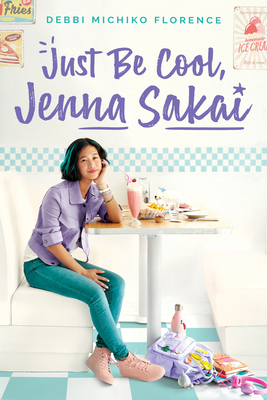
Just Be Cool, Jenna Sakai

by Debbi Michiko Florence
First sentence: “Heartbreak is for suckers.”
Support your local independent boosktore: buy it there!
Content: There is some talk of first romance and divorce. It’s in the middle grade section (grades 3-5) of the bookstore. But it’d be good for 6-7th grade as well.

Jenna Sakai has sworn off relationships. First, her parents got a messy diverse and her dad “abandoned” her by moving to Texas from California. Then her boyfriend, Elliot, who she thought she was super compatible with dumped her right before Christmas. After a very lonely winter break at her dad’s house, she’s back in California, at her school, determined to make a fresh start. No more relationships. No more Elliot (except he keeps popping up in places where she thought were Elliot-free). Just focus on the things she’s good at: journalism. Then she discovers a cute diner, and takes to going there as an escape from all the other stress in her life. It’s a great place, until she discovers that Rin Watanabe also uses the diner as a refuge, specifically what she’s come to think about as “her booth”.

Thus begins a tumultuous friendship between Jenna and Rin, as Jenna writes an article digging into a donation his family made to their school. It’s a bit more complicated than that, but that gets the gist of things.

I thought it was cute. I was a little “meh” at the beginning — boyfriends/girlfriends in 7th grade kind of turns me off, but Florence kept it pretty age-appropriate with just hand holding. But it was a really good story about a girl learning to trust other people again, after a couple of very big heartbreaks, first with her parents’ divorce, and then with the breakup with someone she thought was super compatible with her. I liked that it showed that middle school romances aren’t always great (thought there was an example of a good, healthy relationship as well). I also think that Florence does a good job capturing the complicated emotions and friendships that middle school has while not making everyone super annoying (which is easy to do). My only complaint is that I didn’t know this was a companion book to another one, and I kind of felt like I didn’t quite have the whole picture sometimes. But that was more my problem than the wriring.

It was a fun book, overall.

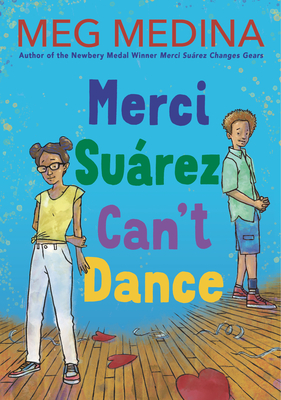
Merci Suarez Can’t Dance

by Meg Medina
First sentence: “It was Miss McDaniel’s idea for me and Wilson Bellevue to work together in the Ram Depot, a job that nobody wants.”
Support your local independent bookstore: buy it there!
Content: There is talk of kissing, periods, and puberty. It’s in the middle grade (grades 3-5) section of the bookstore, but I bet 6th graders would love this.
Others in the series: Merci Suarez Changes Gears

It’s halfway through seventh grade, and Merci is kind of (sort of) figuring things out. She’s not happy with her grandfather’s continuing descent, and her aunt isn’t around as much anymore, leaving Merci to babysit her terror twin cousins. And at school she’s trying to get along with Edna, but it doesn’t seem to be working well. And now, there’s the Heart Ball, the seventh grade fundraiser, which Edna is in charge of, and Merci is trying to avoid. But there’s Wilson, the boy she runs the Ram Depot with and maybe (?) may like-like. It’s all, well, a LOT.

This book had a ton of heart. I loved Merci trying to figure her way out, and I adore her family and the way they have each other’s backs. I loved the way Media wrote a character that was dealing with Alzheimer’s, and how the family worked to make his life easier. You could just tell how much the family loved each other. And I liked the middle school angst of it as well. Merci was delightfully awkward, making the best decisions she could, mostly, and terribly realistic. It was just a delight to read.

I know this book wasn’t really “necessary”, but I’ll take more Merci books any time.

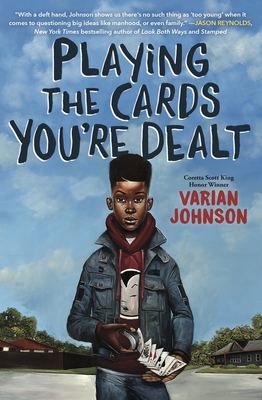
Playing the Cards You’re Dealt

by Varian Johnson
First sentence: “The house always wins.”
Support your local independent bookstore: buy it there!
Review copy provided by the publisher.
Release date: October 5, 2021
Content: There is talk of addiction in adults, some bullying, and a mild “relationship”. It will be in the Middle Grade (grades 3-5) section of the bookstore.

AnthonyJoplin — Ant to his friends, but don’t call him little — comes from a family of serious Spades players. His grandfather, his father, his brother, were all really great at it, winning the local tournament (and then some). But Ant can’t seem to get in the game. He’s “weak”. Or that the way he feels, especially around his dad, his brother, and his friend. That he needs to be stronger, better. He needs to win the tournament, for starters.

He and his friend make a good team, but when his friend is unexpectedly unable to play, Ant turns to the new girl – Shirley – as a partner. Which is its own set of problems. Add to that his father is acting weird, staying up in the middle of the night playing online poker, and Ant is just confused about what he really is supposed to expect out of life.

I love that Johnson gets the middle grade audience, tackling touch subjects like addiction and masculinity without talking down to his readers. I love that he gives us characters that are interesting and complex, which makes them and their problems seem more real. I love that he sprinkles his books with humor, so they are not depressing, but rather reflect life’s ups and downs.

The only think I didn’t like about this book was the narrator: I liked the folksy aspect of it, with the slang and the way it felt like someone telling a story, but I often felt the narrator — who was a character in their own right — got in the way of the story.

But it was’t enough to turn me off of this book. Definitely another very good read!

Life’s Too Short

by Abby Jimenez
First sentence: “Wailing.”
Support your local independent bookstore: buy it there!
Content:There is lots of swearing, including multiple f-bombs. There is also on-screen sex and talk of penis size. It’s in the romance section of the bookstore.

Vanessa Price is a pretty famous travel blogger, and so when she landed in St. Paul to help her sister give birth (its an unplanned an unwanted pregnancy), the last thing she expected was to end up taking care of the baby full time. But, here she is, without content, not having showered for ages. Coming to the rescue is Adrian Copeland, defense attorney, eligible bachelor, and surprising baby whisperer. As the weeks go on, Vanessa and Adrian grow closer together, figuring out life and babies and family and ultimately how to live your life to the fullest.

I absolutely devoured this one. It’s fluffy and fun, but it’s also got depth as Vanessa is dealing with a family history of ALS as well as a parent who is a hoarder and a half-sister (the baby’s mom) who is a drug addict. Mostly, though, it’s a lot of flirting and will they/won’t they and a lot of spending huge amounts of money on wine and home furnishings (Jimnez knows that a man cleaning is sexy!) and ultimately a very satisfying romance. I read it in a weekend afternoon, and then found out it was part of a “series”, so I picked up the first one.

I can’t wait to devour that one, too.

The Elephant in the Room

by Holly Goldberg Sloan
First sentence: “What SilaTekin would remember about that afternoon was that she had been wearing her favorite shirt.”
Support your local independent bookstore: buy it there!
Content: It deals with heavy subjects, but on an accessible level. It’s in the middle grade (grades 3-5) section of the bookstore.

Sila Tekin has lived in Oregon all her life, but her parents are immigrants from Turkey. They’re in the United States legally, but one day, Sila’s mom gets deported because her paperwork is not “correct”. It was supposed to be short deportation, but turns into nearly a year as Sila and her dad become more and more depressed. Enter Gio – an older man whose wife passed four years earlier and who recently won the lottery. The three of them – and they add a school mate of Sila’s, Mateo, later – make a sort-of family, helping each other through the process of healing. And then there’s an elephant.

The elephant is a rescue from a family circus, and brings more healing for our characters. I think Sloan was trying to advocate not only against circuses but in favor of humane animal treatment in captivity. She also had a strong case for elephant-human bonding. I just think Sloan really likes elephants.

The story itself was… okay. I think it’s good for a picture of immigration — and as a reminder that not every immigrant comes through from the southern border — and to help kids deal with tough situations. I’m just not sure Sloan was the best person to tell this story. Sloan says she has been profoundly affected by her time in Turkey, but I think this story may have been told better by someone who has had the experience of being an immigrant.

It’s not a bad book, but not my favorite by her either.