The Year of Shadows

by Claire Legrand
First sentence: “The year the ghost came started like this:”
Support your local independent bookstore: buy it there!
Review copy provided by the publisher for the Cybils.
Content: There are ghosts and shades and it gets pretty scary. There’s also a lot of pre-teen Angst and a little bit of romance. For those reasons, even though it’s in the middle grade (3-5th grade) section of the bookstore, I’d probably hand it to the older end of the spectrum. But that’s just me.

Olivia hates her life. Her father — whom she less-than-affectionately calls the Maestro — is wholly absorbed with being the conductor of their town’s struggling orchestra. So involved that Olivia’s mother left. So involved that they sold their house and auctioned off their belongings and moved into the back rooms of the concert hall in order to keep the orchestra afloat. And for 13-year-old Olivia, this does not sit well. In fact, she loathes it. (Understatement of the century.)

She’s miserable, she’s basically homeless, and then… she discovers there are ghosts in the concert hall. Not just ghosts, but shades — ghosts that have given up the search for the chance to move on and given into Limbo — as well. And it’s the shades that are Dangerous. And it’s up to Olivia and her new friend Henry to help the ghosts move on and defeat the shades. And, perhaps, in the process maybe they can figure out how to save the concert hall and the orchestra.

I adored this book for lots of reasons. Olivia was dark and grumpy and prickly and perfect for a ghost story. I loved the musical setting for this — the concert hall, the strains of orchestral music (it needs a soundtrack!) running through the story; in the endnote, Legrand talks about choosing pieces to fit the mood of Olivia’s life, and being familiar with many of the pieces, I think she did fabulously. (I don’t know how non-musical readers would react to it, though. Would it make them want to go look up the pieces?) I enjoyed Henry and some of the other minor characters, with their New-Agey feel and their support of Olivia. Because the Maestro? He’s firmly in the bad parent camp. He’s not a “abusive/horrible/evil” dad, but rather the “neglectful/unobservant” dad. And I can understand Olivia’s anger towards him.

There is one quibble: there’s a plot twist near the end of the book that I didn’t feel was absolutely necessary. (And which added to the Maestro’s bad parent-ness.) I think Legrand needed it for plot purposes, but it felt like it was out of left field, and didn’t quite fit with the rest of the book.

Other than that, though, it was highly enjoyable.

(Just for the record: because this is a Cybils nominee, I’ve been asked to make sure y’all know this is my opinion only, and not that of the panel.)

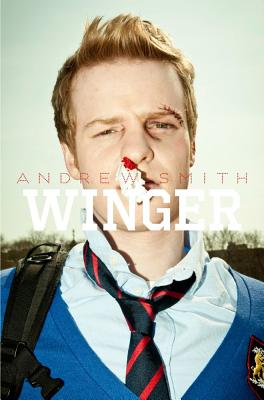
Winger

by Andrew Smith
ages: 14+
First sentence: “I said a silent prayer.”
Support your local independent bookstore: buy it there!
Review copy picked up at ABA Winter institute for me. Yes, I have taken that long to get to it.

Ryan Dean (yes, that’s his whole first name) West has a lot going for him: he’s a junior at Pine Mountain, a boarding school for troubled rich kids (his dad’s a high-powered Boston lawyer) in the Pacific Northwest. He is first string winger (think running back in football, but more intense) for the rugby team. He’s pretty smart.

But there are some downsides: he got transferred into O-Hall this year because he was caught hacking into a cell phone account at the end of last year. And, to top it all off: hes only 14.

And when you’re in O-Hall with all the delinquent football and rugby players? It’s not going to be a stellar year.

Add to that some major girl drama (he’s in love with his best friend, Annie, but snogging his roomate’s girlfriend), late night poker games (let’s just say that Ryan Dean is not a good drunk), and lots and lots of testosterone-induced fights. Let’s just say, I was impressed that Ryan Dean — who was decent human being underneath all the 14-year-old boy nonsense — survived until Thanksgiving.

I’m of two minds about this book. On the one hand, I can sum it up in two words: sex and rugby. Actually, the sex is all in Ryan Dean’s mind: he’s incredibly immature, and objectifies EVERY girl, and EVERY situation becomes about sex. In other words: he’s a normal 14-year-old boy. But unlike Carter’s Unfocused One-Track Mind which I couldn’t get through (and which is the best comparison to this one), I found myself endeared to Ryan Dean. Maybe it was the underdog element. Maybe it was because although he was annoying, he was almost mostly harmless. Maybe it was because he really did mean well, in the end.

Because, I found myself compelled by this. I was invested in Ryan Dean’s drama. I loved the camaraderie of the rugby team. I enjoyed Ryan Dean, dork that he was.

My only real problem was with the ending. See: Ryan Dean becomes good friends with the rugby captain, Joey, who also happens to be gay. Joey’s sexuality isn’t a big deal for Ryan Dean (though he feels the need to comment that he isn’t a lot), but it is for other guys in O-Hall. And in the last 20 pages of the book, it takes a sharp left turn and stops being a fun boarding school drama, and becomes Something More. Not that I minded something more, it was the sharp left turn that threw me. It didn’t work. I didn’t feel pain, or anguish, or anything at all at the end, because I was flabbergasted that a fun and entertaining book so suddenly became Serious. It came off as bad pacing and lack of focus rather than anything more substantial.

It didn’t ruin the book for me, but it did take some of the shine off. Which is too bad, because I was having fun with it before then.

The Actor and the Housewife

by Shannon Hale
ages: adult
First sentence: “Becky was seven months pregnant when she met Felix Callahan.”
Release date: June 9, 2009
ARC sent to me by the publisher.

Becky is your normal, average, run-of-the mill, Mormon mother of (almost) four (she’s pregnant with her fourth when the book opens). She doesn’t work, instead focusing most of her energies on running her house and taking care of her kids and husband. She does dabble in screenwriting, and sends one off to a publishing house on a whim, not expecting much of anything. To her surprise, an agent asks to meet with her; she flies out to LA, and it’s at this meeting that her future changes: she meets, accidentally, Hollywood heart-throb Felix Callahan. When she and Felix discover they’re staying at the same hotel, and he offers to buy her dinner, Becky figures it’s a once-in-a-lifetime, never-to-be-repeated experience (and will make a great story); besides, what do a Mormon mom and a British actor have in common, anyway?

Turns out that they the have formed a bond — purely platonic, of course — that keeps them connected through thick and thin. Over the course of eleven years, through good times as well as bad, Becky and Felix keep their friendship strong, and find the rewards that come from having a best friend.
Only in Hale’s adept storytelling hands can something this far-fetched become a poignant story of a Mormon woman, who in the face of a fairly prohibitive religious community (where men and women don’t usually form friendships outside of marriage) happens to have an unconventional friendship, with not only a man, but someone who is outside of the community and faith. The story becomes not one about friendship — there’s really not much given as a basis for Felix and Becky’s friendship; it’s just stipulated by Hale that they are — as it is a story about Becky, and how her friendship with Felix affects her life. There’s laughs (at least for me; Hale happens to have a sense of humor that I appreciate), there’s tears (lots and lots), there’s uncomfortable moments (especially for me, as a Mormon) as well as moments of true joy. Hale has a fascinating story here, and she knows how to milk it for all that it’s worth.
That said, I’m not sure that this book will be for everyone. It’s a very Mormon book, in the way Chaiam Potok’s are Jewish: Becky is Mormon, it permeates her life, her thinking, her being. It’s who she is. And while Hale does explain elements of the religion and culture, someone who is not familiar with it has the potential to be hanging at loose ends, wondering why this character would even begin to think this way. On the other hand, it’s not a conventional Mormon book; she doesn’t pander to traditional Mormon literature conventions, something which I greatly apprecaited. I liked Hale’s portrayal of Mormonism; she treats the religion and culture with love and good-humored ribbing. But, for a Mormon reader, who’s expecting the story to go in particular ways (it’s a book by a Mormon author with a Mormon main character, after all), they might be sorely disappointed.
Then again, it’s not a conventional chick-lit book, even though that’s the way Bloomsbury is marketing it. For one, it’s a very married book; more important than her relationship with Felix is her relationship with her husband, Mike. I liked her portrayal of them as a married couple: it’s a healthy, giving, committed relationship, one in which both partners feel loved, respected and valued. There’s very little romance, in the traditional chick-lit sense. And the ending, for better or for worse, is not a conventional ending (in any sense). I was surprised with the direction Hale took the story, but, in the end, very gratified.
I have to say, overall I adored it. I laughed, I cried, I fantasized, and it touched a place within me that I don’t often like to look at. I wondered… what if? But, then I put the book down, and looked out at my four girls playing outside with my dear husband, and was grateful for what I’ve got. And, perhaps, that’s all that Hale really wanted to do with this story.