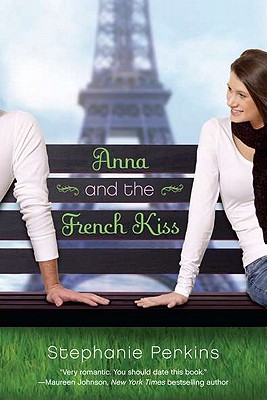
Anna and the French Kiss

by Stephanie Perkins
ages: 14+
First sentence: “Here is everything I know about France: Madeline and Amélie and Moulin Rouge.”
Support your local independent bookstore: buy it there!
Copy given to me by the lovely Vasilly

So, this one has been getting a lot of hype, all of it saying how wonderful, how great, how supremely perfect this was.

M, when she finished it said, “Well, that was cheesetastic. Good cheese, but so cheesy.”

The basic story: Anna Oliphant is the daughter of a Nicholas Sparks-type author, who, not wanting to be outdone by all his Posh Hollywood Friends, ships Anna off to a Posh boarding school in Paris. (Oh noes.) She doesn’t know a lick of French, doesn’t want to leave her comfortable life in Atlanta, doesn’t want to leave her blossoming almost-relationship with Toph. But, to Paris she goes.

Where she bumps into — literally — Étienne St. Clair.

(cue dreamboat music)

What ensues is a lot of romantic push-and-pull. Anna obviously St. Clair, but she has a double problem to deal with: he’s got a girlfriend though she’s kind of out of the picture, and Anna’s friend Mer likes him as well. Then there’s the question of whether or not St. Clair likes her? Sure, they’re friends, and they hang out all the time. But does he like her?

(Because, you know, we ALL want to know that.)

That’s not to say this is a bad book: it’s predictable, sure. But I did enjoy the relationship between Anna and St. Clair, it’s heights and valleys, and it’s inevitable, swoon-worthy resolution. It’s not a simple book, and much like Maureen Johnson’s work, Perkins knows how to write a romance that deals with more even while putting the relationship front-and-center.

Update, 2018: I can see how I thought it was cheesy, but for whatever reason (time, place, etc.), I found it to have a lot more depth this time. There were themes about communication and assumptions that touched me, and a reminder that while my children are my responsibility, they are also their own people with their own dreams, and it’s not up to me to control their lives. Also: I missed the subtext that Americans really can be awful (en masse) the first time around. Still a very good book.

Not perfect, b I ut delightful.

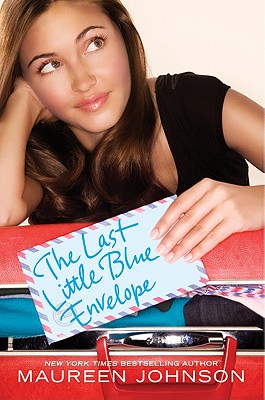
The Last Little Blue Envelope

by Maureen Johnson
ages: 13+
First sentence: “It was that time of day again.”
Support your local independent bookstore: buy it there!

It’s been forever and a year since I’ve read 13 Little Blue Envelopes, and while I remember enjoying it, I didn’t remember much else. I wanted to read this book not so much because I was invested in the story of Ginny and her quest to do what the letters from her (now dead) aunt instructed, but because I adore Maureen Johnson and her writing. I’m on board for any story she wants to tell.

Thankfully, MJ made it easy for me to pick up this one without revisiting the first one.

Apparently (since I didn’t remember that), Ginny’s backpack with the letters in it got stolen at the end of the last book. (Hence the need for a sequel. And for the title.) She’s basically given up ever completing the quest, and has tried to move on with her life, filling out college applications. It’s all just okay, being normal. Then out of the blue, a guy named Oliver contacts her: he has her letters, and he’s willing to give them back to her. For a price.

And, off she goes on another adventure. This one will take her across France, Belgium, Netherlands, and Ireland. It will involve romance, but again only in a subtle, understated way. It’s more about tying up loose ends, saying goodbye and learning about art. There’s a lot about art, actually, something which I thoroughly enjoyed.

It’s a good book; intelligent fluff for those who think their books should be smart and fun as well as swoony and sweet.

The Youngest Templar: Trail of Fate

by Michael P. Spradlin
ages: 10+
First sentence: “The room was full of bright light with a glare so intense that I closed my eyes.”
Support your local independent bookstore: buy it there!
Review copy sent to me (ages ago) by the publisher.

Dear authors of a series:

I enjoy a series as much as the next person. Really I do. There are characters I love that I want to spend more time with. And if you’d like to keep writing books about these characters, I won’t mind.

But, honestly: as much as I love these characters, and as fun and interesting and gripping your story is, I do have a problem. See, even if Tristan and Robard and Maryam (I didn’t get it until this book: it’s Robin and Marian!) are bouncing around France in the 12th century (was it called France in the 12th century?) I’d like the book to actually end by the ending. I was enjoying the book — sure it was a bit heavy-handed, but I figured, hey, it’s campy Robin Hood, I can handle that — and then, wham, the three words I hate most: TO BE CONTINUED.

Seriously?

Seriously? It’s an intense climax, a showdown at noon, a holdup, and you give us TO BE CONTINUED?

My first reaction is that you totally want to sell the next book. That you’re not confident enough with the story to give us an ending, trusting that we’ll want to visit with the characters in the next book. There is no call for TO BE CONTINUED in a series. It’s a cop out. A wimpy strategy. It is possible to give us an ending for the book, and still have us wanting to come back for more.

And honestly, I prefer it that way.

Thanks.
Melissa

Troubadour

by Mary Hoffman
ages: 12+
First sentence: “A small group of monks was making its way down to the river crossing.”
Review copy sent to me by publisher.

I generally like historical fiction. I generally like the pre-Renaissance time period. I generally like stories set in France. I sometimes like unrequited love. I generally like girls who know their own minds and set out to do what they want in spite of the odds.

But, even though this book had all those elements, it just didn’t do anything for me. In fact, it did so little that I abandoned it a third of the way in.

Perhaps it was me; it is August, I’m a bit distracted in my life right now, and I’m not focusing terribly well on complex books. Fluff is about my speed…

But, it also could be the book: there’s so much that Hoffman’s trying to bite off here. Not only is it a sweeping work of historical fiction, but there’s freedom of religion conflict, portraits of troubadour life, Medieval French politics… perhaps it was a bit much for a single story. That, and the narrator kept flipping between Elinor — our heroine who leaves her noble life for that of a troubadour so she won’t have to marry the man her father picked out; Bertran — the troubadour Elinor loves who is also a follower of the religious sect the Cathars whom the Catholic Church persecuted; and Pope Innocent II. It was a bit much for me.

And, perhaps the story would have picked up as it went along. I didn’t have the patience or fortitude to stick it out, though. And, perhaps that means I’ll be missing out on an excellent historical novel.

But then, maybe not.

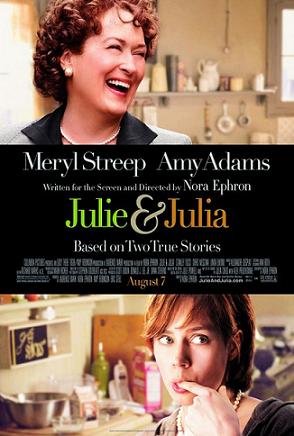
Book to Movie Friday: Julie and Julia

I expected a nice, light chick flick when I got a group of foodie-minded friends together to see this last weekend.

What I got was half of a brilliant movie. The other half was fun– more fun than I expected — but not nearly as brilliant.

The half that I adored was the Julia Child half. Based on My Life in France, it took the best parts of the book — the beginning, when she was discovering France and French cooking — and played them for all that they were worth. Meryl Streep did a fantastic job channeling Julia, but it was more than that. Stanley Tucci was absolutely perfect as Paul Child, and you could feel the affection between the two of them as a couple. I was a tad bit disappointed that they didn’t do more of my favorite bits from the book — I liked her classes at Le Cordon Bleu, and her experiences with the Gourmandes — but what they did do was absolutely perfect. They got the Valentine’s cards in; they captured Julia’s determination and scientific approach.

And if the movie had just been about Julia Child, I would have loved it.

But, they needed — maybe because too much Julia Child would have been too much? — to juxtapose that with something more modern, and who better than Julie Powell? It’s not that I didn’t like Julie and Julia; I did well enough. And there were moments of her story that I did like, too (specifically the lobster). But, she came off as real needy in the movie; an attention-seeker, where everything was building up to a particular moment: the moment when the World noticed that she was a Writer. Sure, Julia Child was an inspiration, and a project, but she was also a stepping stone to something Bigger. Something Julie.

I’m not sure if that’s what she meant to portray when she wrote the book, but that’s really how it came off in the movie. And that soured the joy that was the Julia Child sections.

Verdict: see the movie! Read My Life in France, too. The other book’s optional.

My Life in France

by Julia Child with Alex Prud’homme
ages: adult
First sentence: “This is a book about some of the things I have loved most in my life: my husband, Paul Child; la belle France; and the many pleasures of cooking and eating.”
Support your local independent bookstore! Buy it there.

Julia Child is an awesome woman.

Okay, yeah, I like food books and French books — and this book is both of those things — but mostly it’s the force of Julia Child’s personality that carries this book.

A forceful, entertaining, incredible personality.

It’s the story of Julia’s introduction to France, her discovery of her passion for French food, and the birth of Mastering the Art of French Cooking. It’s a fascinating journey, and it’s made all the more interesting by the way Julia writes about it. She’s full of joie de la vie, especially for all things French. She’s no-nonsense, methodical, and passionate. And, most of all, she writes like you’re sitting down next to her, sipping a cup of whatever, and she’s just rattling off memory after memory of her fascinating life, holding you spellbound.

Some basic highlights: She moved to France in 1946 — she was 36 — with her husband, Paul, who was stationed there with the USIS. She had never been there, and was totally ignorant in the ways of cooking and food in general. She shortly became passionate about the food, and decided about six months into their stay to study at Le Cordon Bleu.

While she appreciated the basic education that Le Cordon Bleu gave her, she was ultimately dissatisfied with the school. She did graduate, but only after having to go through some bureaucratic hoop-jumping. She had discovered that she was passionate about cooking, especially cooking French food, and so even though the school didn’t work out the way she wanted it to, she kept up with teaching herself.

One of the things that really impressed me was how methodical she was in her learning. She took the time to research everything, especially when she started working on the cook book (or “cookery-bookery” as she called it), and was more than willing to listen and learn from the experts. It took her — she collaborated with a couple of French women — 10 years to get the first Mastering book done and into the hands of a publisher, and another 9 on Volume 2. I found that immensely impressive.

On top of all that, she was as gifted linguist: she picked up French, German and Norwegian during her husband’s years in the service, before settling down in Cambridge, Massachusetts. She does get into how her TV show came to be, and dealing with the effects of celebrity, but I felt it was all almost an afterthought. The heart of the book, and the most interesting parts, are in Paris. Which is probably as it should be.

I loved the last paragraph, though:

In all the years since that succulent meal, I have yet to lose the feelings of wonder and excitement that it inspired in me. I can still almost taste it. And thinking back on it now reminds me that the pleasures of the table, and of life, are infinitetoujours bon appetit!

Bon appetit, indeed.

The Exiles in Love

It’s not very often that I like the sequel better than the original, but I have to say that enjoyed The Exiles in Love so much more than I did The Exiles. I didn’t need the tissue at the end, like the blurb from Horn Book said I would, but I did laugh, quite a bit (and manage to pick up on the satire this time!), at the escapades of the Conroy sisters.

The girls — most of them, anyway — are in love. Ruth is in love with no less than four men/boys: the bus driver, the Temporary English teacher, Alan Adair (the butcher’s son), and Philippe, the grandson of Big Grandma’s French friend who comes to say with the Conroys for a few weeks. Naomi and Rachel, in comparison, are only in love with one each: the Temporary English teacher for Naomi, and Phillipe for Rachel. (Though Rachel is very level-headed about it all, asking Philippe to marry her the second he walks into the house.) Phoebe, on the other hand, is mildly disgusted by this business with the “family failing” (aka, falling in love), preferring to devote herself to John le Carre, and becoming an international spy. To cure the girls of their failing, Big Grandma proposes an escapade to France, staying in a cottage on the property of her friend, and the girls manage to have a few adventures, as well as manage to fall out of love. All is well, of course, in the end.

I loved the trip to France. Having spent a summer in Germany, without knowing German, I completely empathized with the girl’s frustrations and insecurities about being in France. The part where they went shopping in the villa had me in tears, I was laughing so hard. And I thought they were all very cute and sweet and silly about falling in love… Ruth especially was good at pining. And I did catch this time around that McKay was satirizing parents who expect perfection from their kids. Mrs. Conroy is always moaning that her girls aren’t normal little girls, that they read too much, and aren’t normal enough, and get much too dirty for their own good. And when Rachel goes up for May Queen at her school, finally, Mrs. Conroy thinks, she’s acting like a “normal little girl”. Puh-lease. (Maybe I just needed the satire spelled out more blatantly; it was there in the first book, but I just found it annoying there. Here, I was amused by it.)

The book was told in flashbacks by Naomi and Ruth, each chapter beginning with a little conversation between the two of them. At first, I found that annoying, but eventually, it grew on me. And I have to admit, I did like the ending.

But the absolute best thing, the only thing I really marked because I liked it so much, was this quote, when they’re in France:

“And speaking of food,” said Big Grandma, “we’d better make a list. You girls will have to go shopping after breakfast.”
“Aren’t you coming?”
“With my ankle?” [she twisted it at the beginning of their vacation, and spent the week lounging in the orchards]
“What will you do then?”
“I shall sit quietly in the orchard with A Tale of Two Cities. I always enjoy books much more when I read them on location.”

Indeed.

Suite Francaise

I’ve spent the past week in France, enjoying the lyrical and evocative writing of Irene Nemirovsky. Amira highly recommended it a (long) while back, and so I was excited that my in person book group (which sometimes does pick really good books!) chose it this month.

It took me a bit to get into the book, but once I realized that there was no real plot, no real character development, but that it was a portrait of a time and a place and how individuals dealt with the time and place, I lost myself in it. And it was easy to do. The first part, Storm in June, dealt with the exodus of Paris in the wake of the German invasion. Nemirovsky followed a dozen or so people in the exodus, how they reacted to the crisis, how they managed to deal with an extreme situation. Some managed admirably, some horribly; some were noble and respectable, some were petulant and miserly. It was fascinating watching it all unfold, interesting to see how each individual person reacted to each individual situation.

The second part, Dolce, was my favorite of the two. It was the portrait of a country village after the German occupation and how the villagers responded to their German occupiers. My heart went out to Lucile, living with a horrible mother-in-law, and falling in love with the German who was living in her house. There was less going on in the second part, but I really thought Nemirovsky perfectly captured the emotions of a human being trapped between two realities.

And, then there’s the note at the end, about Nemirovsky’s history and how this book came to be. It shed a lot of light on how she treated some of her characters, especially wealthy and upper-middle-class women, and it made the whole book much more tragic.

And, because these popped out at me, I’ll include some of my favorite quotes…

From early on in Storm in June:

“I keep telling you, you don’t pay enough attention to the minor characters. A novel should be like a street full of strangers, where no more than two or three people are known to us in depth.”

And from Dolce:

She said “we” out of that sense of propriety which makes us pretend we share other people’s misfortunes when we’re with them (although egotism invairoable distorts our best inetntions so that in all inocencewe say to someone dying of tuberculosis, “I do feel for you, I do understand, I’ve had a cold I can’t shake off for three weeks now”).

Let them go where they want; as for me, I’ll do as I please. I want to be free. I’m not asking for superficial freedom, the freedom to travel, to leave this house (even thought aht would be unimaginably blissful). I’d rather feel free inside — to choose my own path, never to waver, not to follow the swarm. I hate this community spirit they go on and on about. The Germans, the French, teh Gaullists, they all agree on one thing: you have to love, think, live with other people, as part of a state, a country, a political party. Oh, my God! I don’t want to! I’m just a poor useless woman; I don’t know anything but I want to be free!

Empire of Ivory

So, I picked up this one — the latest in the Temeraire series by Naomi Novik — about a month ago at the library. Hubby scooped it up, excited, and dove in. Three and a half weeks later, he gave it back with the summation: “Lousy story, good ending.”

I needed something different to read after being in YA-land for Estella’s Revenge last week, and I picked this one up on Friday. I stopped on page 81, turned to Hubby and asked for a summary of events, so I could just skip to the ending. (The due date is looming, anyway.) Here’s what I missed (to save you 330 pages of reading):

When Laurence and Temeraire finally get back from their adventures to China and the continent, they find the English dragons in a terrible state. They are all wasting away from this mysterious disease. Sick and miserable, they can hardly defend the country. After a series of events, Temeraire and Laurence discover that the cure to this sickness is some rare mushroom only found in Africa. So, Laurence and Temeraire are sent to Cape Town to go into the depths of Africa to find more of the mushrooms. They get there, get captured by the elusive Empire of Ivory, where dragons are considered to be reincarnations of previous clan chiefs. Somehow (probably mildly interesting) they escape with the mushrooms and the Empire dragons hot on their tale. The Empire wrecks havoc on the colonial towns of Africa (I think it was because they thought Temeraire and Laurence were there to capture slaves), and somehow Laurence and Temeraire get back alive and in one piece.

So. Now you can start the book on page 330, Chapter 14, where things get interesting. Hubby did say that there was an interesting sub-plot with Harcourt (she’s a female dragon rider from the first book) getting pregnant by Laurence’s Navy friend Riley. But that’s only if you want to slog through the middle chapters.

But, the ending — which I did read — was exciting. Laurence comes back to find that the Admiralty sent an infected dragon to France to wipe out their dragons. Laurence and Temeraire are sickened at this, and commit treason by stealing the mushrooms and delivering them to France. There’s a great escape scene, and what happens to Laurence at the end is very interesting.

Which makes me think about Novik as a writer. She doesn’t do the whole adventure to other lands thing very well. I understand it’s interesting exploring other dragon cultures — the whole idea that different cultures would treat their dragons differently is a compelling one — but she just doesn’t do it all that well. The books are best when she’s writing about the war — the fighting, the flying, the escapes — and Temeraire and Laurence’s part in it. Dragon culture and emancipation is all fine, but give me a good fight scene. It’s really all I want out of these books.

Beast

An item of business, first. When I put Wildwood Dancing on my list for the Once Upon a Time challenge, I was confident that my wonderful local library would have it in and I would get to read it. Well, it’s days before the challenge ends, and, my wonderful local library has failed me. The book is still “on order” and since I’m the second person in line to read it, it ain’t goin’ to happen, at least for this challenge. (Oh, I know, I could BUY the book, but I have a thing about buying books before I read them, because if I don’t like it, I feel like it’s a waste of money, and yes, I know that’s a hangup I have. But then, that’s why there are libraries, right?)

So. I wandered the stacks, and discovered Beast, by Donna Jo Napoli. You have to understand that I read Zel by Napoli probably 10 years ago and had such a viscerally negative reaction (don’t remember why) to it, that I’ve avoided Napoli books since. So it was amazing that I even managed to take it home, let alone read it.

And I remembered why I didn’t like Napoli books.

It’s not the stories — this one is Beauty and the Beast from the Beast’s point of view, with an added twist that he was Persian and Muslim — it’s the storytelling. It’s not just that she’s incredibly graphic in her descriptions of things (did I really NEED to know about how Prince Orasmyn rutted with lionesses soon after he was transformed? Really?) but it’s also that she just gets lost in page after page after page of internal monologue and exposition. Which really got dull after a while. I didn’t care all that much about Orasmyn or his plight (I think I was supposed to), and I didn’t feel the transformation. How did he come to love Belle? Why? Was it just because she was there? He wasn’t a sympathetic prince. Then there was the whole unanswered questions at the end. He’s Muslim, she’s Christian. How are they going to make this relationship work? Is she going to go back to Persia with him? Will she convert? (He won’t.) How will she deal with life in Persia? Will they just stay in the castle in France, instead? (Okay, maybe it’s just me that has these questions at the end of the book. )

While I didn’t hate this book, it did little to change my opinion of Napoli.

In other news, I saw Midsummer Night’s Dream on Friday and loved it. And I’m going to try and read it, and now that I can picture what’s going on in my mind, I’ll probably enjoy it more.