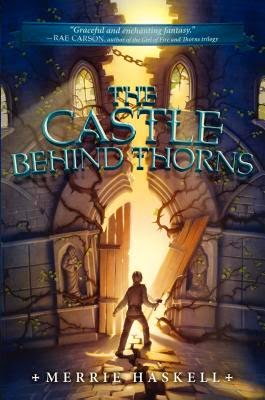
The Castle Behind Thorns

by Merrie Haskell
First sentence: “Sand woke, curled in the ashes of a great fireplace.”
Support your local independent bookstore: buy it there!
Content: There’s death and betrayal and politics, and lots of funny French names, so maybe it’s not for the most reluctant of readers. It’s in the midde grade (grades 3-5) section of the bookstore.

Sand, short for Alexandre, is the son of the local smithy in a small French duchy. (Well, it’s in one of those offshoots just when France was becoming, well, France.) The duchy castle has been in disrepair for longer than Sand’s 13 years, and surrounded by thorns. No one has gone to see what could be seen  inside.

Then Sand, who has been arguing with his father about attending university (he doesn’t want to), throws a token in Saint Melor’s wishing well, and ends up inside the castle. With no clue how he got there or how he will get out.

A brief aside here: we discover things right along with Sand, and while that generally annoys me, in this book it works to great effect. Sand is disoriented and alone, and Haskell captures that perfectly, transferring Sand’s anxiety and his slow realization that he’s stuck there and no one is coming to get him to the reader. All of which is followed up by his determination to survive and make things work.

During his explorations, Sand finds a body of a dead girl, and straightens her up. And because this place is magical (something which comes on very slowly, and quietly), she wakes up. Suddenly, Sand is not alone, and he and Perrotte — who happens to be the daughter of the long-dead Count — have to work together to find their way out of the castle.

I know it sounds boring, but it’s not. Haskell is a gifted writer, and she captures so many inner emotions and struggles and makes them not only real but captivating. I loved the friendship that developed between Sand and Perrotte (and that it wasn’t a romance!). I loved how they worked together to figure out how to get out of the castle. I loved that Sand’s strengths and Perrotte’s strengths were different and they found a way to compliment each other.

Yeah, all of this is really introspective for a middle grade fantasy novel, but in Haskell’s talented hands, it works well.

More than just well: it works wonderfully.

Graphic Novel Round-Up, November 2014

I spent a Saturday recently just reading graphic novels to help me out of the slump. I think it might have worked; I feel much more interested in reading a full-length book now. Also, both A and K picked some of these up and found themselves completely engrossed. So, it’s a good batch.

Odd Duck
by Ceci Castellucci and Sara Varon
Support your local independent bookstore: buy it there!
Content: There’s nothing. And the words/ideas are pretty simple. It’s good for reluctant readers as wel as those who just want a good, short story. It’d be in the middle grade graphic novel section of the bookstore.

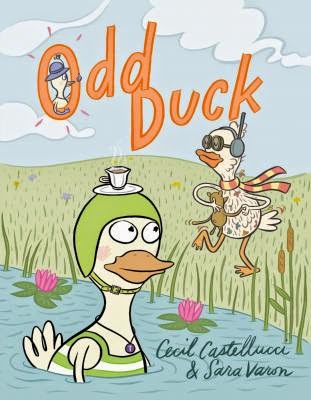
Theodora is an ordinary duck. She does her ordinary duck exercises in the morning, goes for her ordinary duck walk (because she doesn’t like to fly), and reads ordinary duck books in the afternoon. She lives a nice, quiet life and is very happy.

That is, until Chad moves in next door. Chad is not an ordinary bird. He does not do his exercises in an ordinary way (if at all), He dyes his feathers weird colors. He does art (gasp)! Theodora is not happy. But then, come winter, she and Chad bond (because they don’t fly south). They discover that they have things in common, and that they really enjoy each other’s company. And that maybe being different isn’t so bad.

It’s a charming little graphic novel, full of adorable art and sweet little lessons, but it’s never heavy-handed or didactic. Perfect for younger and reluctant readers.

Monster on the Hill
by Rob Harrell
Support your local independent bookstore: buy it there!
Content: Linguistically, it’s more challenging. But it’s probably on par with the Amulet books, which means it’s probably good for 3rd grade and up. Content-wise, there’s some monster violence, but that’s it. It’d be in the middle grade graphic noel section of the bookstore.

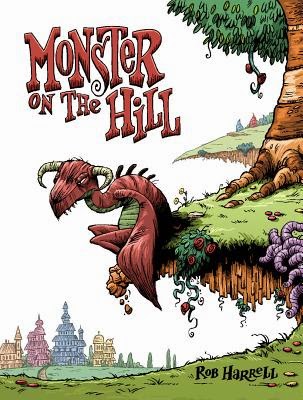
In this version of 1860s England, there are monsters that terrorize every town. But never fear: that’s what the townspeople want. (Seriously.) But, in Stoker-on-Avon, they have a problem: their monster, Raymond, doesn’t do anything but moan and complain. It’s bringing the town down. So, the town leaders send the eccentric Dr. Charles Wilkie (and a street urchin, Timothy, hitches along for the ride) to convince Raymond to buck up and do his job.

This leads to a road trip, a lot of bonding, some lessons learned, and a giant battle against an unstoppable foe before everything is set to rights again.

This one had me eating out of the palm of its hand. I loved Raymond — he was delightfully pathetic — and his schoolmate, Noodles (aka Tentaculor) and their relationship. There was so much that had me just laughing out loud. True, there could have been a female character (just one? Please?)  or perhaps some diversity (though it was England in 1860-something), but for the most part, I found this simply charming.

Hidden
by Loïc Dauvillier, Marc Lizano, and Greg Salsedo
Support your local independent bookstore: buy it there!
Content: It’s about the Holocaust, so there will definitely be things to discuss. It glosses over the worst of the horrors; there’s a passing image of a concentration camp survivor, as well as illusions to other horrors. Even so, it’s very kid-appropriate. It’s in the middle grade graphic novel section of the bookstore.

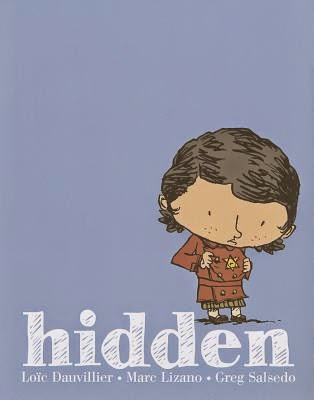
This one is your standard Holocaust fare. Mostly. Framed as a story a grandmother is telling her granddaughter about the time when she was a child, Dauvillier focuses mostly on the Resistance and the people in France who helped those who were Jews get away.

It’s a very tender story of a young girl, Dounia (the grandma) whose parents were taken to the concentration camps in 1942, near the end of the war. Even though Dounia hides during the inital raid, the neighbors (some of whom are part of the reistance), know they’ll be back, looking for her. So, they arrange for her to live with a woman in the country. In the act of escaping, the neighbor’s husband is caught, though he’s only arrested and released. He manages to find his way back to his wife and Dounia. Her main concern, though, is finding her parents again and so they keep looking, especially once France is liberated. Eventually, they do find her mother, and the story ends.

I liked this one well enough, but (possibly because it’s tamed down a bit) it lacks the emotional punch that other Holocaust books have. Still, it’s a good introduction to the topic.

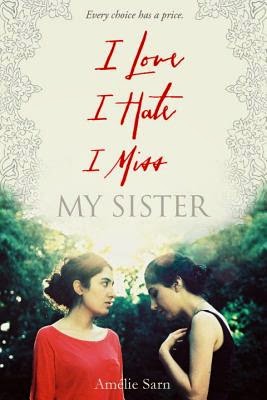
I Love I Hate I Miss My Sister

by Amélie Sarn, translated from French by Y. Maudet
First sentence: “The women walk slowly, heads down.”
Support your local independent bookstore: buy it there!
Release date: Augst 5, 2014
Review copy snagged from the ARC shelves at my place of employment.
Content: There is violence, some mild swearing, and some teen drinking and smoking. I’ll probably put this in the Teen (grades 9+) section of the bookstore, though I wouldn’t hesitate to give it to a 7th- or 8th-grader who is interested.

Sohane Chebli is many things: 18 years old, a daughter, a sister, a scholar, French, and a Muslim. She lives in an apartment complex full of others of  Algerian heritage, and mostly she and her younger sister (by 11 months), Djelila, get along with their neighbors, schoolmates, and each other just fine.

Then, during Sohane’s senior year, a few young Muslim men take it on themselves to start harassing Djelila because she dresses in jeans and tighter shirts. Because she wears makeup. Because she smokes with her friends. And Sohane, whose path has become more conservative — she wears the hijab — doesn’t step in to defend her sister. Partially because Sohane thinks her sister is wrong for following a path away from Islam. And partially because Sohane’s been expelled from school, due to a French law banning all religious symbols, for wearing the hijab.

I’m going to spoil a bit — it’s not too bad, because from the beginning,  you know this — but Djelila is killed by the Muslim boys for her refusal to conform to their expectations. And it’s that paired with the other side of the coin: Sohane’s constant discrimination for wearing the hijab. (Not that I mean to compare murder with discrimination.) But it got me thinking: why do we feel a need to tell others how to behave? Why did these boys feel compelled to not only shame, but eventually kill a girl for not following her/their religion to the letter? Why did people refuse to see Sohane’s hijab wearing as an expression of her religion, instead interpreting it as an act of repression? It’s a thought-provoking book.

And it’s written well, in tight, short chapters. It took a bit for me to catch the rhythm of the book because it’s translated, but once I did, I was hooked. And I wasn’t disappointed, in the end.

Blue Plate Special

by Kate Christensen
First Sentence: “Often, whenever I come up against anything painful or difficult, my mind escapes to food.”
Support your local independent bookstore: buy it there!
Content: There are other issues, but mostly, lots of f-bombs (didn’t count).

I’m going to spare you this review and tell you what I think straight up: much like Vizzini, this book is not what Christensen (or I) thought it was. It says, right there on the cover, “An Autobiography of My Appetites.” And I thought: “Oh good! Food book!” Even though Christensen threw me a bone in the form of a recipe every once in a while (though honestly: BEAN BURRITOS), this had none of the hallmarks of a food book (except said recipes): luxurious, descriptive, evocative passages about the food and the eating experience.

What it was, however, was a very long, very involved, very sordid, very blunt telling of Christensen’s very messed-up life. It’s the epitome of tell-all: she Told it ALL, from her father’s abuse of her mother to her very horrid first marriage. I read the whole thing, though I often wondered why. (Actually, I knew why: it was one of those books that I kept hoping would get around to being what I Wanted It To Be, but never did. Those are the WORST KIND.) I wondered what the point was, because even though Christensen led an adventurous life, the book version of it was anything but interesting. I don’t know what her purpose was: to make us feel sorry that she never appreciated anything? To purge all her secrets so that she can make a fresh start? Whatever it was, all I got was annoyed: annoyed that she was going amazing places and not Taking Advantage. Annoyed that she spent her 30s drunk and unhappy. Annoyed that I picked up this stupid book in the first place.

The writing wasn’t even lyrical, or evocative. It was boring on a sentence level. Which makes me wonder about her novels, which I’ve never read. But then again, a person may be able to write a novel, but not manage to be evocative about a picnic in Italy. I think I’ll go find some Frances Mayes as a counter balance.

The Second Life of Abigail Walker

by Frances O’Roark Dowell
ages: 9+
First sentence: “The fox had been stepping into stories since the beginning of time.”
Support your local independent bookstore: buy it there!

Sixth grade has not been the best for Abigail Walker. Her best friend recently moved away, and she’s been caught up in a group of mean-ish girls because her mother wants Abby to be friends with them. In addition, her parents (especially her dad) are always on her case about eating, since she’s a bit more overweight than they’d like her to be. Between these two things, all Abby wants to do is hide in her closet and eat candy bars.

I’m going to interject here:  I want to give this one to parents. Just so they can see the effect their comments have on their children. The parents in this one earn a great big huge OY, PEOPLE. I want to smack them.

Anyway. Abby starts frequenting the field across the street from her house, and discovers a fox, which bites her (not hard). She also meets a boy, Anders, and his father who is recovering from PTSD from his tour in Iraq. Between Helping Anders with his dad and the fox, Abby begins branching out, discovering a strength in her to make new friends and to begin to stand up to her parents.

Aside from the whole parent-issue thingy, this was just an okay book. Abby is dealing with lots of issues, and I was glad to see her being to make things right. For a while, I was thinking O’Roark Dowell would wrap everything up in a nice bow, and I was quite glad she didn’t. (I should trust her more; she rarely steers me wrong.) The only real misstep in this one was the fox; I was never quite sure why the fox really needed to be there. It seemed like it belonged in a different book, one that was wholly an animal fantasy, rather than a middle grade issue-oriented book.

But aside from the fox, it was a sweet story about a girl who’s trying to figure out who she really is in the face of everyone’s expectations.

Renegade Magic

by Stephanie Burgis
ages: 10+
First sentence: “it was a truth universally acknowledged that my brother, Charles, was a hopeless gamester, a ridiculous oversleeper, and the one sibling too lazy to take part in any family arguments, no matter how exasperating our sisters might have been (and usually were).”
Support your local independent bookstore: buy it there!
Others in the series: Kat, Incorrigible

In the beginning, everything seems to be going well for Kat and her family: it’s her oldest sister’s wedding day, her other sister is on the verge of being engaged, her brother is managing to stay out of trouble, and Kat is going to be inducted into the Guardian Order.

Then Lady Fotherington — Kat’s deceased mother’s nemesis — butts in and ruins everything.  Aside from the wedding, everything is in shambles: the Stephenson’s reputation (which was precarious to start with), Angelica’s almost-engagement, and most relevant to Kat, her standing with the Guardians.

The only thing to do is go to Bath. (Of course!) Where the Stephensons barge in on some well-to-do second-cousins, make a spectacle of themselves, get involved in some nefarious pagan rituals, and somehow save England from traitors who were going to sell information to France (it’s the Napoleonic wars, after all). All in a week’s work.

All the set-up out of the way, this book was a lot more fast-paced than the first one in the series. Kat is still a heroine with a tendency to get into trouble, in spite of her stepmother’s attempts to make a lady out of her. Her father is still mostly absent, except for a tender moment near the end of the book. She makes a new friend out of her cousin, someone who is drawn to the unrespectable nature of being a witch. There’s a bit of a love story: her older sister manages, in the attempt to thwart their stepmother, to make a complete mess of the situation (there’s a nice undertone that 12 year olds are SO much smarter than their 16 year old sisters that I think that C would like).  And while I liked this one as much as the first, I found myself feeling (as I so often do with historical fiction these days) that Kat is very much a 21st century heroine. That, and I felt the whole pagan Minerva rituals to be a bit out of place. Not that it was bad, but that it just didn’t completely gel the way the first one did.

That said, I’ll keep reading the series, because it’s a lot of fun.

(Just for the record: because this is a Cybils nominee, I’ve been asked to make sure y’all know this is my opinion only, and not that of the panel.) 

Dearie

by Bob Spitz
ages: adult
First sentence: “‘Now, dearie, I will require a hot plate for my appearance on Professor Duhamel’s program.'”
Support your local independent bookstore: buy it there!

I have to admit that I didn’t grow up as a Julia Child groupie. Oh, I knew who she was, but I wasn’t that into food (I was more into sports) or cooking, and what she did didn’t interest me. My parents may have watched her French Chef show — I don’t know — but it’s not like she was an influence in my upbringing.

Then I read Julie and Julia and, later, My Life in France, and I became an unabashed Julia Child fan. So, of course, when the new biography came out (on August 15, her 100th birthday), I had to read it. (Granted, I wasn’t going to read it just yet, but a friend thrust it in my hands and said it was due back at the library in 2 weeks, so, really, what else was I going to do?)

Spitz admits, in the acknowledgements, that he is not really an unbiased reporter of Julia’s life. He met her in 1992 and developed a bit of a crush on her through their interaction. So, when the opportunity fell into his lap to write a biography of her, he, of course, jumped at the chance.

This really is a comprehensive (and by default, huge, coming in at 530 pages) biography: from her early upbringing in Pasadena, California, through her stint with the OSS (which really is much less glamorous than it seems), through her marriage to Paul Child and their years in France (which Spitz kind of glossed over, but I didn’t mind, since I’d read about that already), and through all her various incarnations in television, up through Paul’s, and her own, death.

But Spitz is an excellent writer, and his enthusiasm for Julia shows. He really delves into her life, drawing her both in broad strokes (she really WAS manic, full of energy; at one point, I pointed out to Hubby that she must have been exhausting to know), and small details (the amount of work this woman did, basically up until she died, was simply amazing; also she LOVED men. Not like affairs, or anything: she was devoted to Paul; she just loved having men around.), which gave a more thorough picture of the real person behind the persona. (By the way, she adored the Dan Ackroyd Saturday Night Live skit.) Additionally, there was enough foodiness, especially later on, to keep the foody side of me happy.

It was the combination of my admiration for Julia (I admire her more the older I get; she started a completely new career at age 50, and made it work) and Spitz’s writing that made this book such a delight to read.

A must for any Julia Child fan. 

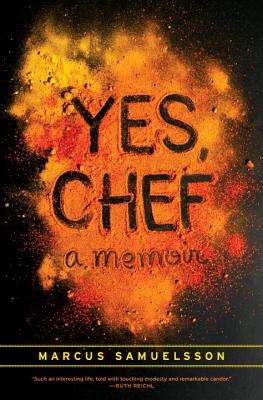
Yes, Chef

by Marcus Samuelsson
ages: adult
First sentence: “I have never seen a picture of my mother.”
Support your local independent bookstore: buy it there!
Release date: June 26, 2012
Review copy provided by my place of employment.

I am not really into the whole food “scene”. I love reading books about good food, I like cooking (but I’m a cook, not a chef, even though I worked in a restaurant for a year when I was a teenager), and I like the idea of good food, but when it comes to names of chefs, I’m pretty much limited to the really popular Food Network people.

So, before a Random House rep came into the store pitching hot books this summer, I  had never heard of Marcus Samuelsson. I think that was a good thing, however, because I was able to come to his story free of biases, open to whatever journey he was willing to take me on.

And it’s quite the journey: Born in Ethiopia, he, his mother and his sister contracted tuberculosis when Marcus was 2. His mother walked for days to get to a hospital, dying soon after reaching there, leaving the children orphaned. Luckily, there was an older couple in Sweden who were desperate for children, not caring what color or nationality they were, and they adopted both Marcus and his sister.

Samuelsson spends quite a bit of the book on his childhood and upbringing in Sweden, primarily because he firmly believes that this was the foundation for all his successes. His mother’s mother taught him to cook, in the classic Swedish style. His parents taught him the work ethic that made Samuelsson what he his today, and supported his journeys around the world, as well as his choice of career. These parts of the book are fascinating: from his stages (I guess that’s what they’re called) in Sweden, Switzerland, Austria, and New York before the ultimate stage in France and then back to America where he became — almost by accident — the executive chef of Aquavit. He is liberal with praise for the people who helped him, candid about the people who were jerks, he muses about the idea of race in the restaurant and food world. But always, always these reflections are centered around his food journey and his chasing the flavor around the world.

The latter third of the book, his time at Aquavit, his stint on Top Chef masters (and winning that competition), to his finding his birth family in Ethiopia and opening his current restaurant, Red Rooster, in Harlem are not as compelling as the first part, though they still hold interest. The time line gets a little fuzzy, and I felt like he was rushing through things, when I wanted him to linger, especially on the flavors and the tastes of the food he was creating.

Even with that slight drawback, it’s a marvelous foody memoir. Enough that I would love to step into his world, just to taste the dishes he made sound so delicious. Anyone up for a trip to Harlem?

Maman’s Homesick Pie

by Donia Bijan
ages: adult
First sentence: “My mother had been dead eight days when I showed up in her kitchen.”
Support your local independent bookstore: buy it there!

This book is very much like a gumbo: it needs a little bit of everything to make it work. It’s one part cookbook — every chapter has a couple recipes from the kitchen of world-class chef Donia Bijan; one part memoir — it’s nominally Bijan’s story from Iran to France to the kitchen of her own restaurant; but also one part love story to her mother.

Bijan grew up in Iran, the third — and last — daughter of a doctor and a nurse. She was privileged there, going to a private international school, enjoying holidays on the Caspian Sea. Her family was on vacation in Spain when the revolution happened in 1978, effectively cutting them off from their country. For Bijan, her sisters, and her mother, this was a hardship, but also an opportunity: they emigrated to America, and took to their new lives. For her father, however, this became an obstacle that he never surmounted.

He also had issues when Bijan decided to major in French in college with the express goal of going to France to learn to be a chef. Her mother, on the other hand, supported her wholeheartedly. This was where the book fell apart for me. Her memories of childhood were sweet, and even her life in transition was interesting. However, by the time she got to France to learn cooking, I began to wish that there was more to this book. It felt like she was brushing over everything lightly, not wanting to deal with the negatives, or even with the hardships, not thinking about anything too much. All this is well enough, but I wanted more: more feeling, more depth, more descriptions of food, more of her life.

While I found it a pleasant homage to her mother and the way she supported Bijan in her endeavors, there wasn’t quite enough in it to make this book anything more than “nice.”

Zazoo

by Richard Mosher
ages: 12+
First sentence: “The boy on the bike came and went.”
Support your local independent bookstore: buy it there!

Zazoo is a 13-year-old girl who lives in a small village in France. There’s nothing really remarkable about that, except that Zazoo is Vietnamese; her Grand-Pierre (not her grandfather) took her from her country at the end of the war, when she was three. She doesn’t remember her birth home, and Grand-Pierre doesn’t talk about it. She’s been basically happy in France, but in this turbulent winter her life is about to turn upside down.

It’s a quiet novel, poetically written, with spare language that evokes a strong sense of place. It jumps through time, giving us not only a portrait of Zazoo’s upbringing, but of the story behind the village and Grand-Pierre’s legendary stubbornness. For that reason, it becomes a bit of a war book; Grand-Pierre has a history in World War II, perhaps of good, perhaps not. The book reserves judgement: Zazoo is, in many ways just collecting facts, piecing an old puzzle together. It’s delightfully complex and revels in shades of gray; Grand-Pierre is neither a villain nor a hero, but rather a human.

There is a bit of a love story, and honestly that’s the only thing that really bothered me about the book. Not the story per se: Zazoo and the boy on the bike, Marcus, develop a friendship over sending postcards back and forth, which evolves into a love. What bothered me was the age of the characters: Zazoo is only 13, and while she’s labeled as precocious in the novel, that’s still a bit young to be taking up with a 16-year-old, even in 1980-something. I think, for that aspect of the novel to fully work for me, Zazoo should have been a bit older, even if it meant losing some of the innocence in the other aspects of the novel.

Even with that complaint, it was a surprisingly sweet story.