Hoot

by Carl Hiaasen
First sentence: “Roy would not have noticed the strange boy if it weren’t for Dana Matherson, because Roy ordinarily didn’t look out the window of the school bus.”
Support your local independent bookstore: buy it there!
Content: There were a few mild swear words (which A found amusing), and some instances of bullying and domestic violence. It feels like a genuine middle grade book, with real middle grade heroes (yay!) and happily sits in the middle grade (grades 3-5) section of the bookstore.

Ah, Florida. The air is hot and humid, it rains a ton, and Roy Eberhardt hates it. With a burning passion. He most recently lived in Montana, the land of the huge vistas and great snowboarding, but because of his dad’s job, he’s stuck in boring Florida. Until the day he notices a strange boy with dirty feet running away from the bus stop. His curiosity piqued, Roy follows the boy and discovers Something To Care About. See: Mother Paula’s Pancake House is building a new restaurant. On top of some burrowing owl dens, and the boy is bound and determined to stop the company. And Roy, for better or for worse, finds that he Cares enough to get involved.

I remember reading this ages ago — probably when it first came out — and liking it. Though, I seem to remember it being funnier than I found it this time. It was amusing, sure, especially when Bully Dana Matherson gets his come-uppance at the hands of Beatrice Leep, Tough Girl Extraordinaire. But, mostly, it’s a quiet book about Making A Difference. I like how Roy finds out that while vandalism is one way to get a corporation’s attention, there are other — possibly more effective — ways of handling it. It’s not only a fun book, it’s a lesson in civics and awareness. There are layers of complexity; Roy is bullied (a lot) and there’s some domestic issues with Beatrice. But Hiaasen did it without being preachy; this is NOT an issue book.

Which, honestly, is a mark of a talented writer. And for that reason alone more than worth the time it takes to read it.

Zora and Me

by Victoria Bond and T.R. Simon
ages: 11+
First sentence: “It’s funny how you can be in a story but not realize until the end you were in one.”
Support your local independent bookstore, buy it there!
Review copy sent to me by the publisher

It’s an interesting idea: take a famous, respected novelist — in this case, Zora Neale Hurston — who had a unique childhood — in this case, living in the all-black town of Eatonville, Florida in the early 1900s — and turn it into a middle grade mystery. The “me” part of the title, is one of Zora’s fictional friends, Carrie (the other being Tom) and we see Zora and the adventures through her eyes.

It all begins one night when Carrie and Zora see a giant alligator maul a local man. The alligator disappears, and Zora — who was always one to spin a story — decides that another man, this one a bit of a recluse — is actually the Gator King, half-man, half-alligator, and can morph between the two. It’s a bit far-fetched, but in pursuit of the story, they inadvertently stumble upon something deeper and darker in their town.

It’s a story about the power of stories, and belief in stories. But it’s also a story of race, and acceptance, and — to a much lesser extent — justice. As far as historical fiction goes, the book captures you and sweeps you away to a town where, on the surface, it doesn’t matter what color you are. But as the layers are peeled away, it’s much less rosy. My only real quibble comes with the use of the n-word: on the one hand, that it’s in the book at all speaks towards historical accuracy. It is the early 1900s, after all. But, the first time it was used, I did a double-take and chalked it up to historical fiction. The fourth and fifth times, however, I went searching for an authors note explaining the use. There was none. This really bothered me: I feel that that word, especially, should not be used lightly, or in passing, without some sort of explanation or disclaimer. I found it disturbing, and it took away from the enjoyment I had reading the book.

The mystery was interesting, the use of Zora Neale Hurston as a character was clever. The racial issues, however, overran the book, and while there was resolution at the end, there was a bitter taste left over. Perhaps this is what the authors intended when writing, or perhaps I’m overreacting. Either way, I was left torn: I liked the book, but I didn’t feel I could recommend it.

It’s amazing what one little word can do.

(Just for the record: because this is a Cybils nominee, I’ve been asked to make sure y’all know this is my opinion only, and not that of the panel.)

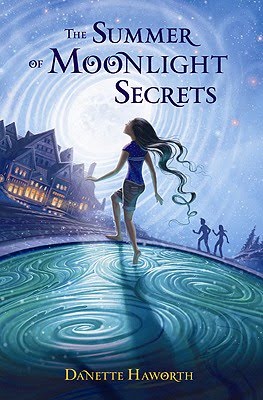
The Summer of Moonlight Secrets

by Danette Haworth
ages: 8+
First sentence: “‘Hey!’ I yell.”
Support your local independent bookstore: buy it there!
Review copy sent to me by the publisher

Sometimes I find a book enjoyable, even though when I finish I have no idea why. This was one of those books. Nice and sweet, but left me wondering at the end just why I thought it was enjoyable. That, and what was it all about, anyway?

Told in alternating chapters, it’s the story of Allie Jo, resident of the Merriweather Hotel in Hope Springs, Florida and Chase, who’s there for a summer with his father while he’s on a travel writing assignment. It’s a little bit of everything: there’s some historical fiction (well, it’s set in the 80s, which calling historical kind of makes me cringe), there’s a splash of fantasy, there’s a bit of a growing up story, and an inkling of romance.

All of which were enjoyable: it was fun visiting the 80s, even though there really wasn’t a whole lot to indicate that it was the 80s; just a few hints and references here and there. The growing up story was mostly Allie Jo’s; she’s an only child, introverted, and a tad bit ashamed of living in a hotel, even while she’s proud of the legacy the Merriweather has. She has to learn, over the course of the book that she is okay with who she is, and that she’s much stronger than she realizes.

The romance belongs to Chase (though he has a — gasp — divorce in his family to deal with), and it’s a very sweet and slightly awkward one, as should be the case when you’re only 13. But it was the fantasy element — in this case, a twist on Irish folklore — that made the book intriguing. There’s a mystery to it as well, as Chase and Allie Jo meet and befriend Tara, they need to unravel just what it is that makes her special.

Even with all that (maybe it was too much?), I ended the book scratching my head. What was it about, really? What was the point? While I enjoyed it, I never really connected with it, never really felt any reason to think about it beyond when I was reading it. It didn’t really capture my fancy.

But it was enjoyable. Maybe that should be enough.

Turtle in Paradise

by Jennifer L. Holm
ages: 9+
First sentence: “Everyone thinks children are sweet as Necco Wafers, but I’ve lived long enough to know the truth: kids are rotten.”
Support your local independent bookstore: buy it there!

Turtle lives with her mom in New Jersey and has (mostly) become accustomed to her role as “the housekeeper’s kid”. It doesn’t mean kids are nice, but her mom has a job, and since it’s the middle of the Depression, that’s a good thing. Then her mom starts working for a woman who makes Mr. Scrooge look cheery, and Turtle finds herself shipped off to Key West, Florida to live with her mother’s sister.

And all the boy cousins.

There’s Bean and Kermit and Buddy and their friends Pork Chop and Ira. They are incredibly amusing and adorable, these boys: at times fierce and downright mean, at other times completely sweet. They are the Diaper Gang: going around island, helping out mothers of babies, taking care of them in return for candy. They even have a super-secret formula for taking care of rashes on babies’ bungys.

The book is mostly about painting a picture of life in the Keys during late-summer. It’s all about mood and place and experience. There are a few adventures, as Turtle finds her way around the town, and discovers things about the island and her past and her family and belonging that she couldn’t have found out had she not visited. But the plot is almost incidental to the book. And it didn’t really matter. Turtle and the boys were entertaining enough; besides, it felt right for the lazy pace of life in the Keys. If there was a lot of action, rushing around from place to place, it wouldn’t have felt as gorgeously summery as the book did.

And I wouldn’t have traded all the action in the world for that.

Cosmic

by Frank Cottrell Boyce
ages: 11+
First sentence: “Mom, Dad — if you’re listening — you know I said I was going to the South Lakeland Outdoor Activity Center with the school?”

I had high hopes for this one. I really did. It was on my radar a couple of years ago when it was nominated for a Cybils, but no one could find a copy, so it went unread. And so, when someone (Betsy at Fuse #8? I know Sherry at Semicolon reviewed it…) reviewed it and liked it, I stuck it on my list.

Now, remember: this may just be me. In fact, it probably is. I have a bad habit of not being able to read books from any other perspective than my own. And I can really see an eleven or twelve-year-old boy absolutely loving this one. But, me? I couldn’t get more than a third of the way through the book before my suspension of disbelief completely failed.

See, our main character, Liam, is a 13-year-old boy who can pass as an adult. Well, at the very least people seem to think he’s an adult: he’s tall, he’s mature (physically, at least) for his age. And so, when an opportunity for the “ride of a lifetime” comes up, he gets one of his friends, Florida, to pretend she’s his daughter, and off they went.

And, that’s as far as I got. I really have no interest in seeing what happened once they got there. The book was slightly amusing, though all the Worlds of Warcraft references were driving me nuts. (If I were a gamer, I might care more.) But, honestly, I didn’t care enough about the humor to keep me interested in the story.

Darn.

The Orchid Thief

I began this book, by Susan Orlean, thinking it was about a weird guy in Florida named John Laroche, and his arrest and trial for stealing orchids out of Fakahatchee preserve in south Florida. What it ended up being was a long, and sometimes interesting, look at obsessions, particularly orchid obsessions and what drives the people who are obsessed by them.

What I learned: orchid people are weird. I don’t understand what people see in them in the first place, and I don’t feel any more enlightened. It’s an either you love them or you hate them type of thing. I thought the history of orchid collecting was fascinating, especially about the orchid hunters, the people rich collectors in England would send out to actually get the orchids (since they most likely died in England, and they didn’t know how to clone them yet). They lived fascinating, dangerous, mostly undocumented lives. Then there was the role that the state of Florida played. I’ve never been, but the way Orlean described it, it’s a weird and unusual and vaguely terrifying place. I liked the parts about Florida and the wildness of it best.

The writing was good, but I had to read this one in short doses, because as weird as the people are and as good as the writing is, it just couldn’t grip me and hold my interest for long periods of time. I guess I just don’t go in for obsessions much. And a whole book on a plant I’m not really interested in was a bit much.

Though I did finish it, so that must mean something. Right?

Looking for Alaska

I really wanted to like this book. Mostly because I like John Green. He’s very funny. (See here, courtesy of Mother Reader…) He’s smart. He’s hip(ish). I liked his argument about this book, how it’s not p*rn (that’s the second video on the link). I thought for sure I’d like the book. Sure, I knew it’d be different from the YA stuff I usually read and like (I did watch the video after all), but I figured that the smart, funny side of John Green that I like would come through. (Besides, books that get banned always make me a bit curious…)

It was smart. The writing’s very smart, very tight. And it is funny in parts. And, sure, I don’t want M reading it right now (it’s a bit more littered with the F-bomb than I would expect from a YA), I could see some 11th or 12th grade English teacher wanting to teach this, and I feel like they’d be mature enough to handle (heck, they probably *see* and *hear* this every day!) the book.

What I didn’t expect was for it to feel so… pretentious.

Miles is bored with his little life in Florida. No real friends, no real interests (except for “collecting” people’s last words through reading biographies), and so when he reads Francois Rabelais’s last words, Miles decides that he wants to go find the “Great Perhaps”. So, he enrolls in the private school his father went to, Culver Creek, and goes to find his great perhaps. What he finds is the Colonel, Alaska, Takumi, Lara, booze, cigarettes, and pranks. So deep. It was all a bit edgy, a bit too hip for me. I kept rolling my eyes thinking “wow this is how people find meaning in their life??”

Then Alaska dies. (Sorry. That’s a big spoiler. I thought the “before” and “after” had to do with sex, not with death.) And Miles and everyone else goes into free fall, not caring (hence more booze and cigarettes), not socializing, hating Alaska for leaving. Because you see, she’s the one with Energy, with Life, with Drive. And it’s such a waste that she’d be out driving drunk at 3 a.m. and crashed headlong into a cop car. So, Miles and the Colonel decide to find out why she died, how she died, (her last words would be nice), pull a grand prank for her, and find their way out of the Labyrinth of Suffering.

I suppose this would resonate with some. And I’m not making fun of anyone that it does resonate with. Really. I think Green was trying to search out some Meaning of Life, some depth, and by making two of his four main characters poor(ish), troubled, scholarship kids, he avoided most of the “rich brats trying to find Meaning” cliches. Still, it just rang shallow for me. It lacked the something that would give it true depth (perhaps it was the booze and cigs? Or maybe that everyone was at an exclusive boarding school? Hard for me to find meaning either place.), and therefore would allow it to truly resonate with me.

That said, I’ll probably give Green’s other book a try (partially because I like the cover). I think he’s got talent. I just didn’t really like this particular manifestation of it.

Early Bird

The subtitle is “a memoir of premature retirement”. The premise: Rodney Rothman, former head writer for David Letterman (a fact he doesn’t let you forget) gets burned out from working so hard after the TV show he was working on in LA got canceled (I guess being a writer for a TV show is a lot of hard work) and decides to retire (as an experiment mostly) to Florida. Just to see.

Like a lot I’ve read lately, this had potential to be really funny. It turned out okay.There was really only one part that I found myself laughing out loud. But other than that, it was a mildly interesting, sometimes sweet, sometimes weird picture of life in a retirement community in Florida. I liked some of the observations he made and people he met– the way we call old people “adorable”, and his friend Amy the 93-year-old former stand-up commedian — but my two favorite chapters by far were the one on shuffleboard (he tries to encourage a comeback — “Shuffleboard: the safe sport”) and on the acting class a man he met gave. Rothman went hoping to meet some “aspiring young actresses from the Tampa area” and it turned out to be a class for high schoolers. He was a bit put off, but it got better when he got cajoled into doing an improv scene with one of them. She looked at him and said, “Hey, can I talk to you Principal Jackson?” He totally flips out and goes on for the next page about it. The best part: “Turn to the author photo right now. Do I look like a principal to you? At worst, I look like the young, good-looking English teacher fresh out of Vassar. The kind of young man who could wear a sport coat and mustache and mke it work. That’s what you get for driving five hours to hang out with some chicks. They turn out to be underage murderers of the English language, and then they call you Principal Jackson.”

But in the end, the book is kind of pathetic. I mean, really, he’s 28 years old and hanging out in a retirement community. That kind of screams pathetic. That, and all the people in the retirement community are kind of pathetic. Makes me not want to retire to Florida. What’s the point, if you’re going to turn out pathetic. Besides, Florida will proably get washed out by a hurricane someday.