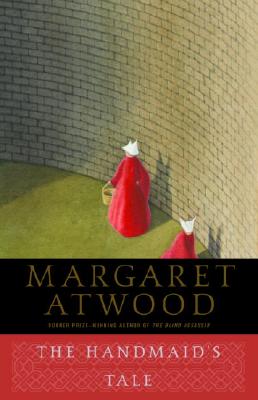
The Handmaid’s Tale

by Margaret Atwood
ages: adult
First sentence: “We slept in what had once been the gymnasium.”
Support your local independent bookstore: buy it there!

I read this book in my early 20s, sometime soon after I finished college. I remember thinking that this was a Great Warning; plausible enough to become true, and thus making it that much more powerful to me. I was moved to anger by the treatment of women as objects, and considered this one of the Best Books I’ve Ever Read.

This time around — 15 years later — I am still moved by it, but in a completely different way. The basic plot, for those who are unfamiliar with this dystopian classic, is that the U.S. falls apart after an attack which kills the president and Congress. The country is put into a state of emergency, which evolves into this warped religious state. Offred, our main character, is a handmaid: a woman whose sole purpose in life is to have babies for the Commanders. She is told that it is her religious duty to do so; the Wives and Marthas (the maids and cooks) tolerate her presence because her “duty” is so important. Offred — we never learn her real name — longs for her former life: the one where she had a job, money, husband, child. And it’s all she can do to put one foot in front of the other in her life.

I found this all monstrous. I’m thinking of it in a different light — I could very easily be Offred — and it’s monstrous what Attwood has dreamt up. Not only for the handmaids, but for the wives and commanders, too. (Maybe those books on polygamy are influencing my reading of this, too, because there are definite parallels there.) And I was depressed by it. I don’t think we — as a country — would ever head that way (though there was this one passage that struck me because of its similarities to 9/11 and the Patriot Act), but it’s depressing that there is that awful potential in people to control other people in that way. There are also Taliban similarities, as well — something which wasn’t even on the radar when I read this the first time around — that saddened me.

I can’t imagine — more like, don’t want to imagine — a world where women are treated as nothing more than the sum of their bodies, where men get excused for their behavior because of their position, where women hate and loathe each other because of their roles. Wait… that, too much, describes what our world is like now. Without the religious framework, without the robes, without the martial law, there are elements of this world around us.

And that really depresses me.

Dear Julia

by Amy Bronwen Zemser
ages: 12+
First sentence: “When Elaine Hamilton was six years old, she told her mother she wanted to be a cook when she grew up.”

Elaine Hamilton has been cooking since she was small. Her favorite person is Julia Child, and she decided very early on that she wanted to be exactly like her. Elaine’s father bought her a boxed set of Mastering the Art of French Cooking (volumes one and two) when she was eight, and she has spent the last nine years memorizing and mastering the recipes. All but the lowly omlette; that she can not make.

Every time Elaine hits a snag in her cooking, she writes a letter to Julia Child. Except that she doesn’t mail them. They sit in a trunk in her room, testimonies to her passion, her desire to be a chef, and… to her inability to make friends.

That is, until Lucida Sans (yes, she’s named after the computer font) comes into Elaine’s life. With a bang. Literally. They form an unusual friendship, that leads (because of Lucida’s weakness for a certain handsome cad) to an attempt at a cable show and, ultimately, to the Young Chef’s American Culinary Competition.

In some ways, the book is absolutely delightful. It has a fairy-tale quality (including what I thought was a hokey ending, that M pointed out it completly fit the fairy-tale-ness of the book) that was entertaining and charming. Both Elaine and Lucida were fun, sweet, enjoyable characters. Even the cad was amusing with all his preening and begging.

But, with all the sweetness, there was an underlying brashness. Elaine’s mother, an old-school feminist and a Congresswoman, dislikes her daughter’s love of cooking. In fact, the rest of the first page underscores this quite well:

“Oh, Elaine,” she had said, hurriedly stuffing papers into her briefcase, “Can’t you aspire to something higher? Twenty years since liberation and you want to stay home and slave over a burner?”

I wanted to throttle the woman. She spent the whole book underappreciating her daughter’s ability (I can’t even pronounce half of what Elaine can cook, let alone prepare it!), and trying to force her daughter to be exactly like her. (While Elaine’s brothers are free to do what they will.) The nerve of the woman. (Can you tell this really bothered me?)

And then there’s the tone of the book. The narrator bothered me at first, and while the annoyance went away, I was never fully able to lose myself in the book. (Perhaps this same critique can be said of The Disreputiable History of Frankie Landau-Banks?) I kept being bothered by the way the story was being told. And then there was the hokey ending. After finishing, I thought it was overly corny, but I can see M’s point: there is a bit of the unreal, the fairy tale perfect about it. Which, while it rubbed me the wrong way, really does suit the book.

All that aside, what I really wished was that Zemser would spend time being more sensuous about Elaine’s cooking. She dropped a lot of French words and terms, but never really described anything except the processes that Elaine used to make. I’d like to know more about the dishes (besides that they were delicious), about the smells, the sounds, the tastes. In the end, it left me not filled and satiated, as I was hoping, but empty, wishing for more.

Which is too bad. Because it was a cute little story.

The Disreputable History of Frankie Landau-Banks

by E. Lockhart
ages: 12+
First sentence: “I, Frankie Landau-Banks, hereby confess that I was the sole mastermind behind the mal-doings of the Loyal Order of the Basset Hounds.”

When I picked this book up Monday, I was totally enthralled with Frankie. Totally loved her, the narrator, the references to Wodehouse, the neglected positives. (Gruntled. Mayed. Ept. Cracked me up.) I got about halfway through (right after she discovered the Loyal Order of the Bassett Hounds) before life got in the way, but I thought a lot about the issues it was addressing: of feeling valued, not for something people impose upon you, but for something inherent in yourself. Or, the need to feel accepted and part of a group. Or the stupid hierarchies of boarding schools. (Or high school for that matter.) And I adored the voice of the narrator; it felt like a defense lawyer was patiently taking us through the evidence of Frankie’s character, explaining, so we, at least, will understand, will get what Frankie is about. And that she’s not a mere misanthrope. (Does that mean an anthrope is someone who is respectable in society?)

But, when I picked it up yestrday, it had lost a bit of its luster. Maybe all the fun is in the anticipation of the planning, but not the execution. Either that, or if you keep reading it in one sitting, the momentum builds and keeps you in the world that Lockhart has spun. In its defens: I did love the pranks. So very Drones Club. So very brilliant of Frankie (what a mastermind). I liked the social commentary aspect of them. But it was, in many ways, anticlimatic. Sure, she could show up the boys, but the actual act of showing them up wasn’t important. It was that she could.

I think, in the end, what I really liked was that Frankie felt familiar. If I were at a boarding school, and my mind tended just a little more that way, yeah, I could see myself doing what she did. I always thought that boys were more interesting than girls, anway. I can understand why it wasn’t enough to just start a secret girls’ club, why Frankie needed to prove herself good — no, better — than the boys. And I can understand why she did it for a guy, to try to prove to him that she was better than he assumed he was. And that it all backfired on her in the end was quite, well, understandable.

So, yeah, I thought the book was uneven, and the ending just kind of ended. (I do think the ending fits the book, even though Frankie doesn’t go out and do anything spectacular; that’s not the point.) I liked it, though, mostly for Frankie, and the ideas that Lockhart was addressing (whether she intended to, or not). Frankie did something big; she proved something to herself — and to her family — that she can do something. Sure, they reacted badly, but then, most people react badly to people who think outside the box. Even if that box is something as simple and silly as a secret boys’ club at a posh boarding school.

So, here’s to the Frankie’s of the world: the girls who think outside of the box. Who invent neglected positives, and need people to understand (not just talk at) them. And here’s to the books that celebrate them.

No Cream Puffs

by Karen Day
ages: 10+

Madison’s a girl who likes sports. It doesn’t seem like it should be that big of a deal, but two things happen the summer of 1980 to make her life more complicated. First, Casey moves in and “steals” Madison’s best friend, Sara, with her tube tops, lip gloss, and perfectly manicured nails. Suddenly Sara is no longer interested in bike riding and swimming at the lake. Madison agonizes over not only the loss over her friend — wondering how they could have gone such vastly different directions in such a short of time — but also in figuring out and justifying her own wants and desires. She wants boys to pay attention to her, but they don’t because she’s not labeled, and doesn’t dress like, a “pretty girl”. She spends hours in front of a mirror, wondering what the implications of lip gloss are. And, not since Are You There God, it’s Me, Margaret, have I read about a character who’s as obsessed with her breasts. Madison’s always focusing on them; they’re sources of pride (they’re larger than the other girls), and resentment (same reason) for her.

The second big thing, and probably the more defining one, is that Madison decides to play in the boy’s baseball league. She’s a brilliant pitcher, and is encouraged by her older brother to test her skill in the league (since there isn’t a girl’s league). Because of this, she makes waves in her little town. Some people want to make her a pariah: she’s a girl, she has an unfair advantage because no one will want to hurt her, she’ll bring down the level of the game. Others, her mother included, want to make her out to be a trailblazer, a feminist, someone who stands up for women’s rights. Madison, refreshingly, just wants to play the game. She wins the boys on her team over by her hard work and skill, even though there’s constant competition between her and the other pitcher on the team. And, aside from the desire to get rid of her breasts (she wears a swimsuit under her uniform, so her left boob doesn’t “poke through” the “O” on the team name), she’s more comfortable around boys in her baseball uniform than otherwise.

This is a fun look at a girl’s desire to just be herself, and dealing with the conflicting interests in her life — there’s some sub-plots that involve her divorced parents and a rock star that moves in across the street, too — and finding a way to be her best self. It’s not a perfect book, but it sure is enjoyable to read.

(Just for the record: because this is a Cybils nominee, I’ve been asked to make sure y’all know this is my opinion only, and not that of the panel.)

Off the Menu

It’s not often I get a request to be a part of a book tour, and so when I got an email about this one, as part of the TLC book tours, I jumped at the chance.

The novel follows three Asian-American women — Whitney, Hercules and Audrey — two of which are children of immigrants (the other is an adopted child of rich, white parents). All three were valedictorians of the same high school, and have kept up their friendship (albeit a slightly competitive friendship) ever since. It’s an interesting look at women and friendships, Asians and achievement, and how friendships and dreams and parents all work together (or not).

I don’t think I went in with any expectations — good or bad — but I invariably compared it to the Amy Tan novels I read. (I’m sure that Son is going to get a lot of those comparisons…) And I didn’t find it lacking. In fact, while I didn’t get the same cultural feel that one gets from a Tan novel, I did find I could relate to the characters on a more visceral level. Sure, they’re younger than I am and Asian, but what woman (or man) doesn’t have problems with their parents sometimes? Or their friends? Or harbors secret dreams of doing something other than what society expects of her (or him)?

In addition, I liked the characters. Hercules is a vibrant character — brash and abrasive, yet lovable and approachable. She was my favorite, I think, because she worked so hard, and cared so much and yet was completely clueless as to how to show it. I think I liked Audrey the least — she’s brilliant, beautiful, rich, loving, with a totally supportive man… in short, completely perfect. Sure, her mom’s a total control freak, but that didn’t do enough to humanize her in my mind. In fact, when her dreams all worked out for her in the end, I just rolled my eyes. Whitney was somewhere in the middle — good, perfect even, but had enough challenges to make her seem less goddess-like than Audrey came off.

Son managed to balance the three perspectives quite nicely; I never felt like the story was choppy, or that any of the lesser characters were slighted for Whitney’s story (even if hers felt like the main one). My only real complaint is that I felt confused with the passage of time; the events of one chapter would unfold, and then the next would take place three weeks, or six months later. It would always take me a bit to catch up and figure out when everything was going on.

But that’s a minor quibble. On the whole, it was a good, interesting read.

Don’t forget to check out the rest of the tour!
Friday, November 7th: Ramya’s Bookshelf
Monday, November 10th: Pop Culture Junkie
Tuesday, November 11th: 8Asians
Wednesday, November 12th: Savvy Verse and Wit
Thursday, November 13th: In The Pages
Friday, November 14th: She is Too Fond of Books
Monday, November 17th: Planet Books
Tuesday, November 18th: B & B ex Libris
Wednesday, November 19th: DISGRASIAN
Thursday, November 20th: Booking Mama
Monday, November 24th: The Literate Housewife Review
Tuesday, November 25th: Feminist Review
Wednesday, November 26th: Diary of an Eccentric

Rebecca

I saw the Alfred Hitchcock movie years and years ago, and remember thinking that I should probably read the book. I didn’t follow through (don’t know why, it really was that long ago!), but when Cami told me she wasn’t talking to me 🙂 until I read Rebecca, I figured it was time to actually get the book read.

And…

I’m not sure. It was a really good melodrama, full of suspense and tension. I liked the descriptions. I thought Mrs. Danvers was sufficiently horrible and horrifying in her attachment to the dead Rebecca, and her attempts to sabatoge Maxim’s current marriage. I thought the ending, while abrupt, was probably the most fitting way (and I know I should have seen it coming, but it still caught me off guard) to end the book. There were parts when I cringed, there were parts that I wondered how it would all work out, there were parts that really creeped me out, and I understood why it was Hitchcock who put this book on film.

But. The fact that the current Mrs. de Winter never had a name really bothered me. Enormously. I’m still trying to put a finger on why; perhaps it was a feminist thing, but I think it was mostly that I like my characters to have names. I can’t imagine what they look like if they don’t have a name. And I have no idea how to summarize a book if I don’t have a name to give to the main character. I understand the literary motivation behind du Maruier’s choice not to name her main character, it just really bothered me. And — I suppose this is connected to the name thing — her relationship with Maxim bothered me, too. This time I’m sure it’s the 21st-century feminist in me, because I didn’t like how totally and utterly submissive Mrs. de Winter was. If she only had a bit more backbone, she wouldn’t have ended up in the situations she ended up in. But, I guess that was the point. She gained backbone through the course of the book, when all the secrets were out; but why did it take the assurance of Maxim’s love to give her one? Couldn’t she have one on her own?

I am glad I read it, though; it was an interesting and intriguing book. And now I need to go watch the movie again. I’m curious as to how it stands up.

The Hollow Hills

When I started this one, Hubby commented that it was his favorite of the trilogy, mostly because Merlin goes traveling across Europe. While I liked Crystal Cave because I liked the Merlin that Stewart created, I liked this one primarily because this is my favorite part of the Arthurian legend. That, and Merlin goes a-traveling, which is always fun, too.

The Hollow Hills picks up right after the fateful night of Arthur’s conception, with Merlin limping back to his home in the cave in Wales. He’s servant-less for a while (which was mildly amusing; Merlin is just incapable of taking care of himself), but eventually gains a reluctant servant in Ralf, when he’s banished from the King’s (and by now Queen’s) presence, mostly for his role in that fateful night. Eventually, the Queen (and King) call Merlin to them and ask him for his help in taking care of Arthur and making sure Arthur is safe. Merlin, of course, makes the arrangements, and then, possibly to add mystery to the tale and most definitely to misdirect his (and Arthur’s) enemies, he takes off for the mainland of Europe, traveling to all the big cities. It’s not a large part of the novel, but it is an enjoyable one.

Once he deems it safe — well, actually because King Uther is dying and Merlin is who he is — Merlin heads back to Britain. He takes up residence in the Wild Forest, near where Arthur is being fostered, and takes over the mentoring of Arthur. I love this part; basically the last third of the book when Arthur himself enters the story. It’s the stuff legends are made of (well, duh): a strong-willed, energetic boy, learning all he can from an older, wiser man and then that boy somehow making himself worthy to become what he truly is… a King.

I did have some quibbles with this one, most notably with Morgause. I think I like Marion Zimmer Bradley’s treatment of the women better (as well I should, since Mists of Avalon is a pretty feminist-slanted work). While I recognize that Stewart was trying to be as faithful to history, giving men all the “power” and shunting the women off to the side (Merlin’s mother, Ninane wasn’t terribly well portrayed, though she wasn’t as weak as Ygraine), it still grated on me how Morgause, from pretty much the get-go was portrayed as a power-hungry, evil woman. Perhaps she was. (Perhaps she didn’t even exist.) But, I prefer Bradley’s interpretation of the women.

Aside from that (and that’s really only the last chapters), it’s a thoroughly enjoyable book. I still like Merlin as a character, and I think Stewart’s aging him nicely. I like that his character feels different in this book than he did in the last one: more mature, weightier, as he comes into the power and reason for existing that he’s been waiting for his whole life. He’s still portrayed as an imperfect human, but she draws more heavily on the prophecy and Sight aspects of Merlin’s character. Because of this, he’s beginning to take on the role that he’s known for best: that of Arthur’s right-hand, as well as prophet and enchanter. Even with all this, though, Merlin’s still a sympathetic character, as well as an understandable one.

Only one more book to go.

Eight Feet in the Andes

I think, perhaps, several years ago I would have been more inclined to like this book by Dervla Murphy. I think I would have admired her, thought her ambitious and adventuresome for climbing the Andes mountains with no companions except her 9-year-old daughter and a mule, living on the land and the generosity of the Peruvians. I think I would have found her feminist observations — why can’t a woman do this by herself, anyway? — inspiring.

Now… I just think she’s crazy. Crazy for even thinking about hiking through the Andes. Crazy for taking her daughter along. Crazy because… well… let’s just say it’s not something I even remotely related to. (Not that I have to, but it didn’t amuse or inspire me, either.)

It took me a while to get into the book — it’s a diary, and those are hit and miss with me. This time, it was more misses than hits. There’s really no story here. They hike from place to place. They have food sometimes; they sleep in various places. They almost freeze, rescued by a native family who didn’t speak a word of Spanish or English. And, by the entries in mid-October I was tired. Tired of her whining about modern civilization (though early on I thought it had Wendell Berry-esque overtones), tired of the paces she put her child through. Tired of Peru.

So, I abandoned them. Sure, I checked the back: whew, they made it to the end of the trail safe by Christmas Day. Yee-haw.

That’s the third book for the Armchair Challenge. Not one memorable one yet. Maybe I ought to re-think my list….

September Bookworms Carnival: Class is in Session

Welcome to the September Bookworms Carnival!

Our theme, this month, is classics (new or old). I picked this theme because it’s back to school time for many of us, whether it’s kids going back to grade school, or starting a university program ourselves. Because of that, I decided to style the carnival like a college course catalog. Below you’ll find the courses that are offered, and the selected reading for each course. (And yes, for curiosity’s sake, they are REAL college courses I borrowed from the catalogs of a couple of universities.)

Enough blathering. On with the carnival.

ENG 201: Introduction to Literature
An overview of the best literature has to offer. Cami (Turpin Family Blog) offers up her ten favorite classics, spanning both the continents and the centuries.

ENG 210: World Masterpieces
Major world civilizations as see through literature. Nymeth, at Things Mean A Lot, finally got around to reading The Odyssey, and found that she thoroughly enjoyed it. The status of The Last Summer, by Boris Pasternak (of Dr. Zhivago fame) as a classic is questioned by John at Book Mine Set. And Jan (Jan’s Journal) delves into the world of Franz Kafka, reading and reviewing several of his works.

ENG 211: British Literature
Selected readings from medieval times to present. Chris at book-o-rama reviewed one of her favorite authors’ works: George Eliot’s The Mill on the Floss. I read Jane Eyre and decided that I like Charlotte Brontë much better than her sister Emily. Ann at Patternings read Stella Gibbons’ novel Cold Comfort Farm, and found it a delightful parody of Hardy, Lawrence and Mary Webb with superb comic timing. Eva at A Striped Armchair posts her thoughts on a few classics: The Eustace Diamonds, The Scarlett Pimpernell, and Candide (which I know isn’t British, but bear with me here.) Lostcheerio (The Harpoonist) bucks the tendency for people to like everything by Jane Austen and expresses her frustration with Ann Wentworth and Persuasion here. Last-minute addition: Becky (Becky’s Book Reviews) reflects on her relationship with Mary Shelly’s Frankenstein.

ENG 221: American Literature
Selected readings from Puritan times to present. Karen (Misadventures of an Aussie Mom) and Nyssaneala (Book Haven) both weighed in on Harper Lee’s classic, To Kill a Mockingbird. Suzanne at Adventures in Daily Living read, and was surprised she liked, John Gardner’s classic, Grendel. Gautami tripathy at My Own Little Reading Room focused on an F. Scott Fitzgerald work, Tender is the Night. Jan (Jan’s Journal, again) reviewed Richard Halliburton’s lesser known work, The Royal Road to Romance, and highly recommends it. Last-minute addition: Annie (reading is my superpower) reviews Memoirs of an Ex-Prom Queen, a 1970s feminist classic and finds it hopelessly depressing, even if 30 is the new 20.

ENG 305: Critical Reading
Analyzing the meaning of classic and what constitutes a classic work. Corrine at Littlest Bird and Heather (Litter of Leaves) each muse on what defines a “classic work”.

ENG 335: Young Adult Literature
Reading and discussing specific works of middle-grade and young adult literature. Jeremy, at Jeremy’s Consumer’s Corner, proposes The Spiderwick Chronicles as a series that will appeal to children of all ages. Valentina (Valentina’s Room) read Lois Lowry’s Newbery-winning classic, The Giver, and decided that while it was a quick read, it was anything but simple. Last-minute additions: Dewey (the hidden side of a leaf) reviews the 1923 Newbery-winning The Voyages of Dr. Dolittle. Annie at reading is my superpower reflects on the death of Madeleine L’Engle with a series of quotes from her books.

ENG 470: Special Topics in English
This term we will be discussing Fantasy Classics. Alatáriël, at One Blog to Rule them All (which is devoted to Lord of the Rings, itself a classic), asks the question that many a fantasy fan has asked: Narnia or Middle Earth? Olli at Pieces of Speculative Fiction lists his Top 10 classic fantasy novels. Suzanne (Adventures in Daily Living, again) read the latest novel set in Middle Earth, Tolkein’s Children of Hurin. She found that while it was a slow starter, it eventually picked up and was worth the time spent reading it.

Bookstore
If you’re wondering about how to get your hands on a classic, Annette at Homeschooling Journey has a list of links to free literature textbooks.

The next carnival will be hosted at This is the Life. Her theme is Thrills and Chills: Spooky Books That Keep You Up at Night. Deadline for submissions is October 12.

Mrs. Mike

I hate Valentine’s Day.

Oh, I’m sure I liked it as a kid — decorating valentine’s boxes (there would always be a competition, and I would never win), handing out store-bought valentines. But sometime in high school (during my mismatched earrings, torn-jeans, hairy-legged feminist stage) I grew to loathe this holiday. Why do we need a day when we get chocolate and flowers? I don’t especially like red or pink or white, and while roses are pretty, I think I prefer them on a bush. Cheryl wrote about her friend’s anarchist fiance who boycotts major holidays. While I don’t subscribe to it during the month of December, anarchism in February sounds just about right.

All that said, Mrs. Mike by Benedict and Nancy Freedman, is a perfect Valentine’s Day book. (It’s also book number four for the classics challenge.)

The story is simple enough: It’s 1907 and Kathy, an Irish immigrant living in Boston, is sent to Edmonton, Alberta, because of her pleurisy. Once there she meets Mike Flannigan, a Canadian Mounty, falls in love and marries him. She follows him to his post in the Northwest Territory, where she’s pretty much the only white woman. And they experience life. Fires, bears, babies, death, mutilation, festivals, friendship, love. It’s a quiet little book, but a tender one. Kathy learns to cope with a husband who belongs not just to her, but to the whole community. She makes friends, she deals with loss. She finds strength in community and in her husband.

I can see why it’s a classic.