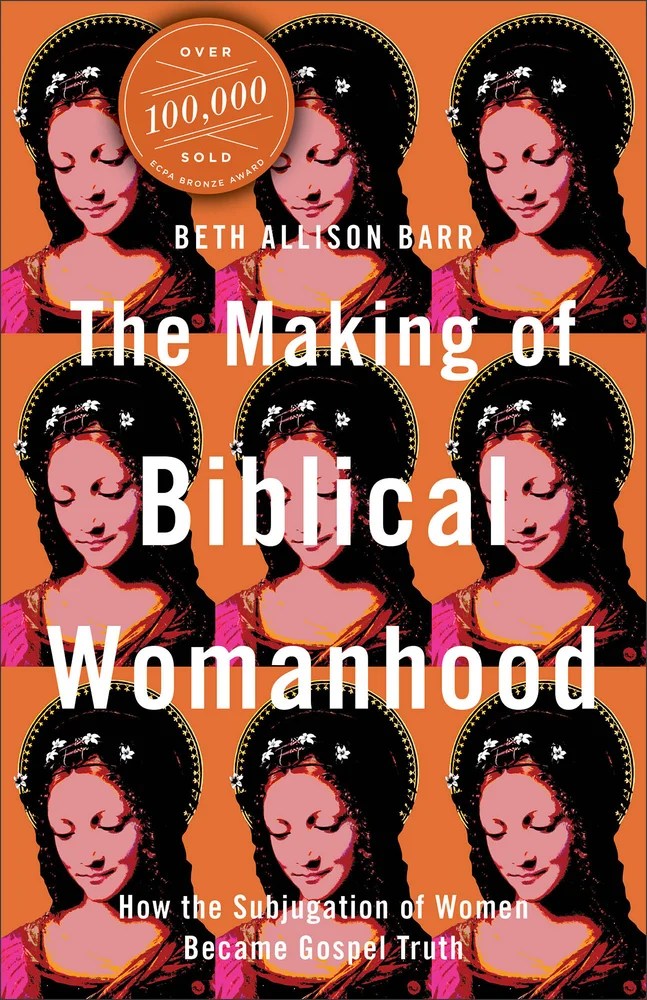
The Making of Biblical Womanhood

by Beth Allison Barr
First sentence: “I never meant to be an activist.”
Support your local independent bookstore: buy it there!
Content: While this isn’t a true work of scholarship, there is scholarship there, and it might be a lot for some people. It’s in the Theology and Religion section of the bookstore.

Barr wrote this book after her husband was fired from his job as youth pastor at a Baptist church in Texas. The reason? Simply put, he supported having women in leadership/teaching roles. This book, on the evolution of the idea of “Biblical womanhood” and the “God-given” roles that men and women are supposed to have, is the result of that firing. Barr is a medieval Church historian, and as she shows time and time again, the way conservative Christians think things have always been is, in fact, not the case.

I found this fascinating and enlightening. Barr tackles the Pauline creeds, puts them in context, and explains that really it’s the combination of the Restoration and the current trend for Biblical inerrancy that has led to women needing to be silent, submissive to their husbands, and focused entirely on being a wife and mother above all else. Barr is a good writer, helping someone like me without much scriptural knowledge or historical background through the murky waters of history and theology.

Absolutely worth picking up.

Mother Brain

by Chelsea Conaboy
First sentence: “What does it mean to become a mother?”
Support your local independent bookstore: buy it there!
Release date: September 13, 2022
Review copy provided by the publisher
Content: It’s very science-y and gets in the weeds with the science sometimes. It will be in the Science section of the bookstore.

I picked this up because my boss pulled it off the ARC shelves at work, and asked if I would be willing to give it a look-over and maybe nominate it for IndieNext. I figured I’d just read a few pages and give it a look, but I soon found myself engrossed in it.

The basic premise of the book is Conaboy’s experience being a pregnant person. She didn’t have the “ideal” and “expected” experience with pregnancy and mothrehood, and that lead her to look into the science of it. She’s not a scientist but rather a journalist who covers health and science, which gives her an interseting angle into the subject.

learned so much, and felt so validated with my own experience being a pregnant person. There were a lot of times that I underlined and dog-eared the pages because what she wrote resonated with me. It was so validating to know that the science – as little as there is – validated what I was feeling, that there isn’t one way to be preganant and a new parent.

I’d put this up there with Invisible Women as an important science book that just proves the need for science to include non-cishet men in their studies, in order to get broader picture of what it means to be human.

Highly recommended.

Libertie

by Kaitlyn Grenidge
First sentence: “I saw my mother raise a man from the dead.”
Support your local independent bookstore: buy it there!
Review copy provided by the publisher.
Release date: March 30, 2021
Content: There is tasteful on-screen sex and use of the n-word. It will be in the adult fiction section of the bookstore.

It is the middle of the 19th century, and Libertie is a free Black girl being rasied by a single mother who has the audacity to become a doctor. And who wants only the best for Libertie. Which is to say, she expects Libertie to follow in her footsteps and become a doctor as well. The weight of that is so much for Libertie, that before her mother can find out that she flunked out of college, she marries and runs off with a man — her mother’s assistant — to Haiti. Only to find that the freedom she was hoping for isn’t there.

It’s less about the plot, though, than it is about Libertie and her relationship with her mother. There is very much a push-and-pull there; with Libertie wanting love and unconditional acceptance, and her mother showing her love with the expectation of excellence. It’s set in a world where there is slavery, racism, and colorism but that only brushes up against the plot. It’s mostly about expectations: those that are placed upon us by others — parents, spouses, society at large — and the ones we place on ourselves.

Greenidge is a very talented writer, and I think Libertie is a character that will stay with me for a while. I’m not sure I thought the ending was realistic, but I appreciated it. It was a good read and I’m glad I read it.

White Tears/Brown Scars

How White Feminism Betrays Women of Color
by Ruby Hamid
First sentence: “‘I am so uncomfortable having this conversation,’ said Fox News host Melissa Francis during a live broadcast of the network’s panel program Outnumbered on August 16, 2017.
Support your local independent bookstore: buy it there!
Content: There are some swear words, including a few f-bombs. It’s in the Sociology section of the bookstore.

I was scrolling through Instagram one day and one of the bookish accounts I follow (I wish I could remember which one) said that if you’ve read Hood Feminism, you really ought to read this one. So I stuck it on hold at the library.

And that account is right: as a white woman, and a feminist, this one is a must read.

Hamad — who identifies as an Arab-Australian — deconstructs what it means to be a Brown and Black woman in the world where the effects of colonialism and racism is still felt. Every day. There is some history here: understanding the history of how white men used white women’s bodies (and white women, knowing the power structure went along with it willingly) to control Indiginous and slave populations is important to understanding the power structure in today’s society. And there are contemporary examples, white women who have made gains in business politics, an society, but who use those gains to keep out their Black and brown sisters.

It made me think of the saying: “If we lift from the bottom, everyone rises”. Colonialism and, by extension, capitalism lifts from the top. (It’s not just America; it’s a product of all colonialism — any place a different population came in and displaced the Indigenous population, any population that enslaved another population are affected this way. So really, the entire world.) It benefits Whiteness and punishes everyone else. (Or at least that’s the way I see it.) And Hamad’s book was basically an invitation to explore how I, as a White woman, interact with Black and brown people, how I use my whiteness (to help? to hurt?), and how I can can do and be better.

So, yeah. A tough read. But a very, very important one.

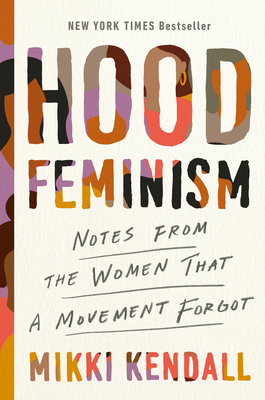
Hood Feminism

by Mikki Kendall
First sentence: “My grandmother would not have described herself as a feminist.”
Support your local independent bookstore: buy it there!
Content: There is some mild swearing. It’s in the Sociology section of the bookstore.

I’ve had this one on my pile for several months; probably since soon after George Floyd was murdered and I became more invested in reading books by Black (and other POC) authors. I also consider myself a feminist, so I figured this was a good merging of the two interests.

What it is is a series of essays by Kendall, where she reminds feminists — specifically (mainstream) White Feminists — that while the issues they’re fighting for — equal pay, reproductive rights, misogyny etc — are all fine and good, if they don’t think about the issues that are affecting women of color, then they’re not *truly* being feminists. Issues like housing and food availability, gun violence and single parenting. Things like making sure Black (and other POC) women are included in the conversation, and reminding White women that just because they’re oppressed by men doesn’t mean they can’t turn around and be oppressors as well.

No, it’s not an easy read. Kendall admits up front that she’s not out to be nice or polite. She’s is out to speak her truth (she grew up in the inner city, her first marriage was abusive and she admits that she had privileges that allowed her to get out of both situations and achieve a middle class-adjacent life, in her words) but also the truth for women, specifically Black women, who are not given the opportunity to speak.

But it’s an important read. It’s important to remember that the charity work we do is good but not enough if the government is taking away housing opportunities and punishing poor people for being poor. It’s a reminder that, as a White woman, I need to listen the voices of my BIPOC sisters and not just barge in there thinking I have the answers.

It’s definitely a book I will go back to and would love to discuss with others.

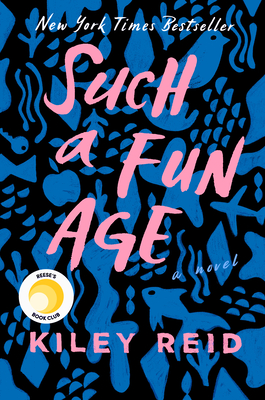
Audio book: Such a Fun Age

by Kiley Reid
Read by Nicole Lewis
Support your local independent bookstore: buy it there!
Or listen at Libro.fm
Content: There is a lot of swearing, including multiple f-bombs. There is also talk of sex, but none actual. It’s in the Fiction section of the bookstore.

Emira is a 25-year-old Black woman who is kind of aimless. All her friends seem to have “real” jobs, but she’s working as a temporary typist for the Green Party in Philadelphia and as a babysitter for Alix and Peter Chamberlin. The thing is, Emira adores Briar, the girl she sits, and doesn’t really feel much of a need to change things up. Then she meets Kelly — at a grocery store after Emira had a run-in with a security cop. And they begin to date, which sets up a run-in with Alix.

It doesn’t sound like a whole lot happens in this book from the description, but it’s more thoughtful and intricate than that. It’s a meditation on relationships — can a wealthy White woman really have a “friendship” with her Black babysitter? Is a White man who sees himself as an ally because he has Black friends and dates Black or biracial women, really an ally? — but it’s also a meditation on how we perceive ourselves. Reid did a fabulous job making no one out to be the “villain” here. Everyone had reasonable motivations (or at least presented reasonable motivations) and I could see they were all operating from a place they thought was reasonable. But, I could also see how the decisions were self-interested. Everyone said they were trying to help Emira, but were their decisions really helping? There’s a lot to talk and think about, especially about the way White people center themselves, even when they’re trying to help.

On top of that, the narrator was fabulous. I loved the way she portrayed each character (especially 3-year-old Briar; she was perfect!) and the way she made them distinctive and intriguing. She kept me coming back (though I think this one would have worked for me in print form, as well) and wanting to see what was going on next with Emira and Alix.

Definitely worth the buzz it’s been getting.

Women Who Run With the Wolves

by Clarissa Pinkola Estes
First sentence: “Wildlife and the Wild Woman are both endangered species.”
Support your local independent bookstore: buy it there!
Content: There’s frank talk about bodies and sex. I have no idea where this would be (Self-help, maybe?) if the bookstore had it.

I came across this book in an article for the last class I took, and I thought it sounded interesting.

How it came off 25 years after publication was a lot of heteronormative, new-agey, psychobabble nonsense. Estes takes a fairy tale — generally from another culture, but we’ll give her mid-90s self a pass on that — and then deconstructs it to help explain why society has trapped the Wild Woman inside of women and how she needs to be freed. Now don’t get me wrong: I agree with the premise. Society HAS trapped women into gender roles and norms that are not just harmful for women but for men as well. However, I’m not sure that this was the best way to communicate it. Well, maybe it was in 1995. But now it just seemed very very dated.

And so I ended up skimming and skipping a lot. I did enjoy her tales; some of them I had heard before but many I had not. But the rest of it? Well, there are always self help books about finding your inner wildness. Maybe read one of those instead.

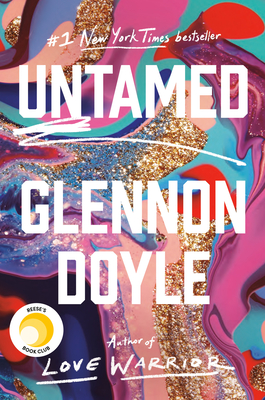
Audio Book: Untamed

by Glennon Doyle
Read by the author
Support your local independent bookstore: buy it there!
Or listen on Libro.fm
Content: There are several f-bombs as well as some mild swearing. There is talk of addiction. It’s in the Biography section of the bookstore.

Sometimes a book comes into your life at the right time. I picked this one up to fill out a category in the #ReadICT challenge — everyone’s reading it (or they were back in March, but who’s keeping track?) — and got something completely unexpected and absolutely needed.

I have heard of Glennon Doyle, but never read any of her work, so I was going into this blind. In a series of short essays (some longer than others), the book is essentially the story of her falling in love with a woman, divorcing her husband, and building an entirely new life. But it was about more than that: it was about taking back ownership of your decisions, your life, your feelings and not being “caged” by anything, whether it be society, religion, yourself. It’s a hard thing, being true to your own truest self. It’s much easier to lean on other people’s beliefs and perceptions of you. It doesn’t require the work of figuring things out for yourself. And I think that’s something I needed to hear right now.

I appreciated the humor of the book, the thoughtfulness, the encouragement. I adored Doyle’s honesty and forthrightness, and her willingness to be true to herself at all costs. She sounds like an imperfect but utterly remarkable woman. Doyle is also a good narrator, and I’m glad she read this one; it made it that much more personal.

I’m not sure this is a book for everyone, but I really enjoyed listening to it.

Juliet Takes a Breath

by Gabby Rivera
First sentence: “There was always train traffic ahead of us and that Saturday was no different.”
Support your local independent bookstore: buy it there!
Review copy provided by publisher.
Content: There are a ton of f-bombs, some tasteful on-screen sex, and pot use. It’s in the Teen section (grades 9+) of the bookstore.

So, while doing some Googling and looking when I finished this, I discovered that it was published four years ago by a small press, but picked up by Dial Press and re-published last year. Which explains 1) how I got an ARC from our Penguin rep and 2) why I missed it the first time around.

Because this a a spectacular piece of feminist LGBT writing.

The premise is this: Juliet has grown up in the Bronx, but gone away to a liberal arts college in Baltimore. Once there, she began discovering her sexuality, and read “Raging Flower” a seminal feminist book by Harlowe Brisbane. On a whim, Juliet decides to write Harlowe and ask if she needs an intern, which Harlowe readily agrees to. So, Juliet takes off across the country to Portland, hoping to be inspired and discover out more about herself.

What she discovers is that Harlowe doesn’t have all the answers, but the experiences — both good and bad — are immensely worth having.

The book was not kind to Portland; the people there were VERY hippie. So much hippie. And maybe that’s the way Portland really is, but I kind of felt like it was overkill. That said, I think Rivera did an amazing job exploring the space between adoring someone and being hurt by them and questioning their motivations. I also loved Juliet’s exploration of her sexuality and her relationship with her mother. But mostly I adored her cousin Ava.

It’s a good feminist book, encouraging girls (and women) to stand up and question not just patriarchy but their own individual responses. It was also a good exploration of intersectionality, and how if we don’t welcome everyone to the table, there’s not a lot of good that can be done. It’s all about taking ownership, and I can get behind that.

And it wasn’t a bad story either.

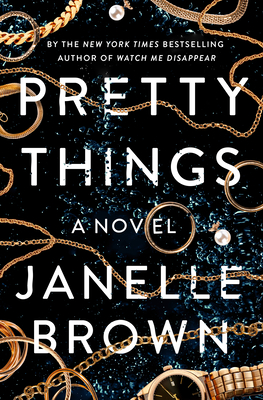
Audiobook: Pretty Things

by Janelle Brown
Read by Julia WhelanLauren Fortgang & Hillary Huber 
Support your local independent bookstore: buy it there!
Or listen on Libro.fm
Content: There is a lot of swearing, including many f-bombs, as well as non-graphic depictions of sex. It’s in the Fiction section of the bookstore.

Nina Ross has always been at the mercy of her mother’s lifestyle. They’ve moved over and over again, never quite getting ahead. Mostly because her mother really couldn’t hold down a job, preferring to con rich men out of their money. It’s not been a great life, except for that one year when she lived up in Tahoe, and met Benny, but was put off by his uber-rich family (including his sister, Vanessa). But that was all in the past, and Nina herself has resorted to conning and stealing with her boyfriend to help pay her mother’s medical bills since she came down with cancer.

Vanessa is the privileged daughter of a once uber-wealthy family. She wanted to make her own mark on the world, though, so she tried out several things (losing a lot of her trust fund) until she settled on being an Instagram influencer and all that comes with it. But her mother committed suicide, her brother is in an asylum because of his schizophrenia, and her father died and left her the family home, Stonehaven, at Tahoe.

Which is where Vanessa and Nina’s lives intersect: Nina and her boyfriend head up to Tahoe to con Vanessa out of the money Nina is sure is in the house safe. But will they succeed?

Alternating Vanessa and Nina’s viewpoints, this one kept me thoroughly engrossed. I don’t know if it was in part because the narrators were so fabulous (So fabulous!) or if it was the story that kept me interested, but I would sit for hours (working on puzzles) listening to the tale of Vanessa and Nina unfold. There’s a lot in there as well: class issues and privilege and perspectives and how we do or don’t trust and believe in people. Ultimately, it is the story of two women figuring out how to believe in themselves.

Definitely worth reading.