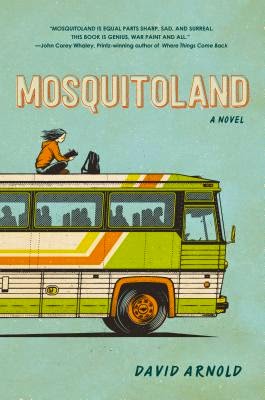
Mosquitoland

by David Arnold
First sentence: “I am Mary Iris Malone, and I am not okay.”
Support your local independent bookstore: buy it there!
Release date: March 3, 2015
Review copy handed to me by the publisher rep.
Content: There’s a whole lot of language, both mild and strong. There’s some creepy characters, including a serial rapist, but nothing is graphic. It’ll be in the teen section (grades 9+) of the bookstore.

Mary Iris Malone, Mim to everyone but her mother, is not happy. Her father, in a whirlwind, divorced her mother — who then disappeared — married the waitress at the local Denny’s, then relocated the three of them — Mim had no choice — to the middle of nowhere, Mississippi.

This does not sit well with Mim, who just wants her mother back, her old life back, her home back. So, when she’s called to the principal’s office and overhears her dad and Kathy talking about Mim’s mom with the principal, she snaps. She takes off from school, packs a backpack, grab’s Kathy’s coffee can stash of money, and heads to the Greyhound bus station. She’s headed back to Ohio this Labor Day weekend to see her mother, come hell or high water.

It’s not as easy as it sounds; there’s perils in them thar woods, and Mim is in for one of those life-changing adventures. There are some creepy people on the road, but she makes friends, both causal and the best-friend-types. And she discovers that maybe humanity — and Kathy — aren’t as bad as she’s always made them out to be.

I thoroughly enjoyed this one. Seriously. It started out slow and kind of awkward; Mim is a tough shell to crack and a prickly one at the beginning. But the more time I spent with her, the more I grew to love her. The more she revealed about her family and her life, the more I enjoyed spending time with her. And her adventures were fantastic. The people she met were fascinating and quirky, and I wanted to go on more adventures with them. I was almost sad when the book ended because I wouldn’t be spending more time with Mim and her friends.

I’m not sure this is a book for everyone. But for those who love good road trip adventures, and quirky characters, it’s a gem.
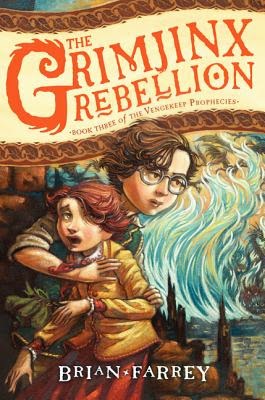
The Grimjinx Rebellion

by Brian Farrey
First sentence: “Of all the wisdom passed down through the generations of the Grimjinx clan, the bit I think about most came from Jerrina Grimjinx, wife of Corenus, our clan father.”
Support your local independent bookstore: buy it there!
Others in the series: The Vengekeep Prophecies, The Shadowhand Covenant
Content: There’s some action, and a few intense moments. The length will probably deter less confident readers, but (aside from the made up words) it’s really a page-turner. It’s in the middle grade (grades 3-5) section of the bookstore.

Jaxter thought, after he defeated the Shadowhand, that his troubles would be over. But, the High Laird has been raising taxes, and the population of the Five Provinces are getting restless. None of this bothers Jaxter very much, until the mages kidnap his sister. Who happens to be a powerful seer.

Jaxter, of course, can’t let this happen. So he, his parents, and some of his friends, head off to rescue Aubrin from the power-hungry mages and discover that they’re plotting to overthrow the High Laird and take over the provinces. Once again, Jaxter (and the whole Grimjinx clan) is in over their heads. But, true to form, they rally and figure out a way to Save the Day.

This is such a solid series: a great overarching story (elements of the first book came back again in this one), that involves themes of freedom and who has the right to rule. But it’s also grounded in family: I love the whole Grimjinx clan (even the wayward uncle) and how they pull for each other. They can do things individually, true, but as a family unit, they’re unstoppable. And I love how Jaxter’s friends got adopted into the family: they’re as important to him as his actual family. I especially like his relationship with Callie: you can tell he’s concerned about her, but there’s no romance. They’re just friends, and that’s great.

I also loved how this wrapped up, but didn’t tie everything up in a nice, neat bow. Farrey chose to leave things hanging; and I appreciated the ambiguity. Anything could happen, and that’s just great.

It’s a fantastic end to a fantastic series.

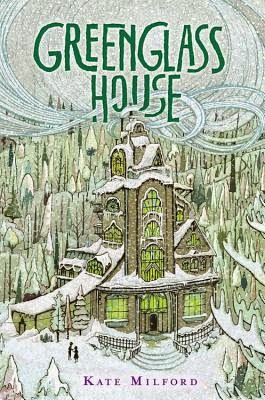
Greenglass House

by Kate Milford
First sentence: “There is a right way to do things and a wrong way if you’re going to run a hotel in a smuggler’s town.”
Support your local independent bookstore: buy it there!
Content: There’s nothing in the usual objectionable categories. However, it’s a slow book, especially at the start, and there’s some confusion sometimes when the characters switch names. That said, a good reader who loves mysteries would really like this one. It would be in the Middle Grade (grades 3-5) section of the bookstore, but I wouldn’t be adverse to putting it in the YA (grades 6-8) section either.

Milo and his parents run an inn at the top of a hill overlooking a river just outside of the fictional town of Nagspeake. The thing that makes their inn special is that it’s a safe having for smugglers. Milo and Mr. and Mrs. Pine know how to keep secrets.

However, it’s winter break, and Milo is looking forward to spending time alone with his parents. Without guests. So, he’s predictably disappointed when four guests, one right after another, show up for the winter.

Soon, they are in full swing, and have to bring up their usual cook, with her daughter, who just happens to be Milo’s age. Soon he and Meddy find themselves embroiled in an adventure and a mystery: figuring out why each of the four guests are there, their connection with the old house that Milo’s parents inherited, and who keeps stealing stuff.

The comparisons to Westing Game that I’ve read are valid. There is a mystery to solve, and it’s a quietly clever one, with a twist that I should have seen coming, but didn’t. (As we all know, I’m not the most careful of readers.) But it’s more than a mystery: it’s a lovely book, full of stories and quiet adventures (Meddy and Milo play a Dungeons & Dragons-like game for most of the book). I’m impressed that Milford wrote such a compelling book on such a small scale; because of the weather, Milo and Meddy hardly ever leave the house. It’s a very bleak landscape (Think The Dark is Rising bleak), but Milford infuses it with both warmth and mystery.

One more thing: Milo is adopted. He’s of Chinese nationality with white parents, and he feels that difference keenly at this point in his life. So, it’s not only a book with a mystery, it’s a book about belonging and family.

I loved it.

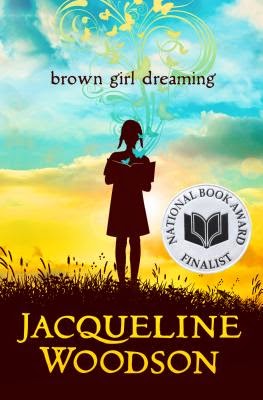
Brown Girl Dreaming

by Jacqueline Woodson
First sentence: “I am born on a Tuesday at University Hospital Columbus, Ohio, USA — a country caught between Black and White.”
Support your local independent bookstore: buy it there!
Content: There’s nothing objectionable. And it’s even an easy-ish read. Sure, it’s poetry, but it’s not difficult. Hand it to anyone with an interest in writing, kids, and history. It’s in our middle grade biography section at the bookstore.

I’m not quite sure where to start on this one. It seems We’ve (the collective we, here) been inundated by memoirs and biographies of celebrities, People of Note, and at first glance Jacqueline Woodson’s new book just falls into that pit of “celebrity” (of a sort) biographies.

Except, it’s not so much a biography or memoir as it is a reflection upon a childhood. Woodson makes her childhood an Everyperson experience, something that the reader can readily identify with, even if they didn’t have her exact same experiences.

Her childhood begins in Ohio, but mostly it’s spent in South Carolina, with her grandparents, and in Brooklyn, where her mother finally settled with Jacqueline and her brothers and sister. I kept trying to figure out the timeline (if she was born in 1963, then it must be…) but eventually, I just gave up and let myself get absorbed in the story.

And absorbed I was. Woodson wove historical elements into her story — sit-ins in the South; the way her grandmother felt about the way she was treated in stores by white people; music that was playing on the radio — all of which helped put her personal story in a larger framework. I could easily forget I was reading a memoir; it felt so much like a novel.

Part of that, too, was the form. Written in free verse, the memoir took on a lyrical quality. There were moments, especially toward the end, where I was moved by her insights not only in her life, but for Life in general.

One more thing: I appreciated her portrayal of religion. I get the sense she’s not a practicing Jehovah’s Witness anymore, but she portrayed the religion of her grandmother and her own childhood with respect. It was neither good nor bad; it was just a part of her life. And I found that refreshing.

Highly recommended.

Thursdays with the Crown

by Jessica Day George
First sentence: “‘You are not leaving me behind,’ Celie repeated.
Support your local independent bookstore: buy it there!
Others in the series: Tuesdays at the Castle, Wednesdays in the Tower
Content: There’s nothing objectionable, really. It’s a good book for both readers who love fantasy, and for struggling readers — lots of white space, and short chapters — who need action. It’s in the middle grade (grades 3-5) section of the bookstore.

When we last left Celie, Rolf, and Lila, they had just disappeared from Slene (along with Lulath and Pogue). No one knew where they went or why the castle sent them away.

As the book opens, Celie and her intrepid siblings and friends are stuck in a place they didn’t know existed. And they need to find the Glorious Arkower, the head magician, to go back to Slene. Except, things aren’t that simple. They discover that Rufus (Celie’s griffin) isn’t the only one; he’s got parents. Who happen to be the king and queen of the Royal Griffins. The motley crew manages to find and hatch a couple more griffin eggs (one for everyone!) and discover that the Glorious Arkower is… not so glorious. And things aren’t as simple. The question is: can Celie figure out a way to return back (and wake up!) the castle she loves?

This is such an adorable series, though I think it might be one that’s better read in one sitting. Sure, I fell pretty fast into the world (I haven’t read the other two in a while). But, I think I would have liked it more had I read them all in quick succession. Even so, Celie’s delightful, Lulath’s still my favorite, and I’ll happily spend time in Slene with them for as long as George wants to write about them

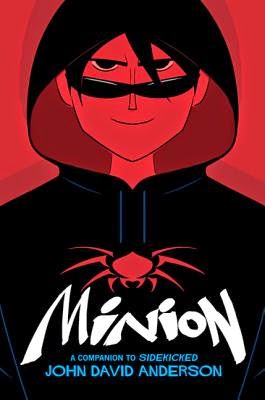
Minion

by John David Anderson
First sentence: “I want you to know, right from the start, that I’m not evil.”
Support your local independent bookstore: buy it there!
Others in the series: Sidekicked
Content: There’s really nothing objectionable, and I ended up putting these in the Middle Grade (grades 3-5) section of the bookstore. It still feels slightly older than that, however. I just can’t place why.

Michael Morn is a villain. His adoptive father is one of those mad scientist types, who invents boxes that do… well, stuff. Like scrambling all the cameras, or maybe blowing up. And so the duo have committed crimes. Nothing extravagant, mostly just bank robberies when they needed the money.

But Michael also has a secret: he has unusual powers of persuasion. When he looks someone in the eye, he can compel them to do something. Sure, it has to be within the realm of possibility, but he can do it. So far, he and his dad have kept that power under wraps, only using it when they really have to. But with the arrival of The Dictator — a true super-villain — and his nemesis, the Comet, Michael’s life is about to change. And not necessarily for the better.

I remember liking the companion book to this, Sidekicked, but even so, when I picked this up, I wasn’t quite sure what to expect. On the one hand, it’s a very clever take on superheroes and super powers. I like the world that Anderson has created, where being super isn’t necessarily an unusual thing and superheroes aren’t necessarily saviors of the world. And where villains are just people trying to scrape by.

That said, I felt that this one was missing something: A concrete ending, for starters. I won’t give anything away, but it left more questions than answers by the end. And it didn’t feel like a real middle grade (or even YA) novel, either. Michael did stuff, sure, but mostly he was reacting to the adults around him, and spent more time being their pawn (from this father, to the crime boss his father worked for, to The Dictator, in the end) and didn’t actually do anything. It felt like an elaborate set-up without much of a pay-off.

That said, it wasn’t bad either. Or, at least, not bad enough to put down. But it wasn’t satisfying in the end.

10 Awesome Middle Grade/YA Families

I had a bad week, and I ended up pulling the Casson family books (by Hilary McKay) off the shelf, just for some comfort reading. And I realized: THIS (with the exception of Bill, who’s a jerk) is a great family. And it got me wondering: with all the dead moms, and bad dads, and missing parents in middle grade and YA literature… how many books are out there with some really great families? (Great enough that you remember they’re wonderful.)

This is what I came up with.

Saffy’s Angel, by Hilary McKay: I couldn’t live in the Banana House, but I want, very much, to live next to the Banana house and be best friends with the Cassons.

The Misadventures of the Family Fletcher, by Dana Alison Levy: I loved the every day feel of this, and I wanted Dad and Papa to be my parents. They were really amazing dads.

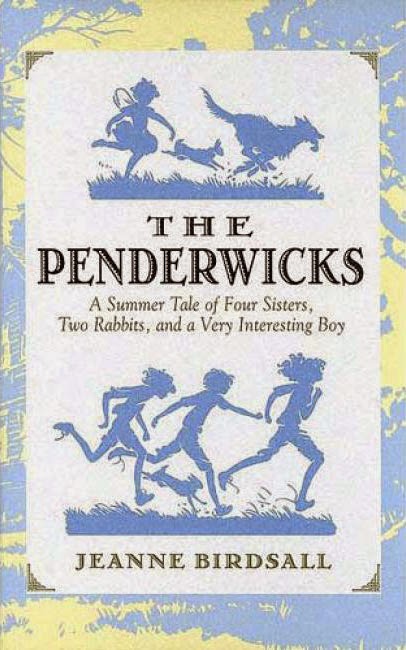
The Penderwicks, by Jeanne Birdsall: I feel like this is one of my go-to books for these lists, but it really is that good. And yeah, there is a dead parent (Mr. Penderwick gets remarried the end of the second one, though.), but I love the way the Penderwicks work as a unit.

Tuesdays at the Castle, by Jessica Day George: Another one where the family just rocks. Sure, Mom and Dad are missing for most of the book, but the kids care enough to look for them and fight for them, and the work really well as a unit. Even though I loved Celie on her own, I really enjoyed her in context of her family.

Penny Dreadful, by Laurel Snyder: I’m not sure this one is a good family as much as a good community book. I loved the place Penny ended up and the people she met. The town became her family and I loved that.

Three Times Lucky, by Sheila Turnage: same goes for Mo and the town of Tupelo Landing. She doesn’t have a “family” but she finds one in the town and Ms. Lana and the Colonel. I want to move there and just be friends with everyone.

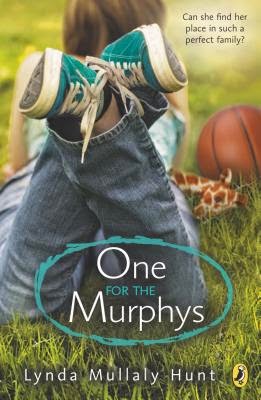
One for the Murphys, by Linda Mullaly Hunt: Another non-traditional family. There is one in the book, but the main character doesn’t belong to it. And what I loved is that the family embraced her and made her one of their own. Wonderful.

Counting by 7s, by Holly Goldberg Sloan: The best part of this book is not the dead parents in the beginning, but the fact that Willow created another family for herself out of broken fragments. And it was a good thing.

The Raven Boys, by Maggie Stiefvater: Sure the focus of the book is the boys and the search for the ley line and Glendower. But let’s not forget the psychic house and the way these women — some related, some not — are a complete, close-knit family. They are there for each other. And much like the Cassons, I wouldn’t want to live there, but I would want to visit often.

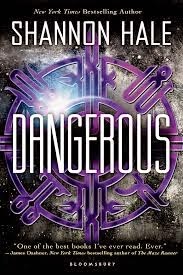
Dangerous, by Shannon Hale: Again, family is not the center of this story, but let’s take a minute to recognize that Maisie has awesome parents. They don’t hover, they don’t control, they let her be what she wants and needs to be. It’s wonderfully refreshing.

So, what did I miss? (And this is not an especially diverse list. Help me out?)

Amulet: Escape from Lucien

by Kazu Kibuishi
First sentence: “There’s a real comfort in being a nobody like me, Master Griffin.”
Support your local independent bookstore: buy it there!
Others in the series: The Stonekeeper, The Stonekeeper’s Curse, The Cloud Searchers, The Last Council, Prince of the Elves
Content: There’s a lot going on, and sometimes the vocabulary is a bit challenging, but K (who’s 8) loves these books, so I’d say it’s good for a strong 2nd or 3rd grade reader. It’s in the middle grade (grades 3-5) graphic novel section of the bookstore.

I’ve been saying for years that I ought to break down and buy this series. And K discovering them this summer gave me the perfect excuse. However, I didn’t go back and reread the past ones before I dove into the new one. So, I’m still a bit behind on the story, but that’s my fault now.

Things are coming to a head and getting more desperate for Emily and the band of rebels. The Elf King is still in power, but his son, Trellis, is learning things and gaining power and confidence. But while we learn things about Max (he’s the Saruman figure) and his backstory, this book really belongs to Emily’s brother Navin, who is a pilot with the resistance, and is sent with his classmates (kinda sorta; he ends up tagging along because of reasons) to the city of Lucien, which has been bombed out and completely taken over by the “shadows”, evil blobs that possess people and turn them, well, evil. Their job: to see if there are any survivors, and to turn on the beacon, sending out a signal for help.

I really don’t have anything new to add to my thoughts on this series. Still gorgeous. Still not coming out fast enough. I’m still going to buy the next one when it comes out next year. I adore this series.

The Misadventures of the Family Fletcher

by Dana Alison Levy
First sentence: “Eli sat on the wooden porch steps, crammed in with his brothers, while Pap fiddled with the camera.”
Support your local independent bookstore: buy it there!
Review copy given to me by our Random House Children’s rep.
Content:  The typeface is pretty big and the words are simple without being simplistic. Also, there’s a hint of liking girls, but no real romance. I’d say it’s pretty happy in the Middle Grade (grades 3-5) section of the bookstore.

I’ve been sitting here thinking about how to pitch this one (especially in conservative Kansas), and I think I’ve come up with it: it’s The Penderwicks, but with boys.

The similarities are there: a classic, homespun feel; a family of four siblings ranging from the cute young one (Frog, age 6, in this case) to the wise, older one (Sam, just starting 6th grade); simple, true-to-life challenges, rather than huge conflict; and a charming, whimsical feel that just makes you smile when you’re done reading.

The book follows the Fletcher family — Dad, a history teacher; Papa, who stays at home and does consulting work while the boys are at school; and their sons, Sam and Frog (who is Indian, by the way), but also Jax (age 10 and African American) and Eli (also age 10, but Jax is older by some months) — through the course of a year. As I said, none of the conflicts are huge and overarching, (except, perhaps, their grumpy neighbor Mr. Wilson) but rather small, realistic ones. Eli deals with a starting a new school for “scholarly minded” students and realizes pretty early on that he hates it. Jax deals with a best friend who is growing up and whose interests are changing. Sam is dealing with being on the cusp of teenager hood as well as the idea that something he discovered he likes — acting — may not be “cool”. And Frog has to deal with his family not believing him when he says he has a new friend whose name is Ladybug.

It’s a charming, sweet little book, one that I think will be able to reach a number of readers. In fact, the diversity of this one is my second favorite thing about it (my first favorite being the old-fashioned feel). I loved how Levy had a hugely diverse cast and showed how everyone is just. like. me. (Duh.) But she did it in such a way that wasn’t preachy. And I loved that.

In fact, I want to hand this one to all the kids and say: “You know that person who is different from you? This will help you understand them.” I’m not sure that will sell this book, so I may just have to stick to “Penderwicks with boys.” I just hope kids read this one.

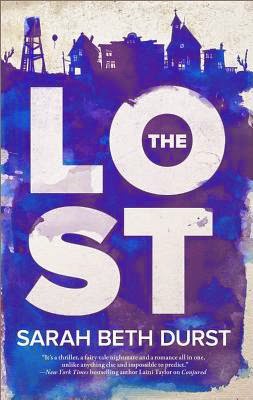
The Lost

by Sarah Beth Durst
First sentence: “For the first hundred miles, I only see the road and my knuckles, skin tight across the bones, like my mother’s hands, as I clutch the steering wheel.”
Support your local independent bookstore: buy it there!
Content: The publisher is marketing this one as fiction, but I think it’s because the main protagonist is 27. There’s some mild swearing, and lots of kissing, but other than that, nothing. I’d give this one to a teenager who is interested.

I’ve had a difficult time getting into adult fiction lately. Too often, I picked it up and it’s just Words and no Plot or Characters or anything interesting. But, I saw that Sarah Beth Durst (whom I love) had an adult book (!) out, and I figured if there was an adult fiction book I’d love, it’d be one written by Durst.

I was right.

Lauren Chase is in a holding pattern in her life. She’s given up on her art to get a practical job because her mother has been diagnosed with cancer. But on this particular day, the day in which the book starts, her mother is off to get Bad News, and Lauren can’t handle it. So she runs away. And finds herself in Lost. A place where all the lost things go, once you arrive in Lost, you’re pretty much stuck. Until you find the thing you lost, and then the Missing Man can send you back.

Except the Missing Man, when he saw Lauren, bolted. Which means, she’s got half the town out to get her, and has to figure out how to survive. Thankfully, she has Claire, a precocious 7-year-old, and Peter, who is the Finder, to help her.

It sounds a little trite, writing it all down, like it’s been something that’s been done before. But Durst made it new and fresh for me. Told from Lauren’s point of view, we got her panic when she initially encountered Lost, as well as her confusion and determination as things got worse for her. And the end, while open for the intended sequel, also gave me a sense of closure.

Perhaps I’m just a genre-fiction reader, but I found reading this one to be so much more enjoyable than many of my other forays into adult fiction. Which is something that made me very happy.