Jack

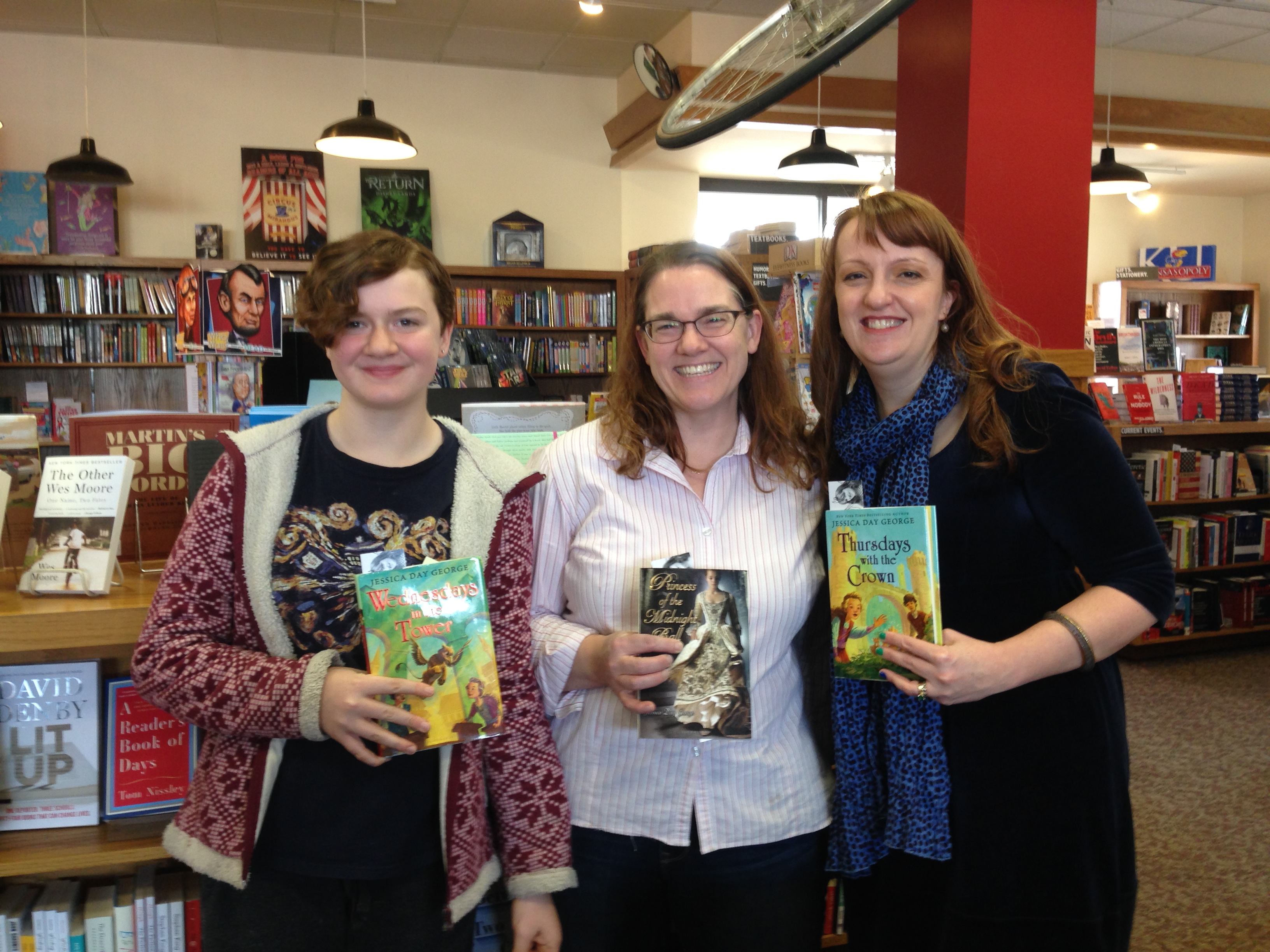
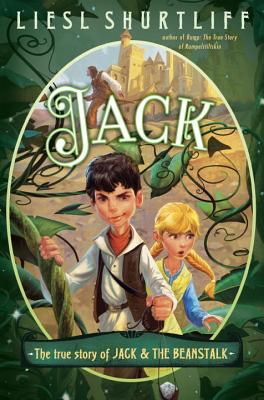
jackby Liesl Shurtliff
First sentence: “When I was born, Papa named me after my great-great-great-great-great-great-GREAT-grandfather, who, legend had it, conquered nine giants and married the daughter of a duke.”
Support your local independent bookstore: buy it there!
Review copy snagged off the ARC shelves at my place of employment.
Content: It’s pretty basic and a slim book, though it’s definitely  above a beginning chapter level. Give it to those who aren’t ready for longer, more involved books. It’s in the middle grade (grades 3-5) section of the bookstore.

Jack has spent his whole life on his parents’ rinky dink farm, hearing tales of his great-grandpa’s exploits. He’s sick and tired of growing wheat; he wants to see the world! He wants to do something grand!

So, when crops, animals, and buildings (not to mention people, including Jack’s father) in his village go missing, stolen by the giants in the sky (which his mother scoffs at), Jack figures this is his chance to make a difference. Three magic beans later, he climbs the beanstalk to find (and rescue) his dad.

What he finds is a giant nation in peril.H There’s a tyrant for a king who covets gold and taxes his people until they can’t pay any more. And there’s a famine on, which is why the king’s henchmen are stealing the food from the “elves” (non-giant people) and making them their slaves. Jack knows he needs to put a stop to all this, but what can one boy do?

It gets more complicated when Jack’s younger sister joins him up in giant land. They almost get trampled, they get taken by pixies, and Jack must learn to listen to and trust his younger sister and his friends if he’s ever going to get back home.

It’s not a bad book, and I did enjoy the nice twist on the Jack and the Beanstalk Tale. But it was just okay in the end. There were Lessons Learned and Adventures Had and Reunions and it just kind of all fell flat. But, that doesn’t mean a fairy-tale loving kid wouldn’t just love this to death.

(Just for the record: because this is a Cybils nominee, I’ve been asked to make sure y’all know this is my opinion only, and not that of the panel.)

Audiobook: The Boston Girl

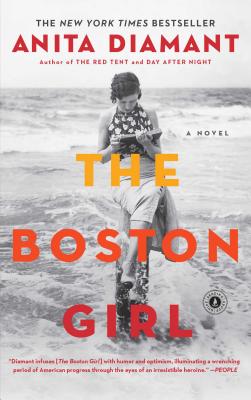
bostongirlby Anita Diamant
Read by: Linda Lavin
Support your local independent bookstore: buy it there!
Content: There are some mild swear words and references to drinking and smoking. It’s in the adult fiction section of the bookstore.

Addie Baum is the daughter of Eastern European immigrants, who came to American when the persecution became too bad back home. Addie was born in 1900 in Boston, and grew up in a world wholly different from that her parents, and even her older sisters (the youngest who was 14 years older than Addie), knew. It was a world where Addie went to school instead of getting married young and having babies. A world where she held a job and chose love for herself. A fascinating, modern world, but one that put her at odds with her parents — especially her mother — and the way of life they had always known.

I loved this one from the start. It begins as a series of reflections of an 85-year-old Addie in response to the question asked by her 22-year-old granddaughter: “How did you get to be the woman you are today?” The whole novel felt like a personal history, complete with asides that a grandmother would say in the telling. And while it covered Addie’s whole life, the focus was on her formative years from when she was 15 until she met and married her husband. The opportunities she had (because of the people she met), her struggles with family and religion and men, her jobs and the experiences she had because of them. It was a fascinating slice of life.

And the narrator was perfect. She caught that personal history vibe and ran with it; so very often I could almost see Addie, sitting in her living room, telling this story to an interested granddaughter. No, she didn’t do voices, though she had a good Boston accent overall, but I don’t think it was needed for this. The way Lavin read it was just perfect.

As was this story.

Challenger Deep

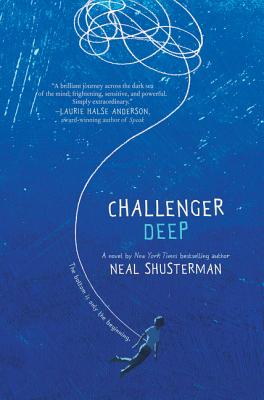
challengerdeepby Neal Shusterman
First sentence: ”
Support your local independent bookstore: buy it there!
Content: There’s some talk about drinking, but none actual. And there’s some mild swearing. But the reason it’s in the Teen (grades 9+) section of the bookstore is because it’s an extended metaphor. I’d give it to someone in 7/8th grade if I thought they’d “get” it.

Very seldom does a jacket flap so succinctly sum up a book, but in this case, I think whomever at HarperTeen did this, was spot on:

Caden Bosch is on a ship that’s headed for the deepest point on Earth: Challenger Deep, the southern part of the Marianas Trench.

Caden Bosch is a brilliant high school student whose friends are starting to notice his odd behavior.

Caden Bosch is designated the ship’s artist in residence to document the journey with images.

Caden Bosch pretends to join the school track team but spends his days walking for miles, absorbed by the thoughts in his head.

Caden Bosch is split between his allegiance to the captain and the allure of mutiny.

Caden Bosch is torn.

This book. I’ve been avoiding it for months, and I really only picked it up because Pop Culture Happy Hour did a recent podcast on it. But this book pulled me in and didn’t let me go. I don’t know of a more accurate, a more compelling, a more beautiful rendering of the spiral that mental illness — it really doesn’t matter what Caden’s diagnosed with — is. Shusterman gives us an allegory with the ship that is compelling and intriguing and maybe a little confusing. But the confusion is part of the trip; Shusterman not only wants us to read about Caden’s descent into illness, he wants us to feel that with him. And feel I did.

Powerful. And definitely one that will stay with me for a long time.

Crenshaw

by Karherine Applegate
First sentence: “I noticed several weird things about the surfboarding cat.”
Support your local independent bookstore: buy it there!
Review copy snagged off the ARC shelves at my place of employment.
Content: There’s some difficult things for the younger set to handle, but Applegate handles them at an age-appropriate level. There’s larger print, a lot of white space, and illustrations as well. It’s in the Middle Grade (grades 3-5) section of the bookstore.

Jackson has had a bumpy life. His parents are musicians, which isn’t the most stable job, and his dad has MS. They’ve managed okay, mostly; though there was the one time when they were living in their van for a few months. It was during this time that Jackson’s imaginary friend, a huge cat named Crenshaw, showed up.

For the past few years, though, they’ve been pretty stable. Except things are going downhill again. How does Jackson know? Crenshaw has showed up again.

The question is: what can Jackson do about the piling bills, and the growing sense of helplessness that he feels. The answer may lie with Crenshaw.

I wanted to love this one. I really did. I adored The One and Only Ivan, loved Applegate’s simplicity in relating a story. But this one kind of fell flat. It wasn’t Jackson’s story: I feel that his story, the one of good people who just can’t make ends meet, is one that needs to be told. But I never could quite figure out what Crenshaw was doing there. Or why he was necessary. To add a bit of levity? To help Jackson? It never quite felt right, felt seamless to me.

That said, Applegate does know how to tell a story; it wasn’t so bad that I didn’t finish it. It just felt a little… off.. to me. Which, in the end, was disappointing.

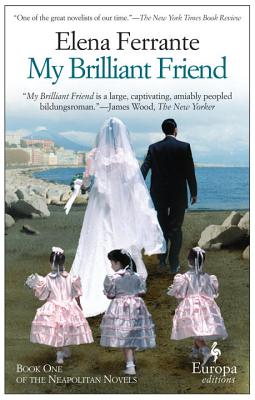
Audiobook: My Brilliant Friend

by Elena Ferrante
Translated by: Ann Goldstein
Read by: Hillary Huber
Support your local independent bookstore: buy it there!
Content: There’s a few mild swear words and some frank talk about not-quite sex. It’s incredibly slow with a lot of narration rather than dialogue, but I’d give it to a high schooler who was interested in historical fiction. It’s in the adult section of the bookstore.

I picked this one up because I’ve heard good things about Ferrante from our translation book club (they only read works in translation), and because I needed a book in translation for my bingo card.  (Which I’m going to end up being three squares short from getting a blackout. I read a lot.) I didn’t know much about it, going in, so I didn’t think I had any expectations. (I did however, expect to really enjoy the narrator, which I did.)

What it turned out to be was a very slow, intricate, detailed portrait of a girl, Elena, in a neighborhood in Naples, Italy, and her (somewhat obsessive) relationship with her best friend, Lila. This first book is a lot of set up: their lives — Lila is the daughter of a shoe repairman; Elena the daughter of a porter, whose mother has a wandering eye and limp and is cruel — and their relationship — mostly competitive, mostly on the side of Elena — to each other. They meet in elementary school, where Lina is the smartest and the best. But because she is poorer than Elena and because her parents won’t be bullied by the teacher (there was a lot of bullying by people in this), Lina drops out of school while Elena continues.

And yet, everything Elena does is because she wants to seem important to Lina. She wants Lina to look at her and feel like she Needs Elena in her life. And yet, for the most part, she doesn’t.

I’m still not sure how I feel about this one. On the one hand, I adored Huber’s narration, the way she embodied the characters (and how effortlessly the Italian names and places came off her tongue). She really is a talented reader, and I love listening to her. But, I’m not sure I figured out what was so great about the novel. I was interested enough to keep reading; the character’s lives were intriguing and, yeah, I guess I did want to hear what Elena and Lina would do next. But, in the end, I don’t know if I cared. I finished the book and kind of went, “Huh.” Maybe it’s because I don’t read a lot of books like this (both translated as well as adult fiction), but it just kind of washed over me.

Not that it was bad. It just wasn’t something I was terribly enthusiastic about.

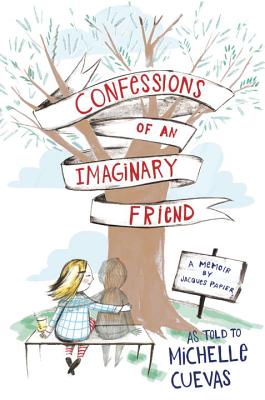
Confessions of an Imaginary Friend

A Memoir by Jaques Papier
by Michelle Cuevas
First sentence: “Yes, world, I am writing my memoir, and I have titled the first chapter simply this: EVERYONE HATES JACQUES PAPIER.”
Support your local independent bookstore: buy it there!
Release date: September 4, 2015
Review copy provided by the publisher rep.
Content: Aside from a few big words, this one is written at an 8-year-old’s level. I’d give it to 3rd-graders and up. It’ll be in the Middle Grade (grades 3-5) section of the bookstore.

For all eight years of his life, Jacques Papier has been happy. He has a wonderful twin sister, Fleur, and even though is parents seem to ignore him and the weiner dog, Francois, hates him, he’s pretty happy. Then one day, in second grade, his is forced to face this realization: he’s imaginary. This sets off both an existential crisis and an adventure as Jacques figures out what to do now that he’s no longer “real”.

It’s a pretty simple premise, but Cuevas executes it brilliantly. It’s framed as a memoir, and her voice for Jacques is spot-on. I love the other imaginary beings he comes across in his travels, and the way he becomes the imaginary friend of several other children. It’s scattered through with drawings (I think done by the author), which just adds to the whimsy of this one. And the ending is incredibly sweet without being too saccharine.

I adored it.

Sunny Side Up

by Jennifer Holm and Matt Holm
Support your local independent bookstore: buy it there!
Release date: August 25, 2015
Review copy provided by the publisher rep.
Content: There’s some implied drug and alcohol abuse by the character’s older brother, so it’ll probably engender some discussion. It’ll be in the middle grade graphic novel section of the bookstore.

It’s 1976, and Sunny is being sent to live with her grandpa in Florida. It’s not something Sunny wants to do; she’d rather be at the coast with her best friend. But, her older brother’s been having problems with drugs and alcohol (that’s putting it mildly), and so Sunny is being sent away for her own safety. On paper, it’s okay: Florida has Disney World, right? But, in reality? Her grandpa lives in a retirement community, and that’s just boring. Trips to the post office or the grocery store, early all-you-can-eat buffet dinners, a kid-less pool. Thinks look up when she meets Buzz and he introduces her to comic books. But, she’s still haunted by  her brother’s actions and the secrets she keeps. Can Sunny make the most of the summer she’s been given?

The Holm siblings have come up with a semi autobiographical novel addressing some pretty heavy issues. Granted, they do it in such a way that’s accessible to kids and that engenders discussion. K read this one, too, and we talked a lot about how other people can hurt us but that it’s not our fault. The only complaint we had, though, was trying to figure out how the flashbacks fit into the present story line. It was a bit confusing at first, but we eventually figured it out. We did like the relationship between Buzz and Sunny as well as Sunny and her grandpa. The other residents of the community were delightfully quirky, and it’s also great that Buzz and his family were immigrants from Cuba.

It’s not the Holms’ usual fare; it’s more like Raina Telgemier’s books. But, it’s a very heartfelt and sweet look at a very dark subject.

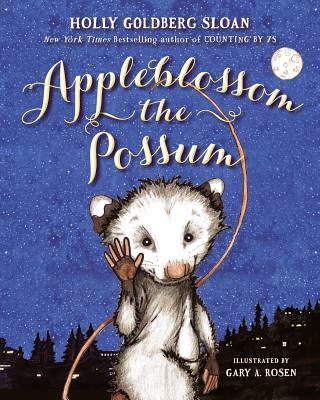
Appleblossom the Possum

by Holly Goldberg Sloan
First sentence: “One moment she’s calm and cozy with a knee in her nose and a tail around her neck.”
Support your local independent bookstore: buy it there!
Review copy acquired at CI3 and signed by the author (squee!).
Release date: August 11, 2015
Content: It’s pretty basic: simple language (though there are a few difficult words thrown in), and a lot of white space and illustrations. It’s probably appropriate for a strong 2nd grade reader and up. I think it’d make a great read-aloud for younger children, as well.

The store’s publisher rep warned me, when she highlighted this book (and I got all excited), that this is a departure for Sloan. And she’s right: talking possums is a bit of a departure for Sloan. But that’s really the only departure; many of the themes — of family and resilience — are the same.

Appleblossom is the youngest of Mama Possum’s first litter (which is why Appleblossom and all her siblings have A names). She’s happy when she’s younger, hanging out with her brothers and sisters, and learning acting lessons from Mama. It was scary, especially the lessons about People monsters and Dog monsters, but she knew she had her family with her. And then the day came that Mama left. (It’s the wild. It happens.) Appleblossom and two of her brothers — Antonio and Amlet (because Hamlet isn’t an A name) — decide that they don’t really want to go off on their own so they stick together in their neighborhood. And then tragedy strikes: Appleblossom falls down a chimney into a house. With a Dog.

First off: I think this is one of those books that would be better read aloud. The way the book is written feels like a story one would tell around a campfire or at bedtime, rather than a book to lose yourself in. The language Sloan uses to describe the people world, and the characters of the possums — the brothers end up meeting their dad, Big Poss — as well as the simple adventures the possums have all lent the story an air of whimsy that lends itself more to reading aloud.

Given that framework, it’s a wonderful tale. It’s full of adventure and humor and charming artwork. I think (even though I didn’t absolutely love it like I did Sloan’s other books), given its intended audience, it’s absolutely perfect.

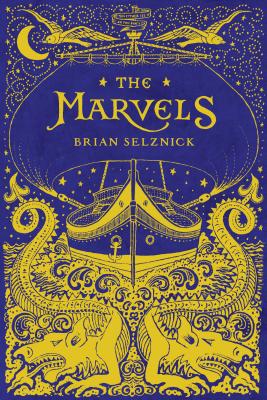
The Marvels

by Brian Selznick
First sentence (which comes about 400 pages in): “Joseph was lost.”
Support your local bookstore: buy it there!
Review copy provided by the publisher.
Release date: September 15, 2015
Content: It’s a huge book, which will be daunting. But 2/3 of it is pictures. And the text section may be a big confusing for younger readers. There is some smoking by adults, but other than that, there’s nothing that would stop me from giving this to a precocious 9- or 10-year-old. It will be in the Middle Grade (grades 3-5) section of the bookstore.

I don’t usually like to write about books months before they come out. But, since this is the first one I finished for the 48 hour book challenge, I figured it was okay.

I’m also going to be coy and not tell you too much about the book. I knew very little about it going in, and I think that’s the best way to experience it.

That said, I liked this one nearly as much as Hugo. It’s about the theater and family and truth in storytelling. Selznick’s art is gorgeous, as always, and even though the text section starts out a bit confusing, stick with it. It’s completely worth it at the end. Oh: and read the afterword. It makes everything that much better.

There’s really not much else to say, except: I can’t wait to share it with everyone else.

Circus Mirandus

by Cassie Beasley
First sentence: “Four small words.”
Support your local independent bookstore: buy it there!
Review copy provided by the publisher. (Plus: popcorn!)
Release date: June 2, 2014
Content: It’s kind of slow, and definitely heavy on the exposition, which may make more reluctant readers, well, reluctant to give it a try. But I’m assuming there will be gorgeous art throughout (I haven’t seen it yet), and so there’s that to give it a boost with those who like pictures with their books. It’ll be in the middle grade (grades 3-5) section of the bookstore.

Micah has been raised by his grandfather since his parents died when he was young. He’s had a good life; his grandfather is one of those Good people who know how to be happy. He was also a storyteller, raising Micah on stories of the grand Circus Mirandus and the Lightbender, who promised Micah’s grandfather a miracle.  Now, when grandfather’s health is failing, he calls in the Lightbender’s miracle. But getting that isn’t as easy as all that. And it’s up to Micah (and his friend Jenny Mendoza) to help grandfather get the miracle he deserves.

I am not a critical reader. I fall head first into stories, and they either work for me or they don’t. I don’t stop to think much about a deeper meaning, or issues, or (sadly) stereotypes and cliches. I like characters (or not), I like the plot (or not), I like the writing (or not). And so, I find myself loving books and not having a real “reason” for it.

This is one of those books. I loved it. Wholly and unabashedly. I fell into the magic and the suspension of disbelief. I understood the magic and the story that Beasley was trying to tell. I cried at the end. I am not sure I’ve felt this in love with a book since I read the first Penderwicks. This book? This book is my people.

I loved it. I loved the Big Fish-esque feel of the story. I loved Micah and his grandpa’s relationship. I loved the flashbacks to grandpa’s time with the circus. Yeah, so some of the characters — Aunt Gertrudis, especially — were pretty much caricatures, but so is Trunchbull in Matilda, and no one complains about that. I loved that Jenny was smart, and that they were just friends and that she wasn’t a romantic interest. I loved her skepticism, and her belief in her friend (if not in the magic). I loved the whimsy of the book. But most of all, I loved the heart of it. It has such a big heart.

I’m sure there are drawbacks, and people who this book won’t speak to. But, for me, this was a little slice of perfection.