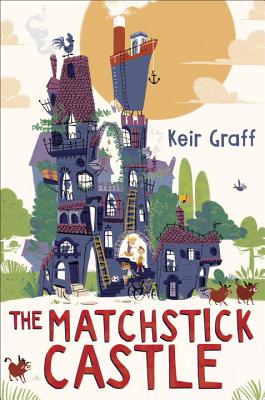
The Matchstick Castle

matchstickby Keif Graff
First sentence: “It was supposed to be the perfect summer.”
Support your local independent bookstore: buy it there!
Content: It’s a whole lot of silly, and there are some big words, but I’d give it to a precocious 3rd grader and up. It’s in the Middle Grade (grades 3-5) section of the bookstore.

Brian has a good life in Boston. Friends, his family (consisting of Dad and two older brothers), soccer. Then this summer comes along and his dad gets an opportunity to go to Antarctica to look through this awesome telescope (which probably had something to do with his job, but I was never quite sure), and takes it. Brian’s older brothers can either stay with friends or are old enough to stay home alone, but Brian is farmed out to his Uncle and Aunt’s house… in Boring, Illinois. (At least it’s not Ohio or Kansas).

Brian and his cousin Nora are in for the most Boring of Boring summers: Uncle Gary is developing educational software and needs beta testers. He’s obsessively strict about it: “school” starts at 8:45 and goes until 4, and the kids aren’t allowed to leave the yard. (UGH.) But Brian breaks the rules and goes exploring in the woods and finds… this awesomely weird and crazy house with an awesomely weird and crazy kid, Cosmo, with his awesomely weird and crzy family He drags Nora into it (after there’s some grounding and a lot of lying on the part of the kids), and they end up having a couple of Adventures as they search for Cosmo’s missing uncle (turns out he was in the house) and fight against Boring’s Bureaucracy that wants to knock the house — the titular Matchstick Castle — down.

I liked that it was just weird and crazy and not Magical; everything unusual that happened had a rational, realistic explanation while still seeming fantastical.  It did have an old-fashioned feel (it’s interesting to see how authors get around the Modern Dilemma of hovering parents and technology; in fact, one of my favorite bits was the weird and crazy family interacting with computers, which they have avoided for lo these many years) to it, which was fun.

But, I wasn’t super wowed by it either. Uncle Gary was such a caricature of overbearing parents that it was silly. And, aside from Nora, there wasn’t any girls in it at all. (Well, Cosmo’s mom does make an appearance, and Nora does have a mom who kind of hovers in the background). And, honestly, Nora doesn’t do all that much, either. Which was disappointing.

It was fun enough, though, even if it wasn’t brilliant.

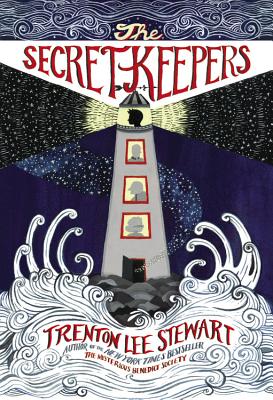
The Secret Keepers

secretkeepersby Trenton Lee Stewart
First sentence: “That summer morning in the Lower Downs began as usual for Reuben Pedley.”
Support your local independent bookstore: buy it there!
Review copy provided by the publisher. Full disclosure: I had dinner with the author at Children’s Institute, and think he’s delightful.
Release date: September 27th
Content: There’s a few scary moments, and it is long (500+ pages), so it might be intimidating for young/reluctant readers. It will be in the Middle Grade (grades 3-5) section of the bookstore.

Reuben has perfected the art of being invisible. He can sneak in and out of places, and knows just how to go unnoticed in a crowd. And then, one summer day, he climbs up to a ledge (just because he can) and discovers something Wonderful: an antique pocket watch shaped like a globe in a wooden box engraven “Property of P. Wm Light”. It’s cool enough as it is; but once Reuben (accidentally) discovers that it can actually turn him invisible, he’s thrilled. Except the watch is wanted by the big mob boss in town, a man known as The Smoke. And suddenly Reuben isn’t quite so invisible anymore.

So Reuben sets off to solve the mystery of the watch: where it came from and why does The Smoke want it so badly. And in doing so, he not only makes several friends for life, he discovers that he is much more than he originally believed.

Even though this is a big book, and starts slowly (I’m not sure we needed Reuben’s entire backstory, as well as the backstory of the watch, but I’m not the editor here…) I was hooked by the middle and sold by the end. (The end, especially.) Stewart knows how to write a puzzle that readers want to solve, and how to keep them guessing along the way. I honestly didn’t know what would happen, at times, and I thoroughly enjoyed finding out. And the best part? It’s not a series (yet). Definitely a fun read.

The Piper’s Son

piperssonby Melina Marchetta
First sentence: “The string slices into the skin of his fingers and no matter how tough the calluses, it tears.”
Support your local independent bookstore: buy it there!
Content: There’s a bunch of f-bombs and some talk of sex (nothing graphic). It has a more adult sensibility than I was expecting, and although the library has it in its Teen section, I’d be tempted to put it in the adult fiction section of the bookstore.

Two years after the death of his favorite uncle in a terrorist bombing in London, Tom’s dropped out of university, living with some crap flatmates, and basically a mess. Then, hitting rock bottom, he finds his way back to his Aunt Georgie (who’s been knocked up by her ex-boyfriend) and begins to piece his life back together.

Some books are plot-driven and some are character-driven, and this one is the latter. There’s not much plot-wise — mostly it’s the ways in which Tom and Georgia (and the rest of the McKee family) are dealing (or not dealing) with the crap in their life — but the characters make this book worthwhile. Tom is brash and abrasive at first, but he grows so much that by the end, I was sobbing. And Georgia gives the book a heart that otherwise would be missing. This family is so messed up, but so fierce in their love for each other; it’s truly one of those books that show how families really do come in all shapes and sizes.

Technically, this is a sequel to Saving Francesca, but you can definitely read it as a stand-alone. And it’s so very worth it.

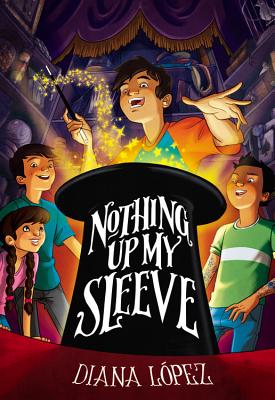
Nothing Up My Sleeve

nothingupmysleeveby Diana López
First sentence: “Z could always find a reason to feel cursed.”
Support your local independent bookstore: buy it there!
Review copy provided by the publisher.
Content: It’s bigger font on small pages, so even though it looks thick it goes fast. It reads very much like a Wendy Mass story, with short chapters, alternating viewpoints, and a lot going on. There’s a slight not-quite-romance (a couple of the boy main characters “like” the girl, but it goes nowhere). It’s in the middle grade (grades 3-5) section of the bookstore.

Z, Dominic, and Loop have been friends for a long, long time. Which means their friendship is one part they like each other and one part competitive. And so when, one hot Texas summer, they discover a magic shop and enter a competition, it becomes somewhat of a tension-creator. They spend the summer working on their magic tricks, but what starts out as just fun becomes more tension-filled. Will their new hobby ruin their friendship?

The good things first: this is full of diversity. Yay for making Texan kids Latin@! And giving them real-world problems: Dominic’s parents are divorced, Z is the youngest of a big family and is always getting ignored, and Loop just found out the man he thought was his biological father isn’t. Plus the way López writes about magic is really neat. She explains the tricks, so you can get a sense of what’s going on, but she doesn’t give away any (well, not many, anyway) of the secrets of the trade.

My big problem was that I felt sorry for Z, who was pathetic, and I felt Dominic was a bit annoying, but Loop and Ariel (she’s the daughter of the magic shop owners) were so annoying I wanted to smack them. Maybe I should give López props for making me care enough to want to smack the kids, but I found them annoying. Which means I really didn’t care too much about how it all resolved. I finished it — it wasn’t really bad — but I didn’t love it. (It really wasn’t bad. It just wasn’t great either.)

Maybe I just wasn’t the right person for it.

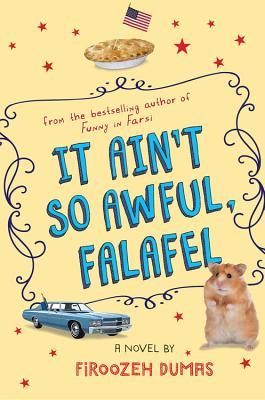
It Ain’t So Awful, Falafel

aintsoawfulby Firoozeh Dumas
First sentence: “Today’s Sunday and we’re moving, again.”
Support your local independent bookstore: buy it there!
Review copy provided by the publisher.
Content: There’s no swearing (well, maybe a mild one) but the subject matter — middle school and the Iran Revolution in 1978 — might be a little mature for the younger set. It will be in the middle grade (grades 3-5) section (or the YA — grades 6-8 — section, I haven’t decided) of the bookstore.

I was in third grade in 1981 when the American hostages in Iran were released and I have a vague memory of it. Nothing substantive, just some hazy images of me seeing the news on TV. I don’t know much else about that, and even though I’ve read a bit about the Iranian revolution, that’s one aspect that I didn’t know much about.

Zomorod Yousefzadeh is in America because her father has a job with an oil company in California. They’ve been here before, when Zomorod was younger, but now she’s going into 6th grade, and she wants to turn over a new leaf. Be more American. So, she changes her name to Cindy and sets out to make new friends. It’s not easy being Iranian in California in the late 1970s (most people either think she’s Mexican, or ask her if she owns a camel. The answer is no to both), but eventually, Cindy figures things out. And then the Iranian revolution happens, and suddenly the home she and her parents thought they could go back to is no longer there. Add to that, Americans were taken hostage, and suddenly Cindy and her parents find themselves subjected to anti-Iranian sentiment. Her father loses his job. Garbage is left on their doorstep. Kids at school tell her to “go home”. It’s not easy.

Loosely based on Dumas’ life, this novel not only captures a slice of history (fairly accurately, but without being kitschy) but also manages to be timely as well. I found myself thinking about how Americans reacted to Muslims after 9/11 (or now, really). Or how immigrants are treated in general. It’s a good thing to see American life from the perspective of an immigrant, and to find out that we’re equal parts good and bad. (Which really isn’t a surprise.) Dumas also manages to capture the awkwardness of middle school with grace and humor. There were some actual laugh-out-loud parts. She definitely understands middle school, with all its ups and downs. And it was delightful to read a book where the parents weren’t bad or sick or dead.

It’s definitely an excellent read.

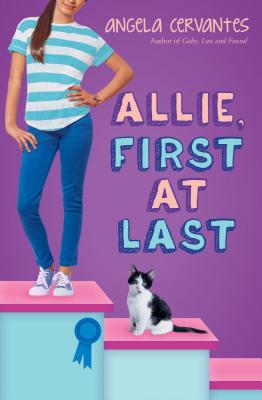
Allie, First at Last

alliefirstby Angela Cervantes
First sentence: “Blame it on Junko Tabei.”
Support your local independent bookstore: buy it there!
Review copy pilfered from the ARC shelves at my place of employment. G
Content: It’s a great book for middle readers, short (but not dumbed-down) with no romance or awkward situations. It’s in the Middle Grade (3-5 grade) section of the bookstore.

Allie comes from a highly competitive family. Her great-grandfather was the first World War II Veteran to get a Congressional Medal of Honor. Her mother has won best anchorwoman four years running. Her big sister is a national debate champion. Her big brother is a soccer star, and her younger sister is an aspiring actress. However, Allie feels like she’s just a string of flops. She can’t win anything, most recently the Science Fair. So when the Trailblazer Award comes along — with a fancy trophy and a $200 prize — she’s determined to win.

This was a cute, inter-generational book without the whole mystical Mexican thing. (Mexicans, yes, but not mystical at all.) I liked Allie’s relationship with her Bisabuela, and how he was able to guide Allie through life experience and stories. I liked that there was a nice moral at the end, but the book itself didn’t seem preachy at all. (I didn’t like that all the kids seem to have cell phones and were super-privileged, but that seemed to fit into the story okay, so by the end I let that go.)

It really is a sweet little story.  Plus: the author is from Kansas, which is nice.


Hour of the Bees

hourofbeesby Lindsey Eagar
First sentence: “Something flies too close to my ear.”
Support your local independent bookstore: buy it there!
Review copy provided by the publisher.
Content: It’s a tricky story, moving between “reality” and “magic” for much of it. Though there’s really nothing content-wise that would be inappropriate for younger readers, they might lose interest with the plotting. It’s in the YA section (grades 6-8) of the bookstore, though I’d give it to a 4th or 5th grader if they expressed interest.

All Carol wants to do the summer before 7th grade is hang out with her friends and have pool parties and sleepovers, but instead she’s stuck out at her grandfather’s ranch in southwest New Mexico, helping her family pack him up in order to send him to a nursing home. Not exactly her idea of fun. And it doesn’t help that her grandfather is suffering from dementia, either. It’s shaping up to be a long, hot, boring summer.

Except, once she gets there, Carol finds out that her grandfather is full of crazy, magical stories, ones that may or may not be true. And, over the course of the summer, Carol decides that maybe it’s not too bad.

Okay, that’s not exactly all there is to it. There’s a whole thread about a drought, and a tree, and bees taking away the rain that, honestly, I didn’t find all that interesting.

Maybe I should start with the good: I really like that there’s a book out there that deals with grandparents, dementia and death. It’s something that children do need to deal with, and it’s good that there’s a book that does take something like moving a grandparent out of the house and into a nursing home as well as tackling the mood and personality swings that come with dementia.

That said, this smack WAY too much of the Magical Mexican for me. Truthfully, it may just be me (though as I was relating it to E — who’s Mexican — she said, “Um. No.” But she may have been biased from my retelling); please let me know if you read it and you think I’m wrong here. But, I felt like the whole thing of “needing to get back to your roots” and the whole magical realism story thing just didn’t work. Yes, roots are important. But, so is change and growth. You don’t need to sacrifice one for the other (and I felt like Eagar was coming down firmly on Family and Roots are Very Important, especially since we’re Mexican).  It just felt… forced. Off. Not quite natural. And then there was Carol’s whole flipping from being a city girl to being a ranch hand at the end. I just didn’t get WHY. Was it her grandfather’s stories? Where did this deep connection to her roots come from? Why did it happen so suddenly, and so deeply that she would do drastic and rash things at the end? It didn’t make sense to me. (Again: it may just be me. I’ll admit I skimmed a lot.)

At any rate, it ended up not being one that I really loved.

Booked

bookedby Kwame Alexander
Support your local independent bookstore: buy it there!
Review copy pilfered off the ARC shelves at work.
Release date: April 5, 2016
Content: There’s a wee bit of romance and some difficult situations with bullying and divorce. Give it to readers ages 10 and up. It will be in the middle grade (grades 3-5) section of the bookstore.

The thing that I admire most about The Crossover was the style of it all. The way the poetry flowed on the page, the way that Alexander captured the rhythm of his characters in the ebb and flow of the poetry.

And lest we think lightning only strikes once, Alexander gives us Booked, repeating much of what I loved about his first book.

Instead of basketball, this time Alexander immerses us in the world of competitive soccer. Nick and his best friend Coby are extremely good, playing not only in competitive leagues but also for fun on the weekend plus the FIFA video game. It’s their whole life. Except, for Nick, it’s not that simple. His parents are going through a rough patch, and they separate so his mother can go help train a horse for the Kentucky Derby. His dad is a linguist and insists that Nick read this dictionary that he wrote, something that Nick resents. And, he’s bullied by these twins at school. There are bright spots: his mother makes him take this etiquette class, but there’s this girl he kind of likes (and who kind of likes him back). And the librarian at school is WAY cool. So, maybe Nick can find a balance in his life after all.

Not only is the story complex and compelling, I again, adored the poetry. Alexander has a way of making something as “stuffy” as poetry accessible and cool, which is wonderful.  I loved how the voice and the form of the poems changed depending on the characters (Nick was ostensibly our narrator, but there were appearances from other characters as well). I loved the footnotes with definitions of some of the bigger words (including snarky asides).  It’s fun and engaging, and yet Alexander tackles tough subjects like bullying and divorce with grace and ease. It’s not just a smart way to get reluctant readers interested in books or unsure kids interested in poetry. It’s a fantastic book.

Completely Clementine

clementineby Sara Pennypacker
First sentence: “As soon as I woke up Monday morning, I flopped onto the floor with my drawing pad.”
Support your local independent bookstore: buy it there!
Review copy snagged from the ARC shelves at work.
Others in the series: Clementine, The Talented Clementine, Clementine’s Letter, Clementine, Friend of the Week, Clementine and the Family Meeting, Clementine and the Spring Trip (I thought I’ve read them all, but I guess I missed one!)
Content: It’s short, there’s lots of illustrations, and it’s perfect for beginning readers. You don’t have to read the series in order, but it does help a little.

I have a confession: this book came out in hardcover a year ago and I just couldn’t bring myself to read it. I couldn’t, not after eight years of loving Clementine, believe that it was coming to an end. So, I put it off. And put it off. But the paperback came out a bit ago, and I got brave and decided that maybe good things can come to an end.

Interestingly enough, that’s the theme of this last Clementine book. It’s the end of 3rd grade, and Clementine doesn’t want to move on. She doesn’t want to leave her teacher and move on to fourth grade. It’s all so new and scary. It also doesn’t help that she’s not talking to her father because she’s become concerned about animal rights and he won’t become vegetarian like her. Oh, and her mother is about to have another baby.

Pennypacker does with this one what she’s done in all the Clementine books: gives us a normal, every-day kid with a normal, every-day family and makes it super interesting. Clementine is such an affable character in all her normalness, that every kid can relate. Change is hard, and Pennypacker captures that resistance in Clementine. It’s charming, sweet, endearing, and cute. All the things I’ve come to expect from this series.

I’m just sad to see it end.

Fridays with the Wizards

fridaysby Jessica Day George
First sentence: “It was good to be home.”
Support your local independent bookstore: buy it there!
Others in the series: Tuesdays at the Castle, Wednesdays in the Tower, Thursdays with the Crown
Content: These books are so great for those middle readers who don’t like super long books, but want action-packed stories. Not too many difficult words, and George keeps them short and sweet. It’s in the middle grade (grades 3-5) section of the bookstore.

Now that Castle Glower is whole again and Wizard Arkwright is captured, Celie figures her work is done and she can just go back to normal. Except that normal isn’t, well, normal anymore. Lilah and Lulath are engaged (yay!) and so there are preparations to go to Grath and meet Lulath’s family. The king decides that a ship really needs to be built. And people keep bonding with all the baby griffins, though they soon learn that it’s the griffins who choose, not the people.

Celie isn’t happy with all these changes, but she can deal. Until they discover that Wizard Arkower has escaped his prison and is creeping around the secret passageways of the Castle. Celie’s the one who knows the Castle best, and so it falls on her to figure a way to capture the wizard. If she can.

This series is such a delight. I love that the family is a good one, that Celie has challenges that are outside of her family and that her family is generally supportive of her as a person. It’s wonderfully refreshing. I also enjoy that these books build on each other while offering an individual adventure that actually comes to a stopping point. No real cliffhangers, which is nice. And that she writes at a kids’ level without talking down to them. It really is a fun series. I’ll definitely be sad when it ends.

As a bonus, I got to host her here for school visits and a store event a couple weeks ago. She’s just as delightful as her books!

IMG_5775