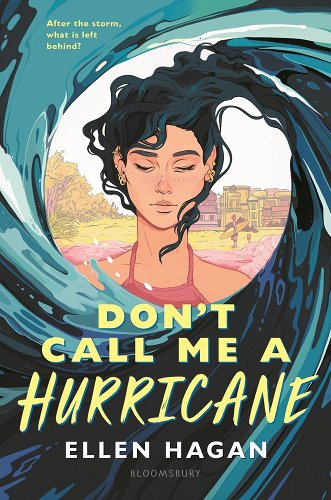
Don’t Call Me a Hurricane

by Ellen Hagan
First sentence: “‘Grab your board,’ Isa shouts, throwing open the screen door letting sunshine and cool breeze into our living room.”
Support your local independent bookstore: buy it there!
Review copy pilfered from the ARC shelves at work
Content: There is mention of teenage drinking and some intense moments with a natural disaster. It’s in the Teen section (grades 9+) of the bookstore.

Eliza’s life hasn’t been the same in the five years since the hurricane hit her island off the Jersey shore. Sure, her family’s still living there, still scraping by, but the island itself has changed. Developers have come in, and bought up houses, knocked them down, in the name of progress. The latest example? They want to build out the marshland. And Eliza – and her friends – don’t want to lose that much of their island.

It also doesn’t help that a new boy – Milo – is from New York City, is one of those rich summer-only island visitors and that Eliza seems to be falling for him.

This one had all the elements I like: it’s about the ocean and island living! It’s got a strong female character! It’s a novel in verse! There’s a strong environmental message! But it fell completely flat. Not so flat that I didn’t finish it, but flat enough that I found myself skimming the chapters, just enough to get the information. I wanted to like this one so much more than I actually did. Not sure where it went wrong: Eliza is a good character and Hagan does a good job of showing the trauma after a natural disaster (though she did amp up the stakes by almost killing Eliza’s brother in the storm), but I just didn’t connect with it.

Dry

dryby Neal Shusterman and Jarrod Shusterman
First sentence: ”
Support your local independent bookstore: buy it there!
Review copy provided by the publisher.
Content: There are many intense situations, some reference to drinking and drug use (by adults, mostly), and violence. It’s in the YA section (grades 6-8) of the bookstore.

I will say this up front: this novel is TERRIFYING. The father-son team takes the plausible — what would happen if there was a severe drought in Southern California and then access to the Colorado River was entirely cut off — and turns it into a gripping, thriller-like survival ride, to answer the question: What would you do for access to water?

The story alternates viewpoints between Alyssa, who with her brother Garret, have to figure out what to do when their parents go missing; their neighbor Kelton, a son of a survivalist who has prepared for Times Like These. When things go from bad to worse — let’s just say their other neighbors aren’t forgiving of the fact that Kelton’s family has prepared — they go on the run, nominally to find a place to ride out the “crisis” and pick up two other kids — Henry and Jacqui — on the way. Interspersed are “snapshots” of how the wider community is reacting and gives the reader a bigger picture of how this is affecting the community as a whole.

Shusterman is an incredible storyteller, and he knows how to keep a plot going from page to page. There are funny bits and touching bits and terrifying bits (lots of those actually), and it all felt incredibly realistic. I could see this playing out — especially with the way society is in denial about climate change — pretty much exactly like this. I’ve heard it said that science fiction isn’t about predicting the future, but rather about what it’s happening in the present. If that’s true, then this should be a wake up call to take better care of the planet. Otherwise, this “prediction” might just become reality.